
ISKCON Mayapur TIMELINE
1971 - ISKCON Acquires Land in Śrī Māyāpur-dhāma
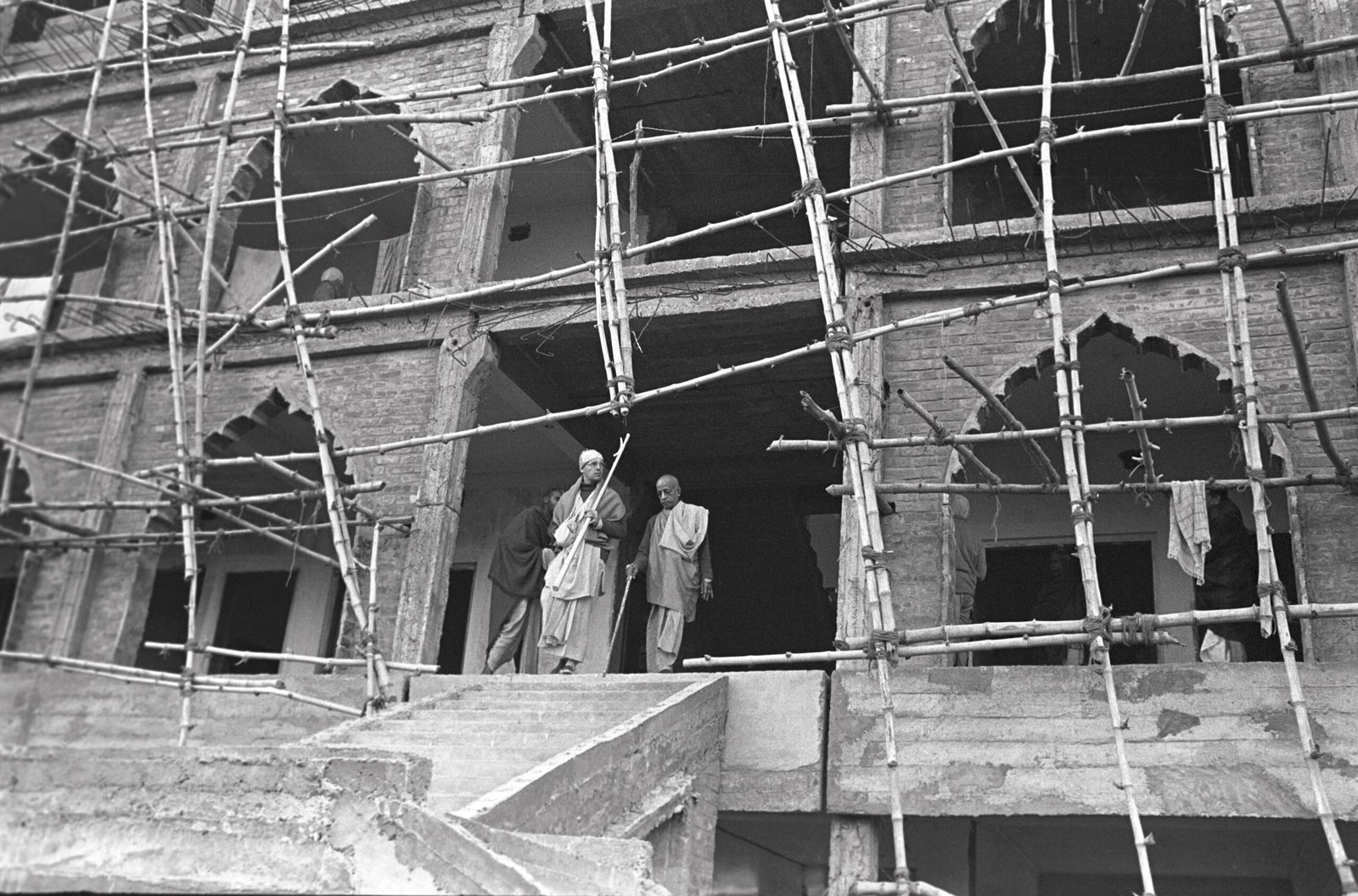
So especially in India, the atmosphere is very good. It is especially meant, within this universe, this plot of land known as Bhārata-varṣa, India, is the most sacred place within this universe. And of the whole land Bhārata-varṣa, in Bengal, it is very sacred. And the whole of Bengal, this Nadia district is very sacred. And in the whole Nadia district, this spot is very sacred, Māyāpur-candrodaya Temple. So by Kṛṣṇa’s grace, you have got this opportunity to live here. Take advantage, full advantage of this opportunity, spiritual opportunity. This is the statement of Bhaktivinoda Ṭhākura.
(750408 – Lecture CC Adi 01.15 – Mayapur)
It appears that Calcutta activities are going on very nicely and I am so glad to learn that you are all going to Mayapur on the 23rd instant, along with Mr. Virendra Das (the lawyer) and Acyutananda Maharaja. I have already written to Mr. Sarkar to see you in this connection and I hope everything is going orderly. I have already sent you one check for Rs. 8,300 and I hope you have received it by this time and done the needful. The next check will be sent as soon as I hear from you that the first check was received.
(710419 - Letter B to Tamala Krishna written from Bombay)
Yes, we are contemplating Indira Gandhi's presence while laying down the foundation stone in Mayapur. So you arrange like that. My going to Delhi is not so important now since we have secured land in Mayapur.
(710427 - Letter to Gurudasa written from Bombay)
You will be glad to know that we have purchased two pieces of land in Mayapur at Rs. 20,000/- and they are going to construct some nice temple there.
(710523 - Letter to Hayagriva written from Calcutta)
You will be glad to learn that we have purchased about five acres of land in Mayapur, the birthsite of Lord Chaitanya and we have proposed to hold a nice festival there from Janmastami day for two weeks. At that time the foundation stone will be set down. I wish that all our leading disciples come to India at that time.
(710528 - Letter to Govinda dasi written from Calcutta)
Prabhupāda wanted an ISKCON center in Māyāpur; it was a desire that had increased within him as his movement had increased throughout the years. He could easily visit or live in Māyāpur; that was no problem. But he needed a place for his disciples. His spiritual master had ordered him to preach in the West; and now with the success of his Kṛṣṇa consciousness society, the Western Vaiṣṇavas required a center in Māyāpur where they could reside and worship and receive the immense benefit of the holy dhāma. Bhaktisiddhānta Sarasvatī had stressed the great importance of Māyāpur, and some of his sannyāsī disciples had temples there. Why shouldn’t the International Society for Krishna Consciousness also be able to take shelter of Māyāpur?
...
“Yes, who is it?” Prabhupāda asked. Tamāla Kṛṣṇa entered and prostrated himself before Śrīla Prabhupāda.
“So,” Prabhupāda asked, “what is your news?”
Tamāla Kṛṣṇa looked up triumphantly. “The land is yours!”
Prabhupāda leaned back with a sigh. “All right,” he said. “Now you can take rest.”
(Śrīla Prabhupāda-līlāmṛta, Volume Two, Chapter 37)
1972 - Māyāpur Bhūmipūjā Performed and First Gaura Pūrṇimā Festival Celebrated
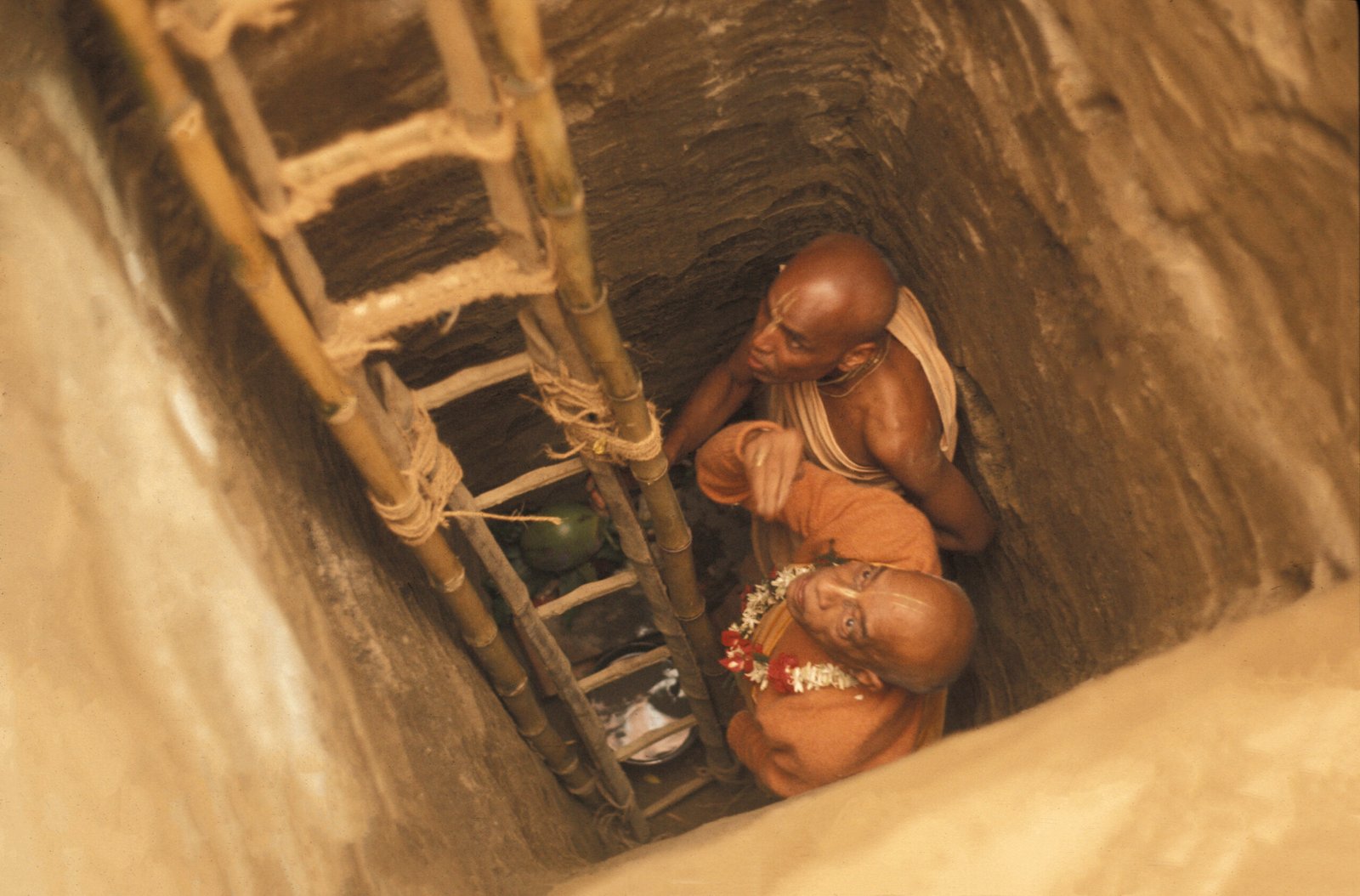
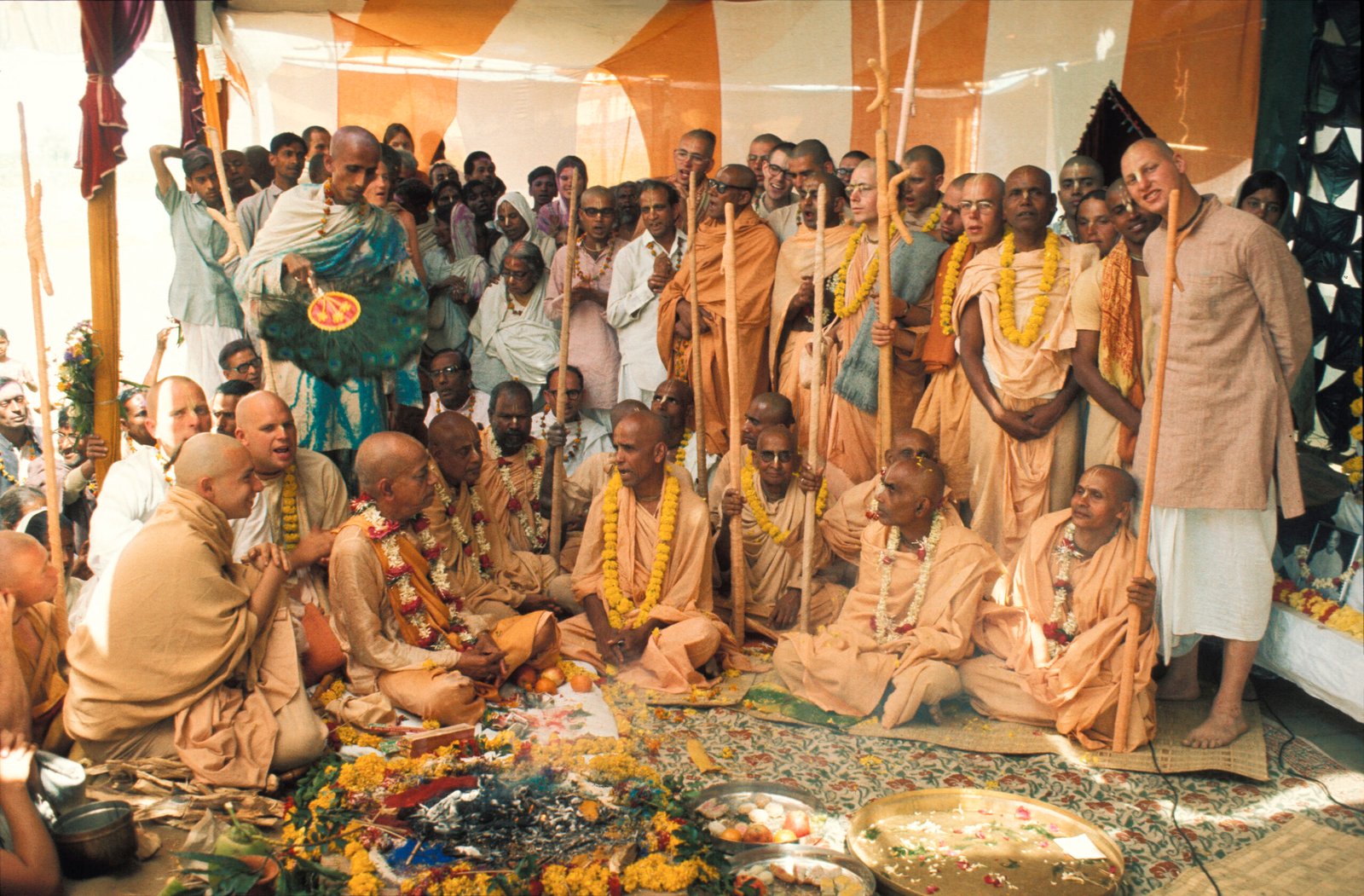
So Kṛṣṇa understanding is not so easy. It is very difficult. Kṛṣṇa says. But by the grace of Kṛṣṇa, because He wanted to distribute Himself, Caitanya Mahāprabhu giving us Kṛṣṇa freely . . . kṛṣṇa-prema-pradāya te (CC Madhya 19.53). Rūpa Gosvāmī says that namo mahā-vadānyāya. Kṛṣṇa was also not so liberal. He simply asked us, "Surrender," but He did not distribute Himself. But in the form of Caitanya Mahāprabhu He distributed Himself, "Take Me, take Me, take Me. Without any price, take Me."
This is Caitanya Mahāprabhu, who is Kṛṣṇa, and He has come in the form of Caitanya, Kṛṣṇa Caitanya, to distribute Himself. Therefore He is recognized, namo mahā-vadānyāya, "The most munificent." No other incarnation, even Rāmacandra or Bhagavān Kṛṣṇa, They were not so liberal. But Caitanya Mahāprabhu is so liberal. Pāpī tāpī jata chilo hari-nāme uddhārilo (Hari Hari Bifale 3). They distributed Himself through the chanting of Hare Kṛṣṇa mantra.
(721031 - Lecture SB 01.02.20 - Vrndavana)
- February 26 - Lecture Bengali - Mayapur
- February 27 - Lecture Bengali - Mayapur
- February 27 - Conversation 1 with Bob Cohen - Mayapur
- February 28 - Conversation 2 with Bob Cohen - Mayapur
- February 29 - Gaura-pūrṇimā, appearance day of Śrī Caitanya Mahāprabhu
- February 29 - Lecture Festival Gaura-Purnima - Mayapur
- February 29 - Conversation 3 with Bob Cohen - Mayapur
1973 ? - Sri Mayapur Chandra Installation (Clay Deity) *
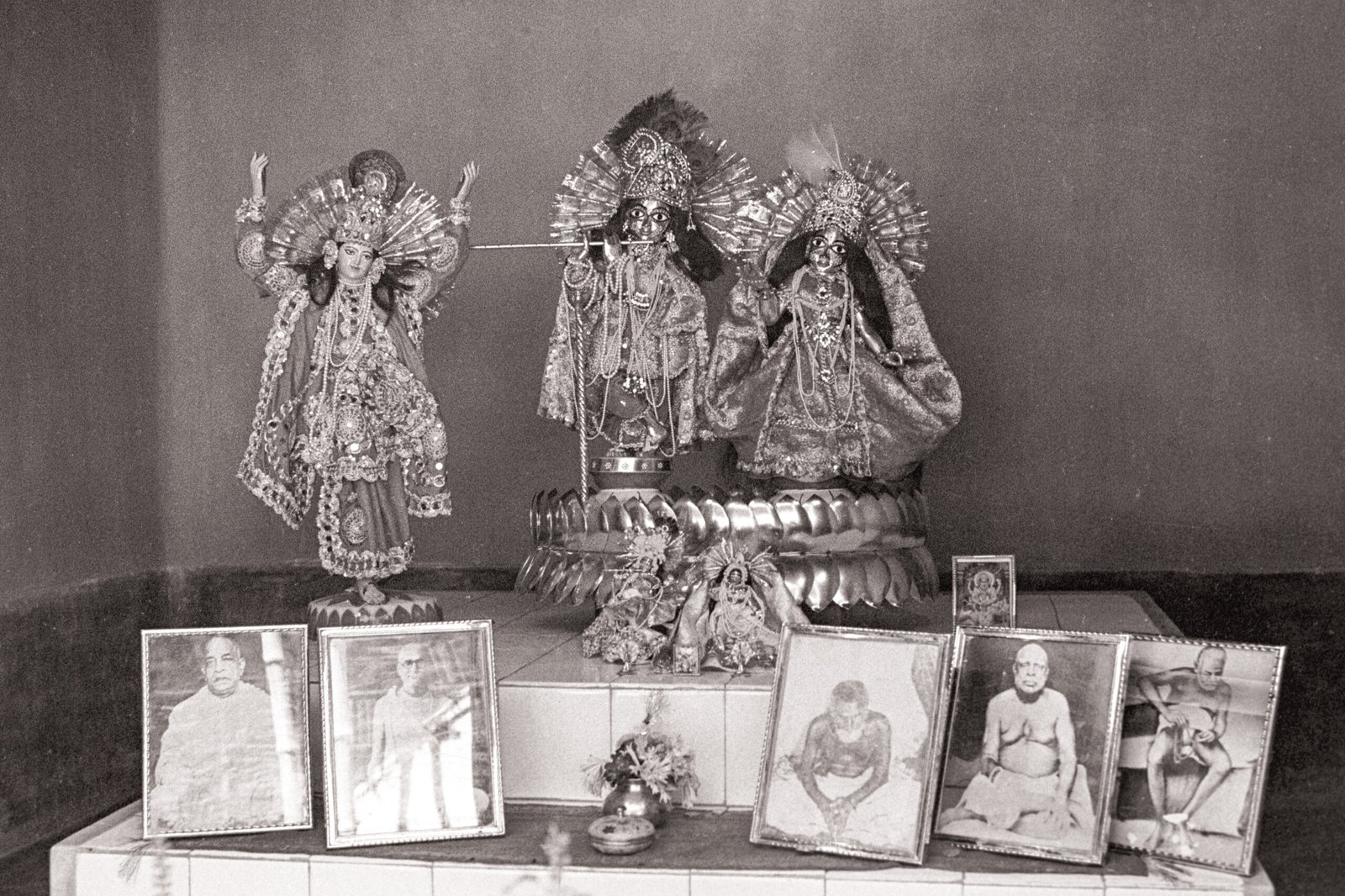
Kṛṣṇa is one, but when Kṛṣṇa wants to enjoy, He must expand His pleasure potency. That is Rādhārāṇī. Rādhā kṛṣṇa-praṇaya-vikṛtir. Kṛṣṇa cannot enjoy anything material. The original spiritual potency, pleasure potency, is Rādhārāṇī. So first of all He expanded, then again He combined together. That is Śrī Kṛṣṇa Caitanya Mahāprabhu. This is the study of the Gosvāmī. Rādhā kṛṣṇa-praṇaya-vikṛtir hlādinī.
Therefore Caitanya Mahāprabhu is given seat along with Kṛṣṇa. He's combination of Rādhā and Kṛṣṇa. We may not misunderstand that Caitanya Mahāprabhu is . . . imitating Caitanya Mahāprabhu, there are so many so-called avatāras. But this is approved by the śāstra. Kṛṣṇa-varṇaṁ tviṣākṛṣṇam (SB 11.5.32). Caitanya Mahāprabhu is Kṛṣṇa, same category, kṛṣṇa-varṇaṁ. Just like we say varṇa: brāhmaṇa varṇa, kṣatriya varṇa, śūdra varṇa, vaiśya varṇa. Varṇa means the same category, varṇa. Or kṛṣṇa-varṇaṁ means who is always describing Kṛṣṇa. Just like Caitanya Mahāprabhu is passing on the road, He's chanting,
kṛṣṇa kṛṣṇa kṛṣṇa kṛṣṇa kṛṣṇa kṛṣṇa kṛṣṇa he
kṛṣṇa kṛṣṇa kṛṣṇa kṛṣṇa kṛṣṇa kṛṣṇa kṛṣṇa he
kṛṣṇa kṛṣṇa kṛṣṇa kṛṣṇa kṛṣṇa kṛṣṇa pāhi māṁ
(CC Madhya 7.96)
Therefore kṛṣṇa-varṇaṁ is He; iti kṛṣṇa. Kṛṣṇa is describing Himself: kṛṣṇa-varṇaṁ tviṣākṛṣṇam. But by His complexion, He is not black—very fair complexion.
(730306 - Lecture BG 10.01-3 - Calcutta)
1973 - Māyāpur Temple Inauguration (Deities Moved from Bhajan Kutir to Lotus Building)
Kṛṣṇa is one, but when Kṛṣṇa wants to enjoy, He must expand His pleasure potency. That is Rādhārāṇī. Rādhā kṛṣṇa-praṇaya-vikṛtir. Kṛṣṇa cannot enjoy anything material. The original spiritual potency, pleasure potency, is Rādhārāṇī. So first of all He expanded, then again He combined together. That is Śrī Kṛṣṇa Caitanya Mahāprabhu. This is the study of the Gosvāmī. Rādhā kṛṣṇa-praṇaya-vikṛtir hlādinī.
Therefore Caitanya Mahāprabhu is given seat along with Kṛṣṇa. He's combination of Rādhā and Kṛṣṇa. We may not misunderstand that Caitanya Mahāprabhu is . . . imitating Caitanya Mahāprabhu, there are so many so-called avatāras. But this is approved by the śāstra. Kṛṣṇa-varṇaṁ tviṣākṛṣṇam (SB 11.5.32). Caitanya Mahāprabhu is Kṛṣṇa, same category, kṛṣṇa-varṇaṁ. Just like we say varṇa: brāhmaṇa varṇa, kṣatriya varṇa, śūdra varṇa, vaiśya varṇa. Varṇa means the same category, varṇa. Or kṛṣṇa-varṇaṁ means who is always describing Kṛṣṇa. Just like Caitanya Mahāprabhu is passing on the road, He's chanting,
kṛṣṇa kṛṣṇa kṛṣṇa kṛṣṇa kṛṣṇa kṛṣṇa kṛṣṇa he
kṛṣṇa kṛṣṇa kṛṣṇa kṛṣṇa kṛṣṇa kṛṣṇa kṛṣṇa he
kṛṣṇa kṛṣṇa kṛṣṇa kṛṣṇa kṛṣṇa kṛṣṇa pāhi māṁ
(CC Madhya 7.96)
Therefore kṛṣṇa-varṇaṁ is He; iti kṛṣṇa. Kṛṣṇa is describing Himself: kṛṣṇa-varṇaṁ tviṣākṛṣṇam. But by His complexion, He is not black—very fair complexion.
(730306 - Lecture BG 10.01-3 - Calcutta)
- March 16 - Lecture Bengali - Mayapur
- March 17 - Conversation Temple Inauguration - Mayapur
- March 17 - Conversation Temple Inauguration Bengali - Mayapur
- June 14 - Lecture SB 01.09.48 - Mayapur
- June 15 - Lecture SB 01.09.49 - Mayapur
- June 16 - Lecture SB 01.10.01 - Mayapur
- June 17 - Lecture SB 01.10.02 - Mayapur
- June 18 - Lecture SB 01.10.03 - Mayapur
- June 19 - Lecture SB 01.10.04 - Mayapur
- June 20 - Lecture SB 01.10.05 - Mayapur
- June 21 - Lecture SB 01.10.06 - Mayapur
- June 22 - Lecture SB 01.10.07 - Mayapur
- June 25 - Lecture SB 01.10.11-12 - Mayapur
- June 26 - Lecture SB 01.10.13 - Mayapur
- June 27 - Lecture SB 01.10.14 - Mayapur
- June 27 - Conversation - Navadvipa
1974 - Śrīla Prabhupāda Visited Māyāpur
Prabhupāda: "Europeans and Americans will come, and they will dance here with the chanting, ' Jaya Śacīnandana!' " So that is being done.
So when they chant and dance, I simply remember Bhaktivinoda Ṭhākura. That's all. I pray to Bhaktivinoda Ṭhākura, "Now they have come to your shelter. Give them protection." That's all. What can I do more? I cannot do anything more.
(740306 - Morning Walk - Mayapur)
So go on cooperating in this way, and I am sure this mission of Caitanya Mahāprabhu will be successful. It must be successful, because Śrī Caitanya Mahāprabhu wanted it to be done. Simply we, the workers, the servitors, must be very sincere. Then Caitanya Mahāprabhu will give us more and more facilities so that we can work very well. So keep this mission always in view and do your best. That is my only request. Thank you very much.
(740927 - Lecture Arrival - Mayapur)
- March 01 - Lecture CC Adi 07.01 - Mayapur
- March 02 - Morning Walk - Mayapur
- March 02 - Lecture CC Adi 07.02 - Mayapur
- March 03 - Morning Walk - Mayapur
- March 03 - Lecture CC Adi 07.03 - Mayapur
- March 04 - Morning Walk - Mayapur
- March 04 - Lecture CC Adi 07.04 - Mayapur
- March 05 - Morning Walk - Mayapur
- March 06 - Morning Walk - Mayapur
- March 07 - Morning Walk - Mayapur
- March 07 - Lecture CC Adi 07.05 - Mayapur
- March 8 - Gaura-pūrṇimā, appearance day of Śrī Caitanya Mahāprabhu
- March 09 - Morning Walk - Mayapur
- March 09 - Lecture CC Adi 07.07 - Mayapur
- September 27 - Lecture Arrival - Mayapur
- September 28 - Lecture SB 01.08.18 - Mayapur
- September 29 - Lecture SB 01.08.19 - Mayapur
- September 29 - Lecture Bengali - Mayapur
- September 30 - Lecture SB 01.08.20 - Mayapur
- October 01 - Lecture SB 01.08.21 - Mayapur
- October 03 - Lecture SB 01.08.23 - Mayapur
- October 03 - Lecture Bengali - Mayapur
- October 04 - Lecture SB 01.08.24 - Mayapur
- October 05 - Lecture SB 01.08.25 - Mayapur
- October 06 - Lecture SB 01.08.26 - Mayapur
- October 07 - Lecture Bengali - Mayapur
- October 08 - Lecture SB 01.08.28 - Mayapur
- October 09 - Lecture SB 01.08.29 - Mayapur
- October 10 - Lecture SB 01.08.30 - Mayapur
- October 11 - Lecture SB 01.08.31 - Mayapur
- October 12 - Lecture SB 01.08.32 - Mayapur
- October 13 - Lecture SB 01.08.33 - Mayapur
- October 14 - Lecture SB 01.08.34 - Mayapur
- October 15 - Lecture SB 01.08.35 - Mayapur
- October 15 - Lecture Bengali - Mayapur
- October 16 - Lecture SB 01.08.36 - Mayapur
- October 16 - Lecture Bengali - Mayapur
- October 19 - Lecture SB 01.08.39 - Mayapur
- October 20 - Lecture SB 01.08.40 - Mayapur
- October 21 - Lecture SB 01.08.41 - Mayapur
- October 22 - Lecture SB 01.08.42 - Mayapur
- October 23 - Lecture SB 01.08.43 - Mayapur
- October 24 - Lecture SB 01.08.44 - Mayapur
- October 25 - Lecture SB 01.08.45 - Mayapur
- October 26 - Lecture SB 01.08.46 - Mayapur
- October 27 - Lecture SB 01.08.47 - Mayapur
- October 28 - Lecture SB 01.08.48 - Mayapur
- October 29 - Lecture SB 01.08.49 - Mayapur
1974 - Śālagrāma Śilā Worship Commenced *
Information – “In 1974, when worship of Śāligrāma-śīlā began, we started offering the 16 items according to the standards of Purusa-sūkta,” Jananivāsa recalls. The change came when Prabhupāda’s Śrī Caitanya-caritāmṛta was published. “One purport mentioned the 64 items of worship,” Jananivāsa says. “During that time Bhavānanda was always hassling me to expand the Deity worship. He would say, ‘Why don’t you expand? In Vindāvana they’re offering so much!’ I’d say to him, ‘I’m doing that,’ and he’d reply, ‘No you’re not!’ I told him, ‘I’ve been asking for a bed for the Deities and you haven’t given me one!’ He said, ‘Oh, really? Okay…’ and so we got a bed for the Deities. From then on, we started incorporating more and more, and after a few years we had the standard. The worship expanded into what it is today, which is the offering of 64 items.”
(Article Full of Abundant Grace’, Mayapur Magazine 2006)
1975 - Śrīla Prabhupāda Visited Māyāpur
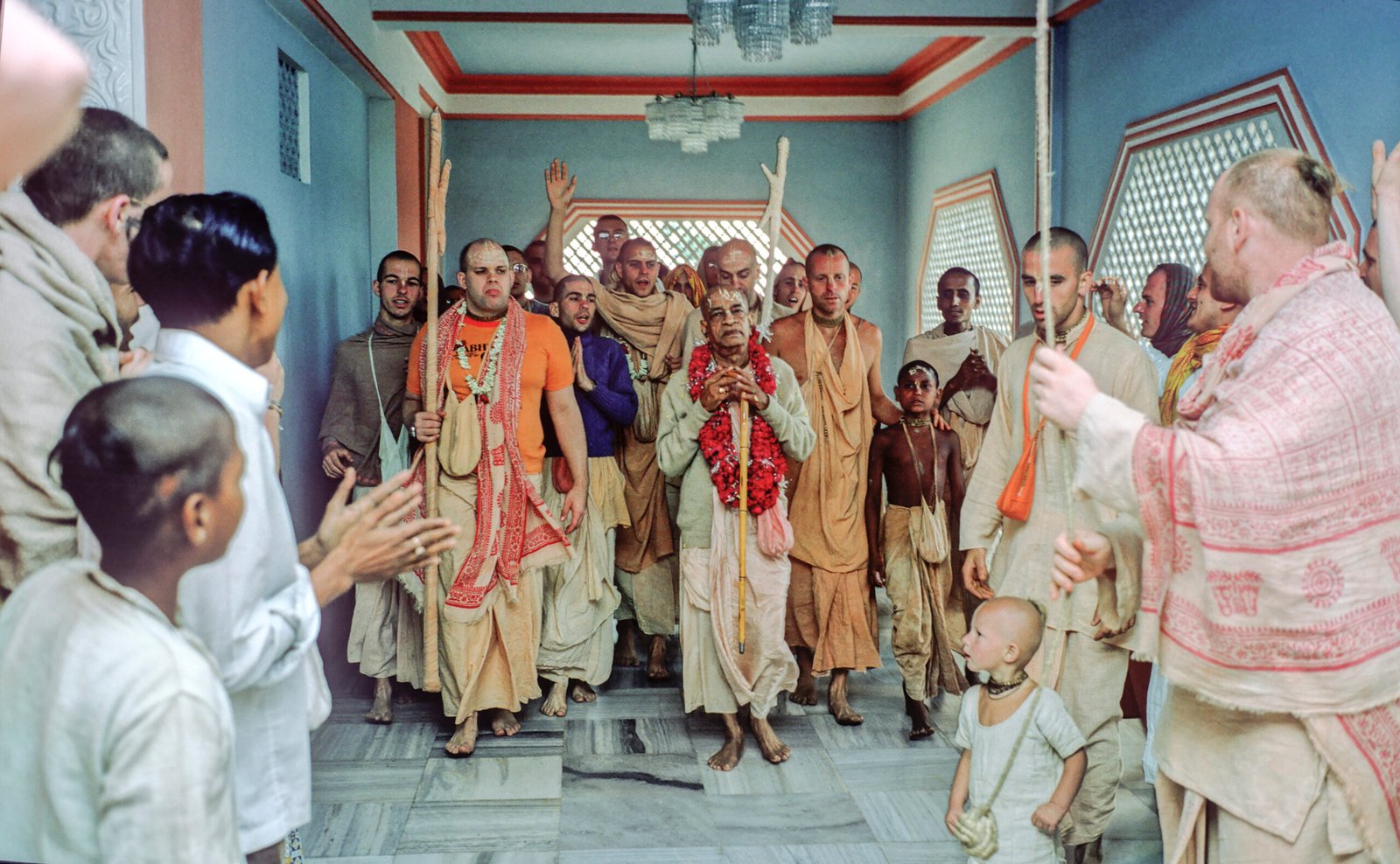
So we have established this temple, Māyāpur-candrodaya. So this is the idea, that Śrī Caitanya Mahāprabhu is just like moon. Śrī Caitanya Mahāprabhu, He appeared in this land of Māyāpur; therefore He is said here as "the moon." Therefore we say candra, Māyāpur-candra. Now, as Śrī Māyāpur-candra is rising . . . rising. Rising means He is to distribute the moonshine all over the world. This is the idea, moonshine. Śreyaḥ-kairava candrikā-vitaraṇam. Śreyaḥ-kairava. Caitanya Mahāprabhu personally said. Don't keep Śrī Caitanya Mahāprabhu compact in your room and take some monetary profit. This is not required. This is not required.
You must allow Śrī Caitanya Mahāprabhu to rise more and more so that this sun, moonshine, may be distributed all over the world. That is wanted. Therefore this temple is situated. Of course, we shall try to construct a very nice temple for Śrī Caitanya Mahāprabhu. This morning we were thinking of this. So from this place, this moon, Śrī Kṛṣṇa Caitanya Mahāprabhu, will distribute. Śreyaḥ-kairava-candrikā-vitaraṇaṁ vidyā-vadhū-jīvanam. The Śrī Caitanya Mahāprabhu's Hare Kṛṣṇa movement . . . paraṁ vijāyate śrī-kṛṣṇa-saṅkīrtanam. This is spoken by Śrī Caitanya Mahāprabhu Himself. Ceto-darpaṇa-mārjanam bhava-mahā-dāvāgni-nirvāpaṇaṁ śreyaḥ-kairava-candrikā-vitaraṇaṁ vidyā-vadhū-jīvanam (CC Antya 20.12). Vidyā-vadhū-jīvanam. This is real enlightenment. People all over the world, they are in darkness. The moonshine will enlighten them.
(750330 - Lecture CC Adi 01.06 - Mayapur)
- March 23 - Arrival - Mayapur
- March 25 - Morning Walk - Mayapur
- March 25 - Lecture CC Adi 01.01 - Mayapur
- March 26 - Morning Walk - Mayapur
- March 26 - Lecture CC Adi 01.02 - Mayapur
- March 27 - Gaura-pūrṇimā, appearance day of Śrī Caitanya Mahāprabhu
- March 27 - Lecture CC Adi 01.03 - Mayapur
- March 27 - Conversation with GBC - Mayapur
- March 28 - Lecture CC Adi 01.04 - Mayapur
- March 29 - Lecture CC Adi 01.05 - Mayapur
- March 29 - Lecture on Manipur Dancing - Mayapur
- March 30 - Lecture CC Adi 01.06 - Mayapur
- March 30 - Conversation with GBC - Mayapur
- March 30 - Interview - Mayapur
- March 31 - Lecture CC Adi 01.07 - Mayapur
- March 31 - Conversation - Mayapur
- April 01 - Morning Walk - Mayapur
- April 01 - Lecture CC Adi 01.08 - Mayapur
- April 01 - Conversation - Mayapur
- April 02 - Morning Walk - Mayapur
- April 02 - Lecture CC Adi 01.09 - Mayapur
- April 03 - Morning Walk - Mayapur
- April 03 - Lecture CC Adi 01.10 - Mayapur
- April 04 - Morning Walk - Mayapur
- April 04 - Lecture CC Adi 01.11 - Mayapur
- April 04 - Conversation - Mayapur
- April 05 - Morning Walk - Mayapur
- April 05 - Lecture CC Adi 01.12 - Mayapur
- April 06 - Morning Walk - Mayapur
- April 06 - Lecture CC Adi 01.13 - Mayapur
- April 06 - Lecture after play - Mayapur
- April 07 - Morning Walk - Mayapur
- April 07 - Lecture CC Adi 01.14 - Mayapur
- April 08 - Morning Walk - Mayapur
- April 08 - Lecture CC Adi 01.15 - Mayapur
- April 09 - Morning Walk - Mayapur
- April 09 - Lecture CC Adi 01.16 - Mayapur
1976 - Main Gate Inauguration
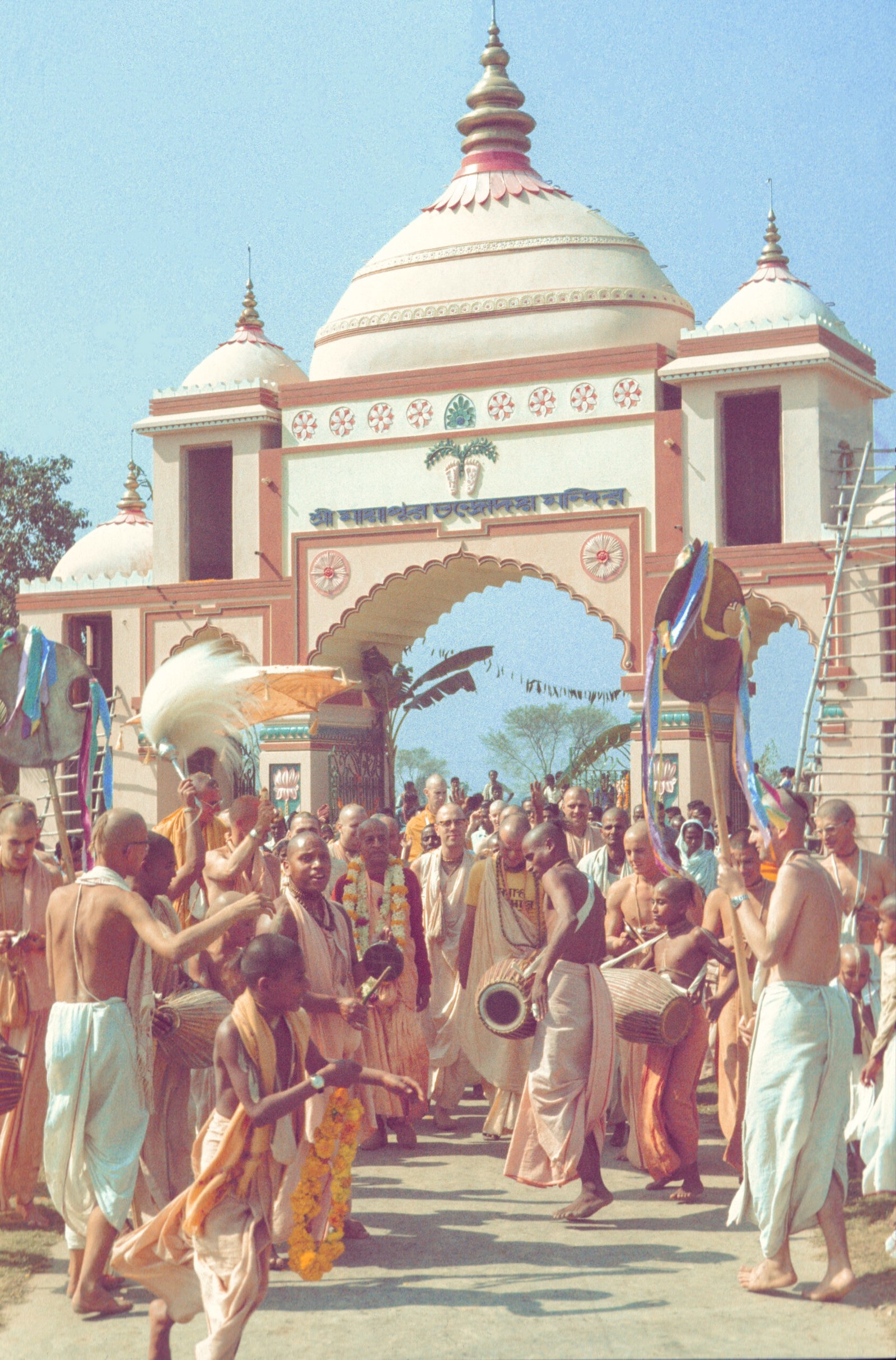
Prabhupāda got out of the car on the main front road. As everyone looked on in great delight, he stepped forward and cut a large ribbon, officially opening the gateway. The formal ceremony over, the metal gates were opened, and he happily walked through the arch and entered the temple compound, followed by a stream of devotees.
(A Transcendental Diary Vol. 1, Chapter 9 – January 17th, 1976)
1976 - Śrīla Prabhupāda Visited Māyāpur
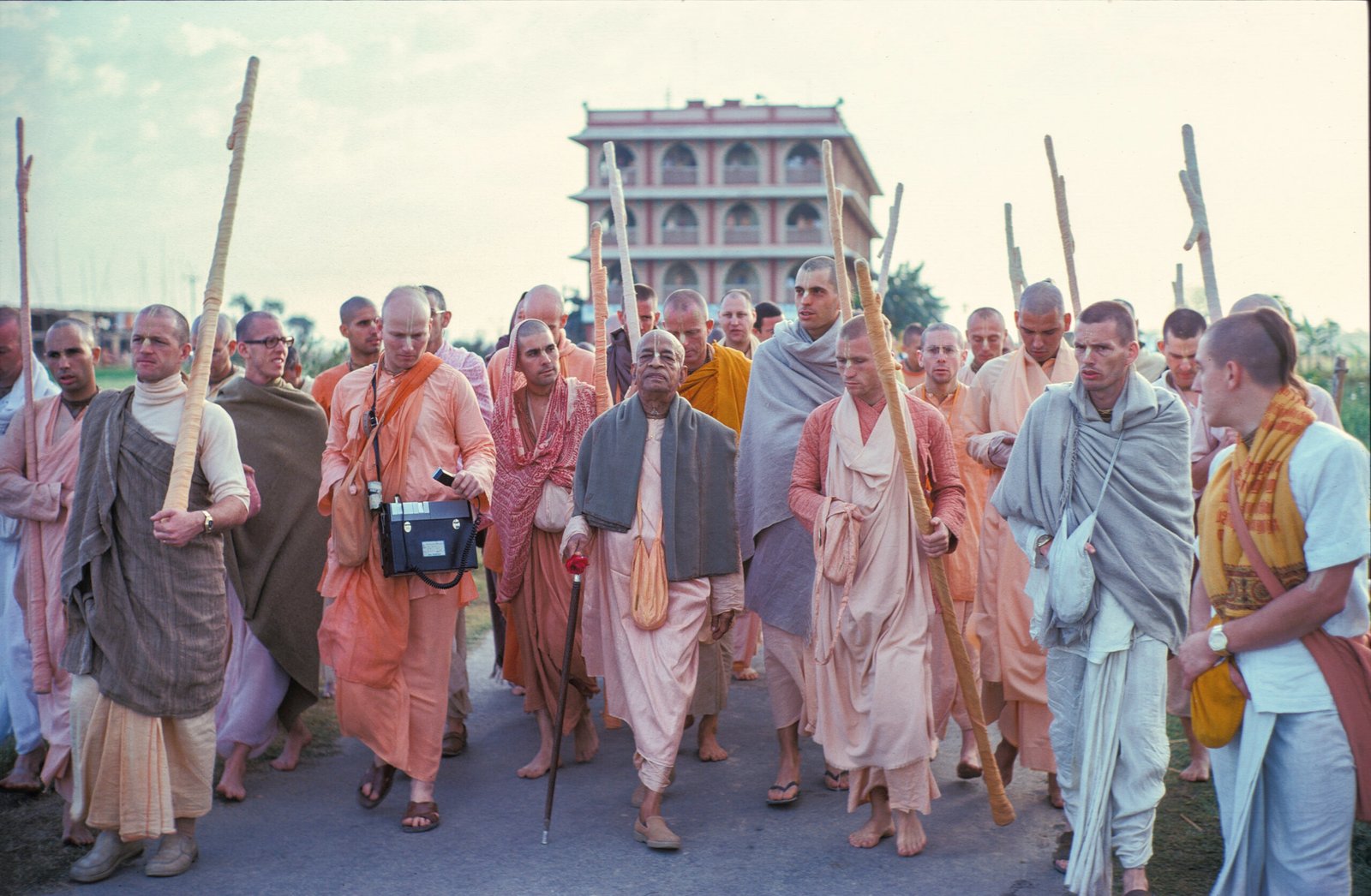
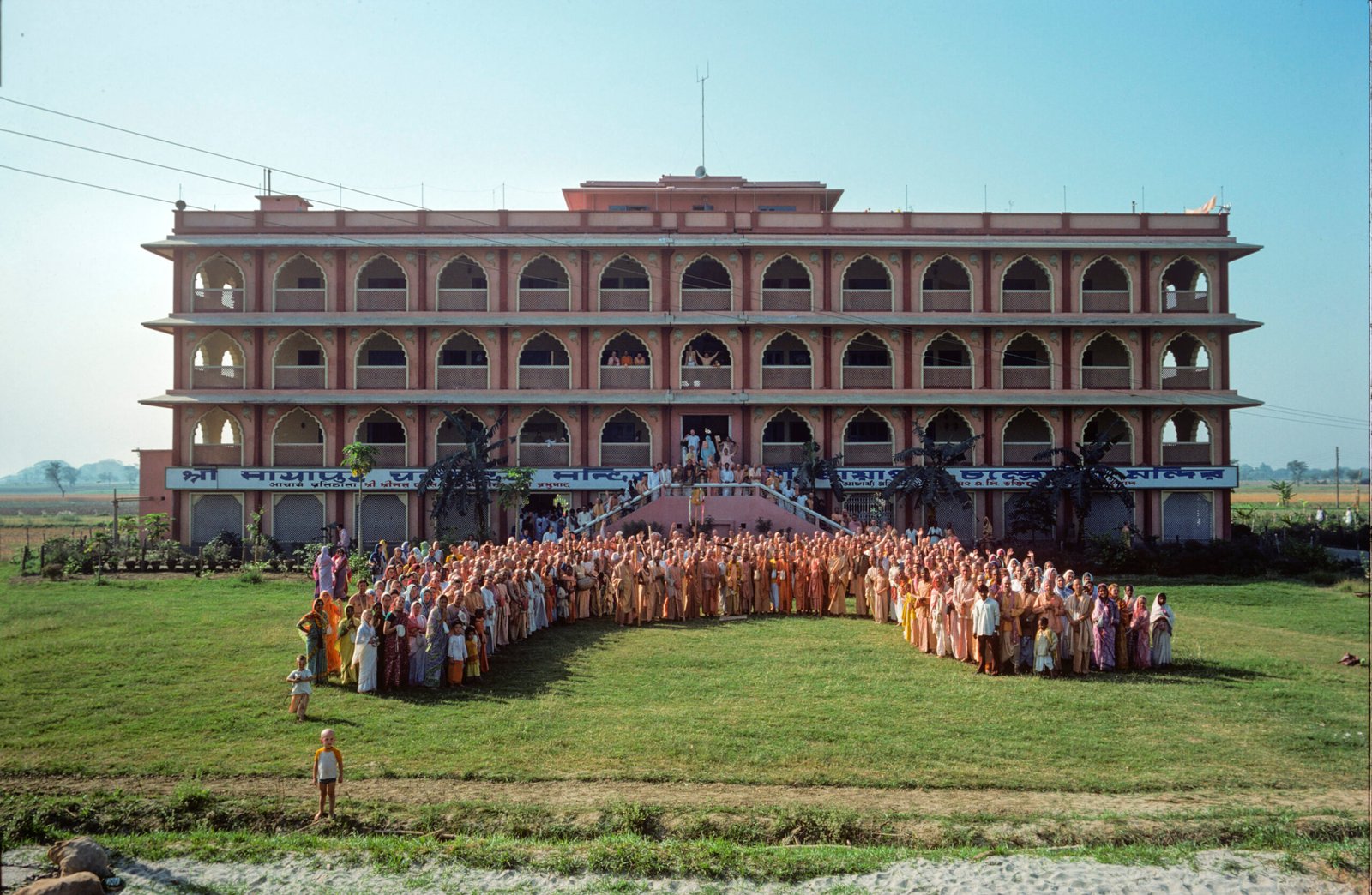
Bhaktivinoda Ṭhākura's aspiration that the Europeans, Americans and Indians all together dance jubilantly and chanting "Gaura Hari."
So this temple, Māyāpur Chandrodaya temple, is meant for transcendental United Nation. What the United Nation has failed, that will be achieved here by the process recommended by Śrī Caitanya Mahāprabhu,
pṛthivīte āche yata nagarādi grāma
sarvatra pracāra haibe mora nāma
(CB Antya-khaṇḍa 4.126)
So you have come from all parts of the world and living together in this temple. So train these small boys. I am very glad, especially, to see that the small children from all other countries, and Indian, Bengalis, all together, forgetting their bodily consciousness. That is the greatest achievement in this movement, that everyone forgets the bodily conception of life. Nobody thinks here as "European," "American," "Indian," "Hindu," "Muslim," "Christian." They forget all these designation, and simply they are ecstatic in chanting Hare Kṛṣṇa mantra. So kindly what you have begun, do not break it. Continue it very jubilantly. And Caitanya Mahāprabhu, the master of Māyāpur, He will be very much pleased upon you, and ultimately you will go back to home, back to Godhead.
(760115 - Lecture Excerpt - Mayapur)
That is the mission of Śrī Caitanya Mahāprabhu. His mission is, especially to the Indians He says,
bhārata-bhūmite haila manuṣya-janma yāra
janma sārthaka kari' kara para-upakāra
(CC Adi 9.41)
Para-upakāra, just to do something good for others, for upakāra. So Caitanya Mahāprabhu says anyone who has taken birth in India, he should, bhārata-bhūmite manuṣya-janma haila yāra (CC Adi 9.41), anyone who has taken birth in India, for every one of them, it is the duty. Janma sārthaka kari': first of all make your life successful, janma sārthaka kari' kara para-upakāra, then you begin the welfare activities for all others. The idea is that India is enriched with Vedic knowledge, and those who are born in India, they should take advantage of this facility, especially those who are in the higher, topmost ranks, the brāhmaṇas, the kṣatriyas, the vaiśyas. Especially the brāhmaṇas. Take this education perfectly well, make your life perfect, and distribute the knowledge all over the world. This is your duty. That is the order of Śrī Caitanya Mahāprabhu.
(760620 - Lecture BG 09.03 - Toronto)
- January 15 - Conversation - Mayapur
- January 15 - Lecture - Mayapur
- January 16 - Morning Walk - Mayapur
- January 16 - Conversation - Mayapur
- January 17 - Morning Walk - Mayapur
- January 17 - Conversation - Mayapur
- January 18 - Morning Walk - Mayapur
- January 18 - Conversation - Mayapur
- January 19 - Morning Walk - Mayapur
- January 19 - Conversation - Mayapur
- January 20 - Morning Walk - Mayapur
- January 21 - Morning Walk - Mayapur
- January 22 - Morning Walk - Mayapur
- January 23 - Morning Walk - Mayapur
- February 03 - Morning Walk - Mayapur
- February 04 - Morning Walk - Mayapur
- February 05 - Morning Walk - Mayapur
- February 05 - Lecture Initiation Sannyasa Excerpt - Mayapur
- February 06 - Morning Walk - Mayapur
- February 08 - Lecture SB 07.09.01 - Mayapur
- February 09 - Morning Walk - Mayapur
- February 10 - Morning Walk - Mayapur
- February 10 - Lecture SB 07.09.03 - Mayapur
- February 11 - Morning Walk - Mayapur
- February 11 - Lecture SB 07.09.04 - Mayapur
- February 12 - Morning Walk - Mayapur
- February 12 - Lecture SB 07.09.05 - Mayapur
- February 14 - Lecture SB 07.09.07 - Mayapur
- February 15 - Lecture SB 07.09.08 - Mayapur
- February 16 - Lecture SB 07.09.09 - Mayapur
- February 17 - Lecture SB 07.09.10 - Mayapur
- February 18 - Morning Walk - Mayapur
- February 18 - Lecture SB 07.09.11 - Mayapur
- February 19 - Morning Walk - Mayapur
- February 19 - Lecture SB 07.09.12 - Mayapur
- February 20 - Morning Walk - Mayapur
- February 20 - Lecture SB 07.09.13 - Mayapur
- February 21 - Morning Walk - Mayapur
- February 21 - Appearance Day, Bhaktisiddhanta Sarasvati
- February 21 - Lecture SB 07.09.14 - Mayapur
- February 22 - Morning Walk - Mayapur
- February 22 - Lecture SB 07.09.15 - Mayapur
- February 23 - Lecture SB 07.09.16 - Mayapur
- February 24 - Lecture SB 07.09.17 - Mayapur
- February 25 - Morning Walk - Mayapur
- February 25 - Lecture SB 07.09.18 - Mayapur
- February 26 - Morning Walk - Mayapur
- February 26 - Lecture SB 07.09.19 - Mayapur
- February 27 - Morning Walk - Mayapur
- February 27 - Lecture SB 07.09.20 - Mayapur
- February 28 - Morning Walk - Mayapur
- February 28 - Lecture SB 07.09.21 - Mayapur
- February 29 - Morning Walk - Mayapur
- February 29 - Lecture SB 07.09.22 - Mayapur
- March 01 - Morning Walk - Mayapur
- March 01 - Lecture SB 07.09.23 - Mayapur
- March 02 - Morning Walk - Mayapur
- March 02 - Lecture SB 07.09.24 - Mayapur
- March 03 - Morning Walk - Mayapur
- March 04 - Lecture SB 07.09.26 - Mayapur
- March 05 - Morning Walk - Mayapur
- March 05 - Lecture SB 07.09.27 - Mayapur
- March 06 - Lecture SB 07.09.28 - Mayapur
- March 06 - Conversation in Bengali - Mayapur
- March 07 - Morning Walk - Mayapur
- March 07 - Lecture SB 07.09.29 - Mayapur
- March 08 - Morning Walk - Mayapur
- March 08 - Lecture SB 07.09.30 - Mayapur
- March 09 - Morning Walk - Mayapur
- March 09 - Lecture SB 07.09.31 - Mayapur
- March 10 - Morning Walk - Mayapur
- March 10 - Lecture SB 07.09.32 - Mayapur
- March 11 - Morning Walk - Mayapur
- March 11 - Lecture SB 07.09.33 - Mayapur
- March 12 - Morning Walk - Mayapur
- March 12 - Lecture SB 07.09.34 - Mayapur
- March 13 - Morning Walk - Mayapur
- March 13 - Lecture SB 07.09.35 - Mayapur
- March 14 - Morning Walk - Mayapur
- March 14 - Lecture SB 07.09.36 - Mayapur
- March 15 - Morning Walk - Mayapur
- March 01 - Lecture SB 07.09.37 - Mayapur
- March 16 - Morning Walk - Mayapur
- March 16 - Gaura-pūrṇimā, appearance day of Śrī Caitanya Mahāprabhu
- March 16 - Conversation - Mayapur
- March 17 - Morning Walk - Mayapur
- March 17 - Lecture SB 07.09.39 - Mayapur
- March 18 - Morning Walk - Mayapur
- March 18 - Lecture SB 07.09.40 - Mayapur
- March 19 - Morning Walk - Mayapur
- March 19 - Lecture SB 07.09.41 - Mayapur
- March 21 - Morning Walk - Mayapur
- March 22 - Lecture SB 07.09.42 - Mayapur
- March 22 - Conversation in Bengali - Mayapur
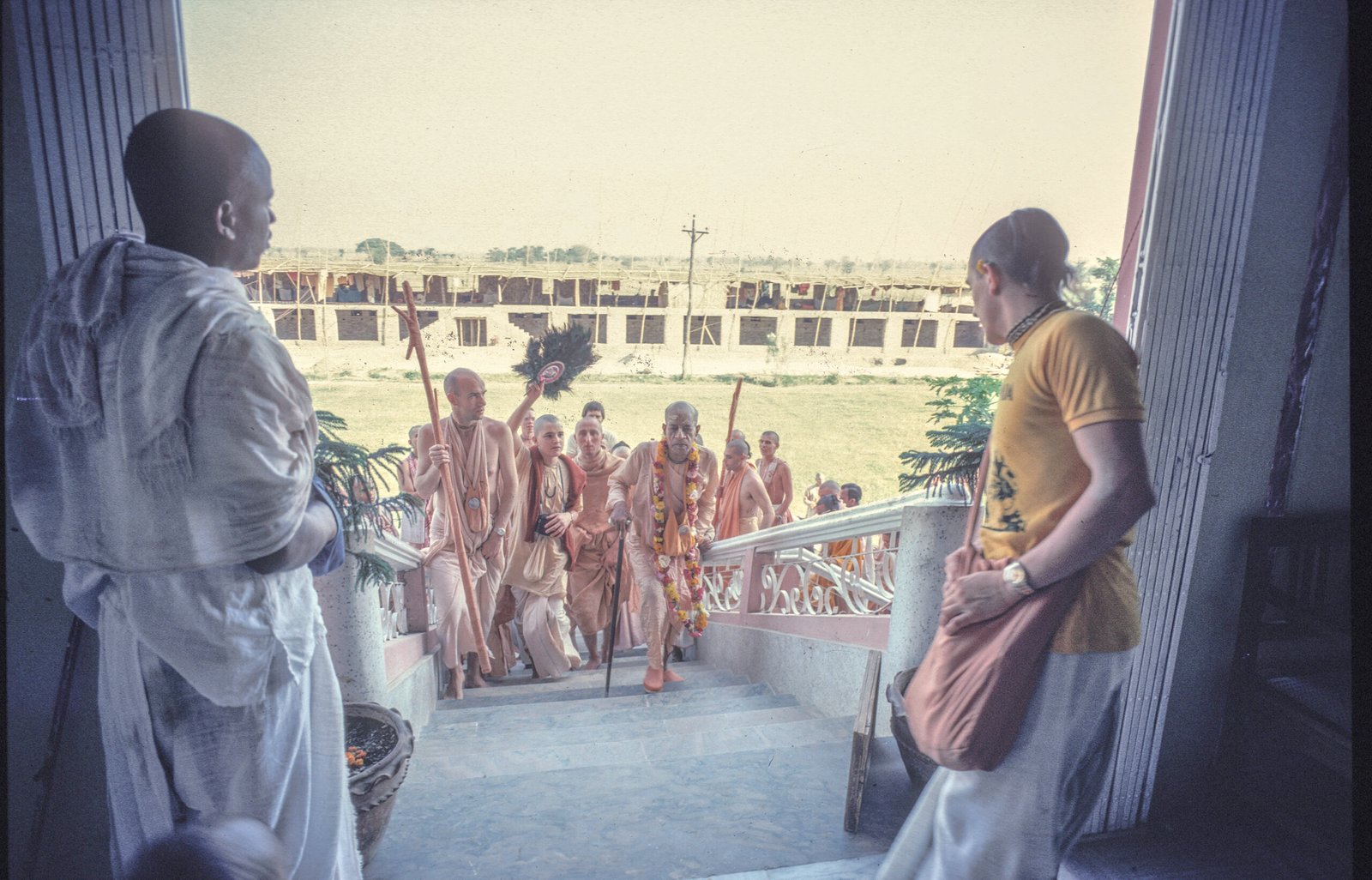
1976 - Śrīla Prabhupāda Instructed Ambarīṣa Dāsa to Finance the Temple of the Vedic Planetarium (TOVP)
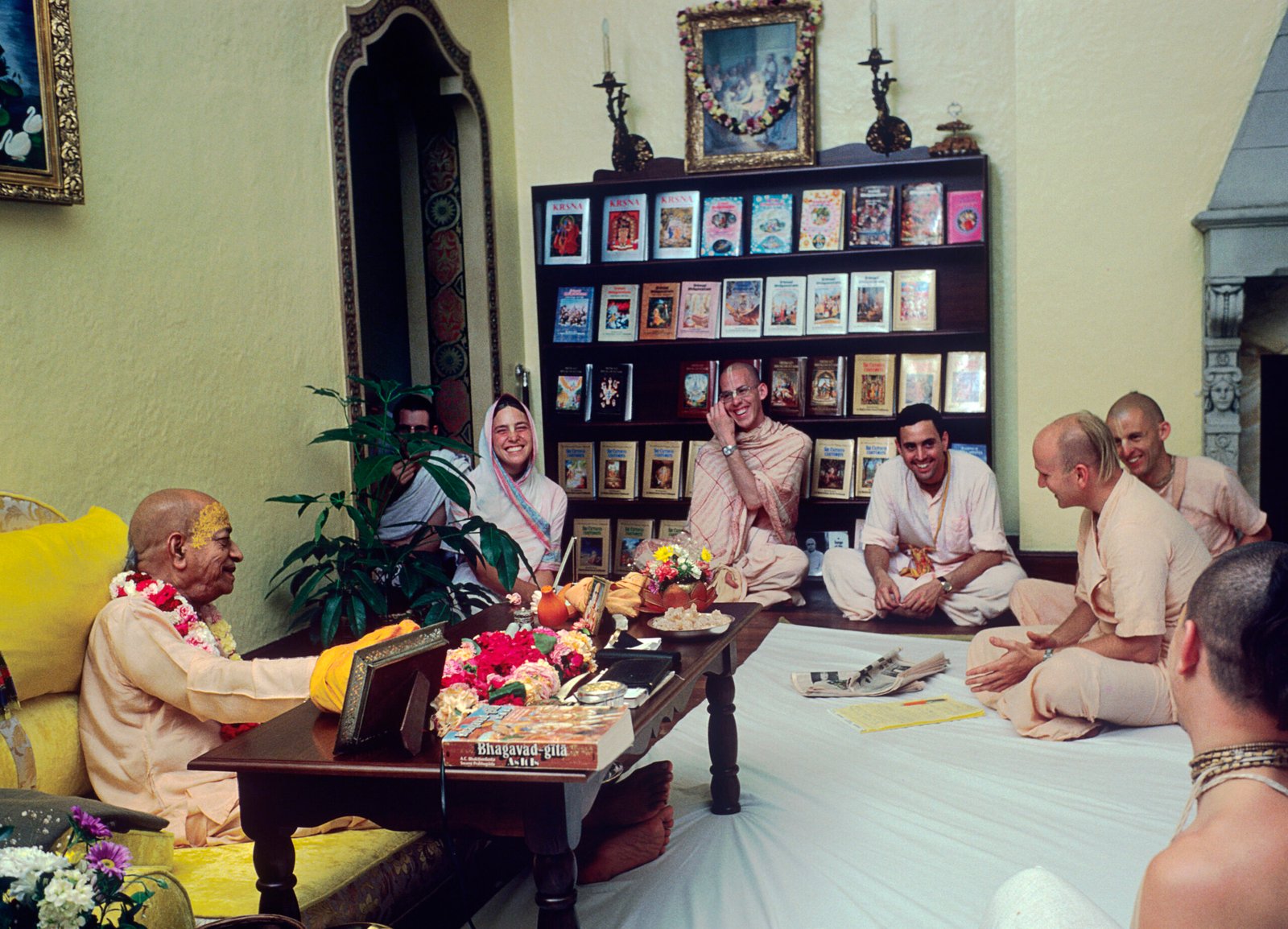
Prabhupāda: Now you all together make this Vedic planetarium very nice, so that people will come and see. From the description of the Śrīmad-Bhāgavatam, you prepare this Vedic planetarium. How do you like this idea, Vedic planetarium?
Ambarīṣa: It seems like a very nice idea.
Prabhupāda: You also like? So finance this project. (laughter) Vedic planetarium.
Ambarīṣa: Where will this be?
Prabhupāda: Māyāpur. My idea is to attract people of the whole world to Māyāpur. So we are just trying to acquire three hundred fifty acres of land from the government. It is going on under consideration.
(760615 - Conversation B - Detroit)
1977 - Food for Life Program Inaugurated
“Prabhupāda: Therefore I started Māyāpur this prasāda distribution. And it is coming to be successful. People are…, politicians are appreciating that here is Hindu-Muslim unity.
Rāmeśvara: All the devotees will appreciate this, then, that the records now, the money is going to be used for food relief.
Prabhupāda: Yes. And we can increase. The same thing we see in the farm, in the village, “Come on, any number, I shall feed you. Come here, chant Hare Kṛṣṇa and take prasādam.” And we shall increase the quality of the prasādam. They will be very much pleased to come and chant. That I want. I am interested in these rascals (indistinct), fighting amongst themselves. What can I do? You can go for some time, see what is the reason he has come. (indistinct) …elderly person, he will come. And if you deliver something (indistinct) younger brothers (indistinct) but that he has no power to do. Misunderstanding there will be; after all, it is the material world. You go and see why he said(?). (pause) I used to think like that. In all our temples the prasāda distribution should be so round-up(?), that within ten miles nobody should remain hungry. There are many persons in India, they are half time hungry. And if you distribute prasādam, “Come over here. You are hungry, take prasādam. If I cannot supply you daily, I’ll supply at least two days, three days weekly.” And they’re coming. You have seen Māyāpur (indistinct), that big prasāda distribution hall. Regular two thousands people are coming, Sunday, Saturday. And Hindu, Muslim, they’re sitting down. No grudges.
Hari-śauri: Is there any reason why we are…, just distribute on a Saturday and Sunday?
Prabhupāda: Oh, if we can, we can distribute every day.
Hari-śauri: Let them come every day.
Prabhupāda: Yes. This is (indistinct). Otherwise I want. Let them eat. They can eat.”
(770113 – Conversation – Allahabad)
1977 - Śrīla Prabhupāda's Final Visit to Māyāpur
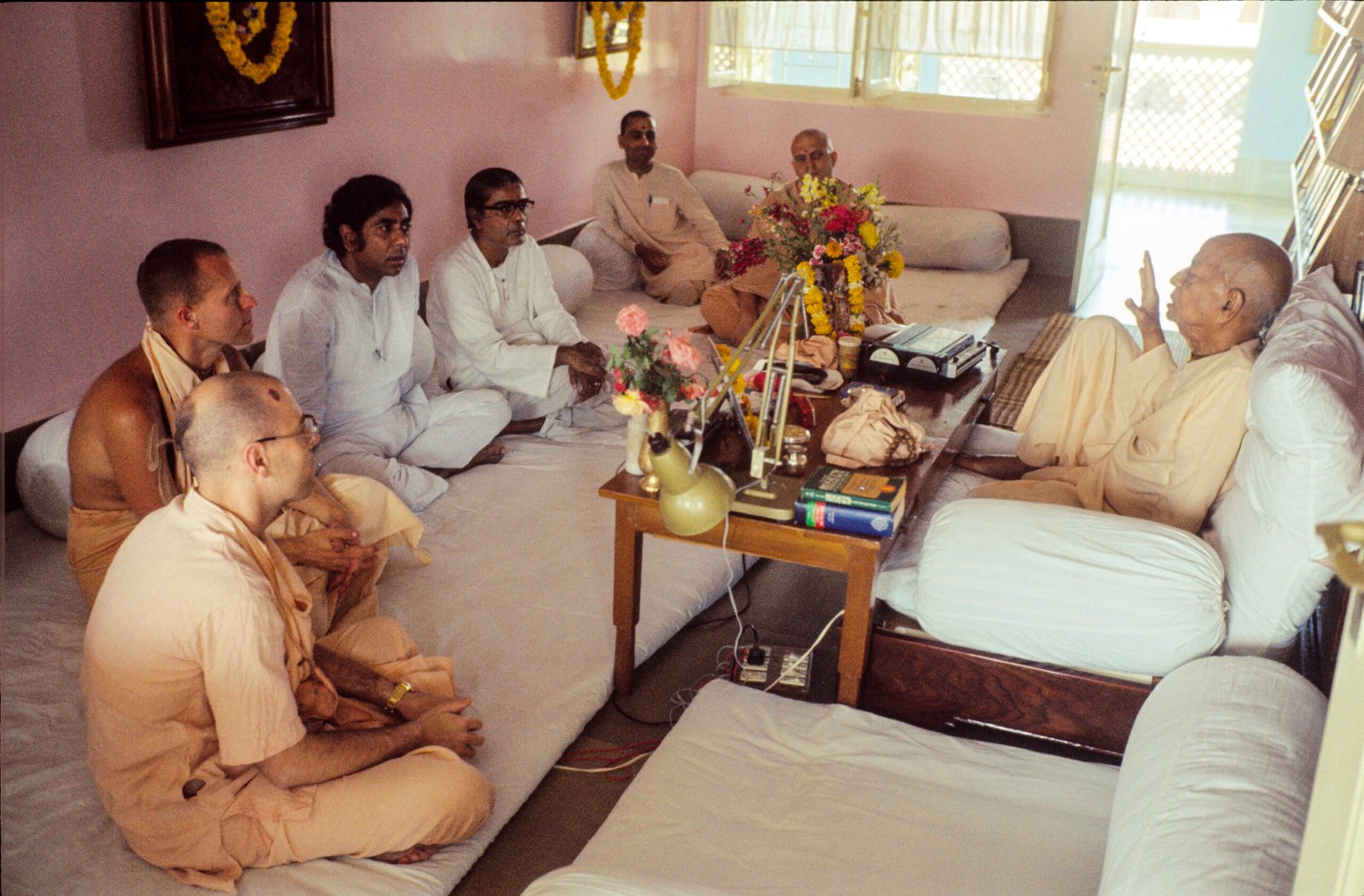
"Just like the sun is in the sky, but we see in the morning it appears; in the evening it retires. That is defectness of our eyes. Actually the sun is always there. So similarly Vaiṣṇava, as Kṛṣṇa comes, yadā yadā hi dharmasya glānir, similarly, a Vaiṣṇava—means the confidential servant of Kṛṣṇa—he also comes for some purpose by the order of the master. So their life and Kṛṣṇa's life, it is same. There is no question of past, present, future. Nityaḥ. Nityaḥ śāśvato 'yam, na hanyate hanyamāne śarīre (BG 2.20). So tirobhava avirbhava, they are the same thing as the appearance and disappearance of sun."
(770208 - Lecture Festival Appearance Day, Bhaktisiddhanta Sarasvati - Mayapur)
- February 07 - Lecture Arrival - Mayapur
- February 08 - Appearance day of Śrīla Bhaktisiddhānta Sarasvatī Ṭhākura
- February 10 - Morning Walk - Mayapur
- February 10 - Lecture SB 07.09.01 - Mayapur
- February 11 - Conversation - Mayapur
- February 12 - Lecture SB 07.09.02 - Mayapur
- February 12 - Conversation - Mayapur
- February 14 - Conversation A - Mayapur
- February 14 - Conversation B - Mayapur
- February 14 - Conversation C - Mayapur
- February 15 - Conversation - Mayapur
- February 16 - Conversation A - Mayapur
- February 16 - Conversation B - Mayapur
- February 17 - Lecture SB 07.09.03 - Mayapur
- February 17 - Conversation - Mayapur
- February 18 - Lecture SB 07.09.04 - Mayapur
- February 18 - Conversation A - Mayapur
- February 18 - Conversation B - Mayapur
- February 18 - Conversation C - Mayapur
- February 18 - Conversation D - Mayapur
- February 19 - Conversation A - Mayapur
- February 19 - Conversation B - Mayapur
- February 19 - Conversation C - Mayapur
- February 19 - Conversation D - Mayapur
- February 19 - Conversation E - Mayapur
- February 21 - Conversation - Mayapur
- February 24 - Conversation A - Mayapur
- February 24 - Conversation B - Mayapur
- February 25 - Lecture SB 07.09.05 - Mayapur
- February 25 - Lecture SB 07.09.01 - Mayapur
- February 25 - Conversation B - Mayapur
- February 25 - Conversation C - Mayapur
- February 26 - Lecture SB 07.09.06 - Mayapur
- February 26 - Conversation - Mayapur
- February 26 - Interview - Mayapur
- February 27 - Lecture SB 07.09.07 - Mayapur
- February 27 - Lecture SB 07.09.01 - Mayapur
- February 27 - Conversation B - Mayapur
- February 28 - Lecture SB 07.09.08 - Mayapur
- February 28 - Lecture SB 07.09.01 - Mayapur
- February 28 - Conversation B - Mayapur
- February 28 - Conversation C - Mayapur
- March 01 - Lecture SB 07.09.09 - Mayapur
- March 01 - Lecture SB 07.09.01 - Mayapur
- March 01 - Conversation B - Mayapur
- March 02 - Conversation - Mayapur
- March 04 - Conversation - Mayapur
- March 5 - Gaura-pūrṇimā, appearance day of Śrī Caitanya Mahāprabhu
- March 20 - Conversation - Mayapur
1980 - Śrī Śrī Rādhā Mādhava Installation (Big Deities) *
Information – It wasn’t until 1980, however, that Prabhupäda’s desire to see life-sized deities in Mäyäpur would come to fruition. Jananiväsa Prabhu takes up the story: “Big Rädhä-Mädhava were installed on Gaura-pürnimä of that year (1980). The temple was in the Lotus Building then, and They were worshipped there until 1986 (View Photo Album), when the first four gopis (Lalitā Sakhī, Campakalatā Sakhī, Citrā Sakhī and Tuṅgavidyā Sakhī) arrived. The other four (Viśākhā Sakhī, Indulekhā Sakhī, Raṅgadevī Sakhī and Sudevī Sakhī) arrived in 1992.”
“Then he made a gesture with his hands, the same gesture as Rādhārāṇī, and he said, ‘Rādhārāṇī will be dancing, because when She is dancing, Kṛṣṇa can never leave Her.’ He then gave the dimensions for Radha-Madhava and the other deities. He said, ‘Kṛṣṇa will be six feet four inches. Rādhārāṇī should be five foot ten inches.’ (‘He’ refers to Srila Prabhupada)
(Article Full of Abundant Grace’, Mayapur Magazine 2006)
1984 - Māyāpur Community Overcomes Dacoit Attack
Information – On the 24th of March, 1984, at 12:20 a.m., thirty-five dacoits (thieves) armed with weapons and bombs attacked Sri Mayapur Chandrodaya Mandir. They harassed the devotees and treated them with derision. But the greatest shock came when the dacoits decided to steal the Deities of Srila Prabhupada and Srimati Radharani. Fearlessly, the devotees challenged the attackers. How could they see Srila Prabhupada and Srimati Radharani carried away? Shots were fired, a few dacoits fell, and their plans were foiled. Srila Prabhupada was rescued, but that beautiful form of Srimati Radharani would no longer grace the main altar.
This incident really disturbed the minds of the devotees. Those involved in management were especially concerned to make some permanent solution. This was not the first time the devotees had faced violence and harassment in Mayapur. Bhavananda Dasa, who was the co-director of ISKCON Mayapur, suggested that Lord Nrsimhadeva be installed. When the dacoits had threatened devotees at the Yoga-Pitha, Srila Bhaktivinode Thakura and his son, Srila Bhaktisiddhanta Sarasvati Thakura, had promptly installed Sri Sri Laksmi Nrsimhadeva. There had been no further disturbances. Other devotees in Mayapur were not so keen to follow so closely in these footsteps. The pujari must be a naisthika-brahmacari (celibate from birth) and the worship ; of Lord Nrsimhadeva must be very strict and regulated…..
(The Appearance of Lord Nrsimhadeva in Mayapur, Page 8)
1986 - Śrī Nṛsiṁhādeva & Prahlāda Mahārāja Installation *
The installation of Lord Nrsimhadeva took place over a three-day period, from July 28th to 30th, 1986.
Information – The sthapati replied, “They are very insistent: They are constantly coming to talk to me about the Deity. Apparently, they have some problem with dacoits.” Handing his guru a sketch of the Deity, he said, “This is the Deity they want.” His guru took the sketch and looked at it knowingly. “Ah, this is ugra category,” he said, “but a Deity in this particular mood is-called Sthanu-Nrsimha: He doesn’t exist on this planet. Even the demigods in the heavenly planets don’t worship a form like this. Yes, this Deity belongs to the ugra category. Ugra means ferocious, : very angry. There are nine forms within this category. They are all very fierce. The one they want is Sthanu Nrsimha: stepping out of the pillar. No. Don’t carve this Deity. It will not be auspicious for you. I will talk with you about this later.” A few nights later the sthapati had a dream. In the , dream his guru came to him and said, “For them you can carve Sthanu-Nrsimha.” The next morning he received a hand-delivered letter from Kanchipuram. The letter was from the Sankaracharya and gave some instructions regarding temple renovations. There was a footnote at the bottom. It read, “For ISKCON you can carve Sthanu Nrsimha.” The sthapati showed me the letter and said, “I have my guru’s blessings. I will carve your Deity.”
(The Appearance of Lord Nrsimhadeva in Mayapur, Page 12)
1986 - Śrī Kṛṣṇa Caitanya and Prabhu Nityānanda Arrival *
Information – The larger deities of Gaura-Nitai in the bhajan kutir are named ‘Sri Krishna Caitanya & Prabhu Nityananda’. They were previously on the sankirtan bus and traveled on the pada yatra from Dwarka to Mayapur. This pada yatra holds the world record for the longest duration, lasting 18 months. It began on Radhastami and concluded in Mayapur at the 500th Birth Anniversary festival of Lord Caitanya.
1986 - Lalitā Sakhī, Campakalatā Sakhī, Citrā Sakhī and Tuṅgavidyā Sakhī Installation (Deities moved from Lotus Building to New Temple) *
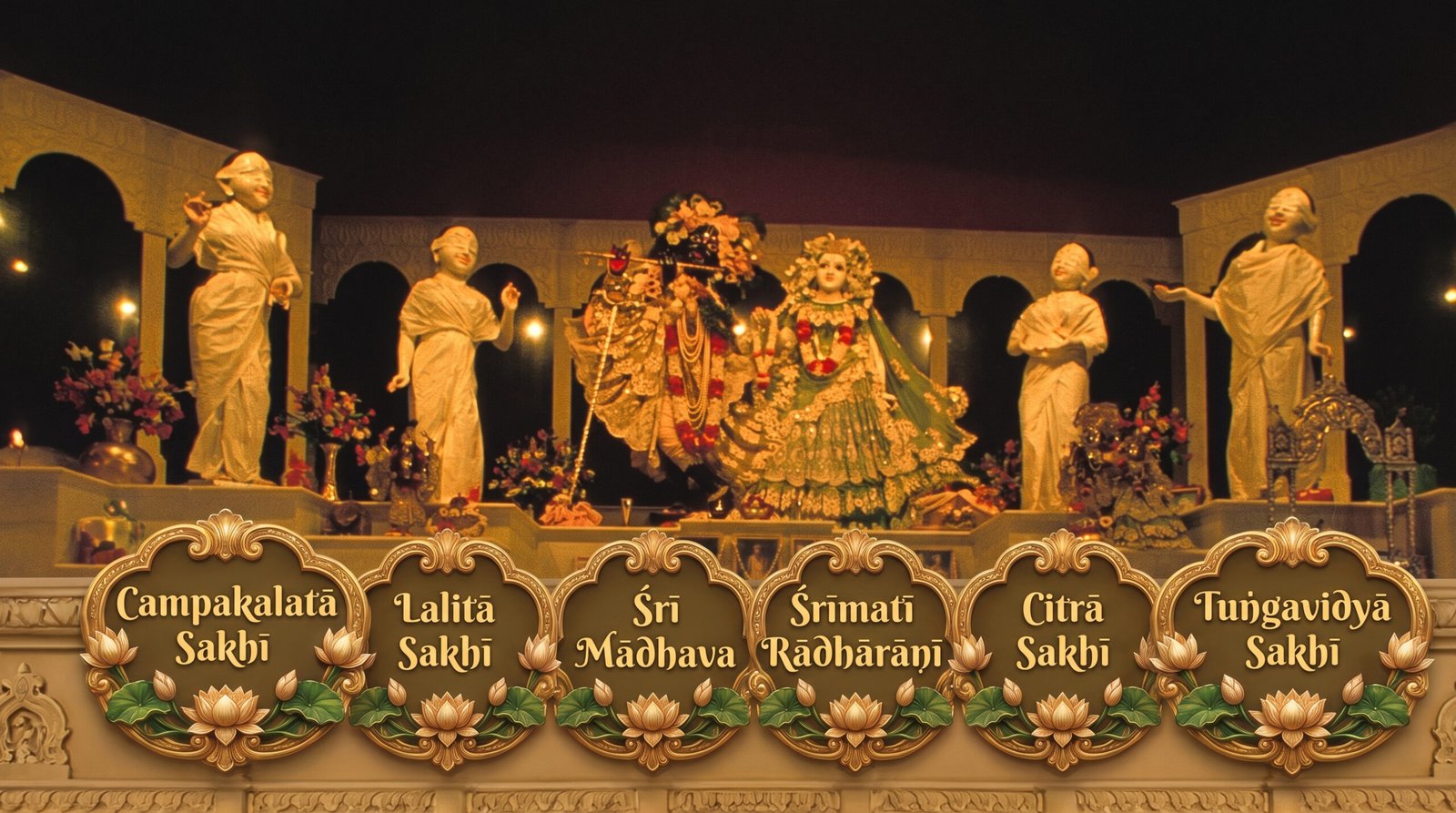
It wasn’t until 1980, however, that Prabhupäda’s desire to see life-sized deities in Mäyäpur would come to fruition. Jananiväsa Prabhu takes up the story: “Big Rädhä-Mädhava were installed on Gaura-pürnimä of that year (1980). The temple was in the Lotus Building then, and They were worshipped there until 1986 (View Photo Album), when the first four gopis (Lalitā Sakhī, Campakalatā Sakhī, Citrā Sakhī and Tuṅgavidyā Sakhī) arrived. The other four (Viśākhā Sakhī, Indulekhā Sakhī, Raṅgadevī Sakhī and Sudevī Sakhī) arrived in 1992.”
(Article Full of Abundant Grace’, Mayapur Magazine 2006)
1992 - Viśākhā Sakhī, Indulekhā Sakhī, Raṅgadevī Sakhī and Sudevī Sakhī Installation *
It wasn’t until 1980, however, that Prabhupäda’s desire to see life-sized deities in Mäyäpur would come to fruition. Jananiväsa Prabhu takes up the story: “Big Rädhä-Mädhava were installed on Gaura-pürnimä of that year (1980). The temple was in the Lotus Building then, and They were worshipped there until 1986 (View Photo Album), when the first four gopis (Lalitā Sakhī, Campakalatā Sakhī, Citrā Sakhī and Tuṅgavidyā Sakhī) arrived. The other four (Viśākhā Sakhī, Indulekhā Sakhī, Raṅgadevī Sakhī and Sudevī Sakhī) arrived in 1992.”
(Article Full of Abundant Grace’, Mayapur Magazine 2006)
1992 - Circular Brahmachari Building
1994 - Gada Bhavan Inauguration
Gada Kitchen: 1995
1995 - Śrīla Prabhupāda Samadhi Inauguration
Plaque - 1 March 1995
Śrīla Prabhupāda Samādhi – Design and Contributors
- Surabhi Mahārāja – Main designer of the Samādhi.
- Kadamka Kanana Swami - Construction and Superstructure
- Sadbhuja Dāsa – Designed the Museum, Gardens, interiors, exteriors, and embellishments.
- Bhakti Siddhānta Dāsa – Assisted in the project.
- Bharat Mahārāja Dāsa – Involved in the terracotta work.
- Matsya Avatāra – The Italian design team carried out the mosaic work on the roof.
- Anakadundubhi Prabhu – Art director who designed the museum exhibits
1996 - Śrī Śrī Pañca-tattva Installation (Small Deities) *
Information – In Srila Prabhupada’s Centennial Year, 1996, Māyāpur Candrodaya Mandir would undergo another change in Deity worship with the arrival of Sri Pañca-tattva (Small), and the temple expanded yet again to accommodate Them. Their worship commenced on Gaura-pūrṇimā of that year.
But the most amazing change was yet to come: the arrival in 2004 of the big Pañca-tattva Deities. That event saw a new era commence in ISKCON. (View Photo Album)”When Radha-Madhava were installed, there were definitely feelings of transcendence,” Jananivasa says. “When we went up to instal the chakra after They were installed, you could feel They were manifesting something. But nothing like the installation of Pañca-tattva. Even before They were installed, there was so much mercy there.” Both installations were many years apart. Was this, then, a maturation of devotional sentiment, or the mercy of the Lord?
“I would say it was an act of mercy, of Their sweet will,” Jananivasa says. “We had fulfilled a desire of Srila Prabhupada’s to bring these Deities, and the overwhelming feelings that everyone experienced was Śri Panca-tattva manifesting Their presence.”
Worldwide, devotees felt that merciful glance of Śri Caitanya Mahaprabhu and His associates; they experienced the abundant grace that emanates from the Deity form of the Lord, and all were swept up in an unmistakable shower of love of God. Jananivāsa concludes, “It’s not something you can create. It’s something that, no matter how hard you try, you can’t produce it. Grace comes of it’s own accord.”
Śrīla Prabhupada said, ‘Lord Caitanya should be seven feet tall and covered with gold,’ and I said, ‘Oh, not marble?’ Prabhupāda said, ‘No, They should be aṣṭa-dhātu.’
(Article Full of Abundant Grace’ , Mayapur Magazine 2006)
1998 - Sankirtan Building Inauguration
2004 - Śrī Śrī Pañca-tattva Installation *
Information – In Srila Prabhupada’s Centennial Year, 1996, Māyāpur Candrodaya Mandir would undergo another change in Deity worship with the arrival of Sri Pañca-tattva (Small), and the temple expanded yet again to accommodate Them. Their worship commenced on Gaura-pūrṇimā of that year.
But the most amazing change was yet to come: the arrival in 2004 of the big Pañca-tattva Deities. That event saw a new era commence in ISKCON. (View Photo Album)”When Radha-Madhava were installed, there were definitely feelings of transcendence,” Jananivasa says. “When we went up to instal the chakra after They were installed, you could feel They were manifesting something. But nothing like the installation of Pañca-tattva. Even before They were installed, there was so much mercy there.” Both installations were many years apart. Was this, then, a maturation of devotional sentiment, or the mercy of the Lord?
“I would say it was an act of mercy, of Their sweet will,” Jananivasa says. “We had fulfilled a desire of Srila Prabhupada’s to bring these Deities, and the overwhelming feelings that everyone experienced was Śri Panca-tattva manifesting Their presence.”
Worldwide, devotees felt that merciful glance of Śri Caitanya Mahaprabhu and His associates; they experienced the abundant grace that emanates from the Deity form of the Lord, and all were swept up in an unmistakable shower of love of God. Jananivāsa concludes, “It’s not something you can create. It’s something that, no matter how hard you try, you can’t produce it. Grace comes of it’s own accord.”
Śrīla Prabhupada said, ‘Lord Caitanya should be seven feet tall and covered with gold,’ and I said, ‘Oh, not marble?’ Prabhupāda said, ‘No, They should be aṣṭa-dhātu.’
(Article Full of Abundant Grace’ , Mayapur Magazine 2006)
2006 - Senior Brahmachari Building
2008 - Mayapur TV Live Broadcast Launched
In 2008, MayapurTV installed cameras in the temle room of ISKCON London, and soon other temples began to use the MayapurTV broadcast service. Los Angeles (who had already pioneered this service), Bhaktivedanta Manor, Ujjain to name a few, soon followed.
In 2009, Sri Dham Mayapur had its first broadcast on the day of the Pancha Tattva's Maha-abhisek.
By 2018, over 150 ISKCON centres, sannyasis and leading devotees broadcast with MayapurTV. Over 20,000 registered viewers as well as numerous casual visitors have immediate access to live ISKCON activities worldwide. MayapurTV regularly facilitates the broadcast of events of international interest such as Rathayatras, Kirtan festivals including the famous Radhadesh Mellows and Mayapur Kirtan Mela, the annual Sri Mayapur Festival including the parikrama, London Janmasthami, etc.. On festival days like Gaura Purnima and Nrsimha Caturdasi there are upwards of 2,000 homes/temples viewing online and over 20,000 unique visits, making these truly worldwide ISKCON celebrations.
Also in 2014, MayapurTV initiated its first cable television broadcast serving over 25,000 West Bengal homes. By 2018, MayapurTV on Cable networks had reached over 3 million homes, with five additional chanels waiting to get connected.
On Radhasthami, 2018, a purpose-built studio was officially opened.
2016 - Sankirtan Building Inauguration
2018 - Sri Chaitanya Cultural World Heritage Center Approved by the West Bengal Government
The Sri Chaitanya Cultural World Heritage Center, a unique temple town project spread over 600 acres, is being developed by Sridham Mayapur Development Foundation, an undertaking of the International Society for Krishna Consciousness (ISKCON), founded by His Divine Grace A.C. Bhaktivedanta Swami Prabhupada.
Objectives of the Sridham Mayapur Development Foundation
1. To provide education and medical relief.
2. To promote and revive Indian culture, art, tradition, music, philosophy, history, traditional cuisine, handicrafts and handlooms.
3. To conserve and preserve ecology and environment, water resources, animal and plant life; organic farming, animal husbandry, agriculture, and alternative energy sources.
4. To propagate religious values, systematic dissemination of spiritual knowledge, and for performing other humanitarian activities directed towards universal integration and for the propagation of yoga.
5. To promote skill development and self employment and to create awareness on social, moral and economic issues affecting the nation, and work towards the upliftment of the society.
6. To undertake welfare activities by developing temporary and permanent accommodation in rural areas for the poor and needy, by providing food and other necessities of life to people regardless of race, caste, creed or gender at Sri Mayapur.
2022 - Śrī Nṛsiṁha Śālagrāma Śilā of Śrīla Viśvanātha Cakravartī Ṭhākura Installation *
Information – On the 22nd of December 2022, the Sri Nrsimha Salagram Shila, worshipped by Srila Visvanatha Cakravarti Thakur, was officially installed on the Nrsimhadeva’s altar in ISKCON Mayapur. This Sila is placed at the center of the altar. In 2018, per the direction of Jayapataka Swami, to restore and establish worship in various Sripats in Gaura Mandala, a team of devotees traveled throughout West Bengal and Orissa, with the guidance of Namahatta director, Sri Gauranga Prem Swami. His Holiness Jayapataka Swami – On a visit to Devagrama, Srila Visvanatha Cakravarti Thakur’s birthplace, local villagers had told the team where they could locate the Saligrama Sila worshipped by Visvanatha Cakravarti Thakur and that it was currently being taken care of by an 80 yr old devotee. This devotee willingly handed the Sila to ISKCON Mayapur. The Sila was then established in Hare Kṛṣṇa Nāmahaṭṭa in ISKCON Mayapur Sri Sri Gaura Nitai mandir.
In November 2022, His Holiness Bhanu Swami Maharaja visited the Namahaṭṭa and took darsana of the Saligrama Sila. Then His Grace Jananivasa Das made a visit and identified it as a Narsimha Saligram. He immediately decorated Him as per Srila Prabhupada’s standards that were instructed to him.