Janārdana Śālagrāma-śilā
History
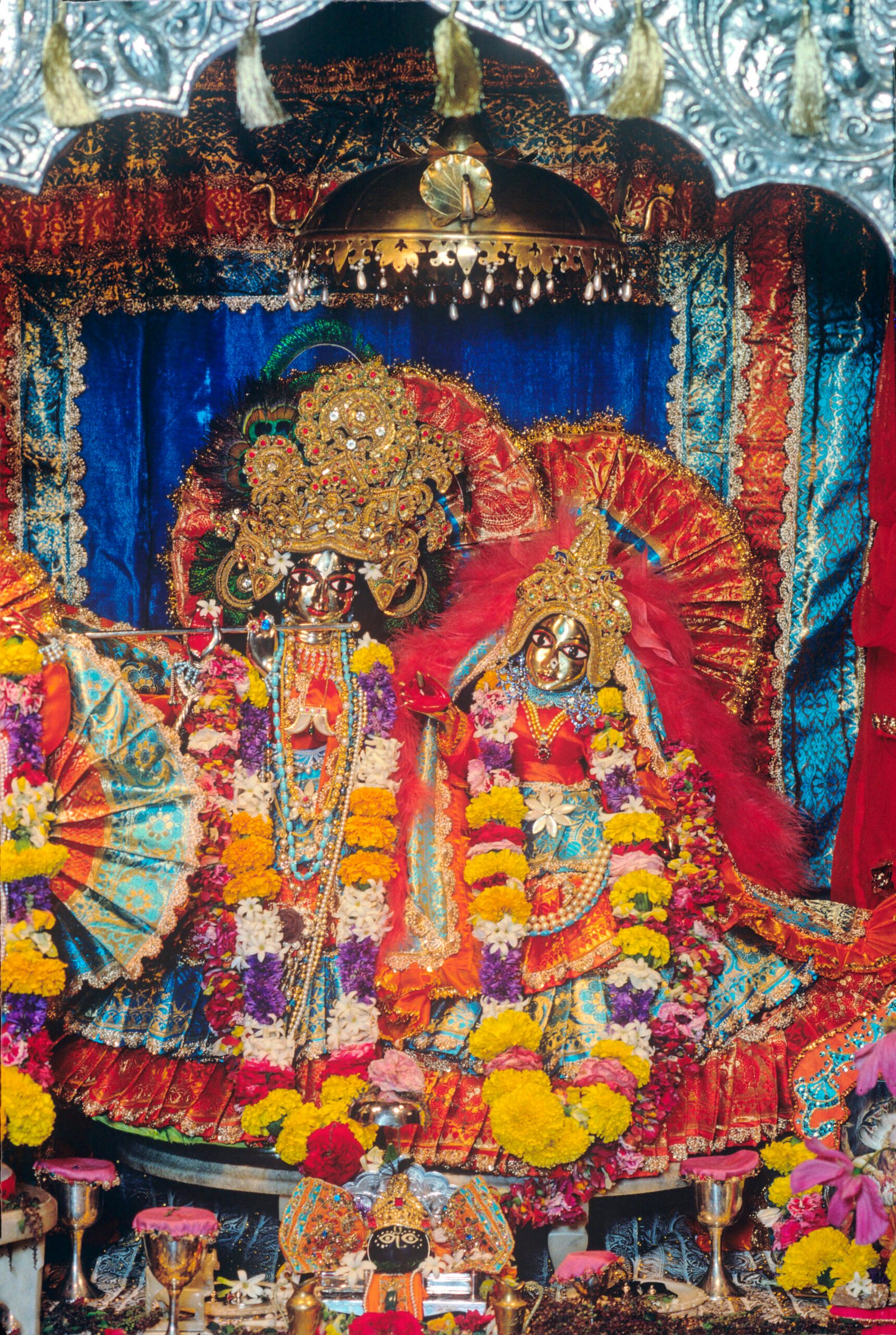
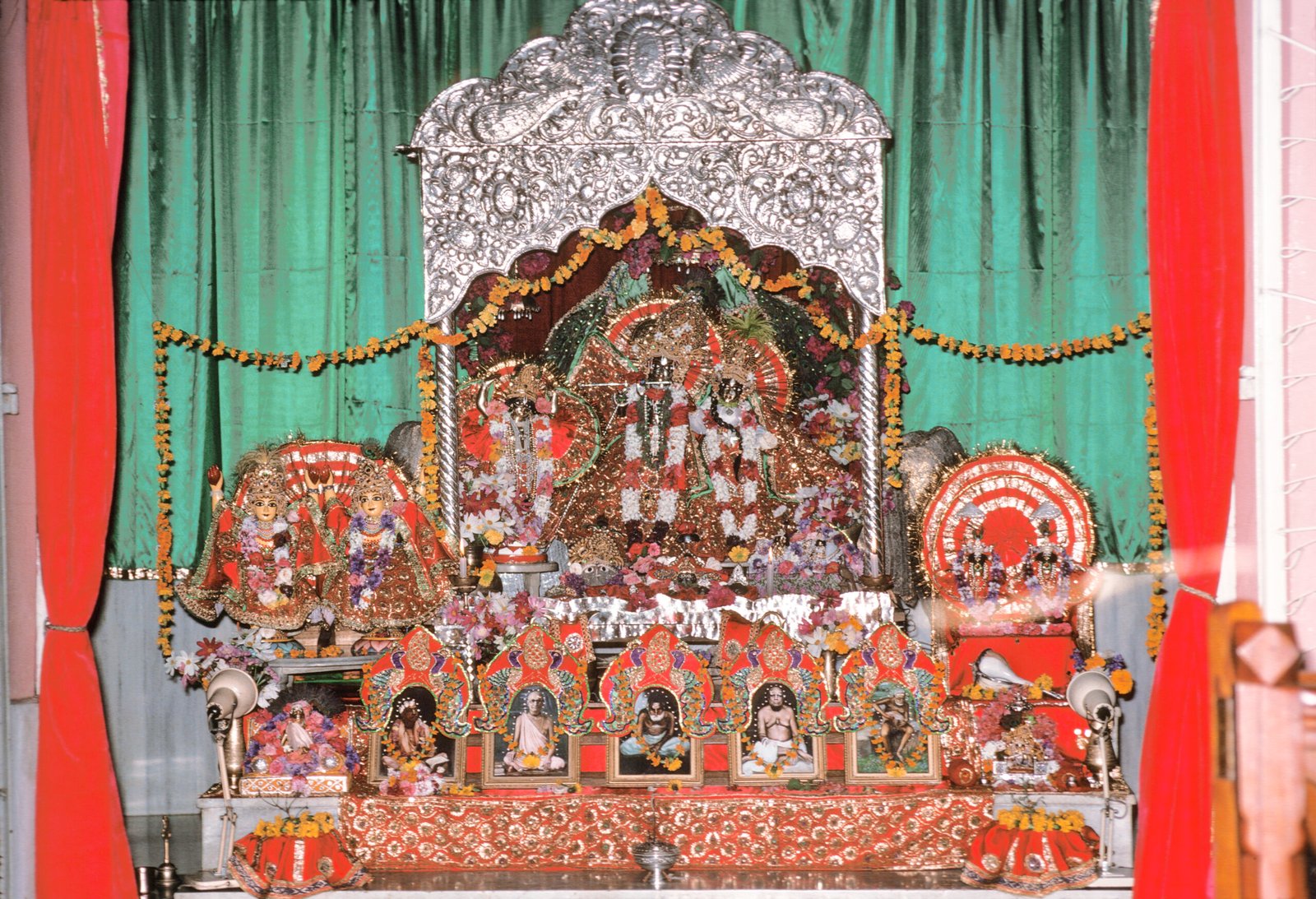
In 1974, worship of the Śāligrāma-śilās commenced in ISKCON Māyāpur. Initially, the Deities were worshipped according to the standards of the Puruṣa-sūkta, offering the traditional sixteen items of worship. Following the publication of Śrīla Prabhupāda’s Śrī Caitanya-caritāmṛta, the worship gradually expanded, eventually developing into the offering of sixty-four items that continues in Māyāpur today.
Jananivāsa dāsa (ACBSP) recalled:
“In 1974, when worship of Śāligrāma-śilā began, we started offering the 16 items according to the standards of Puruṣa-sūkta. The change came when Prabhupāda’s Śrī Caitanya-caritāmṛta was published. One purport mentioned the 64 items of worship. During that time Bhavānanda was always hassling me to expand the Deity worship. He would say, ‘Why don’t you expand? In Vṛndāvana they’re offering so much!’ I’d say to him, ‘I’m doing that,’ and he’d reply, ‘No you’re not!’ I told him, ‘I’ve been asking for a bed for the Deities and you haven’t given me one!’ He said, ‘Oh, really? Okay…’ and so we got a bed for the Deities. From then on, we started incorporating more and more, and after a few years we had the standard. The worship expanded into what it is today, which is the offering of 64 items.”
Source: “Full of Abundant Grace,” Mayapur Magazine, 2006.
History from Deity Division
Śrīla Prabhupāda instructed Jananivāsa Prabhu (ACBSP) to oversee the worship of Śālagrāma-śilā in Māyāpur and throughout ISKCON temples. He also requested Jayapatākā Mahārāja (ACBSP) to obtain a Śālagrāma-śilā, and Jayapatākā Mahārāja traveled by bicycle all the way to Kṛṣṇanagara to acquire one. Upon his return, he presented the Śālagrāma-śilā to Śrīla Prabhupāda.
At that time, Jananivāsa Prabhu had just completed his midday bath, applied tilaka to the twelve parts of his body, and entered Śrīla Prabhupāda’s room in the Lotus Building after being called. Śrīla Prabhupāda was pleased to see him freshly bathed, dressed in clean cloth, and wearing proper tilaka. He remarked that these were the lakṣaṇas (characteristics) of a true Vaiṣṇava.
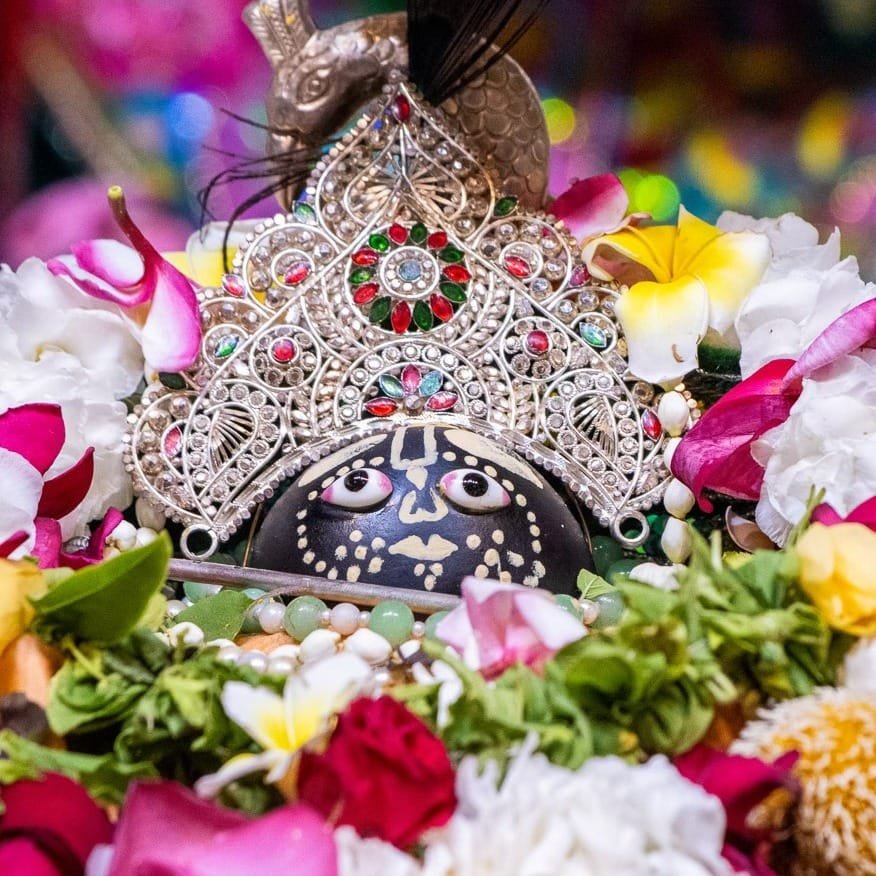
Jayapatākā Mahārāja then arrived and offered the Śālagrāma-śilā. Śrīla Prabhupāda immediately stood up, offered his obeisances, and began preparing the śilā for worship. He folded a piece of cloth like a dhotī, placed the Janārdana Śālagrāma-śilā upon it, and arranged a cādara behind it. Taking tilaka from a nearby table and using a matchstick, he carefully painted the features of the Lord’s face. He then removed his own flower garland and offered it to the śilā.
Śrīla Prabhupāda then explained to Jananivāsa Prabhu that Śālagrāma-śilās are non-different from Śrī Kṛṣṇa and that every ISKCON temple should worship Them. Since the Śālagrāma-śilā had just arrived, they performed a simple pūjā on the spot by offering cloth, decorating the śilā, and placing a flower garland around Him. At that moment, the garland suddenly fell from the śilā, and Śrīla Prabhupāda immediately exclaimed, “See! See! He has accepted my worship.”
That same day, Śrīla Prabhupāda instructed Jananivāsa Prabhu three times to train pūjārīs in the proper worship of Śālagrāma-śilā. From that day onward, Janārdana Śālagrāma-śilā was worshipped alongside Śrī Śrī Rādhā-Mādhava during the daily morning pūjā. In time, additional Śālagrāma-śilās gradually arrived in Māyāpur.
On one occasion, when Śrīla Prabhupāda came for darśana, he noticed a Śālagrāma-śilā that had both a painted mouth and a natural opening (dvāra). Pointing to the śilā, Śrīla Prabhupāda remarked, “Kṛṣṇa doesn’t have a moustache.” When Jananivāsa Prabhu attempted to explain, Śrīla Prabhupāda repeated, “Kṛṣṇa doesn’t have a moustache.” From that day forward, Jananivāsa Prabhu never painted a mouth on any Śālagrāma-śilā that already possessed a natural dvāra.
The form of the Lord described in this verse with distribution of different symbols — beginning from the lower right hand up and down to the lower left hand with lotus, wheel of a chariot, conchshell and club respectively — is called Janārdana, or the plenary portion of the Lord who controls the general mass.
(SB 2.2.8 purport)
The Supreme Personality of Godhead, Janārdana [Lord Kṛṣṇa], is the form to accept all the results of sacrifice. If He is not satisfied, then one’s labor for advancement is futile. He is the ultimate Self, and therefore one who does not satisfy Him certainly neglects his own interests.
(SB 3.13.13)
janārdana — O chastiser of the enemies (BG 11.51)
janārdana — O maintainer of all living entities. (BG 1.32-35)
janārdanaḥ — the controller of all living being (SB 3.7.35)
The śālagrāma-śilā should be worshiped with tulasī where a sufficient quantity of tulasī leaves are available. Worship of śālagrāma-śilā should be introduced in all ISKCON temples. Śālagrāma-śilā is the form of the Lord’s mercy. To worship the Deity with the sixty-four items mentioned may be a difficult job, but the Lord has become so small that anyone in any temple can carefully handle Deity worship simply by performing the same activities with the śālagrāma-śilā.
(CC Madhya 24.336 purport)