
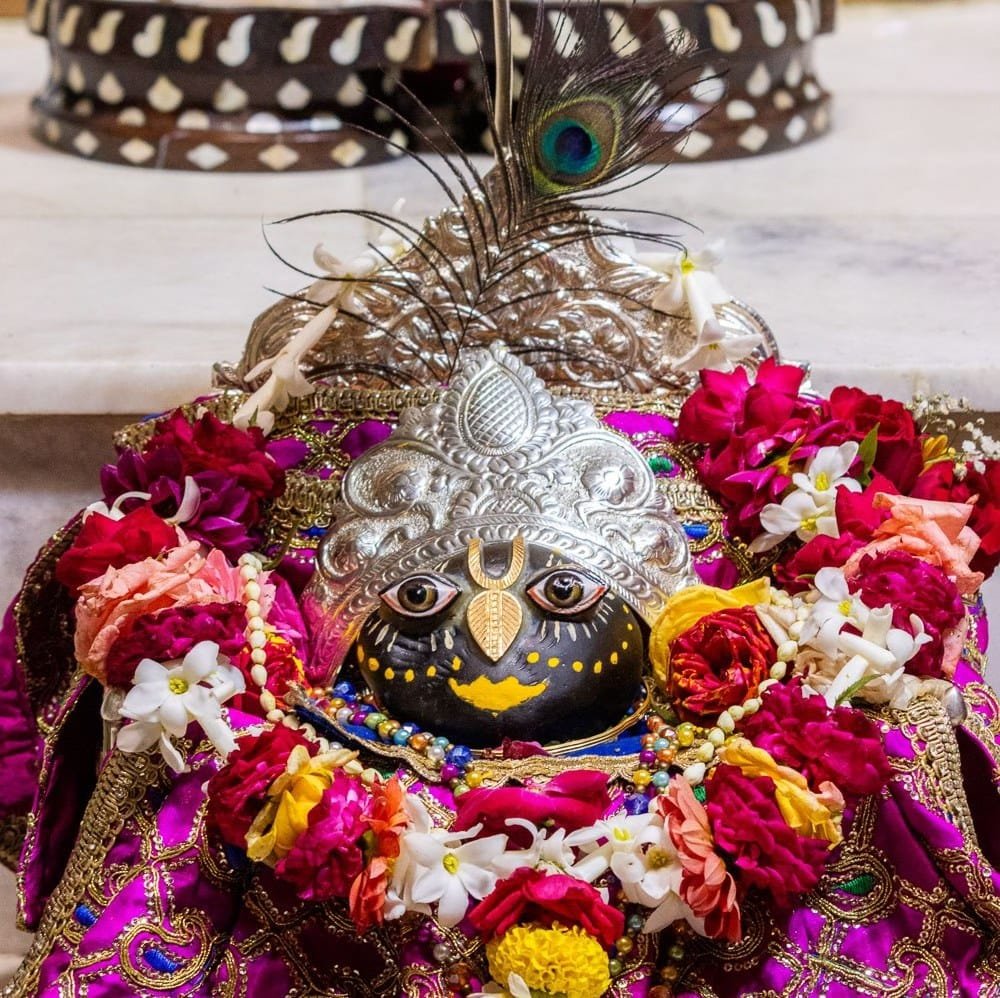
Pañca-tattva Śālagrāma-śilā (Hṛṣīkeśa)
I offer my obeisances unto the Supreme Lord, Kṛṣṇa, who is nondifferent from His features as a devotee, devotional incarnation, devotional manifestation, pure devotee and devotional energy.
(CC Adi 1.14)
The śālagrāma-śilā should be worshiped with tulasī where a sufficient quantity of tulasī leaves are available. Worship of śālagrāma-śilā should be introduced in all ISKCON temples. Śālagrāma-śilā is the form of the Lord’s mercy. To worship the Deity with the sixty-four items mentioned may be a difficult job, but the Lord has become so small that anyone in any temple can carefully handle Deity worship simply by performing the same activities with the śālagrāma-śilā.
(CC Madhya 24.336 purport)
sarvopādhi-vinirmuktaṁ
tat-paratvena nirmalaṁ
hṛṣīkeṇa hṛṣīkeśa-
sevanaṁ bhaktir ucyate
[Cc. Madhya 19.170]
This is the bhakti, to engage the purified senses in the service of the master of senses, Hṛṣīkeśa. Hṛṣīkeśa means master. Hṛṣika means the senses, and īśa means master. Hṛṣīkeśa. Kṛṣṇa’s another name is Hṛṣīkeśa.
So we have to engage our senses. It is not our senses; it is Kṛṣṇa’s. We have forgotten it. I am seeing with my eyes. I am very much proud I can see. But why you cannot see when you are blind? The eyes are there. Because the master has withdrawn the sight power. You can be happy with your decoration of the eyes, but you cannot see. So actually I do not see. Just like I have got this spectacle. The spectacle does not see; I am seeing. Similarly, with my eyes I am not seeing; Kṛṣṇa is seeing. Because Kṛṣṇa is seeing, therefore I am seeing. This is the Vedic version, I will find in Upaniṣad.
(750909 – Lecture SB 06.02.05-6 – Vrndavana)
History – The Pañca-tattva Śālagrāma-śilā
For many years, there was a proposal to establish a Śālagrāma-śilā on the Śrī Pañca-tattva altar that would receive worship on behalf of the five Deities, similar to Śrī Janārdana, the Śālagrāma-śilā worshipped on the altar of Śrī Śrī Rādhā Mādhava.
His Grace Jananivāsa Prabhu and His Grace Paṅkajāṅghri Prabhu searched for many years for a suitable Śālagrāma-śilā for Śrī Pañca-tattva, but without success. Most Śālagrāma-śilās are recognized as manifestations of the various incarnations and forms of Lord Viṣṇu. Although Śrī Pañca-tattva are all Viṣṇu-tattva, They appeared in the mood of devotees (bhakta-rūpa and bhakta-avatāras), concealing Their divine identities. Consequently, there is very little scriptural description identifying a corresponding Śālagrāma-śilā for Their worship. Eventually, the search was set aside.
In 2022, during the Netra-unmīlana ceremony in Rājāpur, Jananivāsa Prabhu was presiding over the sacred ritual of reopening the eyes of Lord Jagannātha after the customary fifteen-day period following Snāna-yātrā. While at the temple, he noticed a newly placed Śālagrāma-śilā at the lotus feet of Lord Jagannātha. When he inquired about it, the pūjārīs explained that it had recently been offered by a devotee from Malaysia, who had requested that it remain in the Jagannātha Temple.
Upon examining the śilā more closely, Jananivāsa Prabhu recognized it as a rare Pañca-tattva Śālagrāma. It possessed a distinctive square form with four sides and a prominent upper surface adorned with beautiful cakras—characteristics understood to correspond with Śrī Pañca-tattva.
The Pañca-tattva Śālagrāma-śilā, named Hṛṣīkeśa, was installed on 1 January 2023.