Full of Abundant Grace
By Braja Sevaki dasi
Source: Mayapur Magazine, 2006
Thirty-two years elapsed between the time Srila Prabhupada first mentioned life-sized Panca-tattva Deities and Their arrival in 2004. But you could hardly call the devotees at Mayapur Candrodaya Mandir “idle” during those intervening years. Two of the Deities’ oldest servants guide us through a brief history of Mayapur Deity worship.
It was the second trip Śrīla Prabhupāda made to Māyāpur in 1972, not the first time, which was the big festival.
“I was in Śrīla Prabhupāda’s half of the straw hut at the main gate – it’s called the ‘bhajan khutir now, but in those days we all hung out there, it was ‘Prabhupāda’s straw huť.” Bhavānanda Prabhu is speaking about the first time Prabhupāda mentioned “big deities” for Mayapur Candrodaya Mandir. “Śrīla Prabhupāda was talking about the deities for the big temple. He said, ‘I want three altars like we have in LA. The first altar will be guru paramparā back to Lord Brahmā. At another time, when speaking of the guru paramparā in this way, Prabhupāda said ‘back to the six goswamis,’ so it’s open.
“Then he said, ‘On the middle altar…” and I of course interrupted him, as we all often did in those days, …will be Rādhā-Madhava?’, because I was thinking that he wanted it like LA, and Rukmini-Dwarkadīša were on the center altar.
Śrīla Prabupāda said, ‘No, Pañca-tattva: Śrī Kṛṣņa Caitanya, Prabhu Nītyānanda, Śrī Advaita, Gadādhara, and Śrīvāsa. And he said, ‘The philosophy is that you bow down to the guru parampara at the first altar. By their mercy, you are delivered to the lotus feet of the Pañca-tattva. Then by Their mercy, you will be brought to the lotus feet of Rādhā-Madhava. So on the third altar will be Radha-Madhava and the asta-sakhīs.’ I said to Śrīla Prabhupāda, ‘What’s that?’ and he replied, ‘The eight gopis.’
“Then he made a gesture with his hands, the same gesture as Rādhārāņī, and he said, ‘Rādhārānī will be dancing, because when She is dancing, Krsna can never leave Her.’ He then gave the dimensions for Rādhā-Madhava and the other deities. He said, ‘Krsna will be six feet four inches. Rādhārānī should be five foot ten inches. Then I asked, ‘And the Panca-tattva?’ Śrīla Prabhupāda said, ‘Lord Caitanya should be seven feet tall and covered with gold,’ and I said, ‘Oh, not marble? Prabhupāda said, ‘No, They should be asta-dhātu.
“That was it. It was 1972, and he never changed anything after that, never said anything contrary to what he wanted. Some people say it was a concoction that the eight gopis were added, but until this conversation, none of us had ever heard the term asta-sakhīs. That was the first time we’d heard the word.”
It was that same year, 1972, that small Rādhā-Madhava came to Māyāpur. “There were three sets of deities made, paid for by one of the Birlas,” Bhavānanda says. “One set is in Boston, and these Deities here in Māyāpur, small Rādhā-Mādhava, were the ones Śrīla Prabhupāda took on pandals. These Deities were the ones he sang Jaya Rādhā-Madhava to for the first time, then he said, ‘Keep Them here always.’ We built Them a little shed and Jananivāsa started worshipping Them.”
Then Prabhupāda made a gesture with his hands, the same gesture as Rādhārānī, and he said, ‘Rādhārānī will be dancing, because when She is dancing, Krsna can never leave Her.’
It wasn’t until 1980, however, that Prabhupāda’s desire to see life-sized deities in Māyāpur would come to fruition.
Jananivāsa Prabhu takes up the story: “Big Rādhā-Madhava were installed on Gaura-pürņimā of that year. The temple was in the Lotus Building then, and They were worshipped there until 1986, when the first four gopis arrived. The other four arrived in 1992.”
Before those last four gopis arrived, though, several other deities would make Their appearance: Māyāpur Candra came in 1972, and soon after was moved to Prabhupāda’s room in the Lotus Building; in 1974 the worship of Śāligrāma-śīlā commenced; and 1986 saw the arrival of both Girirāja (on Gaura-pūrņimā) and Lord Nrsimhadeva (in July).
“In 1974, when worship of Śāligrāma-śīlā began, we started offering the 16 items according to the standards of Purusa-sūkta,” Jananivāsa recalls. The change came when Prabhupāda’s Śrī Caitanya-caritāmṛta was published. “One purport mentioned the 64 items of worship,” Jananivāsa says. “During that time Bhavānanda was always hassling me to expand the Deity worship. He would say, ‘Why don’t you expand? In Vindāvana they’re offering so much!’ I’d say to him, ‘I’m doing that,’ and he’d reply, ‘No you’re not!’ I told him, ‘I’ve been asking for a bed for the Deities and you haven’t given me one!’ He said, ‘Oh, really? Okay…’ and so we got a bed for the Deities. From then on, we started incorporating more and more, and after a few years we had the standard. The worship expanded into what it is today, which is the offering of 64 items.”
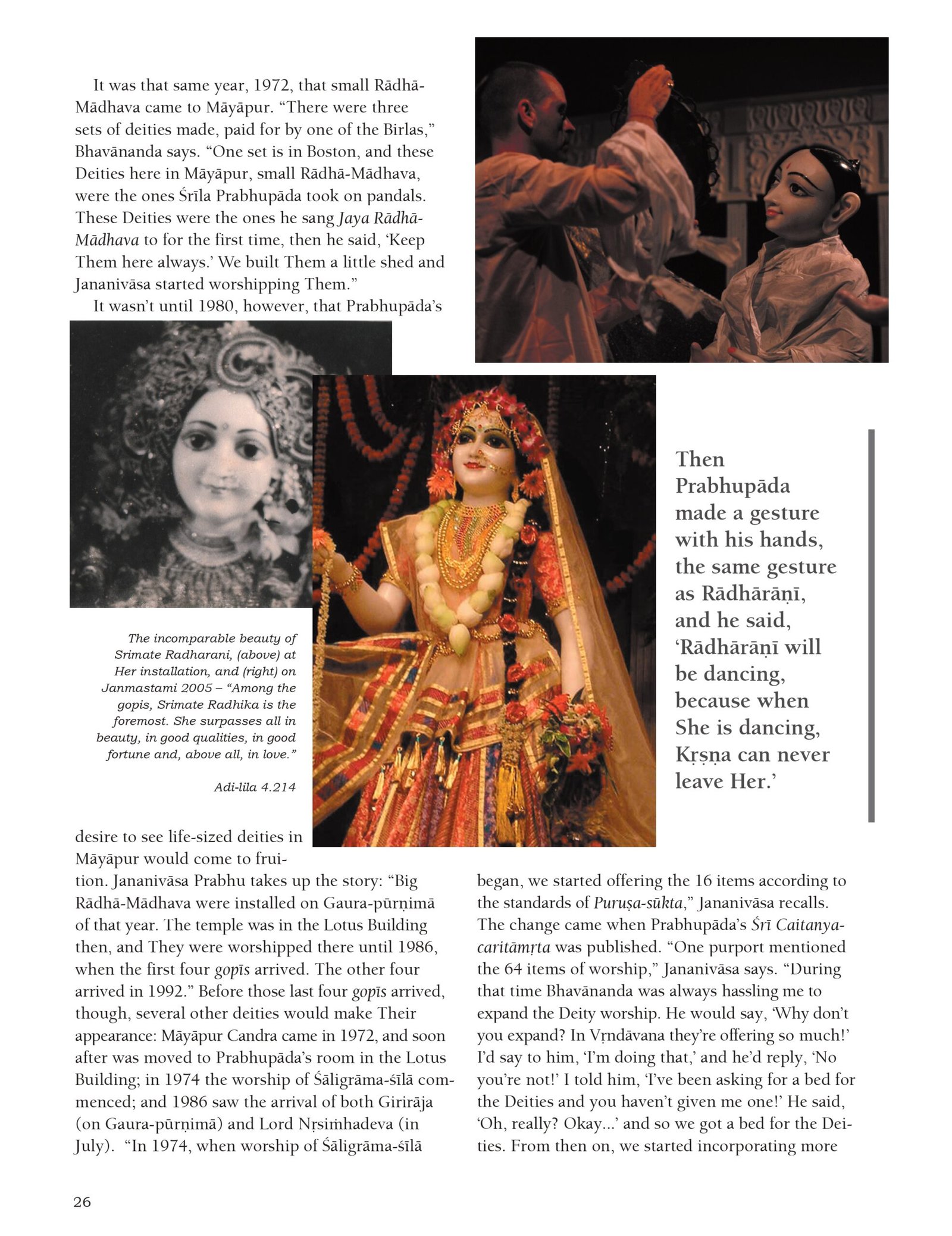
Over the years the Deities have changed in appearance – sometimes dramatically. “It takes time to establish what is best,” Jananivāsa says. “When Radha-Madhava first arrived, Śrīmate Rādhārānī’s eyes were very soft and pale; She looked very young, 15 or 16 years old. In 1992, during the installation of the gopis, Jadurānī and Kartā matajis painted the Deities, and They looked more sophisticated, more like Rukmini-Dwarkadīša – heavier eyeshadow and kajal. Now we’re taking Them back to a more youthful look.”
The standard of dress for the Deities was the arena of the uniquely talented Oṁkāra Dāsa, a French devotee who had dressed mannequins in store windows in France prior to coming to Krsna consciousness. “He was the best,” Jananivāsa recalls. “Omkāra served in Vrndāvana, but Bhavānanda would bring him here during festivals to dress. He created the standard, and we still go by that.”
In Srila Prabhupāda’s Centennial Year, 1996, Māyāpur Candrodaya Mandir would undergo another change in Deity worship with the arrival of Sri Pañca-tattva, and the temple expanded yet again to accommodate Them. Their worship commenced on Gaura-pūrnima of that year.
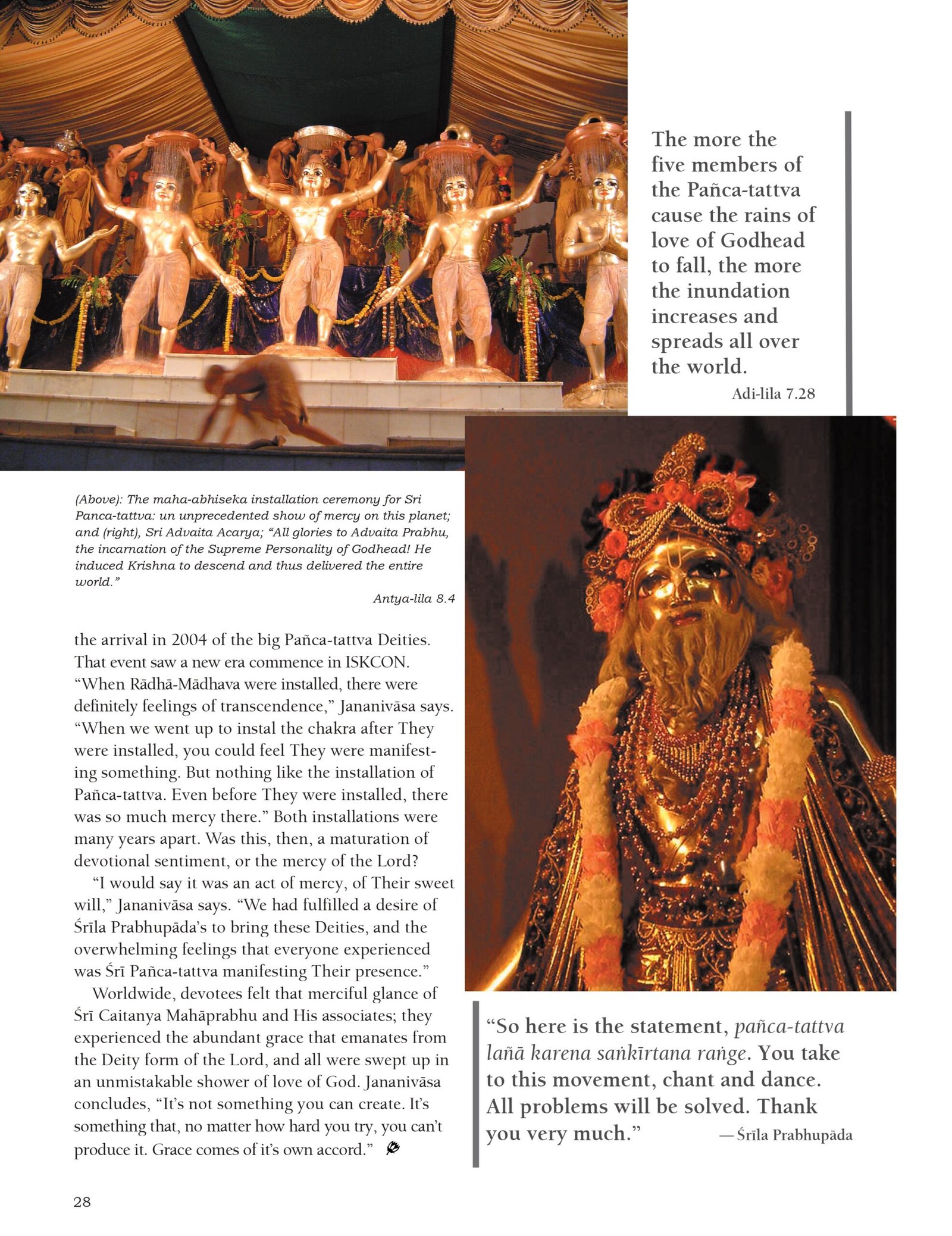
But the most amazing change was yet to come: the arrival in 2004 of the big Pañca-tattva Deities. That event saw a new era commence in ISKCON.
“When Radha-Madhava were installed, there were definitely feelings of transcendence,” Jananivāsa says. “When we went up to instal the chakra after They were installed, you could feel They were manifesting something. But nothing like the installation of Pañca-tattva. Even before They were installed, there was so much mercy there.”
Both installations were many years apart. Was this, then, a maturation of devotional sentiment, or the mercy of the Lord?
“I would say it was an act of mercy, of Their sweet will,” Jananivāsa says. “We had fulfilled a desire of Śrīla Prabhupāda’s to bring these Deities, and the overwhelming feelings that everyone experienced was Śrī Pañca-tattva manifesting Their presence.”
Worldwide, devotees felt that merciful glance of Śrīla Caitanya Mahāprabhu and His associates; they experienced the abundant grace that emanates from the Deity form of the Lord, and all were swept up in an unmistakable shower of love of God.
Jananivāsa concludes, “It’s not something you can create. It’s something that, no matter how hard you try, you can’t produce it. Grace comes of it’s own accord.”
Scriptural & Sidebar Quotations
The incomparable beauty of Srimate Radharani, at Her installation, and on Janmastami 2005 – “Among the gopis, Srimate Radhika is the foremost. She surpasses all in beauty, in good qualities, in good fortune and, above all, in love.”
— Adi-lila 4.214
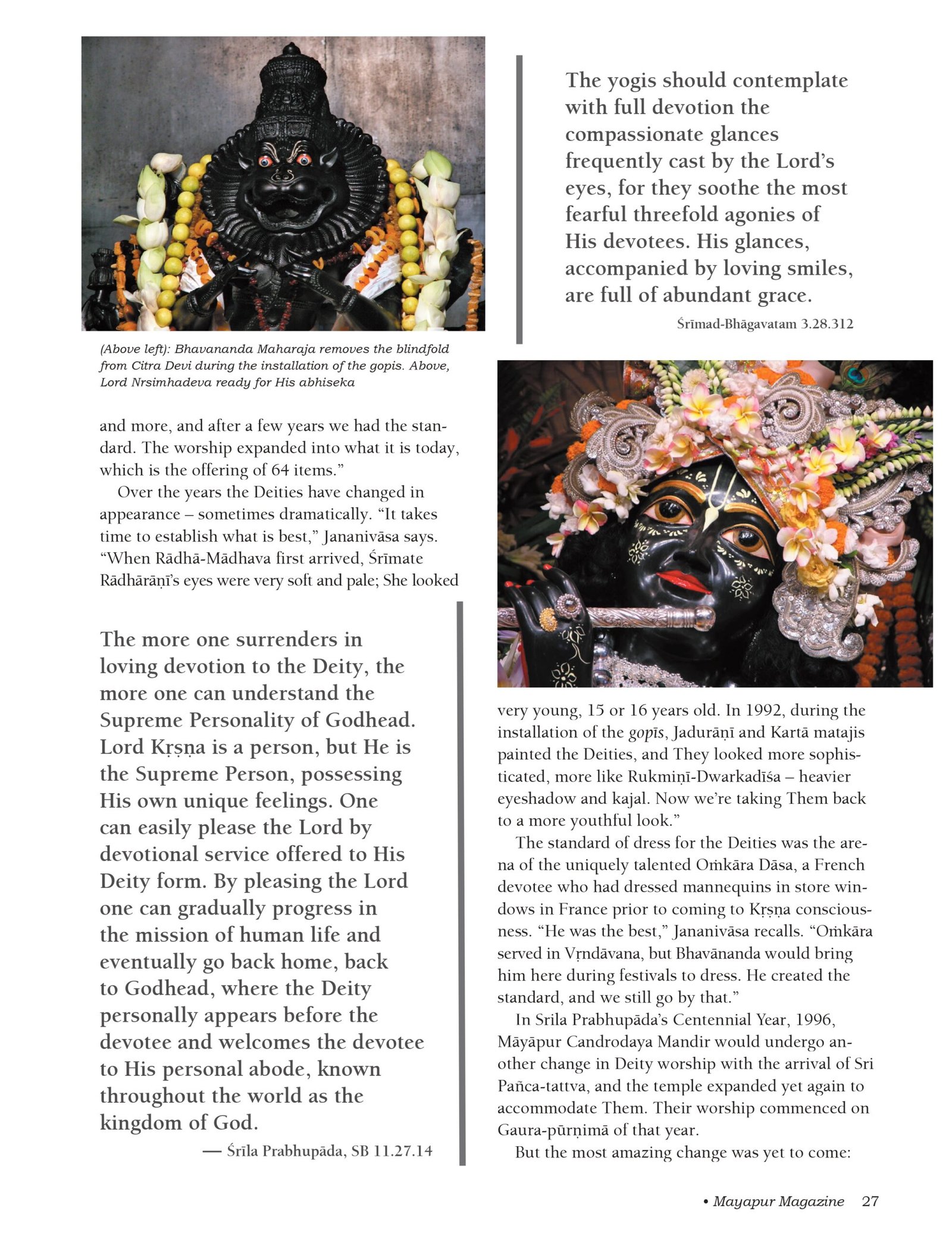
The yogis should contemplate with full devotion the compassionate glances frequently cast by the Lord’s eyes, for they soothe the most fearful threefold agonies of His devotees. His glances, accompanied by loving smiles, are full of abundant grace.
— Srimad-Bhagavatam 3.28.312
The more one surrenders in loving devotion to the Deity, the more one can understand the Supreme Personality of Godhead. Lord Krşņa is a person, but He is the Supreme Person, possessing His own unique feelings. One can easily please the Lord by devotional service offered to His Deity form. By pleasing the Lord one can gradually progress in the mission of human life and eventually go back home, back to Godhead, where the Deity personally appears before the devotee and welcomes the devotee to His personal abode, known throughout the world as the kingdom of God.
— Śrīla Prabhupāda, SB 11.27.14
The more the five members of the Pañca-tattva cause the rains of love of Godhead to fall, the more the inundation increases and spreads all over the world.
— Adi-lila 7.28
“All glories to Advaita Prabhu, the incarnation of the Supreme Personality of Godhead! He induced Krishna to descend and thus delivered the entire world.”
— Antya-lila 8.4
“So here is the statement, pañca-tattva lañā karena sankīrtana range. You take to this movement, chant and dance. All problems will be solved. Thank you very much.”
— Śrīla Prabhupāda