
Śrī Māyāpur Dhama Pañca-krośa Parikramā – Summary
By Nandan Das, Māyāpur Master Plan Office
After that, every Ekādaśī My Lord went on sankirtana, wandering over the sacred islands. Sometimes He wandered over the five krosas of Antardvipa, and sometimes, according to His desire, He wandered eight krosas.
“From His house, He went first to Bārakoṇā-ghāṭa, then around Ballal-dighi, and then to Sridhara’s house. From there, He would go to the edge of Antardvipa and thus easily complete a five krosa tour.
(Sri Navadvipa-Dhama-Mahatmya, Chapter 10)
That person who once visits Mayapur is easily freed from the bondage of māyā. One who walks throughout Mayapur is freed from the influence of maya and the repetition of birth.
(Sri Navadvipa-Dhama-Mahatmya, Parikrama-Khanda, Chapter 3)
The sastras say that one who walks around Navadvipa attains the fruit of millions of asvamedha‑yajnas at every step.
(Sri Navadvipa Dham Mahatmaya, Chapter one)
Wandering in Navadvipa is the best of all opulences, the best of all religious principles, the best of all kinds of worship, the best of all perfections, the best of all glories, and the best of all oceans of sweetness.
(Sri Navadvipa Sataka by Srila Prabhodananda Sarasvati, Text 60)
“My worshipable Lord eternally resides at Māyāpur, situated on the east bank of the Ganges. Although in the eyes of common people, Viśvambhara took sannyāsa and left Navadvīpa to go elsewhere, actually My Gaurāṅga never gives up Māyāpur or Navadvīpa. The devotees can perceive His daily pastimes. You, Jīva, will also see Gaurāṅga dancing. Around Māyāpur is beautiful Antardvīpa, where Brahmā received the darśana of Gaurāṅga. O Jīva, if you want to see all this, please go on parikramā. It will be very beneficial for you.”
(Śrī Navadvīpa-dhāma Māhātmya, Parikramā-khaṇḍa, Chapter Five)
Srila Bhaktivinoda Thakura instructed Srila Bhaktisiddhanta Sarasvati Thakura, “Try to begin the parikramā of Śrīdhāma Navadvipa as soon as possible. Thereby everyone in the universe can receive Krsna-bhakti.”
Śrīla Bhaktisiddhānta Sarasvatī considered walking tours of the dhāmas beneficial both for advanced devotees, who could contemplate the Lord’s pastimes in the very locale where they had been performed, and for neophytes, who could rapidly progress by associating with such elevated Vaiṣṇavas in these most worshipable places within the entire creation. He pointed out that such parikramās afford participants an opportunity to engage simultaneously in all five of the principle practices of sādhana-bhakti: associating with devotees, chanting the holy names, hearing Śrīmad-Bhāgavatam, living in the dhāma, and worshiping the deity. By arranging to bring many devotees together in parikramā, Śrīla Bhaktisiddhānta Sarasvatī also created a new method of mass preaching, both to direct partakers and to local villagers, who would also hear from or receive prasāda from the Gauḍīya Maṭha devotees, or at least be impressed by the proceedings. And many others would learn of it from newspapers and by word of mouth.
(“Sri Bhaktisiddhanta Vaibhava” Volume Two by HH Bhakti Vikasa Swami, Chapter ‘Dhama-Seva’, Page 377)
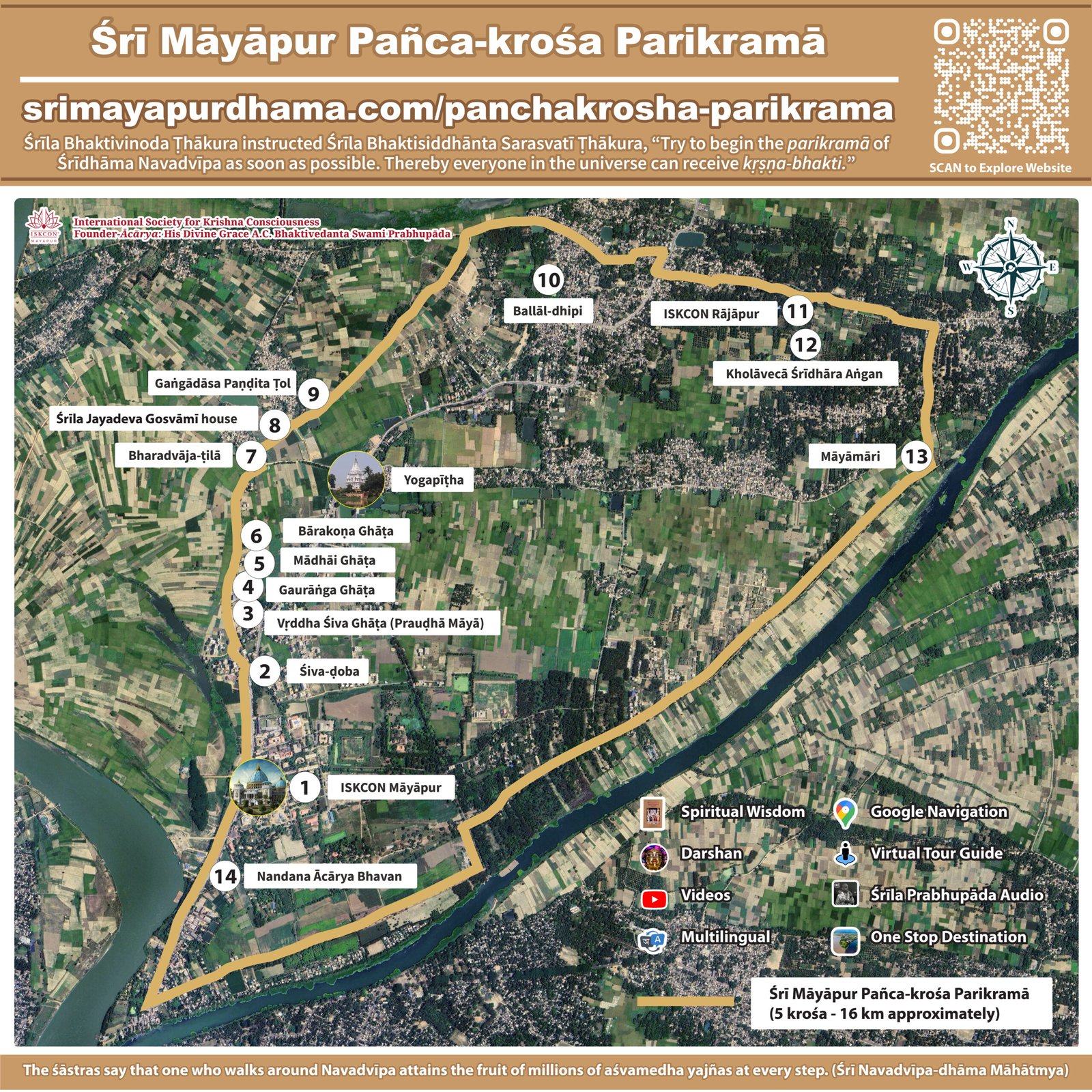
The parikramā begins at Śrīla Prabhupāda’s Bhajan Kutir near the ISKCON Māyāpur Gate and proceeds through several sacred sites: Śiva-ḍoba, Vṛddha Śiva Ghāṭa (Prauḍhā Māyā), Gaurāṅga Ghāṭa, Mādhāi Ghāṭa, Bārakoṇa Ghāṭa, Bharadvāja-ṭilā, Śrīla Jayadeva Gosvāmī house, Gaṅgādāsa Paṇḍita Ṭol, Ballāl-dhipi, ISKCON Rājāpur, Kholāvecā Śrīdhāra Aṅgan(Viśrāma-sthāna), Māyāmāri, and Nandana Ācārya Bhavan—the divine meeting place of Nityānanda and Caitanya.
While doing the Parikramā, we actually circumambulate the main holy places of Antardvīpa—including ISKCON Māyāpur, Yogapīṭha, Śrīvāsa Aṅgan, Advaita Bhavan, Sri Gadādhara Aṅgan, Pṛthu kuṇḍa, Sri Chaitanya Math, Sree Sree Thakur Murāri Gupta’s Sree-Pat, and Chand Kazi Samadhi—even though the parikramā route does not directly enter these temples. The parikramā concludes at the ISKCON Māyāpur Main Gate and typically takes 3 to 4 hours on foot.
Circumabulting – Vrindavan (Vrajapattana), Mathura (Chand Kazi), Jagannath Puri dhama
Samadhi Temple of Prabhupada Śrīla Bhaktisiddhānta Sarasvatī Ṭhākura, Samadhi Temple of Śrīla Gaurakiśora dāsa Bābājī Mahārāja, Srila Prabhupada
Antardvipa
Process of Devotional Service: Ātma-nivedanam (Full Surrender)
Devotee Who Attained Perfection Through This Process: Bali Mahārāja
Siva Doba
A pond called Siva Doba will be seen, indicating the previous bank of the Ganges. In this way, by the Lord’s wish, the devotees will reveal the lost places. Know this for certain. At the end of four hundred years, the task of recovering the lost tirthas will begin.
(Sri Navadvipa-Dhama-Mahatmya, Chapter 5)
After intensive research and according to some confidential hint, we have been able to locate the exact stream of the Ganges. A long stream called Śivera Doba or the pond of Śiva near Khaḍvana, which lies to the south of Māyāpura, is still present. If one stands on the bank of this stream and looks towards Ganganagara, one can see that a tract of land resembling the bank of a river is by the side of Māyāpura.
(Bhaktivinoda Vānī Vaibhāva, Chapter 33 -Cultural Heritage, 22 – Visnupriya Palli Magazine)
A devotee of Lord Kṛṣṇa does not disrespect Lord Śiva, but worships Lord Śiva as the most exalted devotee of Lord Kṛṣṇa. Consequently whenever a devotee worships Lord Śiva, he prays to Lord Śiva to achieve the favor of Kṛṣṇa, and he does not request material profit. (SB 4.24.30 purport)
Prabhupāda: Śaṁbhu is another name of Lord Śiva, Śaṁbhu. Svayaṁbhur nāradaḥ śaṁbhuḥ (SB 6.3.20). He is called Svayaṁbhuḥ, and Śiva is called Śaṁbhu. Vaiṣṇavānām yathā śaṁbhuḥ. Svayaṁbhur nāradaḥ śaṁbhuḥ kumārāḥ kapilo manuḥ. Kumārāḥ. There is a sampradāya from Kumāra, four Kumāras, brahmacārīs. They were sons of Brahmā. When they were born, Lord Brahmā said that, “You now make . . . marry and produce. We want population.” In the creation, in the beginning. So they refused. “Oh, we are not going to marry. We shall remain brahmacārī, devotee.” Then Lord Brahmā was angry, “Oh, you are refusing your father’s order?” So from when he was angry, his eyes became red. From that, Śiva was born. Therefore his name is Rudra. Rudra. Rudra means anger. So when Lord Śiva becomes angry, the whole thing is finished.
(690514 – Conversation with Allen Ginsberg – Columbus)
Vrddha Siva Ghat (Prauḍhā Māyā)
There at the border of Mayapur, Jiva saw the Vrddha Siva Temple. Nityananda Prabhu said, he is the guardian of Mayapur. This is where the Praudha Maya Shakti, yogamaya (in charge of spiritual perception) is eternally situated.
All these ghats on the bank of the Ganges will again be manifest and the devotees will built temples of the Lord. One exceedingly wonderful temple will appear from which Gauranga’s eternal service will preach everywhere. Praudha Maya and Vrddha Siva will again come and perform their duties of revealing the spiritual dham according to the Lord’s desire.
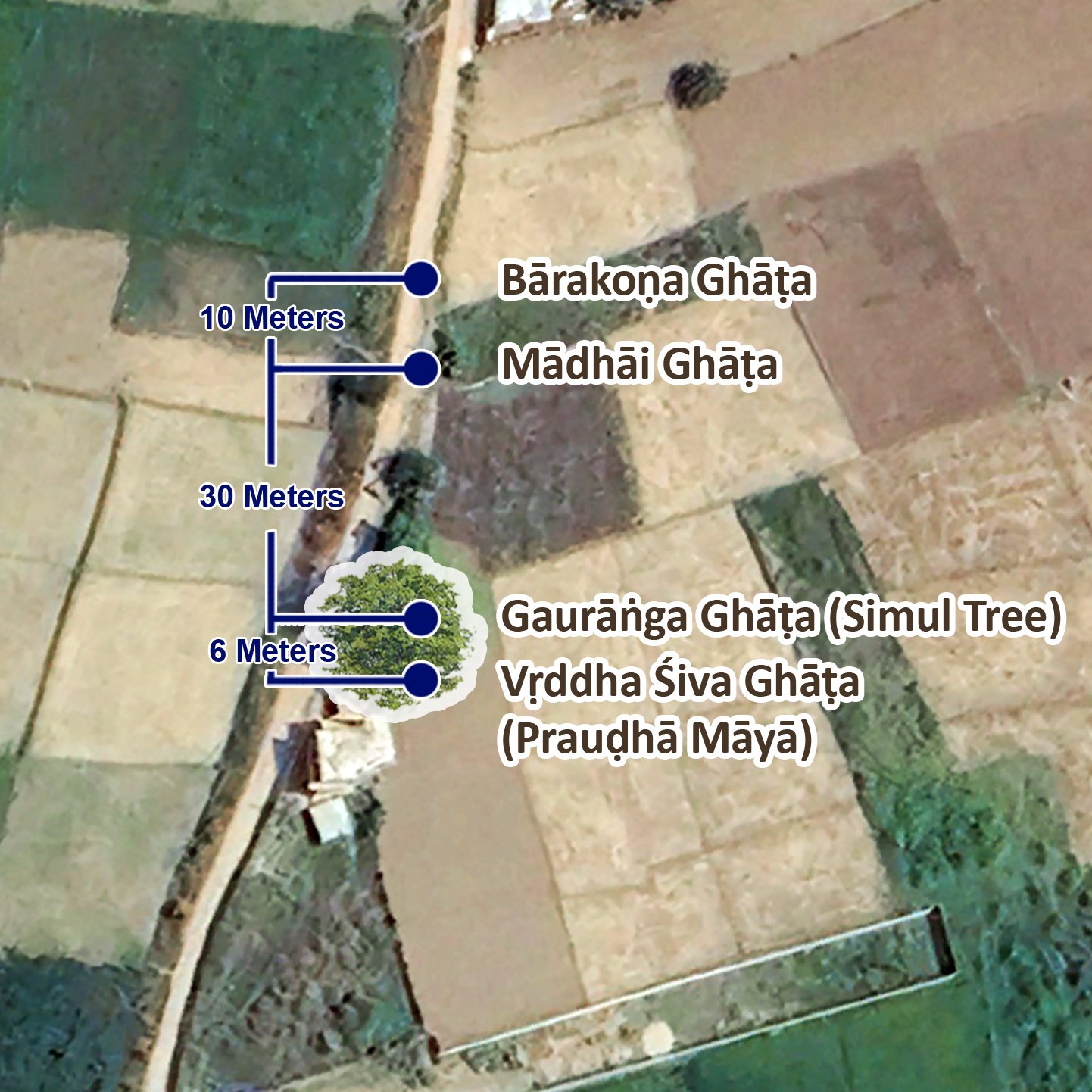
Six Meters from Vrddha Siva Ghat, see Gauranga’s own ghat. There Gaura hari in his childhood played in the water and pulled many pranks.
(Sri Navadvipa-Dhama-Mahatmya, Chapter 5)
Māyāpur = Circumference: 3.5 miles (≈ 5.63 km) / Radius: ≈ 0.9 km (≈ 896 m)
O Navadvipa-dhāma, show favour on me and appear in my heart, so that I may be delivered. O Prauḍhā Māyā, protecting goddess, please be genuinely merciful, for you are the only hope to cross over the obstacles due to ignorance. Vṛddha Śiva, protector of the dhama, be compassionate on me, let the transcendental dhāma be revealed to my eyes.
(Sri Navadvipa-Dhama-Mahatmya, Chapter 18)
“As the external energy of Lord Hari, you give difficulties to the conditioned souls. By your influence, you hide from them the brilliant sunlike Lord of Antardvipa. For that reason Yogapitha is known as Māyāpur, the city covered by Maya, and you are known as Praudhā Māyā. But when Gaurasundara goes to Pulina, then take shelter at Vamsi-vata and attend to the devotees.
“I am known as Vṛddha Siva. Following the Lord’s order, I delude the materialistic fools by means of various false scriptures. And through your power, I am able to enhance the pastimes of Lord Sri Caitanya.
(Sri Navadvipa-Dhama-Mahatmya, Pramana-Khanda, Chapter 4)
Gauranga Ghat
Six meters from Vrddha Siva Ghata, see Gauranga’s own Ghat. There Gaurahari in His childhood played in the water and pulled many pranks. Seeing the Yamuna’s good fortune of taking part in Krsna’s pastimes, the Ganges performed penance for the same purpose. Krsna bestowed His mercy by appearing before Gangadevi and saying, ‘In the form of Gauranga I will perform pastimes in your waters.’ Those pastimes were performed by the Supreme Lord of the three worlds, Gauranga, at this ghata. Fortunate people who see this place attain great happiness.
(Sri Navadvipa-Dhama-Mahatmya, Chapter 5)
I was standing in the water chanting my Gāyatrī, and He grabbed my feet and pulled me down
My son is very young, and your son makes him cry by putting water in his ears
Your son sits on my āsana and eats the offerings I have prepared for Lord Viṣṇu
He exchanges the men’s cloth with the women’s, and then everyone is embarrassed when they go to dress
As the two drunkards wandered from place to place, they came to the bathing ghāṭa where the Lord would take His bath in the Ganges. By divine arrangement they made that place their base from which they would go out to raid various places.
Simul Tree – His skin erupted with goose pimples, and the hairs of His body stood on end. His body resembled the śimulī [silk cotton tree], all covered with thorns.
(CC Madhya 13.102)
Madhai Ghat
Jagāi and Mādhāi, the eighty-ninth and ninetieth branches of the tree, were the greatest recipients of Lord Caitanya’s mercy. These two brothers were the witnesses who proved that Lord Caitanya was rightly named Patita-pāvana, “the deliverer of the fallen souls.”
PURPORT
In the Gaura-gaṇoddeśa-dīpikā (115) it is said that the two brothers Jagāi and Mādhāi were formerly the doorkeepers named Jaya and Vijaya, who later became Hiraṇyākṣa and Hiraṇyakaśipu.
(CC Adi 10.120)
So Śrī Caitanya Mahāprabhu appeared on this part 488 years ago to, I mean to say, hand the same two principles, paritrāṇāya sādhūnāṁ vināśāya ca duṣkṛtām. He . . . vināśāya duṣkṛtām. He killed Jagāi-Mādhāi not by the body, but by their atrocious activities, stopped that. So Śrī Caitanya Mahāprabhu’s mission is to kill the demon—not by life but by their heinous activities. Anyone who comes to be killed by Śrī Caitanya Mahāprabhu, his heinous, nefarious activities becomes killed and he becomes a Vaiṣṇava, just like Jagāi-Mādhāi. So at the present moment, the whole world is full of Jagāi-Mādhāi, their four principles. Jagāi-Mādhāi means illicit sex, meat-eating, intoxication and gambling. This is Jagāi-Mādhāi. So this movement, Kṛṣṇa consciousness movement, is killing these Jagāi-Mādhāi principles: no illicit sex, no intoxication, no gambling and no meat-eating. So one side, killing the Jagāi-Mādhāi principle, and other side protection, chanting Hare Kṛṣṇa mahā-mantra.
(740303 – Lecture CC Adi 07.03 – Mayapur)
Barakona Ghat
Ten meters north of this lies one ghat that attracts the minds of town people. This exceedingly beautiful ghat is called Barakona Ghat. It was constructed on Krishna’s order by Visvakarma. At this ghat, you will see five Siva temple with five lingas and these four ghats make Mayapur very beautiful. Moreover, whoever takes bath here is relieved of all miseries.
(Sri Navadvipa-Dhama-Mahatmya, Chapter 5)
He conquered a champion of learning named Keśava Kāśmīrī – dig-vijayī, which means “one who has conquered everyone in all directions.
Pañca-vaktra Śiva (Belpukur)
While saying this, They combined in one form as Gauranga. Nimbārka was astounded on seeing that form and exclaimed, Never have I seen or heard of such a remarkable form anywhere!’
“Mahaprabhu said, ‘Please keep this form secret now. Just preach krsna-bhakti and the pastimes of Radha and Krsna, for I am very happy in those pastimes. When I appear as Gauranga, I will enjoy educational pastimes. At that time, you will take birth in Kashmir and tour India as a champion scholar out to defeat all opponents. Your name will be Kesava Kasmiri, and you will be celebrated everywhere for your great learning.
(Sri Navadvipa-Dhama-Mahatmya, Chapter 16)
Bhardavaja Tila
Leaving behind Bilvapakṣa. Nityananda Prabhu and the devotees went up to Bharadvaja-tila village. Nityananda explained. “After seeing Ganga-sagara, Bharadvaja Muni came to this place. The great muni stayed here for some days and worshiped Lord Gauracandra.
Satisfied by the worship, Lord Visvambhara mercifully appeared before the muni and said to him. Your desire will be fulfilled. When I advent, you will see Me.’
“After speaking these words, the Lord disappeared and Bharadvaja fainted in great ecstasy. After staying on this hill for some days, the muni departed to see other tirthas. The common people call this place Bhāruiḍāngā. The scriptures consider this a major tīrtha.”
(Sri Navadvipa-Dhama-Mahatmya, Chapter 16)
Crossing the Ganges, the son of Śacī and His associates performed kīrtana all over Rudradvīpa. The Lord of the universe then went to Bilvapakṣa and flooded the devotee brāhmaṇas and Kāñcipuram with love of God. After going to the āśrama of Bharadvāja and chanting the holy names, the Lord entered Māyāpur.
(Sri Navadvipa-Dhama-Mahatmya, Pramana-Khanda, Chapter 4)
The seven stars revolving around the polestar at the zenith are called saptarṣi-maṇḍala. On these seven stars, which form the topmost part of our planetary system, reside seven sages: Kaśyapa, Atri, Vasiṣṭha, Viśvāmitra, Gautama, Jamadagni and Bharadvāja. These seven stars are seen every night, and they each make a complete orbit around the polestar within twenty-four hours.
(SB 9.16.24 purport)
Śrīla Jayadeva Gosvāmī house
“When Laksmana Sena was the king of Nadia, Jayadeva was one of his subjects in Navadvipa. He built a hut on the bank of Ballal-dirgika and peacefully lived there with his wife, Padmā. He wrote the Dasa-avatara poem there, which came into the King’s hand. The king read the poem with great relish and inquired who had written it. Govardhana Acarya told the king the great poet Jayadeva had written it. The king asked where he lived, and Govardhana told him Jayadeva stays in Navadvīpa.
“Hearing this, the king secretly searched and arrived in the night at Jayadeva’s house. The king entered the cottage dressed as a Vaisnava and, after offering respects to the poet, seated himself. Jayadeva, however, knew he was the king dressed as a penniless Vaisnava. The king soon introduced himself and begged the poet to come to his palace. Jayadeva, being very detached from materialism, could not agree to go to the house of a materialist.
(Sri Navadvipa-Dhama-Mahatmya, Chapter 11)
There, in the association of the devotees and overcome with prema, I will continuously taste the poems of your Gītā-govinda, for it is very dear to Me.
(Sri Navadvipa-Dhama-Mahatmya, Chapter 11)
“The king very happily had his ministers build Jayadeva a cottage in Campahaṭṭa. Jayadeva stayed there for some time and worshiped Krsna according to the process of raga-marga. Padmavati would bring heaps of campaka flowers, which Jayadeva would offer to Kṛṣṇa.
“In great love the poet worshiped Krsna, who then appeared before Jayadeva with a complexion the color of the campaka flower, resplendent with the radiance of molten gold. The shining beauty of a million moons would have been put to shame by His beautiful face. He had curly hair and a garland of flowers around His neck. His arms were long, and His effulgence illumined the room. Seeing that form of Gauranga, Jayadeva fainted with tears streaming from his eyes, while Padmavati also fell to the earth unconscious.
Information – Verse 4 is sung with the Nrsimhadeva Arati
(4)
tava kara-kamala-vare nakham adbhuta-sringam
dalita-hiranyakasipu-tanu-bhringam
kesava dhrita-narahari-rupa jaya jagadisa hare
Just like Jayadeva kavi, the Vaisnava poet, Jayadeva. He is worshiping Lord Kṛṣṇa, thanking Him for His accepting the incarnation of Lord Buddha: keśava dhṛta-buddha-śarīra jaya jagadīśa hare (Gītā Govinda, Daśāvatāra-stotra 9). A devotee, in whatever form the Lord is there, because he is devotee he gives glorify, all glories to the Lord, keśava dhṛta-mīna-śarīra (Gītā Govinda, Daśāvatāra-stotra 1). When Kṛṣṇa appeared as a big fish, so the devotee is glorifying, keśava dhṛta-mīna-śarīra jaya jagadīśa hare (Gītā Govinda, Daśāvatāra-stotra 1). When Kṛṣṇa appeared as the boar, this Vaiṣṇava is also glorifying: keśava dhṛta-śūkara-rūpa jaya jagadīśa hare (Gītā Govinda, Daśāvatāra-stotra 3). So similarly, there are so many glorification of daśāvatāra by Jayadeva.
(760517 – Lecture about Mayavada Philosophy – Honolulu)
Gangadasa Tol
In His eighth year, He was admitted into the tol of Gangadas Pandit in Ganganagar close by the village of Mayapur
(Teachings of Lord Chaitanya Prologue)
In Navadvīpa there resided the topmost teacher, Gaṅgādāsa Paṇḍita, who was nondifferent from Sāndīpani Muni. He was in full knowledge of the grammatical literatures, so the Lord desired to study under him. Understanding the desire of his son, Jagannātha Miśra took Him to the house of the brāhmaṇa Gaṅgādāsa. When they arrived, Gaṅgādāsa stood up out of respect and embraced Śrī Miśra. They then sat together on an āsana. Jagannātha Miśra said, “I am offering you my son. Please teach Him everything.” Gaṅgādāsa replied, “It is my great fortune. I will teach Him to the best of my ability.” Gaṅgādāsa was most happy to see his new student, and he treated Him like his own son. After hearing only once, the Lord would assimilate whatever Gaṅgādāsa Paṇḍita explained. He would refute the explanations of His guru and then again establish the explanation that He had just refuted. There were thousands of students, but no one had the ability to defeat His explanations. Gaṅgādāsa was pleased to see Nimāi’s wonderful intelligence, and he accepted Him as his best student. The Lord would regularly challenge and defeat all of Gaṅgādāsa Paṇḍita’s other students. Śrī Murāri Gupta, Śrī Kamalākānta, and Śrī Kṛṣṇānanda were some of the Lord’s prominent classmates. The Lord challenged and defeated them all, even the elder boys, but they would consider the Lord just a child and simply smile at Him.
(Sri Caitanya Bhagavata Adi-khanda 8.26 – 8.39)
I offer my humble obeisances at the feet of Gaṅgādāsa Paṇḍita, whose disciple is Lord of the Vedas and master of the goddess of learning. What else is there to be attained by Gaṅgādāsa Paṇḍita, whose student is worshiped throughout the fourteen worlds? As Lord Viśvambhara walked along with His students, He appeared like the full moon surrounded by the stars. (Sri Caitanya Bhagavata Madhya-khaṇḍa 1)
prabhura atyanta priya—paṇḍita gaṅgādāsa
yāṅhāra smaraṇe haya sarva-bandha-nāśa
Paṇḍita Gaṅgādāsa was the eighth dear branch of the tree of Śrī Caitanya Mahāprabhu. One who remembers his activities attains freedom from all bondage.
(CC Adi 10.29)
Śrī Caitanya Mahāprabhu – Eternal tree of love of Godhead
Caitanya Tree – East 1- 42 branches ; West 43-90
I offer my obeisances to all the dear devotees of Śrī Caitanya Mahāprabhu, the eternal tree of love of Godhead. I offer my respects to all the branches of the tree, the devotees of the Lord who distribute the fruit of love of Kṛṣṇa.
(CC Adi 10.7)
Simply by remembering the names of all these branches and subbranches of the three trunks I have described [Nityānanda, Advaita and Gadādhara], one attains freedom from the entanglement of material existence. Simply by remembering the names of all these Vaiṣṇavas, one can attain the lotus feet of Śrī Caitanya Mahāprabhu. Indeed, simply by remembering their holy names, one achieves the fulfillment of all desires.
(CC Adi 12.91 – 12.92)
Balladhipi
Information – The ruins of the Palace of the famous Hindu King Ballal Sen of Bengal, who had his capital in the ancient city of Nabadwip. This place has been preserved by the Government of India for archaeological explorations.
The celebrated ancient capital of the Sena dynasty, which was known as Gauḍadeśa or Gauḍa, was situated in what is now the modern district of Maldah. Later this capital was transferred to the ninth or central island on the western side of the Ganges at Navadvīpa, which is now known as Māyāpur and was then called Gauḍapura. Lord Caitanya appeared there, and Lord Nityānanda came there and joined Him from the district of Birbhum. They appeared on the horizon of Gauḍadeśa to spread the science of Kṛṣṇa consciousness, and it is predicted that as the sun and moon gradually move west, the movement They began five hundred years ago will come to the Western civilizations by Their mercy.
(CC Adi 1.102 purport)
Just see how these trees are maintaining every living entity! Their birth is successful. Their behavior is just like that of great personalities, for anyone who asks anything from a tree never goes away disappointed. (CC Adi 9.46)
vande śrī-kṛṣṇa-caitanya-nityānandau sahoditau
gauḍodaye puṣpavantau citrau śan-dau tamo-nudau
I offer my respectful obeisances unto Śrī Kṛṣṇa Caitanya and Lord Nityānanda, who are like the sun and moon. They have arisen simultaneously on the horizon of Gauḍa to dissipate the darkness of ignorance and thus wonderfully bestow benediction upon all.
(CC Adi 1.2, CC Adi 1.84)
Now these same two brothers have again descended, as Śrī Kṛṣṇa Caitanya-Nityānanda. Sahoditau: simultaneously They have appeared. Not that one is appeared, another is not there. No. Both of Them, sahoditau. And They are compared with the sun and moon. The business of sun and moon is to dissipate darkness. The sun rises during daytime, and the moon rises at night. But this sun and moon, wonderful sun and moon, citrau, They have appeared together. But the business is the same, tamo-nudau. Business is to dissipate darkness, because we are in darkness. We, anyone who is in this material world, he’s in darkness. Darkness means ignorant, no knowledge. They are mostly animals. “Why they are animals, so civilized men, so well dressed and university education degrees? Why they are in darkness?” Yes, they are in darkness. “What is the proof?” The proof is that they are not Kṛṣṇa conscious. This is the proof.
(750326 – Lecture CC Adi 01.02 – Mayapur)
Chand Kazi Samadhi
Chand Kazi Samadhi, beneath the sacred Champa tree, marks the resting place of Chand Kazi—identified as Kamsa in Krishna-lila. In Sri Navadvipa-dhama Mahatmya, it is said, “By seeing this samadhi the living entities’ old age and disease are vanquished.” The Chand Kazi’s village is none other than Mathura.
Simantadvipa
Process of Devotional Service: Śravaṇam (Hearing)
Devotee Who Attained Perfection Through This Process: Parīkṣit Mahārāja
ISKCON Rajapur
jagannātha-svāmī nayana-patha-gāmī bhavatu me
“O Lord of the universe, please be visible unto me.”
Know for certain that this place is nondifferent from Jagannātha Puri, for Lord Jagannātha is eternally situated here.”
(Sri Navadvipa-Dhama-Mahatmya, Chapter 6)
Jagat means moving. And Jagat-nātha, nātha means the proprietor—master, proprietor. So Jagannātha means the proprietor or the master of all these movements, He is Jagannātha. And Balabhadra, Balarāma, bala means strength, and rāma means enjoyment. So Balarāma means who gives you spiritual strength for enjoying eternal blissful life. He is Balarāma. And Subhadrā, su means auspicious, and bhadra means well-being. Subhadrā, Jagannātha and Balarāma combined together are present before you to reclaim you all from your miserable condition of life. That is the purport of this Ratha-yātrā Festival. Ratha-yā . . . (break) . . . if anyone sees on the car Jagannātha, Subhadrā and Baladeva, then he does not take birth again in this material world. Ratheja vamanaṁ dṛṣṭa.
(700705 – Lecture Festival Ratha-yatra – San Francisco)
Mahaprabhu Simantinidevi
“Saying this, Paravati put Gauranga’s foot dust on her simanta (part in the hair) in great distress. From that, the name of Simantadvipa came. Ignorant people call the place Simuliya. “Gauracandra was pleased, and He said to Parvati, ‘O supreme goddess, listen carefully to My words. You are My energy, you are not separate or different from Me. My one energy has two forms. Within the spiritual kingdom, My original energy has one form as Sri Radha, but for carrying out activities in the material world She has expanded Herself as you. Without you, My lila could not be accomplished, for in the form of Yogamaya, you are necessary in My pastimes. In Vraja, you are eternally present as Paurnamasi, and in Navadvipa you are present as Praudha Maya along with Kshetrapala Siva, guardian of the dhama.’ “Saying this, Gauranga disappeared, and Parvati became overwhelmed with love. Parvati stays in one form as the goddess of Simantadvipa, and in another form as Praudha Maya in Mayapur.”
(Sri Navadvipa-Dhama-Mahatmya, Chapter 6)
Lord Siva
“‘Milk changes into yogurt when mixed with a yogurt culture, but actually it is constitutionally nothing but milk. Similarly, Govinda, the Supreme Personality of Godhead, assumes the form of Lord Śiva [Śambhu] for the special purpose of material transactions. I offer my obeisances at His lotus feet.’
(CC Madhya 20.310)
The Supreme Personality of Godhead, Viṣṇu, or Kṛṣṇa, is known as bhakta-vatsala, and herein we find Lord Śiva described as dharma-vatsala. Of course, the word dharma-vatsala refers to a person who lives according to religious principles. That is understood. Nonetheless, these two words have additional significance. Sometimes Lord Śiva has to deal with persons who are in the modes of passion and ignorance. Such persons are not always very much religious and pious in their activities, but since they worship Lord Śiva for some material profit, they sometimes obey the religious principles. As soon as Lord Śiva sees that his devotees are following religious principles, he blesses them.
(SB 4.24.26 purport)
Kholāvecā Śrīdhara Angan (Kirtana Visrama-sthāna)
Information – Explore the sacred home of Kholavecha Sridhara (Kusumasava in Krishna-lila), also known as Sudama’s house situated in the middle of Madhuvana. After performing kirtana, Gaurahari blessed His devotee by resting here, making it renowned as Kirtana Visrama-sthana (the place of resting). If one takes bath, performs charity, japa, or sacrifice here, one gets results a thousand times increased. Even by remembering those places, a person becomes freed from all sin.
Visrama-sthāna, the place where Mahaprabhu rested after His kirtana, is described in the Varaha Purana as follows, “O Devi, if one bathes in the holy place called Visranti, which is renowned in the three worlds, he will be glorified in My abode. The results that one obtains by bathing in all the tirthas can be obtained by seeing the Lord as He takes rest. O goddess, if a person bathes at Visrama-tirtha, he obtains results that cannot be attained by performance of sacrifice, austerity, meditation, and yoga. A person who sees the Lord at rest and circumambulates Him twice in the morning, noon, and evening attains Visnuloka. At Visrāma-tirtha there are twelve rare sacred places. If one takes bath, performs charity, japa, or sacrifice there, one gets results a thousand times increased. Even by remembering those places, a person becomes freed from all sin.“
(Sri Navadvipa-Dhama-Mahatmya, Pramana-Khanda, Chapter 3)
mahā-satya-vādī teṅho yena yudhiṣṭhira yāra yei mūlya bale, nā haya bāhira (CB Madhya-khaṇḍa 9.143)
He was as truthful as Mahārāja Yudhiṣṭhira. He never deviated from whatever price he fixed.
Close by is Mathura, where Kamsa took birth in Kali-yuga in the family of yavanas. After purifying Kamsa through His kirtana and discussions, Gaurasundara went to twelve tirthas on the Ganges and then to Sridhara’s house, which is the same as Sudama’s house. O Parvati, in that place is a pond called Visrama-kunda.
(Sri Navadvipa-Dhama-Mahatmya, Pramana-Khanda, Chapter 4)
“The cowherd boy known as Kusumāsava in kṛṣṇa-līlā later became Kholāvecā Śrīdhara during Caitanya Mahāprabhu’s līlā at Navadvīpa.”
(CC Adi 10.67 purport)
kīrtana-viśrāma-sthāna, “the resting place of the kīrtana party.”
(CC Ādi 17.70)
The Lord then said, “Today My body has become purified. Now I have attained devotional service to Viṣṇu.” After speaking these words, tears flowed from His eyes. The merciful Lord Gaurāṅga revealed to everyone that one attains devotional service to Viṣṇu by drinking a Vaiṣṇava’s water. “To become freed from all sinful reactions, learned persons should sincerely beg for the Lord’s remnants (foods offered by Vaiṣṇavas) or the Vaiṣṇavas’ remnants. If one is unable to obtain those, he should drink the remnants of a Vaiṣṇava’s water or the water that has washed his feet.”
(Śrī Caitanya-bhāgavata, Madhya-khaṇḍa 23.443 – 447)
Whatever income he had, he used fifty percent for the worship of mother Ganges, and with the other fifty percent he provided for his necessities.
(SB 5.19.7 purport)
The Lord daily visited Śrīdhara’s shop and bought banana leaves, bananas, and banana stems. He would daily quarrel with Śrīdhara for two hours and then buy his goods for half price. Although truthful Śrīdhara quoted a reasonable price, the Lord would take the goods at half price.
(Śrī Caitanya-bhāgavata, Madhya-khaṇḍa 9.162 – 9.163)
The Lord said, “Seeing Me cannot be fruitless. You must take some benediction according to your desire.” Viśvambhara repeatedly said, “Ask, ask,” and Śrīdhara replied, “O Lord, then give me this benediction. Let that brāhmaṇa who forcibly took away my banana leaves be my Lord birth after birth. Let me always engage in the service of the lotus feet of that brāhmaṇa who constantly quarreled with me. While speaking in this way, Śrīdhara’s love for the Lord increased and he began crying loudly with his arms raised. On seeing Śrīdhara cry, all the Vaiṣṇavas became overwhelmed and also cried. Viśvambhara smiled and said, “Listen, Śrīdhara, I want to make you the king of a great kingdom.” Śrīdhara replied, “I do not want anything. Make such arrangement, O Lord, that I may chant Your names.” The Lord said, “O Śrīdhara, you are My servant. That is why you are able to see My opulences. That is why your mind does not deviate from Me. Thus I am giving you a devotional service that is confidential to the Vedas. All the Vaiṣṇavas chanted “Jaya! Jaya!” as they heard the benediction given to Śrīdhara.
(Śrī Caitanya-bhāgavata, Madhya-khaṇḍa 9.222 – 9.232)
Anyone who hears the prayers of Śrīdhara and the benediction he received from the Lord will obtain the wealth of prema, or love of Godhead. One who does not blaspheme the Vaiṣṇavas attains Kṛṣṇa by developing love and devotion at His lotus feet.
(Śrī Caitanya-bhāgavata, Madhya-khaṇḍa 9.243 – 9.244)
kholā-vecā śrīdhara prabhura priya-dāsa
yāṅhā-sane prabhu kare nitya parihāsa
prabhu yāṅra nitya laya thoḍa-mocā-phala
yāṅra phuṭā-lauhapātre prabhu pilā jala
The twenty-ninth branch was Śrīdhara, a trader in banana-tree bark. He was a very dear servant of the Lord. On many occasions, the Lord played jokes on him. Every day Lord Caitanya Mahāprabhu jokingly snatched fruits, flowers and pulp from Śrīdhara and drank from his broken iron pot.
(CC Adi 10.67 – 68)
You will be surprised to know that Lord Caitanya had a very poor friend. In His childhood He had a poor friend. His name was Śrīdhara. His income was daily, in those days, five hundred years before, his income was, say, about five cent daily. And not even that. Suppose five cent. So out of that five cent, he would spend two-half cent for gaṅgā-pūjā, for worshiping mother Ganges.
And with the balance two-half cent, he will maintain his family. So similarly, there are many instances. So it doesn’t matter what is your income—five cent or five hundred dollars. You must try to satisfy according to your capacity the Supreme Lord. That should be.
(670326 – Lecture SB 01.02.12-14 and Installation of Jagannatha Deities – San Francisco)
Mayamari
Nearby this place is Mayamari. Listen to the story from the Puranas. When Baladeva was on pilgrimage, He came to Navadvipa to take rest. The brahmanas there told Him about the Mayasura demon. Hearing about the disturbance that the demon was causing, Baladeva quickly came running to meet the demon in the field. A great battle ensued between Balarama and the demon, and at last the demon was killed. Since then the place has been called Mayamari. This is a very old story I am telling you. In Vrindavana, this tirtha is called Talavana, and it is visible to those who are fortunate.
(Sri Navadvipa-Dhama-Mahatmya, Chapter 6)
Vrindavan Pastime
Dear Kṛṣṇa, to tell You frankly, we are very attracted by this sweet aroma. Dear Balarāma, let us all go there and enjoy these fruits. The aroma of the fruits is now spread everywhere. Don’t You smell it from here?” When Balarāma and Kṛṣṇa were thus petitioned by Their smiling, intimate friends, They were inclined to please them, and They began to proceed towards the forest, surrounded by all Their friends. Immediately upon entering the Tālavana, Balarāma began to yank the trees with His arms, exhibiting the strength of an elephant. Because of this jerking, all the ripe fruits fell down on the ground. Upon hearing the sound of the falling fruits, the demon Dhenukāsura, who was living there in the form of an ass, began to approach with great force, shaking the whole field so that all the trees began to move as if there were an earthquake. The demon appeared first before Balarāma and began to kick His chest with his hind legs. At first, Balarāma did not say anything, but the demon with great anger began to kicked Him again more vehemently. This time Balarāma immediately caught hold of the legs of the ass with one hand and, wheeling him around, threw him into the treetops. While he was being wheeled around by Balarāma, the demon lost his life.
Rukmapura
Rama-tirtha, where Lord Balarama killed the Kolasura demon and then took bath with the Yadus. This place is now known as Rukmapura, and it is situated on one end of the Navadvipa parikrama. During the month of Kartika this place is especially glorious.
(Sri Navadvipa-Dhama-Mahatmya, Chapter 16)
Nityānanda means prakāśa, svayaṁ-prakāśa, Balarāma. Balarāma is, I mean to say, presenting Kṛṣṇa. Therefore Balarāma is guru-tattva. Guru is representative of Balarāma, of Nityānanda, Guru Nityānanda, because He is exhibiting Kṛṣṇa. He is presenting Kṛṣṇa, prakāśa. Just like when there is sunshine you can see everything very correctly. That is called prakāśa. In the darkness everything is covered. At night we cannot see, but during daytime, when there is prakāśa, illumination, then we can see everything. So Nityānanda Prabhu is Balarāma. Balarāma is prakāśa-tattva. He’s manifesting Kṛṣṇa. Balarāma hoila nitāi. So vande śrī . . . Śrī Kṛṣṇa Caitanya is the Supreme Absolute Personality of Godhead, and next, Nityānanda, or, yes, Nityānanda, is exhibiting Him. When Nityānanda was preaching in Bengal, He first of all delivered the Jagāi and Mādhāi. That was his first business.
(750326 – Lecture CC Adi 01.02 – Mayapur)
Godrumadvipa
Process of Devotional Service: Kirtanam (Chanting)
Devotee Who Attained Perfection Through This Process: Śukadeva Gosvāmi
Godruma is nondifferent from Nandisvara, home of Nanda Mahārāja and the cowherd men. Gauranga performs various pastimes here. Having taken some milk products at a cowherd’s house, Nimai would go and herd the cows with His gopa friends.
The cowherd boys tell Nimāi, “O brother, You are a gopāla. Your form as a brāhmaṇa boy does not suit You. Come, I will carry You on my shoulders, and we will go herd the cows. We will head towards Your mother’s place in Māyāpur.” One gopa affectionately gives curds mixed with condensed milk, and another gopa becomes unsteady just by seeing the wonderful form of the Lord. Another gopa gives fruits and flowers, saying, “Come to my house every day.”
“You are worshiped by the brāhmaṇas, but You are also the Lord of us gopas. We cannot give You up.
Nandana Ācārya Bhavan (Meeting Place of Nityānanda & Mahāprabhu)
Nandana Ācārya, the seventeenth branch of the Caitanya tree, is celebrated within the world because the two Prabhus (Lord Caitanya and Nityānanda) sometimes hid in his house. Nandana Ācārya was another companion of Lord Caitanya Mahāprabhu during His kīrtana pastimes in Navadvīpa. Śrīla Nityānanda Prabhu, as Avadhūta, traveled on many pilgrimages, and when He first came to Śrī Navadvīpa-dhāma He remained hidden in the house of Nandana Ācārya. It is there that He first met all the devotees of Lord Caitanya Mahāprabhu. When Caitanya Mahāprabhu exhibited His mahā-prakāśa, He asked Rāmāi Paṇḍita to call Advaita Prabhu, who was hiding in the home of Nandana Ācārya, for Śrī Caitanya Mahāprabhu could understand that He was hiding. Similarly, Lord Caitanya also sometimes hid in the home of Nandana Ācārya. In this connection one may refer to Śrī Caitanya-bhāgavata, Madhya-khaṇḍa, Chapters Six and Seventeen.
(CC Adi 10.39, Translation and Purport)
In this incarnation, Lord Nityānanda is most confidential. One can see Him only when Lord Caitanya reveals Him. The progress of anyone who blasphemes Him without understanding the depth of His characteristics is obstructed, even if he achieves devotional service to Viṣṇu. (Śrī Caitanya-bhāgavata, Madhya-khaṇḍa 3)
Understanding that Nityānanda Prabhu had arrived, Lord Caitanya sent His devotees to Him, and thus there was a meeting between Śrī Caitanya Mahāprabhu and Nityānanda Prabhu.
(CC Ādi 17.12 purport)
As Mahāprabhu, the Lord of Vaikuṇṭha, danced, all His servants surrounded Him and sang. A couple of times, the Lord stopped and said, “O brothers, why am I not feeling any ecstasy today? Am I not feeling ecstasy because I talked to some atheists in the city today? If I have insulted you in any way, then please forgive My offenses and save My life.”
Advaita Prabhu, the great recipient of the Lord’s mercy, frowned and danced as He said, “How will You feel ecstatic love when Nāḍā has drained You? I do not get love of God, and neither does Śrīvāsa. You enjoy Your pastimes of ecstatic love with oil millers and gardeners. Avadhūta has become the servant of Your love, while Śrīvāsa and I are left out. We are not qualified to attain Your love, while this Avadhūta has come and become the storekeeper of Your love. O Gosāñi, if You do not award Me Your ecstatic love, I will dry it all up. Then do not blame Me.”……..In compassion, the Lord asked him, “Tell Me, how is Advaita Ācārya doing?”
“You are asking for more news?” Śrīvāsa Paṇḍita asked. “Yesterday Ācārya fasted. He is surviving only because He is destined to. Please show Yourself to Him and save Him. If someone else had punished Him, would we have tolerated it? O Lord, You alone are our life and soul. Yesterday, in lamentation, we thought that without You, O Lord, why should we maintain our lives? You have given punishment like You said You would. Now please come and show Your mercy.”
After hearing Śrīvāsa’s words, the most merciful Lord went to see Advaita Ācārya. When the Lord came and found Advaita Ācārya practically unconscious, He considered Himself a great offender. After previously receiving the Lord’s mercy, Advaita would wander about like He was intoxicated with pride, but after being punished by the Lord, His body trembled. On seeing His condition, the merciful Lord said, “O Ācārya, get up and see. It is I, Viśvambhara.” Advaita was ashamed to say anything. In ecstatic love, He meditated on the Lord’s lotus feet. The Lord again said, “Get up, Ācārya! Don’t worry. Get up and perform Your duties.” Advaita said, “O Lord, You inspired Me to act the way I did. Whatever You are saying to Me now is all an external show.”
The Lord said, “O Nandana, listen to Me. Today you should hide Me here.”
(Śrī Caitanya-bhāgavata, Madhya-khaṇḍa 17.059 – 17.070)
If we take the path of Śrī Caitanya Mahāprabhu, then—we are embarrassed in so many ways—we can get the light. We can get the light. We can reform our life. Śrī Caitanya Mahāprabhu’s teaching is so nice. Of course, the great author Kavirāja Gosvāmī has depicted the activities and teachings of Lord Caitanya Mahāprabhu, and this Māyāpur is the birth site of Śrī Caitanya Mahāprabhu. Five hundred years . . . 488 years ago, Śrī Caitanya Mahāprabhu traveled on this street. Now, still, that memory is going to be revived by this Kṛṣṇa consciousness movement all over the world because Caitanya Mahāprabhu wanted this.
pṛthivīte āche yata nagarādi grāma
sarvatra pracāra haibe mora nāma
(CB Antya-khaṇḍa 4.126)
So His prediction is coming to be true…Now you European and American, African and Australian, so many, all parts of the world, you have come. This is due to Śrī Caitanya Mahāprabhu’s desire. He wanted it. Pṛthivīte āche yata nagarādi grāma (CB Antya-khaṇḍa 4.126). He wanted to be famous, to become famous, and people should thank Him. He wanted that. He told that that, “When they will know My philosophy”—that is the desire of Śrī Caitanya—”they’ll thank Me.”And actually you are already thanking Him by getting the sublime instruction of Śrī Caitanya Mahāprabhu.
(740301 – Lecture CC Adi 07.01 – Mayapur)
Sri Pulina (Vṛndāvana)
There is Mayapur and Śrī Pulina and in the middle flows the Ganges. O magnanimous one, you should understand that all of this is the abode of Gauranga. One who walks these five krosas of the dhama will see Mayapur and Sri Pulina. And whoever walks these five krosas with the devotees on the Phalguna Pūrṇimā day receives the eternal treasure of love of God.
(Sri Navadvipa-Dhama-Mahatmya, Chapter 5)
Śrī Pulina. Here he showed the place where Sri Rasa-mandala and Dhira-samira of Vraja were located…..
Dhira-samira is situated on the bank of the Yamuna, and here it lies on the bank of the Ganges. Actually what you see, however, is not the bank of the Ganges, but that of the Yamuna, which flows on the western side of the Ganges. As this beautiful Pulina lies on the bank of the Yamuna, Viśvambhara therefore calls this place Vṛndāvana.
(Sri Navadvipa-Dhama-Mahatmya, Chapter 15)
I will fall at Mahādeva’s feet and pray for my own purification. Being merciful, he will place his feet on my head and give me the essence of all teaching.
“Listen, devotion to Srī Kṛṣṇa is the essence; striving for jñāna, karma, yoga, and mukti is useless. By my mercy you will conquer māyā and quickly attain the shade of Gaura’s lotus feet. To the south, see Srī Pulina, so attractive. That is Vṛndāvana within Navadvīpa. Go there to witness Kṛṣṇa’s pastimes. Soon you will attain Rādhā’s lotus feet.”
After giving his instructions, Śiva will disappear. I will bow down and then continue on, crying all the while. Viewing Śrī Pulina for some time, I will fall unconscious to the earth with my voice choked and throat gurgling.
(Śrī Navadvīpa Bhāva-taraṅga)
So especially in India, the atmosphere is very good. It is especially meant, within this universe, this plot of land known as Bhārata-varṣa, India, is the most sacred place within this universe. And of the whole land Bhārata-varṣa, in Bengal, it is very sacred. And the whole of Bengal, this Nadia district is very sacred. And in the whole Nadia district, this spot is very sacred, Māyāpur-candrodaya Temple. So by Kṛṣṇa’s grace, you have got this opportunity to live here. Take advantage, full advantage of this opportunity, spiritual opportunity. This is the statement of Bhaktivinoda Ṭhākura.
(750408 – Lecture CC Adi 01.15 – Mayapur)
Srimati Radharani created there a beautiful place, decorated with creepers and trees and filled with male and female bumble bees. Deer and buck were happily enjoying as they wandered about, and the whole area was filled with the fragrance of jasmine, mallikā, and mālatī flowers. That transcendental abode was adorned with tulasi forests and decorated with various groves.
(Sri Navadvipa-Dhama-Mahatmya, Pramana-Khanda, Chapter 2)
A yogī should similarly meditate on the most benevolent smile of Lord Śrī Hari, a smile which, for all those who bow to Him, dries away the ocean of tears caused by intense grief. (SB 3.28.32)
What they call beautiful nature is but His smile… (SB 1.11.26, Purport)
When you see flower, you see Kṛṣṇa smiling…So specifically good fragrance of flower, Kṛṣṇa says that “I am that.” (750119 – Lecture SB 03.26.44 – Bombay)
Just see how these trees are maintaining every living entity! Their birth is successful. Their behavior is just like that of great personalities, for anyone who asks anything from a tree never goes away disappointed. (CC Adi 9.46)
It is described that every part of Kṛṣṇa’s body was so soft that even at the touch of newly grown leaves, the color of the touched part of His skin would change (Nectar of Devotion 26)
What they call the sweet songs of the birds are but specimens of the whispering voice of the Lord. (SB 1.11.26 Purport)
Srimayapurdhama.com © 2024. All Rights Reserved.
Dedicated to ISKCON Founder-Ācārya HDG A.C. Bhaktivedanta Swami Prabhupāda
Hare Kṛṣṇa Hare Kṛṣṇa Kṛṣṇa Kṛṣṇa Hare Hare
Hare Rāma Hare Rāma Rāma Rāma Hare Hare