
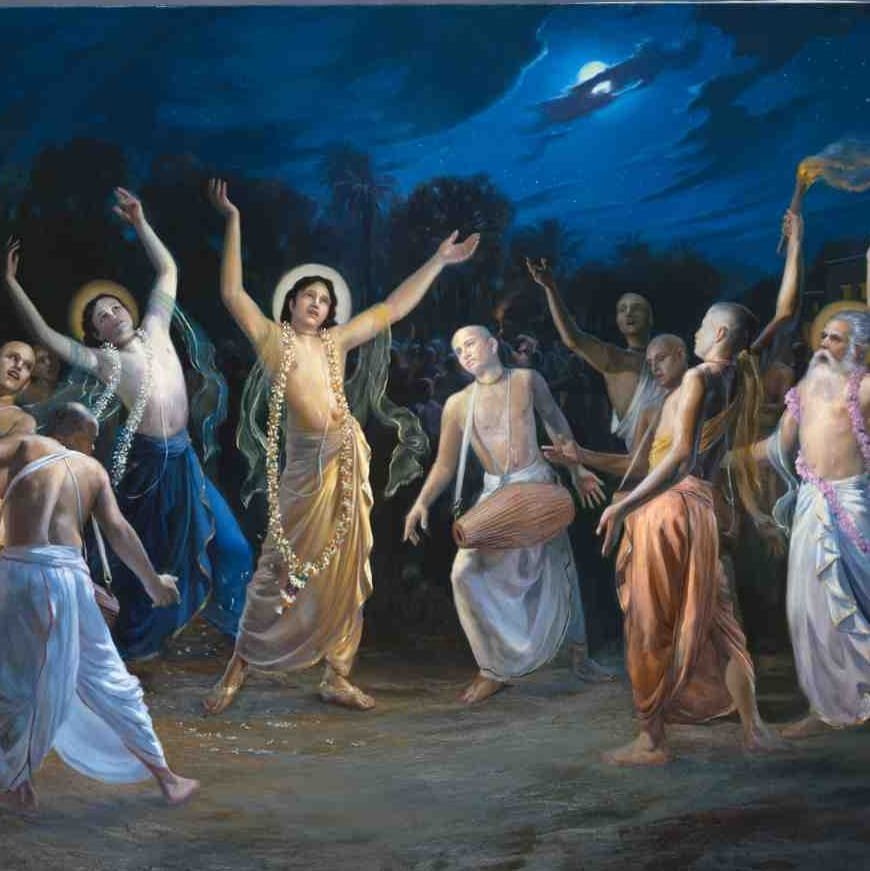
Nāgariyā Ghāṭa
nagariyā — citizens (CC Adi 17.121)
The saṅkīrtana movement started by Śrī Caitanya Mahāprabhu is described in the Caitanya-bhāgavata, Madhya-khaṇḍa, Twenty-third Chapter, beginning with verse 241, which states, “My dear Lord, let my mind be fixed at Your lotus feet.” Following Lord Caitanya’s chanting, all the devotees reproduced the same sound He chanted. In this way the Lord proceeded, leading the entire party on the strand roads by the bank of the Ganges. When the Lord came to His own ghāṭa, or bathing place, He danced more and more. Then He proceeded to Mādhāi’s ghāṭa. In this way Śrī Caitanya Mahāprabhu, the Supreme Lord, who was known as Viśvambhara, danced all over the banks of the Ganges. Then He proceeded to Bārakoṇā-ghāṭa, then Nāgariyā-ghāṭa, and, traveling through Gaṅgānagara, reached Simuliyā, a quarter at one end of the town. All these places surround Śrī Māyāpur. After reaching Simuliyā, the Lord proceeded toward the Kazi’s house, and in this way He reached the door of Chand Kazi.
(CC Adi 17.141)
Śrī Viśvambhara was most restless. He went to each bathing ghāṭa.
COMMENTARY
The word prati-ghāṭe refers to His own bathing ghāṭa, Bārakoṇā-ghāṭa, Mādhāi’s ghāṭa, Nāgariyā-ghāṭa, and other ghāṭas.
(Śrī Caitanya-bhāgavata, Ādi-khaṇḍa 8.50)
At each ghāṭa there were innumerable students, and the Lord debated at every ghāṭa. The Lord swam to each ghāṭa and enjoyed debating there for one or two hours.
(Śrī Caitanya-bhāgavata, Ādi-khaṇḍa 8.51-8.52)
navadvīpa-sampatti ke varṇibāre pāre?
eko gaṅgā-ghāṭe lakṣa loka snāna kare
Who can describe the opulences of Navadvīpa? One hundred thousand people would take bath at one bathing ghāṭa.
(Śrī Caitanya-bhāgavata, Ādi-khaṇḍa 2.57)
After first dancing for a long time at His own ghāṭa, Gaurahari proceeded to Mādhāi’s ghāṭa.
(Śrī Caitanya-bhāgavata, Madhya-khaṇḍa 23.299)
After passing by Bārakoṇā-ghāṭa and Nāgariyā-ghāṭa, He went through Gaṅgānagara to Simuliyā.
COMMENTARY
Bārakoṇā-ghāṭa was situated after Mādhāi’s ghāṭa. After that came a huge ghāṭa for the town residents. After that came the village of Gaṅgānagara.
(Śrī Caitanya-bhāgavata, Madhya-khaṇḍa 23.300)
Information – Now the point is, if one walks to the bank of the Ganges, Bārakoṇā-ghāṭa and Nāgariyā-ghața are not very far. The Nāgariyā-ghāṭa was situated near the main market in ancient Nadia. In addition, this market was situated on the western side of Ballaladhīgi. There is no doubt that if the devotees search for Śrī Māyāpura, the birthplace of Mahaprabhu and His places of pastimes, after carefully considering all these topics, they will certainly find those places.
(Bhaktivinoda Vānī Vaibhāva, Chapter 33 – Cultural Heritage, 22 – Visnupriya Palli Magazine)
Information – This is a Lupta Tirtha, a sacred site whose exact location has yet to be discovered.