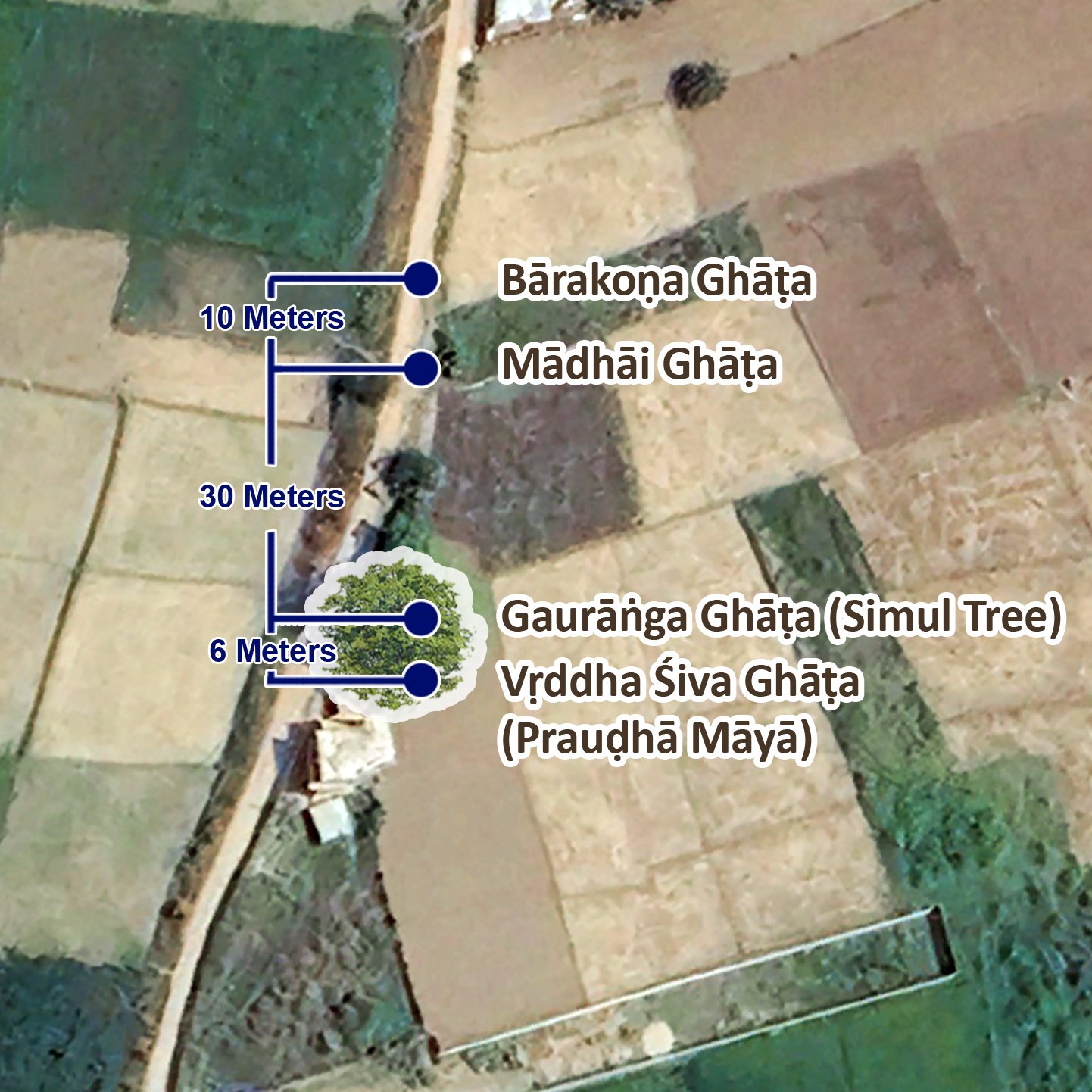

Mādhāi Ghāṭa
Śrīla Prabhupāda Audio
Hear the original words of Śrīla Prabhupāda.
So Śrī Caitanya Mahāprabhu appeared on this part 488 years ago to, I mean to say, hand the same two principles, paritrāṇāya sādhūnāṁ vināśāya ca duṣkṛtām. He . . . vināśāya duṣkṛtām. He killed Jagāi-Mādhāi not by the body, but by their atrocious activities, stopped that. So Śrī Caitanya Mahāprabhu's mission is to kill the demon—not by life but by their heinous activities. Anyone who comes to be killed by Śrī Caitanya Mahāprabhu, his heinous, nefarious activities becomes killed and he becomes a Vaiṣṇava, just like Jagāi-Mādhāi. So at the present moment, the whole world is full of Jagāi-Mādhāi, their four principles. Jagāi-Mādhāi means illicit sex, meat-eating, intoxication and gambling. This is Jagāi-Mādhāi. So this movement, Kṛṣṇa consciousness movement, is killing these Jagāi-Mādhāi principles: no illicit sex, no intoxication, no gambling and no meat-eating. So one side, killing the Jagāi-Mādhāi principle, and other side protection, chanting Hare Kṛṣṇa mahā-mantra.
(740303 - Lecture CC Adi 07.03 - Mayapur)
Śrīla Prabhupāda Audio
Hear the original words of Śrīla Prabhupāda.
Lord Caitanya Mahāprabhu and Lord Nityānanda is standing before you, and He delivered many, many sinful persons to the transcendental position of love of Kṛṣṇa. Śrīla Narottama dāsa Ṭhākura has sung, vrajendra-nandana yei, śacī-suta hoilo sei, balarāma hoilo nitāi. This Balarāma, He became Nitai, and Kṛṣṇa, He became Caitanya Mahāprabhu. These two brothers, the same two brothers, Rāma-Lakṣmaṇa, Kṛṣṇa-Balarāma, again as Caitanya Mahāprabhu and Nityānanda Prabhu. So what was Their business? The pāpī-tāpī jata chilo, hari-nāme uddhārilo. This is Their business. All the pāpīs and all the persons suffering from material anxieties, They delivered? “Yes.” How? Tāra sākṣī jagāi mādhāi. There were two brothers, Jagāi and Mādhāi. They are very debauchees. That debauchees means what was their fault? The fault was that they took their birth in brāhmaṇa family, but they became woman-hunter and drunkards and cheaters, like that. So Nityānanda Prabhu delivered them to become first-class Vaiṣṇava. Pāpī-tāpī jata chilo, hari-nāme uddhārilo, tāra sākṣī jagāi and mādhāi.
(750420 – Lecture CC Madhya 19.53 – Vrndavana)
mahā-kṛpā-pātra prabhura jagāi, mādhāi
‘patita-pāvana‘ nāmera sākṣī dui bhāi
mahā-kṛpā-pātra—object of very great mercy; patita-pāvana—deliverer of the fallen
Jagāi and Mādhāi, the eighty-ninth and ninetieth branches of the tree, were the greatest recipients of Lord Caitanya’s mercy. These two brothers were the witnesses who proved that Lord Caitanya was rightly named Patita-pāvana, “the deliverer of the fallen souls.”
PURPORT
In the Gaura-gaṇoddeśa-dīpikā (115) it is said that the two brothers Jagāi and Mādhāi were formerly the doorkeepers named Jaya and Vijaya, who later became Hiraṇyākṣa and Hiraṇyakaśipu. Jagāi and Mādhāi were born in respectable brāhmaṇa families, but they adopted the professions of thieves and rogues and thus became implicated in all kinds of undesirable activities, especially woman-hunting, intoxication and gambling. Later, by the grace of Lord Caitanya Mahāprabhu and Śrī Nityānanda Prabhu, they were initiated, and they got the chance to chant the Hare Kṛṣṇa mahā-mantra. As a result of chanting, both brothers became exalted devotees of Lord Caitanya Mahāprabhu.
(CC Adi 10.120) / (Caitanya tree – branch 89 & 90)
Thirty meters north is Madhai Ghat, which is known to all.
(Sri Navadvipa-Dhama-Mahatmya, Chapter 5)
In the case of Jagāi and Mādhāi, Śrī Caitanya Mahāprabhu was so angry that He would have immediately killed them, but Nityānanda Prabhu was so kind that He not only saved them from death but elevated them to the transcendental position. Thus what was not possible for Śrī Caitanya Mahāprabhu was carried out by Nityānanda Prabhu. Similarly, if one is true to Gaura-Nitāi ‘s service in the disciplic succession, he can even excel Nityānanda Prabhu ‘s service. This is the process of disciplic succession. Nityānanda Prabhu delivered Jagāi and Mādhāi, but a servant of Nityānanda Prabhu, by His grace, can deliver many thousands of Jagāis and Mādhāis. That is the special benediction of the disciplic succession.
(CC Madhya 16.65 purport)
Jagāi and Mādhāi were two brothers born in Navadvīpa in a respectable brāhmaṇa family who later became addicted to all kinds of sinful activities. By the order of Lord Caitanya, both Nityānanda Prabhu and Haridāsa Ṭhākura used to preach the cult of Kṛṣṇa consciousness door to door. In the course of such preaching they found Jagāi and Mādhāi, two maddened drunken brothers, who, upon seeing them, began to chase them. On the next day, Mādhāi struck Nityānanda Prabhu on the head with a piece of earthen pot, thus drawing blood. When Śrī Caitanya Mahāprabhu heard of this, He immediately came to the spot, ready to punish both brothers, but when the all-merciful Lord Gaurāṅga saw Jagāi’s repentant behavior, He immediately embraced him. By seeing the Supreme Personality of Godhead face to face and embracing Him, both the sinful brothers were at once cleansed. Thus they received initiation into the chanting of the Hare Kṛṣṇa mahā-mantra from the Lord and were delivered.
(CC Ādi 17.17 purport)
“One can chant the holy name of the Lord in a humble state of mind, thinking himself lower than the straw in the street. One should be more tolerant than a tree, devoid of all sense of false prestige, and should be ready to offer all respect to others. In such a state of mind one can chant the holy name of the Lord constantly.” Nevertheless, when the Lord was informed that Nityānanda Prabhu was injured by Jagāi and Mādhāi, He immediately went to the spot, angry like fire, wanting to kill them. Thus Lord Caitanya has explained His verse by the example of His own behavior. One should tolerate insults against oneself, but when there is blasphemy committed against superiors such as other Vaiṣṇavas, one should be neither humble nor meek: one must take proper steps to counteract such blasphemy.
(CC Adi 10.85 purport)
The two brothers submitted, “Dear Lord, You have incarnated to deliver the fallen souls. You should consider that in this world there is none so fallen as us. You have delivered the two brothers Jagāi and Mādhāi, but to deliver them You did not have to exert Yourself very much. The brothers Jagāi and Mādhāi belonged to the brāhmaṇa caste, and their residence was in the holy place of Navadvīpa. They never served low-class persons, nor were they instruments to abominable activities. Jagāi and Mādhāi had but one fault-they were addicted to sinful activity. However, volumes of sinful activity can be burned to ashes simply by a dim reflection of the chanting of Your holy name.
(CC Madhya 1.191 – 1.194)
The Lord said, “Listen as I tell you the means. Construct a bathing ghāṭa on the bank of the Ganges. When people happily take bath in the Ganges, they will all bless you. Serving the Ganges will counteract your offenses. What could be more fortunate for you than this? Humbly offer your obeisances to everyone. Then all your offenses will be forgiven.” Receiving the Lord’s instructions, Mādhāi then circumambulated the Lord and departed. Tears flowed from his eyes as he chanted the name of Kṛṣṇa. Everyone watched as he built a ghāṭa on the bank of the Ganges. People were greatly astonished on seeing this. Mādhāi then offered obeisances to everyone, saying, “Please bless me and forgive me for the offenses that I knowingly and unknowingly committed.” Seeing Mādhāi cry, everyone began to cry in ecstasy as they remembered Govinda. Everyone heard, “Nimāi Paṇḍita transformed Jagāi and Mādhāi into exalted personalities.” On hearing this, everyone was astonished and said, “Nimāi Paṇḍita is not a human being. Sinful people blaspheme Him without understanding. Nimāi Paṇḍita is engaged in the real glorification of the Lord. Nimāi Paṇḍita is a true servant of Lord Kṛṣṇa. Anyone who criticizes Him will be ruined. One who can rectify the mentality of these two must be either the Supreme Lord or empowered by the Supreme Lord. Nimāi Paṇḍita is not a mortal being. Now His glories have become manifest.” The people of Nadia discussed in this way and thereafter avoided the company of those who blasphemed the Lord. Mādhāi performed the most severe austerities and soon became known there as “Brahmacārī.” He constantly saw the Ganges while living at that ghāṭa on the riverbank. He took a shovel in his hand and personally worked there. Even today, everyone proclaims Mādhāi’s ghāṭa as the evidence of Lord Caitanya’s mercy. In this way, the two became greatly glorified as the two rogues who were delivered by the mercy of Lord Caitanya.
(Sri Caitanya Bhagavata Madhya-khaṇḍa 15.076 – 15.095)
brajendra-nandana jei, śacī-suta hoilo sei,
balarāma hoilo nitāi
dīna-hīna jata chilo, hari-nāme uddhārilo,
tāra śākṣī jagāi mādhāi
Lord Krishna, who is the son of the King of Vraja, became the son of Saci (Lord Caitanya), and Balarama became Nitai. The holy name delivered all those souls who were lowly and wretched. The two sinners Jagai and Madhai are evidence of this.
(Hari Hari Biphale Janama)
As the two drunkards wandered from place to place, they came to the bathing ghāṭa where the Lord would take His bath in the Ganges. By divine arrangement they made that place their base from which they would go out to raid various places. Whether influential, rich, or poor, all people’s hearts became filled with fear. No one went to take bath in the Ganges at night, and if they did, they went in groups of ten or twenty. They stayed near the Lord’s house and listened to the Lord’s kīrtana as they remained awake throughout the night. Being intoxicated with wine, they joyfully danced as they listened to the sound of the karatālas and mṛdaṅgas in the kīrtana. As they could hear everything from that distance, they would listen, dance, and then drink more wine. Whenever there was kīrtana, the two would stay there. When they heard the kīrtana, they would get up and dance. They were so overwhelmed by drinking wine that they did not remember where they had been or where they were. When they saw the Lord, they said, “O Nimāi Paṇḍita, You should sing the entire song of Maṅgalacaṇḍī. You have expert singers, who we wish to see. We will bring and give You whatever You need.” Seeing those miscreants, the Lord kept a distance. Others took another path and fled away.
(Sri Caitanya Bhagavata Madhya Khanda, 13.161 – 13.172)
This chapter describes how Mahāprabhu spread the glorification, worship, and teachings of Kṛṣṇa to each and every house through Nityānanda and Haridāsa, their preaching to Jagāi and Mādhāi, Mādhāi’s attack on Nityānanda, Mahāprabhu’s arrival at that spot and His invoking the Sudarśana cakra, the two brothers’ surrender at the lotus feet of Gaura, Gaura-Nityānanda’s forgiveness and deliverance of Jagāi and Mādhāi, the demigods’ service to Gaura, and the consequences of committing vaiṣṇava-aparādha. Since the pastimes of Śrī Gaurasundara are perceived through eyes of love, ordinary people who were devoid of such love considered Him simply as Nimāi Paṇḍita. Only fortunate souls saw His manifestations according to their respective qualifications. One day Mahāprabhu instructed Nityānanda and Haridāsa to go door to door and beg everyone to worship Kṛṣṇa, chant Kṛṣṇa’s names, and practice Kṛṣṇa’s teachings and at the end of the day to inform Him of the results. Although everyone there at first laughed on hearing what they were to beg, Nityānanda and Haridāsa took the instruction on their heads and began to beg such alms from door to door. When householders respectfully invited the two sannyāsīs to accept alms, the two would, according to Mahāprabhu’s instructions, beg them to chant Kṛṣṇa’s names, worship Kṛṣṇa, and practice Kṛṣṇa’s teachings, and then they would leave. Although pious people were happy to see their wonderful method of begging alms and promised to follow their request, some people blasphemed Lord Caitanya and considered the two to be madmen. Some people who were unable to enter Śrīvāsa’s house during kīrtana violently attacked the two and threatened them with royal punishment. But being empowered by Śrī Caitanya, Nityānanda and Haridāsa did not pay the least attention to them; in other words, they fearlessly went on with their activities. One day the two Prabhus saw the most sinful drunkards Jagāi and Mādhāi. On seeing their pathetic condition, the hearts of Nityānanda and Haridāsa, the most merciful deliverers of fallen souls, began to cry. Considering the two brothers as brilliant examples for Mahāprabhu’s pastime of delivering fallen souls, they resolved to inform them of Mahāprabhu’s most auspicious instructions despite the potential dangers in doing so. Thus they loudly requested them to worship Kṛṣṇa. In spite of committing numerous sinful activities, Jagāi and Mādhāi never had the opportunity of accumulating vaiṣṇava-aparādha, so as a result, their good fortune for achieving the mercy of Gaura-Nityānanda was awakened. Blasphemy of Vaiṣṇavas is a grave offense—it checks all piety and results in all degradation. Without the mercy of a Vaiṣṇava, even Kṛṣṇa’s holy names, which are the best form of atonement, cannot nullify an offense committed against a Vaiṣṇava. All the scriptures have warned everyone by boldly declaring this fact. On hearing the call of Nityānanda and Haridāsa, the two rogues thought that their carefree life was being disturbed, so they chased after the two sannyāsīs. After the two Prabhus ran away, they narrated the incident at the feet of Gaurasundara, who was sitting in the company of devotees, and requested Him to fulfill the meaning of His name Patita-pāvana by delivering those sinners. When the assembled Vaiṣṇavas realized that the two sinners have already been delivered by the merciful glance of Nityānanda, they chanted the name of Hari in ecstasy. When Haridāsa Ṭhākura described to Advaita Ācārya the various forms of Nityānanda’s restlessness and the difficulties that he had to experience as a result, Advaita glorified Nityānanda on the pretext of criticizing Him. Thereafter Jagāi and Mādhāi came and camped on the bank of the Ganges where Mahāprabhu used to take bath. As a result, many people became frightened. On hearing the sound of Mahāprabhu’s kīrtana at night, the two drunkards thought it was in glorification of Maṅgalacaṇḍī and danced wildly under the influence of intoxication. Later, when they saw Mahāprabhu, they praised His kīrtana. When Nityānanda Prabhu went before them one night with a desire to deliver them, Mādhāi hit Him in the head. Jagāi was distressed on seeing this, and he checked Mādhāi and chastised him for committing such a sinful act. On receiving this news, Mahāprabhu immediately went there with His associates. When He saw that Nityānanda’s body was covered with blood, He called Sudarśana in order to punish the two sinners. Jagāi and Mādhāi saw Sudarśana cakra with their own eyes. The most merciful Nityānanda Prabhu informed the Lord that He had been protected by Jagāi and begged the Lord to spare the two brothers. When Mahāprabhu heard that Jagāi had protected Nityānanda, He mercifully bestowed ecstatic love on him. On seeing Jagāi’s good fortune, the heart of Mādhāi was also transformed and he fell at the lotus feet of Mahāprabhu and begged forgiveness. Mahāprabhu, however, did not agree to bestow mercy on him, rather He instructed Mādhāi to take shelter at the feet of Nityānanda and requested Nityānanda to bestow mercy on Mādhāi. On the instruction of Śrī Gaura, Mādhāi fell at the feet of Nityānanda, who requested Mahāprabhu to bestow mercy on Mādhāi in exchange for all of His own piety. By the order of Mahāprabhu, Nityānanda then tightly embraced Mādhāi and entered into his body. In this way, both Jagāi and Mādhāi were delivered, and they began offering prayers to the two Lords. Mahāprabhu then forbade them from committing sinful activities again. When they accepted this proposal, Mahāprabhu accepted the burden of their millions of lifetimes of sinful activities. After realizing the mercy of Mahāprabhu, Jagāi and Mādhāi fell unconscious to the ground in ecstasy. Thereafter Mahāprabhu had the two unconscious brothers brought to His own home, and after closing the doors from inside He sat down in the association of the Vaiṣṇavas. Due to transformations of ecstatic love, the two brothers began to roll on the ground. When by the will of Gaurasundara, Śuddhā Sarasvatī appeared on the tongues of the two brothers, they began offering meaningful prayers to Śrī Śrī Gaura-Nityānanda. As everyone there heard the drunkards’ prayers to the Lords, they were struck with wonder and considered this the causeless mercy of the Lord. From that day on Mahāprabhu included Jagāi and Mādhāi among His own associates, and He personally begged all the Vaiṣṇavas to forgive their offenses and bestow mercy on them. After falling at the feet of all the devotees and receiving their blessings, Jagāi and Mādhāi became free from all offenses. Their sinful reactions were then deposited with those who blaspheme the Vaiṣṇavas. By the order of Mahāprabhu, all the devotees then began a huge kīrtana, in which Mahāprabhu and the two brothers danced. At the end of the kīrtana, everyone sat down, their bodies covered in dust, and Mahāprabhu declared that Jagāi and Mādhāi were “mahā-bhāgavatas.” After ordering everyone to respect them as mahā-bhāgavatas, He warned that if anyone acted to the contrary or criticized the two they would be ruined as a result of that vaiṣṇava-aparādha. Thereafter Śrī Śrī Mahāprabhu took everyone to the Ganges, wherein they all freely engaged in tumultuous water sports. In those water sports, everyone was defeated by Mahāprabhu. In the water sports between Śrī Śrī Advaita and Nityānanda, Advaita Prabhu glorified Nityānanda on the pretext of criticizing Him and revealed that He Himself was Lord Viṣṇu. At the end of the water sports, Mahāprabhu gave His own flower garland prasāda to Jagāi and Mādhāi and sent everyone to eat lunch. During this period the demigods would daily come to see Caitanya’s pastimes and offer various services, but no one other than the Lord recognized them. Thereafter the author ends the chapter with a description of the formidable consequences of vaiṣṇava-aparādha.
(Sri Caitanya Bhagavata Madhya Khanda, Chapter Thirteen Summary, The Deliverance of Jagāi and Mādhāi)