
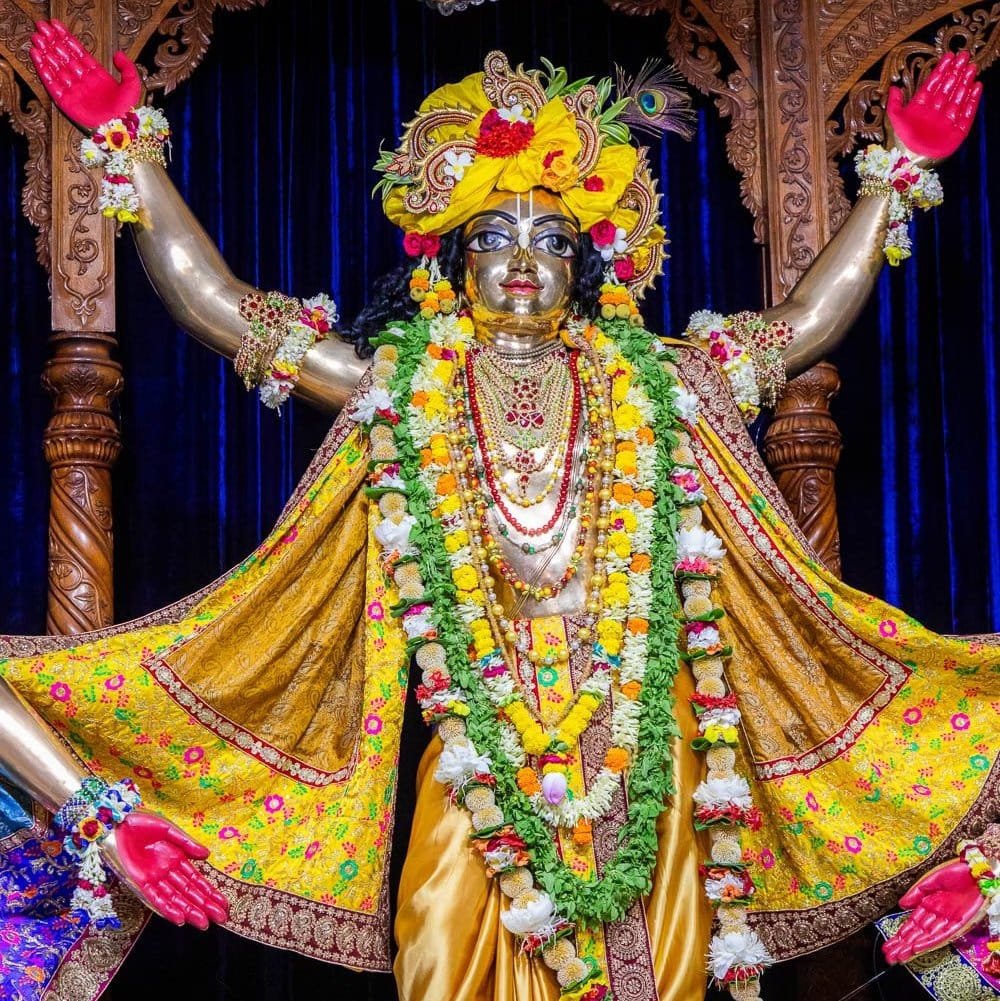
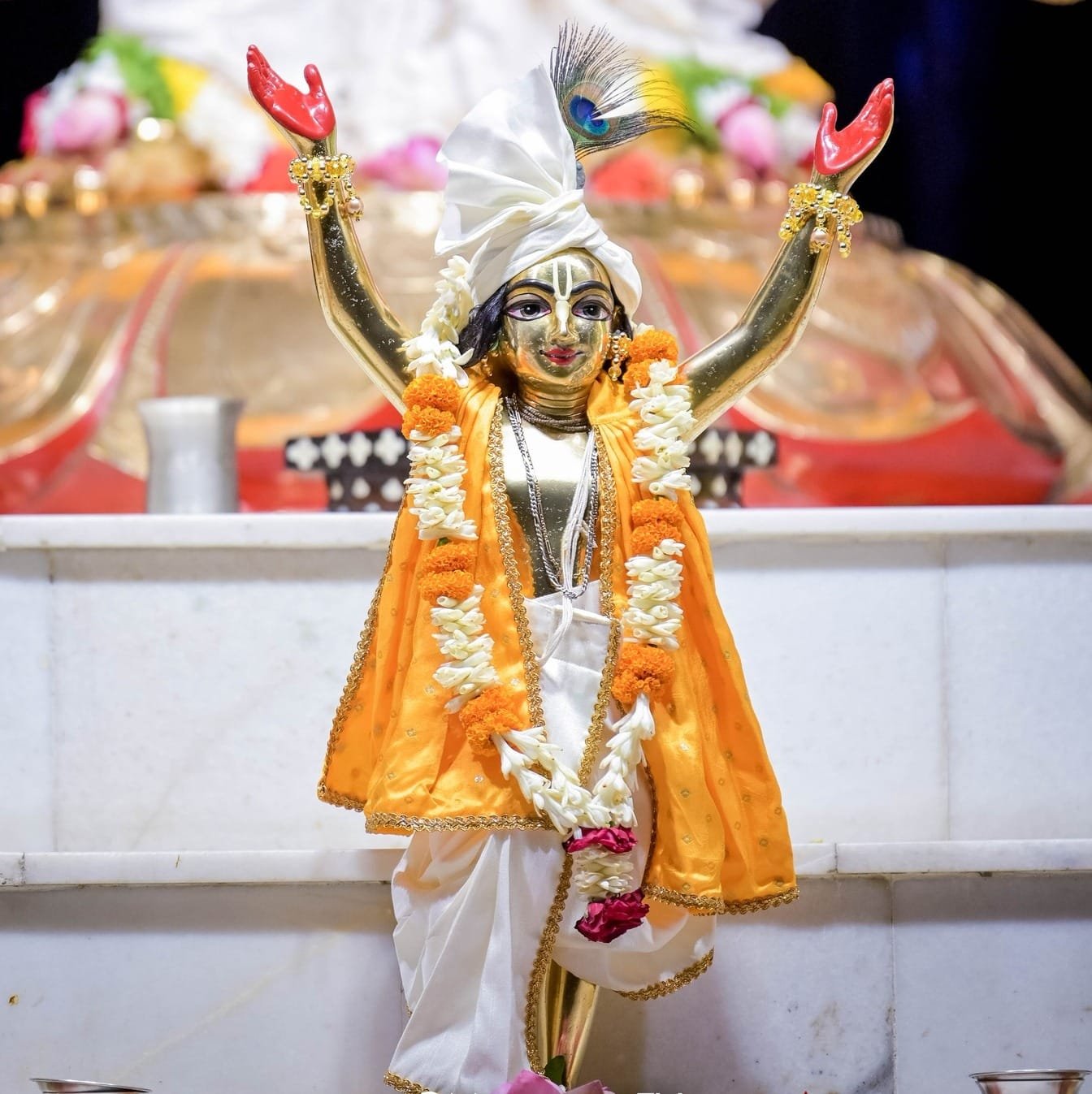
Sri Caitanya Mahaprabhu
vande śrī-kṛṣṇa-caitanya-nityānandau sahoditau
gauḍodaye puṣpavantau citrau śan-dau tamo-nudau
I offer my respectful obeisances unto Śrī Kṛṣṇa Caitanya and Lord Nityānanda, who are like the sun and moon. They have arisen simultaneously on the horizon of Gauḍa to dissipate the darkness of ignorance and thus wonderfully bestow benediction upon all.
(CC Adi 1.2, CC Adi 1.84)
May the Supreme Lord who is known as the son of Śrīmatī Śacī-devī be transcendentally situated in the innermost chambers of your heart. Resplendent with the radiance of molten gold, He has appeared in the Age of Kali by His causeless mercy to bestow what no incarnation has ever offered before: the most sublime and radiant mellow of devotional service, the mellow of conjugal love.
(CC Adi 1.4 / CC Adi 3.4)
The loving affairs of Śrī Rādhā and Kṛṣṇa are transcendental manifestations of the Lord’s internal pleasure-giving potency. Although Rādhā and Kṛṣṇa are one in Their identity, They separated Themselves eternally. Now these two transcendental identities have again united, in the form of Śrī Kṛṣṇa Caitanya. I bow down to Him, who has manifested Himself with the sentiment and complexion of Śrīmatī Rādhārāṇī although He is Kṛṣṇa Himself.
(CC Adi 1.5 / CC Adi 4.55)
Desiring to understand the glory of Rādhārāṇī’s love, the wonderful qualities in Him that She alone relishes through Her love, and the happiness She feels when She realizes the sweetness of His love, the Supreme Lord Hari, richly endowed with Her emotions, appeared from the womb of Śrīmatī Śacī-devī, as the moon appeared from the ocean.
(CC Adi 1.6)
In the mood of Śrīmatī Rādhārāṇī, He also fulfilled His own desires. This is the principal reason for His appearance.
(CC Adi 4.221)
Desiring to understand the glory of Rādhārāṇī's love, the wonderful qualities in Him that She alone relishes through Her love, and the happiness She feels when She realizes the sweetness of His love, the Supreme Lord Hari, richly endowed with Her emotions, appeared from the womb of Śrīmatī Śacī-devī, as the moon appeared from the ocean.
(CC Adi 4.230)
Then we go to Caitanya Mahāprabhu's status: sa-advaitaṁ sāvadhūtam. That is also . . . first of all, Advaita Gosāñi, then Nityānanda Mahāprabhu, Prabhu. Mahāprabhu is applicable only to Śrī Caitanya Mahāprabhu. Others, all prabhus. Ekale īśvara kṛṣṇa āra saba bhṛtya. (CC Adi 5.142)
(710810 - Lecture SB 01.02.02 - London)
Śrī Caitanya Mahāprabhu said, premā pum-artho mahān: “Love of Godhead is the ultimate benediction for all human beings.”
(CC Adi 7.1 purport)
It is to be concluded that although Lord Caitanya is present in the form of a devotee, He is Kṛṣṇa Himself. Therefore Vaiṣṇavas sing, śrī-kṛṣṇa-caitanya rādhā-kṛṣṇa nahe anya: Rādhā and Kṛṣṇa combined together are Śrī Kṛṣṇa Caitanya Mahāprabhu.
(CC Adi 7.11 purport)
That Govinda personally appears as Caitanya Gosāñi. No other Lord is as merciful in delivering the fallen souls.
(CC Adi 2.22)
That same Lord Kṛṣṇa, the fountainhead of all incarnations, is known as the son of the King of Vraja. He has descended personally as Lord Śrī Caitanya Mahāprabhu.
(CC Adi 2.109)
Lord Śrī Caitanya Mahāprabhu, the great apostle of love of God and the father of the congregational chanting of the holy name of the Lord, advented Himself at Śrīdhāma Māyāpura, a quarter in the city of Navadvīpa in Bengal, on the Phālgunī Pūrṇimā evening in the year 1407 Śakābda (corresponding to February 1486 by the Christian calendar)....Lord Śrī Caitanya Mahāprabhu exhibited His transcendental activities for forty-eight years and then disappeared in the year 1455 Śakābda (A.D. 1534) at Purī.
(SB introduction)
I worship Lord Śrī Caitanya Mahāprabhu, whose nectarean mercy flows like a great river, inundating the entire universe. Just as a river flows downstream, Lord Caitanya especially extends Himself to the fallen.
(CC Adi 16.1)
There is no one as merciful as Śrī Caitanya Mahāprabhu within all three worlds. Simply by seeing Him from a distance, one is overwhelmed with love of Godhead.
(CC Madhya 16.121)
Therefore Rūpa Gosvāmī offered his first prayer to Śrī Caitanya Mahāprabhu:
- namo mahā-vadānyāya
- kṛṣṇa-prema-pradāya te
- kṛṣṇāya kṛṣṇa-caitanya-
- nāmne gaura-tviṣe namaḥ
- (CC Madhya 19.53)
Such a difficult subject matter: Kṛṣṇa. "You are not only giving Kṛṣṇa, but You are giving kṛṣṇa-prema, love of Kṛṣṇa." You can meet somebody, some exalted person, you can see, but to become an intimate relationship with such exalted person in love, that is not very easy thing. I can meet the president or some exalted person, but to become in love with him in intimacy, that is not easy job. But Śrī Caitanya Mahāprabhu distributed this Kṛṣṇa love immediately, anyone. That is Kṛṣṇa Caitanya Mahāprabhu's, I mean to say, contribution to the human society. If you simply become under the lotus feet of Śrī Kṛṣṇa Caitanya Mahāprabhu, then love of Kṛṣṇa is very easily achieved.
(740302 - Lecture CC Adi 07.02 - Mayapur)
We are just trying to introduce Kṛṣṇa, following the orders of Śrī Caitanya Mahāprabhu, who appeared five hundred years ago. He is Kṛṣṇa, and He wanted this Kṛṣṇa consciousness to be spread all over the world
(Śrī Caitanya-bhāgavata, Antya-khaṇḍa 4.126):
pṛthivīte āche yata nagarādi-grāma
sarvatra pracāra haibe mora nāma
"In every town and village throughout the world," said Lord Caitanya, "the chanting of My holy name will be heard." Kṛṣṇa is not just for India. He is for everyone, because He is God.
(Civilization and Transcendence 13 - The Way to Peace)
In this age of Kali, the Supreme Personality of Godhead (Bhagavān) does not appear as a līlāvatāra, an incarnation to display pastimes. Therefore He is known as tri-yuga. Unlike other incarnations, Lord Śrī Caitanya Mahāprabhu appears in this age of Kali as a devotee of the Lord. Therefore He is called a concealed incarnation (channāvatāra).
(SB 5.18.35 purport)
I then offer my obeisances to the Supreme Personality of Godhead, Śrī Kṛṣṇa Caitanya. He incarnated in Navadvīpa, and He is known as Viśvambhara.
(Śrī Caitanya-bhāgavata Ādi-khaṇḍa 1.7)
Things that are very difficult to do become easy to execute if one somehow or other simply remembers Lord Caitanya Mahāprabhu. But if one does not remember Him, even easy things become very difficult. To this Lord Caitanya Mahāprabhu I offer my respectful obeisances.
(CC Adi 14.1)
The flood of love of Godhead swelled in all directions, and thus young men, old men, women and children were all immersed in that inundation.
PURPORT
When the contents of the storehouse of love of Godhead is thus distributed, there is a powerful inundation that covers the entire land. In Śrīdhāma Māyāpur there is sometimes a great flood after the rainy season. This is an indication that from the birthplace of Lord Caitanya the inundation of love of Godhead should be spread all over the world, for this will help everyone, including old men, young men, women and children. The Kṛṣṇa consciousness movement of Śrī Caitanya Mahāprabhu is so powerful that it can inundate the entire world and interest all classes of men in the subject of love of Godhead.
(CC Adi 7.25)
yāre dekha, tāre kaha ‘kṛṣṇa’-upadeśa
āmāra ājñāya guru hañā tāra’ ei deśa
“Instruct everyone to follow the orders of Lord Śrī Kṛṣṇa as they are given in the Bhagavad-gītā and Śrīmad-Bhāgavatam. In this way become a spiritual master and try to liberate everyone in this land.”
(CC Madhya 7.128)
The heart of Lord Caitanya is the image of Śrī Rādhikā's emotions. Thus feelings of pleasure and pain arise constantly therein.
(CC Adi 4.106)
In the year 1407 of the Śaka Era (A.D. 1486), Lord Śrī Caitanya Mahāprabhu appeared, and in the year 1455 (A.D. 1534) He disappeared from this world.. For twenty-four years Lord Caitanya lived in the gṛhastha-āśrama [household life], always engaging in the pastimes of the Hare Kṛṣṇa movement. After twenty-four years He accepted the renounced order of life, sannyāsa, and He resided for twenty-four years more at Jagannātha Purī. Of these last twenty-four years, He spent the first six years continuously touring India, sometimes in South India, sometimes in Bengal and sometimes in Vṛndāvana. For the remaining eighteen years He continuously stayed in Jagannātha Purī. Chanting the nectarean Hare Kṛṣṇa mahā-mantra, He inundated everyone there in a flood of love of Kṛṣṇa.
(CC Adi 13.09 - 13.13)
Lord Caitanya thought, “My name is Viśvambhara, ‘one who maintains the entire universe.’ Its meaning will be actualized if I can fill the whole universe with love of Godhead.”
(CC Adi 9.7)
That eternal relationship is described by Śrī Caitanya Mahāprabhu: jīvera ‘svarūpa’ haya kṛṣṇera ‘nitya-dāsa.’ (CC Madhya 20.108). “The living entity is an eternal servitor of the Supreme Personality of Godhead.” When one is convinced about this relationship, which is called sambandha, he then acts accordingly.
(CC Adi 7.142 purport)
Keśava Bhāratī offered the sannyāsa order to Śrī Caitanya Mahāprabhu in the year 1432 śakābda (A.D. 1510) in Katwa.
(CC Adi 9.13-15 purport)
Ananta folded His hands and began to sing the glories of Gaurāṅga, who appeared with a complexion of molten gold. Gaurāṅga’s lotus feet were very beautiful, His toenails glowed like ten million moons, His form glowed like a thousand suns, and He was decorated with a forest flower garland and the mark of Śrīvatsa on His chest. Wearing silk cloth, He was as attractive as ten million Cupids. His arms extending to His knees and a sacred thread draped across His chest. He was smeared with sandalwood pulp and decorated with arm bands and tulasī beads around His neck. He had graceful eyes and beautiful eyebrows and nose. He was slightly smiling, and His ears were decorated with shark earrings. He was peaceful, and His feet are eternally worshiped by the devotees. He is the deliverer of the suffering living entities and the cause of the universes. His form is full of eternity, knowledge, and bliss.
(Sri Navadvipa-Dhama-Mahatmya, Pramana-Khanda, Chapter 2)
Devotees exclusively attracted to the lotus feet of Gaurāṅga, like bees attracted to nectar, certainly attain Rādhā and Kṛṣṇa. If You desire the goal of devotion—servitorship to Rādhā and Kṛṣṇa in Vṛndāvana, which is so rare in this world—then go quickly to Navadvīpa and worship Gaurāṅga, the ocean of mercy. At present, Kṛṣṇa, the dearmost of Rādhā, is residing there in the form of Gaurāṅga.
(Sri Navadvipa-Dhama-Mahatmya, Pramana-Khanda, Chapter 2)
Whoever makes a distinction between Gaurāṅga and Kṛṣṇa is contemptible and will never attain a relationship with Kṛṣṇa. But, in the association of devotees, one who possesses the qualities beginning with humility will first worship Gaurāṅga in dāsya, or servitude, relationship. This dāsya-rasa is the highest mood in the worship of Gaurāṅga. It is in that mood that the devotees call Śrī Gaurāṅga ‘Mahāprabhu.
(Sri Navadvipa-Dhama-Mahatmya, Chapter 18)
When Caitanya Mahāprabhu took sannyāsa, His wife, Viṣṇupriyādevī, although only sixteen years old, also took the vow of austerity due to her husband’s leaving home. She chanted her beads, and after finishing one round, she collected one grain of rice. In this way, as many rounds as she chanted, she would receive the same number of rice grains and then cook them and so take prasāda. This is called austerity.
(SB 4.23.20 purport)
Śrīla Prabhupāda Audio
Hear the original words of Śrīla Prabhupāda.
So Kṛṣṇa understanding is not so easy. It is very difficult. Kṛṣṇa says. But by the grace of Kṛṣṇa, because He wanted to distribute Himself, Caitanya Mahāprabhu giving us Kṛṣṇa freely . . . kṛṣṇa-prema-pradāya te (CC Madhya 19.53). Rūpa Gosvāmī says that namo mahā-vadānyāya. Kṛṣṇa was also not so liberal. He simply asked us, "Surrender," but He did not distribute Himself. But in the form of Caitanya Mahāprabhu He distributed Himself, "Take Me, take Me, take Me. Without any price, take Me."
This is Caitanya Mahāprabhu, who is Kṛṣṇa, and He has come in the form of Caitanya, Kṛṣṇa Caitanya, to distribute Himself. Therefore He is recognized, namo mahā-vadānyāya, "The most munificent." No other incarnation, even Rāmacandra or Bhagavān Kṛṣṇa, They were not so liberal. But Caitanya Mahāprabhu is so liberal. Pāpī tāpī jata chilo hari-nāme uddhārilo (Hari Hari Bifale 3). They distributed Himself through the chanting of Hare Kṛṣṇa mantra.
(721031 - Lecture SB 01.02.20 - Vrndavana)
One must be ready, very eager to carry out the orders of Caitanya Mahāprabhu. Then He will give you instruction. And as soon as you get the favor, mercy of Caitanya Mahāprabhu . . . it is very simple. Simply we must be serious. Caitanya Mahāprabhu says,
āmāra ajñāya guru hañā tara ei deśa
yāre dekha, tāre kaha 'kṛṣṇa'-upadeśa
(CC Madhya 7.128)
This is the sum and substance of Caitanya Mahāprabhu's instruction. And the details are there, but this is the platform. You must be ready to become a guru simply by repeating the instruction of Kṛṣṇa, Bhagavad-gītā. Therefore we have taken Bhagavad-gītā as it is, and following the instruction of Caitanya Mahāprabhu, we are preaching to our best capacity. This is required, that you must be ready, you must be serious. Then Caitanya Mahāprabhu will give you proper instruction, and then you'll be very nice preacher for the benefit of the whole world. Thank you very much.
(760713 - Lecture CC Madhya 20.107 - New York)
If one takes to this philosophy of Kṛṣṇa consciousness and develops love of Godhead, then he can see God at every moment, in every step, in every thing. He's not, for a single moment, is out of the sight of God. Just like in the Bhagavad-gītā it is said, teṣu te mayi (BG 9.29). The devotee who has loved, who has developed love for God, he's also seeing God at every moment.
Similarly, God is also seeing him at every moment. They are not separated. So simple process. This hari-kīrtana, this is the simple process recommended in this age, and if we sincerely do it without any offense and with faith, then seeing of God is not difficult for a devotee. So:
kona brahmāṇḍe kona līlāra haya avasthāna
tāte līlā 'nitya' kahe āgama-purāṇa
(CC Madhya 20.395)
So similarly, in some of the brahmāṇḍas, or universes, there is already present kṛṣṇa-līlā; Kṛṣṇa is there. There is another Bengali verse, very nicely:
adya 'pi akāri līlā gaura-rāya
kona kona bhagavane dekhibāre pāya
Lord Caitanya's pastime is going on, still going on, but some of the fortunate devotees, they can see. Anything, God's pastime, that is perceivable through devotional service. Bhaktyā mām abhijānāti (BG 18.55).
Only. This is the process. No other process
(670102 - Lecture CC Madhya 20.391-405 - New York)
Śrī Caitanya Mahāprabhu
The eternal tree of love of Godhead
Teachings of Lord Chaitanya
Read the book online
Vaiṣṇava Songs
Śrīla Prabhupāda Audio
Hear the original words of Śrīla Prabhupāda.
prabhu kahe-śuna, śrīpāda, ihāra kāraṇa
guru more mūrkha dehki’ karila śāsana
(CC Adi 7.71)
“Yes. You are right, My dear Prakāśānanda Sarasvatī. You are right. But there is reason why do I do it. Now I can explain to you. When I took sannyāsa from My Guru Mahārāja, from My spiritual master, he found Me a rascal and fool number one, rascal.” So guru more mūrkha dekhi’ karila śāsana: “So, because he found Me a foolish person, therefore he has chastised Me.”
Why? What is that? “He said mūrkha tumi: ‘You are foolish. You have no education. You are illiterate.’ ” Tomāra nāhika vedāntādhikāra (CC Adi 7.72): “‘It is not possible for You to understand Vedānta.'” ‘Kṛṣṇa-mantra’ japa sadā—ei mantra-sāra:” ‘Therefore, You simply chant Hare Kṛṣṇa, Hare Kṛṣṇa, Kṛṣṇa Kṛṣṇa, Hare Hare. That will make You all right.’“
Now here is the point, that was Caitanya Mahāprabhu a foolish person? No. He was not a foolish person. In His childhood He was known as Nimāi Pandit, the greatest learned man. Even when He was sixteen years old, He defeated another very learned fellow from Kashmir. So He was reputed scholar, and He was known. And Prakāśānanda Sarasvatī knew it that Caitanya Mahāprabhu, even in His gṛhastha āśrama or in His householder life, He was a teacher of nyāya, logic, and He’s great learned man. He knew it.
But Caitanya Mahāprabhu says that, “My spiritual master found Me a rascal, a fool. Therefore he said that ‘You have no chance for understanding Vedānta. Therefore You take to this principle: chant simply Hare Kṛṣṇa, Hare Kṛṣṇa, Kṛṣṇa Kṛṣṇa, Hare Hare.’ ” What is this purpose of presenting Himself as fool and rascal? The idea is that in this age, 99.9% are fools and rascals; therefore it is very difficult for them to understand what is the purpose of Vedānta. He’s representing Himself as one of the fools and rascals.
(670208 – Lecture CC Adi 07.69-75 – San Francisco)
So Caitanya Mahāprabhu took sannyāsa from Keśava Bhāratī. This Keśava Bhāratī belonged to Śaṅkara-sampradāya. Therefore Prakāśānanda Sarasvatī also belonged to Śaṅkara-sampradāya. So he’s asking that, “I understand that Your name is Śrī Kṛṣṇa Caitanya.”
Now, there are different kinds of names of brahmacārī also under the guidance of a sannyāsī. So the person who is under the guidance of Bhāratī, the brahmacārī’s name is Caitanya. So Caitanya Mahāprabhu, although He took sannyāsa, He did not change His brahmacārī name. That is also very significant. Because in the Māyāvādī sannyāsa, as soon as they take sannyāsa, they think that “I have become Nārāyaṇa.” So Caitanya Mahāprabhu, although He was regularly a sannyāsī, He did not change His name of brahmacārī. That means brahmacārī is meant for serving the spiritual master, so He continued to be a servitor. That is the significance.
(670208 – Lecture CC Adi 07.69-75 – San Francisco)
If we follow Caitanya Mahāprabhu’s instruction, then our life will be successful and we will be happy. And the process is very simple: chanting Hare Kṛṣṇa. There is no very hard and fast rule for chanting Hare Kṛṣṇa mantra. In any position, in any place, in any circumstance, you can very easily chant this Hare Kṛṣṇa mahā-mantra. Even small children, they also take part, chant Hare Kṛṣṇa and dance with the elderly father and mother. So there is very good potency if we simply chant this Hare Kṛṣṇa mantra.
(750811 – Lecture Arrival – Paris)
Now Caitanya Mahāprabhu explained that, “This Hare Kṛṣṇa, Hare Kṛṣṇa is the only universal religious principle in this age.” No other religion process will be effective, because people are so many and diverted in different way. This is the common formula and this is the effective formula. So Caitanya Mahāprabhu says, nāma vinu kali-kāle: “Without chanting this Hare Kṛṣṇa, there is no other alternative for self-realization in this age of Kali.”
nāma vinu kali-kāle nāhi āra dharma
sarva-mantra-sāra nāma, ei śāstra-marma (CC Adi 7.74)
Now the essence of all scripture is this Hare Kṛṣṇa. Essence. Sarva-śāstra-marma means essence of all scripture. And sarva-mantra-sāra. And there are different kinds of hymns and mantras, and this is the, I mean to say, topmost part of all mantras. “In this way, My Guru Mahārāja asked Me to chant Hare Kṛṣṇa.”
(670208 – Lecture CC Adi 07.69-75 – San Francisco)
pṛthivīte āche yata nagarādi grāma
sarvatra pracāra haibe mora nāma
(CB Antya-khaṇḍa 4.126)
Means that, “As many villages and towns are there on the surface of the globe, everywhere this Hare Kṛṣṇa mantra will be preached.” So this Hare Kṛṣṇa movement, or Kṛṣṇa consciousness, has just begun. You will see in future, in every village, every town, they’ll chant and dance. So it is the Caitanya Mahāprabhu’s prediction that is being fulfilled. Nobody can check it.
(740613 – Lecture BG 07.01-3 – Paris)
Vṛndāvana means Rādhā-Kṛṣṇa’s activities, pastimes. So that is the destiny of life. That is the real goal. As Śrī Caitanya . . . Narottama dāsa Ṭhākura says, that manuṣya janama pāiyā, rādhā-kṛṣṇa nā bhajiyā, jāniyā śuniyā viṣa khāinu. One who has got this human form of life, if he does not understand what is Rādhā-Kṛṣṇa, his life is spoiled. Jāniyā śuniyā viṣa khāinu: knowingly they’re eating poison. Because by coming in contact with Rādhā and Kṛṣṇa they can go back to home, back to Godhead, and there will be no more janma-mṛtyu-jarā-vyādhi (BG 13.9). Such opportunity is human life, simply to understand Rādhā Kṛṣṇa. And therefore Śrī Caitanya Mahāprabhu is mahā-vadānyāvatāra, because He is teaching about the love of Rādhā-Kṛṣṇa and teaching everyone kṛṣṇa-prema-pradāya te, real destination of life, how to achieve kṛṣṇa-prema, and He’s personally teaching. Namo mahā-vadānyāya. Rūpa Gosvāmī understood it: “Here is namo mahā-vadānyāya, most magnanimous incarnation.” Similarly, Locana dāsa Ṭhākura has sung:
parama karuṇa, pahū dui-jana
nitāi-gauracandra
saba avatāra, sāra śiromaṇi
kevala ānanda-kanda
Kevala ānanda-kanda, parama-karuṇa: “There are many incarnation, but no better incarnation, no magnanimous incarnation, like Śrī Caitanya Mahāprabhu, Nityānanda Prabhu.” Nityānanda Prabhu is always . . . vrajenda-nandana yei, śaci-suta haila sei, balarāma haila nitāi.
(740301 – Lecture CC Adi 07.01 – Mayapur)
So Kṛṣṇa understanding is not so easy. It is very difficult. Kṛṣṇa says. But by the grace of Kṛṣṇa, because He wanted to distribute Himself, Caitanya Mahāprabhu giving us Kṛṣṇa freely . . . kṛṣṇa-prema-pradāya te (CC Madhya 19.53). Rūpa Gosvāmī says that namo mahā-vadānyāya. Kṛṣṇa was also not so liberal. He simply asked us, “Surrender,” but He did not distribute Himself. But in the form of Caitanya Mahāprabhu He distributed Himself, “Take Me, take Me, take Me. Without any price, take Me.”
This is Caitanya Mahāprabhu, who is Kṛṣṇa, and He has come in the form of Caitanya, Kṛṣṇa Caitanya, to distribute Himself. Therefore He is recognized, namo mahā-vadānyāya, “The most munificent.” No other incarnation, even Rāmacandra or Bhagavān Kṛṣṇa, They were not so liberal. But Caitanya Mahāprabhu is so liberal. Pāpī tāpī jata chilo hari-nāme uddhārilo (Hari Hari Bifale 3). They distributed Himself through the chanting of Hare Kṛṣṇa mantra.
(721031 – Lecture SB 01.02.20 – Vrndavana)
Kṛṣṇa is one, but when Kṛṣṇa wants to enjoy, He must expand His pleasure potency. That is Rādhārāṇī. Rādhā kṛṣṇa-praṇaya-vikṛtir. Kṛṣṇa cannot enjoy anything material. The original spiritual potency, pleasure potency, is Rādhārāṇī. So first of all He expanded, then again He combined together. That is Śrī Kṛṣṇa Caitanya Mahāprabhu. This is the study of the Gosvāmī. Rādhā kṛṣṇa-praṇaya-vikṛtir hlādinī.
Therefore Caitanya Mahāprabhu is given seat along with Kṛṣṇa. He’s combination of Rādhā and Kṛṣṇa. We may not misunderstand that Caitanya Mahāprabhu is . . . imitating Caitanya Mahāprabhu, there are so many so-called avatāras. But this is approved by the śāstra. Kṛṣṇa-varṇaṁ tviṣākṛṣṇam (SB 11.5.32). Caitanya Mahāprabhu is Kṛṣṇa, same category, kṛṣṇa-varṇaṁ. Just like we say varṇa: brāhmaṇa varṇa, kṣatriya varṇa, śūdra varṇa, vaiśya varṇa. Varṇa means the same category, varṇa. Or kṛṣṇa-varṇaṁ means who is always describing Kṛṣṇa. Just like Caitanya Mahāprabhu is passing on the road, He’s chanting,
kṛṣṇa kṛṣṇa kṛṣṇa kṛṣṇa kṛṣṇa kṛṣṇa kṛṣṇa he
kṛṣṇa kṛṣṇa kṛṣṇa kṛṣṇa kṛṣṇa kṛṣṇa kṛṣṇa he
kṛṣṇa kṛṣṇa kṛṣṇa kṛṣṇa kṛṣṇa pāhi māṁ
(CC Madhya 7.96)
Therefore kṛṣṇa-varṇaṁ is He; iti kṛṣṇa. Kṛṣṇa is describing Himself: kṛṣṇa-varṇaṁ tviṣākṛṣṇam. But by His complexion, He is not black—very fair complexion.
(730306 – Lecture BG 10.01-3 – Calcutta)
That is the mission of Śrī Caitanya Mahāprabhu. His mission is, especially to the Indians He says,
bhārata-bhūmite haila manuṣya-janma yāra
janma sārthaka kari’ kara para-upakāra
(CC Adi 9.41)
Para-upakāra, just to do something good for others, for upakāra. So Caitanya Mahāprabhu says anyone who has taken birth in India, he should, bhārata-bhūmite manuṣya-janma haila yāra (CC Adi 9.41), anyone who has taken birth in India, for every one of them, it is the duty. Janma sārthaka kari’: first of all make your life successful, janma sārthaka kari’ kara para-upakāra, then you begin the welfare activities for all others. The idea is that India is enriched with Vedic knowledge, and those who are born in India, they should take advantage of this facility, especially those who are in the higher, topmost ranks, the brāhmaṇas, the kṣatriyas, the vaiśyas. Especially the brāhmaṇas. Take this education perfectly well, make your life perfect, and distribute the knowledge all over the world. This is your duty. That is the order of Śrī Caitanya Mahāprabhu.
(760620 – Lecture BG 09.03 – Toronto)
So when we come to that stage, as Caitanya Mahāprabhu’s teaching, the gopī-bhartuḥ pada-kamalayoḥ. . . He’s also bringing the reference of the gopī because Kṛṣṇa is completely under gopīs. He’s so much indebted to the gopīs that He said that “I cannot repay your debts. It is not possible.” Kṛṣṇa, the all-powerful, all opulences, but He had no means to repay the debts of the gopīs. This is the position of the gopīs. Caitanya Mahāprabhu recommends, ramyā kācid upāsanā vraja-vadhū-vargeṇa yā kalpitā (Caitanya-manjusa). There is no other better shape of worshiping Kṛṣṇa than it was planned by the gopīs. Ramyā kācid upāsanā vraja-vadhū-vargeṇa yā kalpitā. This is the highest. In the same way, He says, gopī-bhartuḥ pada-kamalayor dāsa, Gopī-jana-vallabha. Gopī-jana-vallabha is Kṛṣṇa; pada-kamalayoḥ, one who has taken shelter. Don’t try to become gopīs. No. Rather, try to become the dust of the lotus feet of the gopīs. Gopī-bhartuḥ pada-kamalayor dāsa-dāsānudāsaḥ (CC Madhya 13.80). Just like Uddhava. Uddhava wanted to become one grass in Vṛndāvana because the gopīs will trample over it. This is the highest perfection. So, liberation. Liberation means gopī-bhartuḥ pada-kamalayor dāsa-dāsa-dāsānudāsaḥ. The more you become servant of the servant, servant of Vaiṣṇava, then your perfection is there (CC Madhya 13.80). That is qualification.
(761002 – Lecture SB 01.07.41-42 – Vrndavana)
If we take the path of Śrī Caitanya Mahāprabhu, then—we are embarrassed in so many ways—we can get the light. We can get the light. We can reform our life. Śrī Caitanya Mahāprabhu’s teaching is so nice. Of course, the great author Kavirāja Gosvāmī has depicted the activities and teachings of Lord Caitanya Mahāprabhu, and this Māyāpur is the birth site of Śrī Caitanya Mahāprabhu. Five hundred years . . . 488 years ago, Śrī Caitanya Mahāprabhu traveled on this street. Now, still, that memory is going to be revived by this Kṛṣṇa consciousness movement all over the world because Caitanya Mahāprabhu wanted this.
pṛthivīte āche yata nagarādi grāma
sarvatra pracāra haibe mora nāma
(CB Antya-khaṇḍa 4.126)
So His prediction is coming to be true…Now you European and American, African and Australian, so many, all parts of the world, you have come. This is due to Śrī Caitanya Mahāprabhu’s desire. He wanted it. Pṛthivīte āche yata nagarādi grāma (CB Antya-khaṇḍa 4.126). He wanted to be famous, to become famous, and people should thank Him. He wanted that. He told that that, “When they will know My philosophy”—that is the desire of Śrī Caitanya—”they’ll thank Me.”And actually you are already thanking Him by getting the sublime instruction of Śrī Caitanya Mahāprabhu.
(740301 – Lecture CC Adi 07.01 – Mayapur)
There is no difference between Kṛṣṇa and Caitanya Mahāprabhu. Caitanya Mahāprabhu is combination of Rādhā and Kṛṣṇa. That is the verdict of the Gosvāmīs.
rādhā-kṛṣṇa-praṇaya-vikṛtir hlādinī-śaktir asmād
ekātmānāv api (bhuvi purā) deha-bhedaṁ gatau tau
caitanyākhyaṁ prakaṭam adhunā tad-dvayaṁ caikyam āptaṁ
rādhā-bhāva-dyuti-suvalitaṁ naumi kṛṣṇa-svarūpam
(CC Adi 1.5)
So Caitanya Mahāprabhu is combination of Rādhā and Kṛṣṇa. That is the . . . this śloka is made by Svarūpa Dāmodara Gosvāmī, who was personal secretary of Lord Caitanya.
So Caitanya Mahāprabhu is giving us the easiest process to approach Kṛṣṇa.
(710216 – Lecture CC Madhya 06.154 – Gorakhpur)
Because Kṛṣṇa, Caitanya Mahāprabhu, does not give anything else. Simply directly gives you Kṛṣṇa and His love. And to award this greatest benediction to the human society, He took sannyāsa at the age of twenty-four years only, in this land of Māyāpur, Navadvīpa. It is very glorified place. It is not ordinary place. Therefore Narottama dāsa Ṭhākura says, gauḍa maṇḍala bhūmi, yeba jane cintāmaṇi tara hoy vrajabhūme vāsa. Anyone who understands gauḍa maṇḍala bhūmi in Bengal—this Navadvīpa, Navadvīpa-candra, Śrī Caitanya Mahāprabhu—if anyone understands the spiritual value of this land, he lives in Vrajabhūmi, in Vṛndāvana. There is no difference between Vṛndāvana and this Gaura-maṇḍala-bhūmi. That is the verdict of the śāstra.
(740302 – Lecture CC Adi 07.02 – Mayapur)
So sāṅgopāṅgāstra-pārṣadam. This is the description of the God, Kṛṣṇa, in this age. That is Caitanya Mahāprabhu. Kṛṣṇa-varṇaṁ tviṣākṛṣṇaṁ sāṅgopāṅgāstra-pārṣadam (SB 11.5.32). And how to worship Him? What is the process? Yajñaiḥ saṅkīrtanaiḥ. That’s all. You keep Caitanya Mahāprabhu’s Deity and chant and dance—your life is successful. So easy. We are worshiping Rādhā-Kṛṣṇa. That is very difficult. But if we keep Caitanya Mahāprabhu with His associates, this Pañca-tattva, Gaura-Nitāi, Gaura-Gadādhara, or Pañca-tattva, and worship Him according to the śāstra description . . . the śāstra description is yajñaiḥ saṅkīrtanaiḥ. This is yajña. Life is meant for performing yajña. In the Bhagavad-gītā it is said, yajñārthe karma. You are very busy. Yes, you should be busy always, twenty-four hours. For what purpose? Yajñārthe, not for your sense gratification. That is devotional life.
(750310 – Lecture BG 07.02 – London)