
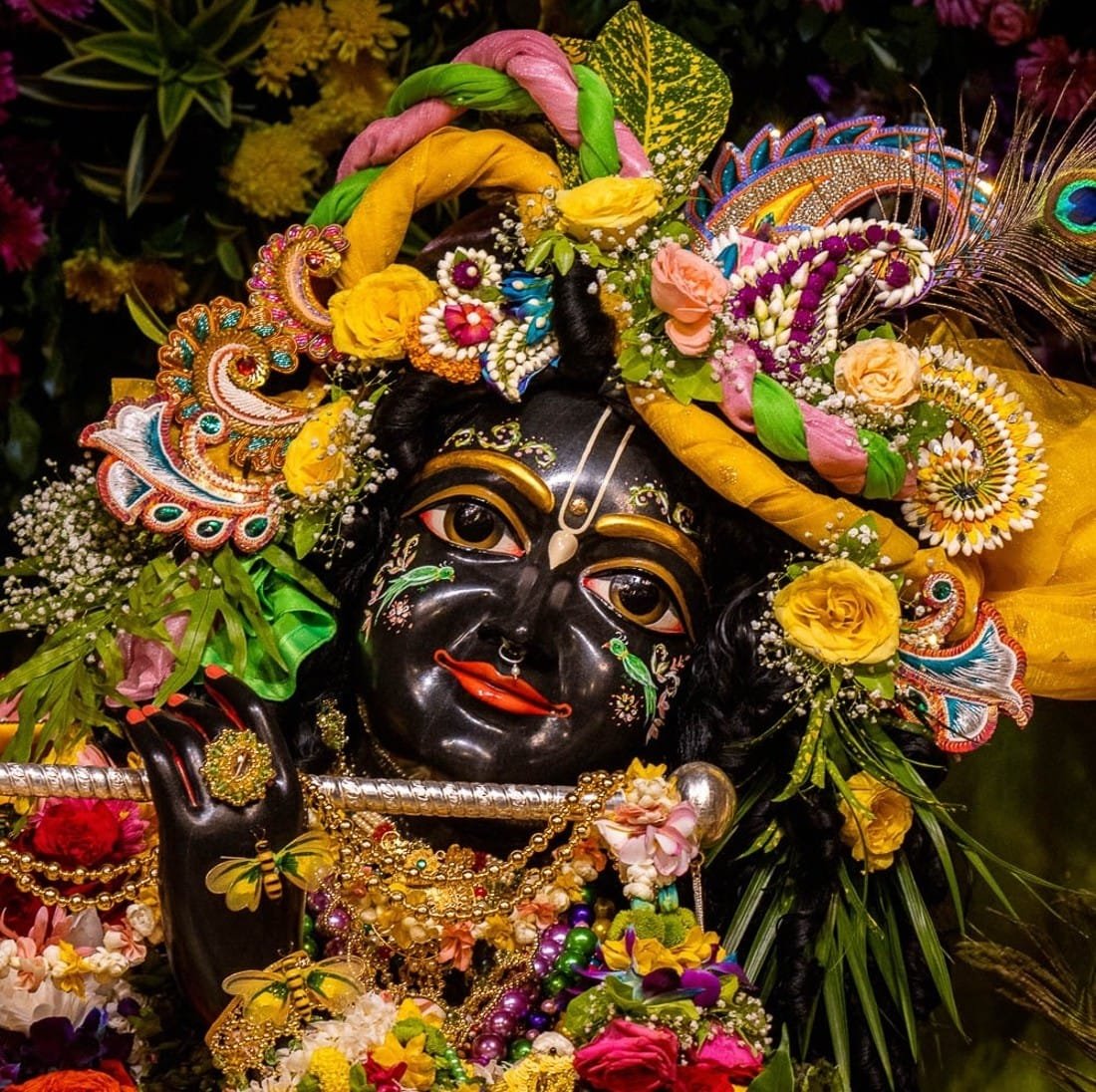
Śrī Mādhava
he kṛṣṇa karuṇā-sindho dīna-bandho jagat-pate
gopeśa gopikā-kānta rādhā-kānta namo ‘stu te
O my dear Kṛṣṇa, O ocean of mercy, O friend of the distressed and the source of creation, O master of the cowherd men and the lover of the gopīs, especially Rādhārāṇī, I offer my respectful obeisances unto You.
Śrīmatī Rādhikā fulfills all the desires of Lord Kṛṣṇa. This is the meaning of “sarva-kānti.”Lord Kṛṣṇa enchants the world, but Śrī Rādhā enchants even Him. Therefore She is the supreme goddess of all.
(CC Adi 4.94 – 4.95)
Śrīla Sanātana Gosvāmī has explained the various meanings of the word mādhava as follows: Mādhava normally indicates Kṛṣṇa to be “the Lord, who is the consort of the goddess of fortune, Lakṣmī.” This name also implies that Lord Kṛṣṇa descended in the dynasty of Madhu. Since the spring season is also known as Mādhava, it is understood that as soon as Lord Kṛṣṇa entered the Vṛndāvana forest, it automatically exhibited all the opulences of spring, becoming filled with flowers, breezes and a celestial atmosphere. Another reason Lord Kṛṣṇa is known as Mādhava is that He enjoys His pastimes in madhu, the taste of conjugal love. Lord Kṛṣṇa would loudly sound His flute as He entered the forest of Śrī Vṛndāvana, thus giving inconceivable bliss to all the residents of His hometown, Vraja-dhāma. These simple pastimes of playfully entering the forest, playing on the flute and so forth were performed daily in the spiritual land of Vṛndāvana.
(SB 10.15.2 purport composed by disciples of Śrīla Prabhupāda)
Whenever and wherever there is a decline in religious practice, O descendant of Bharata, and a predominant rise of irreligion—at that time I descend Myself.
(Bhagavad-gita 4.7)
The yogīs should contemplate with full devotion the compassionate glances frequently cast by the Lord’s eyes, for they soothe the most fearful threefold agonies of His devotees. His glances, accompanied by loving smiles, are full of abundant grace.
(SB 3.28.31)
So Kṛṣṇa also becomes very beautiful. He’s already beautiful, but when a devotee serves Him, a devotee comes to Him, He also becomes very beautiful. A devotee, when with his heart and soul, serves Kṛṣṇa in dressing Him, in feeding Him, in giving Him flower, He becomes smiling. And if you can get Kṛṣṇa once smiling upon you, your life is fulfilled.
(741112 – Lecture SB 03.25.12 – Bombay)
(1)
jaya radha-madhava radha-madhava radhe
(jayadever prana-dhana he)
(1)
All glories to Radha and Madhava, the treasure of Jayadeva Gosvami’s heart!
(Jaya Radha Krsna Giti)
Srila Prabhupada Lectures on Janmastami
- 680816 – Lecture Festival Appearance Day, Sri Krsna, Janmastami – Montreal
- 710813 – Lecture Festival Janmastami – London
- 710813 – Lecture Festival Janmastami Morning – London
- 720901 – Lecture Festival Janmastami Krsna Book Reading – New Vrindaban, USA
- 730821 – Lecture Festival Appearance Day, Sri Krsna, Janmastami – London
- 740811 – Lecture Festival BG 07.05, Appearance Day, Sri Krsna, Janmastami – Vrndavana
Śrīla Prabhupāda Audio
Hear the original words of Śrīla Prabhupāda.
Vṛndāvana means Rādhā-Kṛṣṇa’s activities, pastimes. So that is the destiny of life. That is the real goal. As Śrī Caitanya . . . Narottama dāsa Ṭhākura says, that manuṣya janama pāiyā, rādhā-kṛṣṇa nā bhajiyā, jāniyā śuniyā viṣa khāinu. One who has got this human form of life, if he does not understand what is Rādhā-Kṛṣṇa, his life is spoiled. Jāniyā śuniyā viṣa khāinu: knowingly they’re eating poison. Because by coming in contact with Rādhā and Kṛṣṇa they can go back to home, back to Godhead, and there will be no more janma-mṛtyu-jarā-vyādhi (BG 13.9). Such opportunity is human life, simply to understand Rādhā Kṛṣṇa. And therefore Śrī Caitanya Mahāprabhu is mahā-vadānyāvatāra, because He is teaching about the love of Rādhā-Kṛṣṇa and teaching everyone kṛṣṇa-prema-pradāya te, real destination of life, how to achieve kṛṣṇa-prema, and He’s personally teaching. Namo mahā-vadānyāya. Rūpa Gosvāmī understood it: “Here is namo mahā-vadānyāya, most magnanimous incarnation.” Similarly, Locana dāsa Ṭhākura has sung:
parama karuṇa, pahū dui-jana
nitāi-gauracandra
saba avatāra, sāra śiromaṇi
kevala ānanda-kanda
Kevala ānanda-kanda, parama-karuṇa: “There are many incarnation, but no better incarnation, no magnanimous incarnation, like Śrī Caitanya Mahāprabhu, Nityānanda Prabhu.” Nityānanda Prabhu is always . . . vrajenda-nandana yei, śaci-suta haila sei, balarāma haila nitāi.
(740301 – Lecture CC Adi 07.01 – Mayapur)
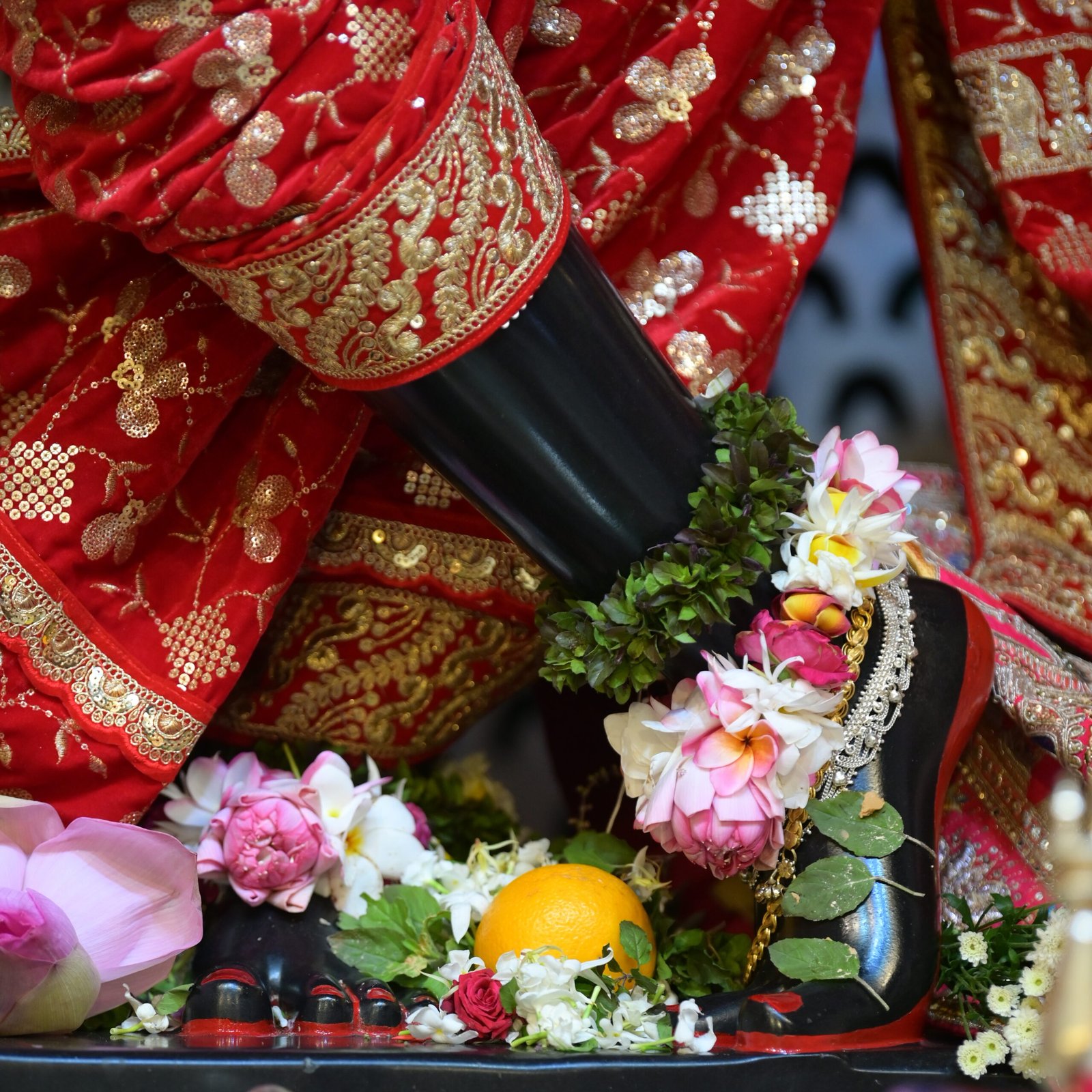
The blessed Lord Śiva becomes all the more blessed by bearing on his head the holy waters of the Ganges, which has its source in the water that washed the Lord’s lotus feet. The Lord’s feet act like thunderbolts hurled to shatter the mountain of sin stored in the mind of the meditating devotee. One should therefore meditate on the lotus feet of the Lord for a long time.
(SB 3.28.22)
History
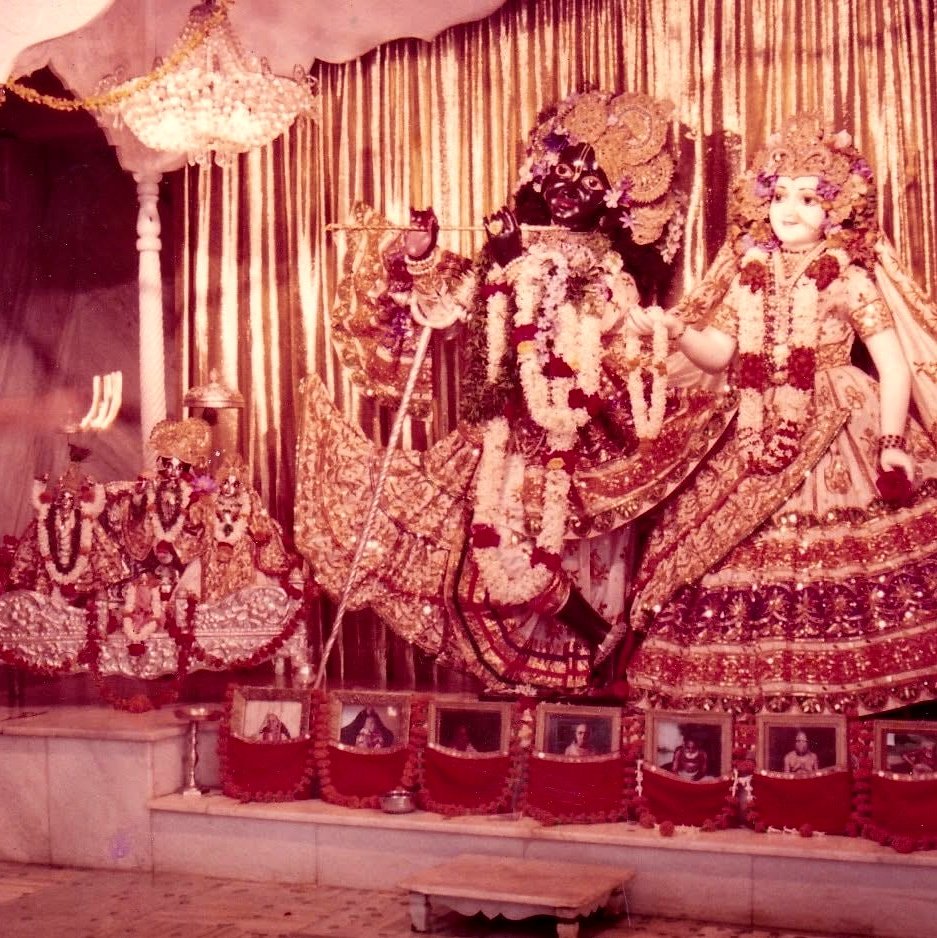
It wasn’t until 1980, however, that Prabhupäda’s desire to see life-sized deities in Mäyäpur would come to fruition. Jananiväsa Prabhu takes up the story: “Big Rädhä-Mädhava were installed on Gaura-pürnimä of that year (1980). The temple was in the Lotus Building then, and They were worshipped there until 1986 (View Photo Album), when the first four gopis (Lalitā Sakhī, Campakalatā Sakhī, Citrā Sakhī and Tuṅgavidyā Sakhī) arrived. The other four (Viśākhā Sakhī, Indulekhā Sakhī, Raṅgadevī Sakhī and Sudevī Sakhī) arrived in 1992."
“Then he made a gesture with his hands, the same gesture as Rādhārāṇī, and he said, 'Rādhārāṇī will be dancing, because when She is dancing, Kṛṣṇa can never leave Her.' He then gave the dimensions for Radha-Madhava and the other deities. He said, ‘Kṛṣṇa will be six feet four inches. Rādhārāṇī should be five foot ten inches.' ('He' refers to Srila Prabhupada)
(Article Full of Abundant Grace', Mayapur Magazine 2006)
In 1978, while in Calcutta, Jayapataka Swami paid a visit to Radhapada Dasa, a wealthy industrialist and ISKCON devotee, who told him that in a dream he had seen a young sadhu who asked him, “Do you recognize me?” Radhapada replied, “No.” “Sometime ago you gave me some money,” the sadhu said, “and I’ve come to repay it.” Radhapada said, “If I give money to a sadhu, I don’t expect it back. No, I cannot accept it.” “Are you sure you don’t recognize me?” the sadhu asked. “No,” replied Radhapada. Suddenly the sadhu assumed the form of an elderly man. “Now I recognize you,” Radhapada said. “You’re Srila Prabhupada.” “Now my disciples are having problems,” Srila Prabhupada said. “After a while everything will be all right, but you should help them now.” As a result of this dream, Radhapada said he wanted to buy Deities for ISKCON. When asked if he would pay for the large Deities of Radha-Madhava for Mayapur, he agreed.
The Deities were carved in Jaipur by the Pandays, a renowned family of sculptors. One day a member of the Birla family (India’s wealthiest family) came and fell in love with the Deities. He offered to pay 100,000 rupees for Them, which at that time was about $12,000 much more than ISKCON was to pay. The Pandays refused to sell the Deities, however, explaining that they had carved Them for ISKCON and would never be able to duplicate Them. One of the sculptors told the devotees that the marble was different from any he had worked with before. “When we carve,” he said, “a beautiful ringing sound comes out of the Deities.” When the sculptors were doing the final polishing, a white line appeared around Madhava’s body, like the sacred thread worn by brahmanas. Then two lines appeared on His forehead, like tilaka.
Once a devotee asked, “Srila Prabhupada, we’re sitting in these rice fields, and you’ve asked us to build a city. Where is all the money going to come from?” Srila Prabhupada laughed. “You are always worried about where the money will come from. Here we have Radha-Madhava. ‘Madhava’ means the husband of the goddess of fortune. You just worship Radha-Madhava nicely, and everything will come by Their mercy. You don’t have to worry about money.”
(The Center of Attention: Radha Madhava, Jananivasa Dasa (ACBSP), BTG 1999)