As you navigate through the Altar, use these arrows to pause and offer your heart’s prayers to the Deities.
Aṣṭa-sakhīs
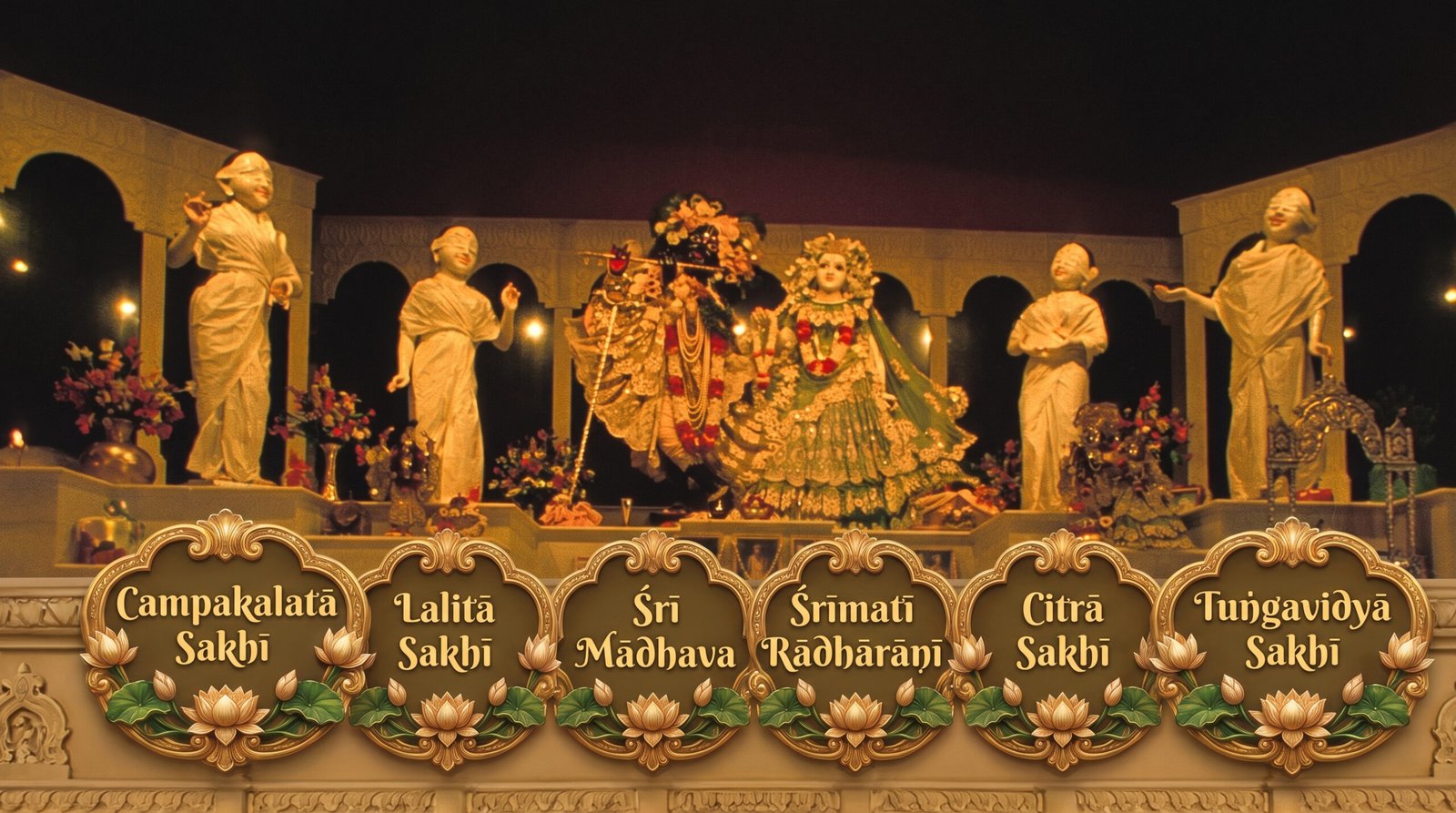
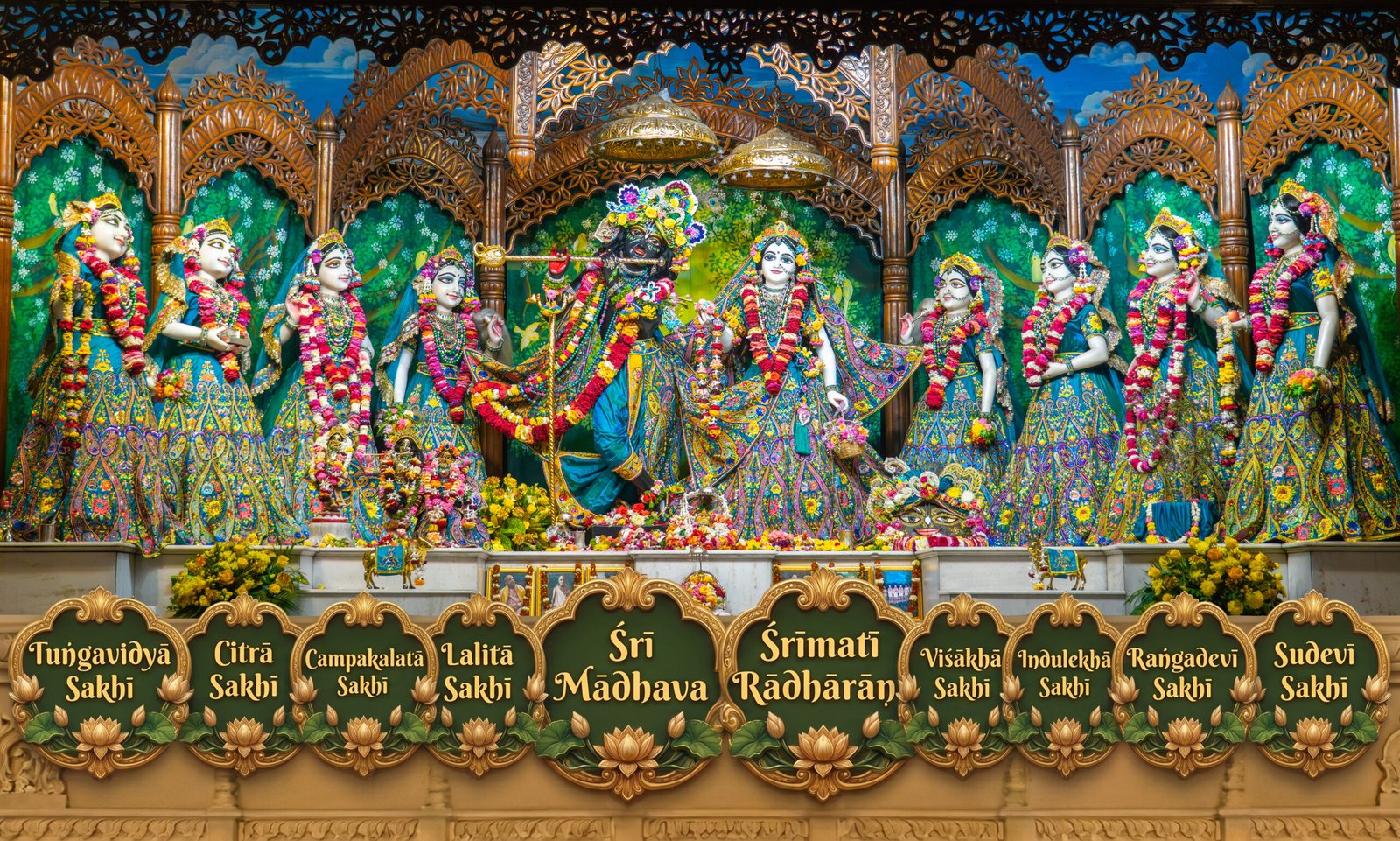
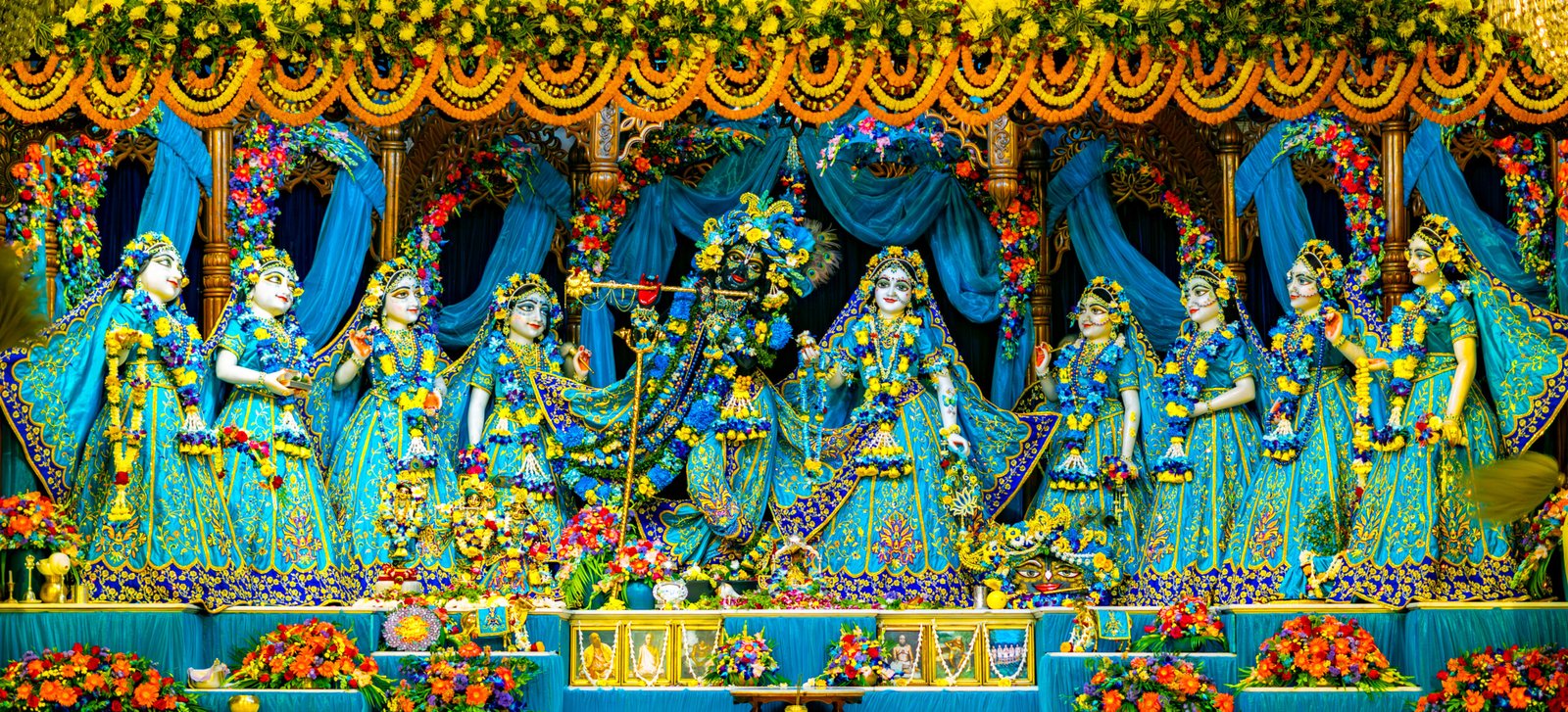
Information – The beautiful deities of Śrī Śrī Rādhā Mādhava, gracefully surrounded by Their Aṣṭa-sakhīs—their eight principal gopī companions.
Left to Right — Tuṅgavidyā Sakhī, Citrā Sakhī, Campakalatā Sakhī, Lalitā Sakhī, Śrī Mādhava, Śrīmatī Rādhārāṇī, Viśākhā Sakhī, Indulekhā Sakhī, Raṅgadevī Sakhī and Sudevī Sakhī.
vande ’haṁ śrī-guroḥ śrī-yuta-pada-kamalaṁ śrī-gurūn vaiṣṇavāṁś ca
śrī-rūpaṁ sāgrajātaṁ saha-gaṇa-raghunāthānvitaṁ taṁ sa-jīvam
sādvaitaṁ sāvadhūtaṁ parijana-sahitaṁ kṛṣṇa-caitanya-devaṁ
śrī-rādhā-kṛṣṇa-pādān saha-gaṇa-lalitā-śrī-viśākhānvitāṁś ca
I offer my respectful obeisances unto the lotus feet of my spiritual master and of all the other preceptors on the path of devotional service, unto all the Vaiṣṇavas and unto the six Gosvāmīs, including Śrīla Rūpa Gosvāmī, Śrīla Sanātana Gosvāmī, Raghunātha dāsa Gosvāmī, Jīva Gosvāmī and their associates. I offer my respectful obeisances unto Śrī Advaita Ācārya Prabhu, Śrī Nityānanda Prabhu and Śrī Caitanya Mahāprabhu, as well as all His devotees, headed by Śrīvāsa Ṭhākura. I then offer my respectful obeisances unto the lotus feet of Lord Kṛṣṇa and Śrīmatī Rādhārāṇī and all the gopīs, headed by Lalitā and Viśākhā.
(CC Antya 3.1)
Official Name: Vasanti Rasa (Amorous Pastimes in the Spring)
(2)
tara madhye hema-pitha asta-dale vestita
asta-dale pradhana nayika
tara madhye ratnasane bosi’ achen dui-jane
syama-sange sundari Radhika
2) In the middle of that lotus is a golden place surrounded by eight petals. On these eight petals the eight principal gopis reside, and in the center Lord Syamasundara and beautiful Srimati Radharani sit on a jewelled throne.
All the other gopīs help increase the joy of Kṛṣṇa’s pastimes with Rādhārāṇī. The gopīs act as the instruments of Their mutual enjoyment.
(CC Adi 4.217)
The parama-preṣṭha-sakhīs are eight in number, and in the ecstatic dealings of Kṛṣṇa and Rādhā they side sometimes with Kṛṣṇa and at other times with Rādhārāṇī, just to create a situation in which it appears that they favor one against the other. That makes the exchange of mellows more palatable.
(CC Adi 4.217 purport)
Rādhā is the beloved consort of Kṛṣṇa, and She is the wealth of His life. Without Her, the gopīs cannot give Him pleasure.
(CC Adi 4.218)
Śrīmatī Rādhārāṇī is the creeper of love of Godhead, and the gopīs are exactly like twigs, flowers and leaves. When water is sprinkled on the creeper, the twigs, flowers and leaves indirectly receive all the benefits of the creeper itself. But water sprinkled directly on the twigs, leaves and flowers is not as effective as water sprinkled on the creeper’s root. The gopīs are not as pleased when they directly mix with Kṛṣṇa as when they serve to unite Śrīmatī Rādhārāṇī with Kṛṣṇa. Their transcendental pleasure lies in uniting Them.
(CC Madhya 8.210 purport)
The personal associates of Rādhārāṇī, the damsels of Vraja, are direct expansions of Her body. As expansions of Her personal form and transcendental disposition, they are agents of different reciprocations of love in the pastimes of Lord Kṛṣṇa, under the supreme direction of Śrīmatī Rādhārāṇī. In the transcendental realm, enjoyment is fully relished in variety. The exuberance of transcendental mellows is increased by the association of a large number of personalities similar to Rādhārāṇī, who are also known as gopīs or sakhīs. The variety of innumerable mistresses is a source of relish for Śrī Kṛṣṇa, and therefore these expansions from Śrīmatī Rādhārāṇī are necessary for enhancing the pleasure potency of Śrī Kṛṣṇa. Their transcendental exchanges of love are the superexcellent affairs of the pastimes in Vṛndāvana. By these expansions of Śrīmatī Rādhārāṇī’s personal body, She helps Lord Kṛṣṇa taste the rāsa dance and other, similar activities. Śrīmatī Rādhārāṇī, being the central petal of the rāsa-līlā flower, is also known by the names found in the following verses.
(CC Adi 4.81 purport)
Thus Gadādhara Paṇḍita is simultaneously an incarnation of Śrīmatī Rādhārāṇī and Lalitā-sakhī.
(CC Adi 10.15 purport)
Svarūpa Dāmodara has been identified as Lalitā-devī, the second expansion of Rādhārāṇī. However, text 160 of Kavi-karṇapūra’s authoritative Gaura-gaṇoddeśa-dīpikā describes Svarūpa Dāmodara as the same Viśākhā-devī who serves the Lord in Goloka Vṛndāvana. Therefore it is to be understood that Śrī Svarūpa Dāmodara is a direct expansion of Rādhārāṇī who helps the Lord experience the attitude of Rādhārāṇī.
(CC Adi 4.105)
The Gaura-gaṇoddeśa-dīpikā (120-24) states that Rāmānanda Rāya was formerly Arjuna. He is also considered to have been an incarnation of the gopī Lalitā, although in the opinion of others he was an incarnation of Viśākhādevī. He was a most confidential devotee of Lord Caitanya Mahāprabhu.
(CC Adi 10.134 purport)
Verse 152 of the Gaura-gaṇoddeśa-dīpikā describes Śrī Dhruvānanda Brahmacārī as an incarnation of Lalitā.
(CC Adi 12.80)
Ananta Ācārya was one of the eight principal gopīs. His former name was Sudevī. Although he was among Advaita Ācārya’s followers, he later became an important devotee of Gadādhara Gosvāmī.
(CC Adi 12.58 purport)
Śrīla Bhaktisiddhānta Sarasvatī Ṭhākura writes in his Anubhāṣya, “Śrī Ananta Ācārya is one of the eternal associates of Śrī Caitanya Mahāprabhu. Previously, during the advent of Lord Śrī Kṛṣṇa, Ananta Ācārya was Sudevī, one of the eight gopīs. This is stated in the Gaura-gaṇoddeśa-dīpikā (165), as follows: anantācārya-gosvāmī yā su-devī purā vraje. ‘Ananta Ācārya Gosvāmī was formerly Sudevī-gopī in Vraja [Vṛndāvana].’
(CC Adi 8.60 purport)
Kṛṣṇadāsa Brahmacārī was formerly among the group of sakhīs known as the aṣṭa-sakhīs. His name was Indulekhā. Kṛṣṇadāsa Brahmacārī lived in Vṛndāvana.
(CC Adi 12.85 purport)
Once Lord Śrī Kṛṣṇa playfully manifested Himself as Nārāyaṇa, with four victorious hands and a very beautiful form. When the gopīs saw this exalted form, however, their ecstatic feelings were crippled. Even a learned scholar, therefore, cannot understand the gopīs’ ecstatic feelings, which are firmly fixed upon the original form of Lord Kṛṣṇa as the son of Nanda Mahārāja. The wonderful feelings of the gopīs in ecstatic parama-rasa with Kṛṣṇa constitute the greatest mystery in spiritual life.
(CC Adi 17.281)
The gopīs were not made happy even by seeing the four-armed form of Nārāyaṇa. Yet they offered their respects to the Supreme Personality of Godhead and begged from Him the benediction of achieving the association of Kṛṣṇa. Such is the ecstatic feeling of the gopīs.
(CC Adi 17.288 purport)
Citra-devi, who had formerly combed and decorated Srimati Radharani’s hair in Vrajabhumi, appeared as Śrī Vanamālī, who was very dear to Lord Caitanya Mahaprabhu. (Gaura-gaṇoddeśa-dīpikā 161)
Srimati Campakalata-gopi, who considered Srimati Radharani as dear as her own life-breath, appeared as Rāghava Gosvāmī, who lived at Govardhana Hill and wrote the book entitled Bhakti-ratna-prakasa. (Gaura-gaṇoddeśa-dīpikā 162)
Tungavidya-gopi, who lived in Vrajabhumi and was learned in all the scriptures, appeared later as Prabodhānanda Sarasvatī, the poet who eloquently glorified the transcendental qualities of Lord Caitanya. (Gaura-gaṇoddeśa-dīpikā 163)
The vraja-gopi Rangadevi appeared as Gadādhara Bhaṭṭa, and the vraja-gopi Sudevi appeared as Ananta Acarya Gosvami. (Gaura-gaṇoddeśa-dīpikā 165)
| Śrī Tuṅgavidyā | Prabodhānanda Sarasvatī |
| Śrī Citrā | Śrī Vanamālī |
| Śrī Campakalatā | Rāghava Gosvāmī |
| Śrī Lalitā | Svarūpa Dāmodara, Śrī Dhruvānanda Brahmacārī |
| Śrī Rādhā | Gadādhara Paṇḍita (incarnation of Śrīmatī Rādhārāṇī and Lalitā-sakhī) |
| Śrī Viśākhā | Rāmānanda Rāya |
| Śrī Indulekhā | Kṛṣṇadāsa Brahmacārī |
| Śrī Raṅgadevī | Gadādhara Bhaṭṭa |
| Śrī Sudevī | Śrī Ananta Ācārya |
Śrīla Prabhupāda Audio
Hear the original words of Śrīla Prabhupāda.
So the vairāgya-vidyā-nija-bhakti-yoga (CC Madhya 6.254). To conquer God is bhakti. If you are advanced in devotional service, then you can conquer God. Just like the gopīs, as I was speaking: their parentage was not very high, not at all high. Village, agriculturist, farmers, no education, practical . . . no education at all. And they were not rich at all. Agriculturist, farmers, they are not very rich. So how they conquered Kṛṣṇa? Kṛṣṇa was just a play toy in their hands.
Gopī-bhāva-rasāmṛtābdhi-laharī. They conquered Kṛṣṇa simply by devotional service. That’s all. They did not know anything except Kṛṣṇa. They did not, I mean to . . . (indistinct) . . . care anything. Simply they’re, always they’re thinking of Kṛṣṇa.
(680202 – Lecture CC Madhya 06.254 – Los Angeles)
So desire tree also described in the Brahma-saṁhitā: cintāmaṇi-prakara-sadmasu kalpa-vṛkṣa (Bs. 5.29)—the same kalpa-vṛkṣa—lakṣāvṛteṣu surabhīr abhipālayantam, lakṣmī-sahasra-śata-sambhrama-sevyamānam. This lakṣmī-sahasra-śata-sevyamānam is described here as preṣṭhālībhiḥ sevyamānau. Preṣṭha-alībhiḥ. Preṣṭha means very dear, and alī means gopīs, associates of Rādhārāṇī, friends. So they are all Lakṣmīs, goddess of fortune. Lakṣmī . . . you have heard the name Lakṣmī, Lakṣmī-Nārāyaṇa, associates of Nārāyaṇa. Kṛṣṇa is Nārāyaṇa. So all these gopīs, they are expansion of Śrīmatī Rādhārāṇī, the original Lakṣmī. This is spiritual world. It is not impersonal, neither nirākāra, formless. Everything form, but that form is different from this form. That form is sat-cid-ānanda form—eternal, full of bliss, full of knowledge.
(750409 – Lecture CC Adi 01.16 – Mayapur)
So when we come to that stage, as Caitanya Mahāprabhu’s teaching, the gopī-bhartuḥ pada-kamalayoḥ . . . He’s also bringing the reference of the gopī because Kṛṣṇa is completely under gopīs. He’s so much indebted to the gopīs that He said that “I cannot repay your debts. It is not possible.” Kṛṣṇa, the all-powerful, all opulences, but He had no means to repay the debts of the gopīs. This is the position of the gopīs. Caitanya Mahāprabhu recommends, ramyā kācid upāsanā vraja-vadhū-vargeṇa yā kalpitā (Caitanya-manjusa). There is no other better shape of worshiping Kṛṣṇa than it was planned by the gopīs. Ramyā kācid upāsanā vraja-vadhū-vargeṇa yā kalpitā. This is the highest. In the same way, He says, gopī-bhartuḥ pada-kamalayor dāsa, Gopī-jana-vallabha. Gopī-jana-vallabha is Kṛṣṇa; pada-kamalayoḥ, one who has taken shelter. Don’t try to become gopīs. No. Rather, try to become the dust of the lotus feet of the gopīs. Gopī-bhartuḥ pada-kamalayor dāsa-dāsānudāsaḥ (CC Madhya 13.80). Just like Uddhava. Uddhava wanted to become one grass in Vṛndāvana because the gopīs will trample over it. This is the highest perfection. So, liberation. Liberation means gopī-bhartuḥ pada-kamalayor dāsa-dāsa-dāsānudāsaḥ (CC Madhya 13.80). The more you become servant of the servant, servant of Vaiṣṇava, then your perfection is there (CC Madhya 13.80). That is qualification.
(761002 – Lecture SB 01.07.41-42 – Vrndavana)
History - The Arrival of the Eight Gopīs
It wasn’t until 1980, however, that Prabhupāda’s desire to see life-sized Deities in Māyāpur would come to fruition.
Jananivāsa Prabhu takes up the story:
“Big Rādhā-Mādhava were installed on Gaura-pūrnimā of that year (1980). The temple was in the Lotus Building then, and They were worshipped there until 1986 (View Photo Album), when the first four gopis (Lalitā Sakhī, Campakalatā Sakhī, Citrā Sakhī and Tuṅgavidyā Sakhī) arrived. The other four (Viśākhā Sakhī, Indulekhā Sakhī, Raṅgadevī Sakhī and Sudevī Sakhī) arrived in 1992.”
Source: Article "Full of Abundant Grace", Mayapur Magazine, 2006
Radhapada then sponsored the carving of the eight gopis. Four were installed in 1986, and four in 1992.
Source: The Center of Attention: Radha Madhava, Jananivasa Dasa (ACBSP), BTG, 1999
Based on the recollections of devotees who were present in Śrī Māyāpur during the installation:
In 1986, a set of eight Gopī Deities arrived in Śrī Māyāpur. According to the recollections of Dayārāma Dāsa, the Deities were transported to Māyāpur by train. Upon their arrival, the Deities were inspected, and it was found that four of them had sustained damage during transit. These four Deities were therefore not installed at that time. It was later understood that these four Deities may have already been broken and repaired with glue before beginning their journey. The movement and handling during the train journey may have caused the previous damage to become visible again. As a result, only the remaining four Gopī Deities were installed in Śrī Māyāpur that year. Replacement Deities were subsequently prepared, and in 1992 the remaining four gopīs were installed, completing the full group of eight gopīs on the altar.
In the present altar arrangement, the four gopīs installed in 1986 are situated on the right side of Śrī Mādhava, while the four gopīs installed in 1992 are situated on His left side.
Information - Jananivasa Dasa recalled this conversation at the Yamuna Dasi Memorial in Vrindavan in 2013.
There was once that, when she came, after she left India with Prabhupada, she didn’t come back for many many years. And then finally she came, and she came to Mayapur, and she was, she said,” I have to tell you a story.” She said, “ When I was in Vrindavan with Gurudas, we were making Krsna Balarama temple. And then I went to Bombay to see Srila Prabhupada to ask him some instructions.”
So she started to explain, and Srila Prabhupada said,” So you can make Radhe Shyamasundar, They can be life-size.” And she said, “ But Srila Prabhupada, They are already made.”
“You can’t make life-size?”
“No, Srila Prabhupada.”
“ You can get the Astha Sakhi then. You can make Astha Sakhi life-size.”
She said, “But, Prabhupada, the deities have already been made, the altar has been made and…”
“Vishaka and Lalita, you can make life-size.”
“ No, Prabhupada, everything has already been made, and it’s all small size.” Then Prabhupada didn’t say anything else, about this. Then she told me, she said, “ Here look, there is Radha Madhava, and the Astha Sakhis. This is what Prabhupada was talking about. This is what Prabhupada was visualizing. Because Vrindavan and Mayapur are non-different,” She said, “ This is exactly what Prabhupada told me he wanted, life-size Radha Krsna and Asta Sakhi.”