Lord Nṛsiṁhadeva Comes to Śrī Māyāpur
Sthānu-Nṛsiṁha: The Chosen Form
The sthapati replied, “They are very insistent: They are constantly coming to talk to me about the Deity. Apparently, they have some problem with dacoits.” Handing his guru a sketch of the Deity, he said, “This is the Deity they want.”
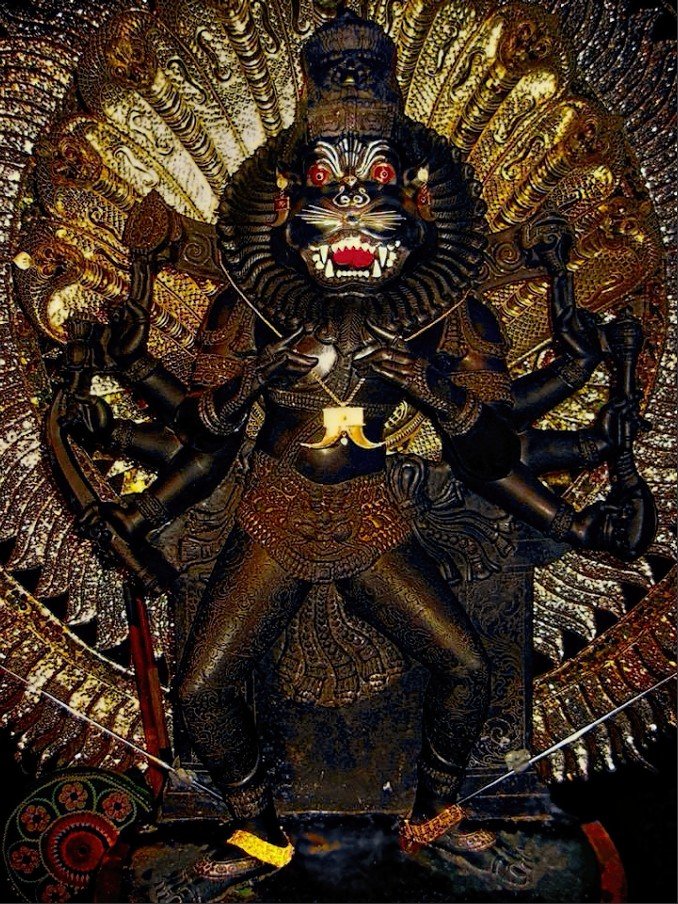
His guru took the sketch and looked at it knowingly. “Ah, this is ugra category,” he said, “but a Deity in this particular mood is called Sthānu-Nṛsiṁha. He doesn’t exist on this planet. Even the demigods in the heavenly planets don’t worship a form like this. Yes, this Deity belongs to the ugra category. Ugra means ferocious, very angry. There are nine forms within this category. They are all very fierce. The one they want is Sthānu-Nṛsiṁha: stepping out of the pillar. No. Don’t carve this Deity. It will not be auspicious for you. I will talk with you about this later.”
A few nights later the sthapati had a dream. In the dream his guru came to him and said, “For them you can carve Sthānu-Nṛsiṁha.” The next morning he received a hand-delivered letter from Kanchipuram. The letter was from the Śaṅkarācārya and gave some instructions regarding temple renovations. There was a footnote at the bottom. It read, “For ISKCON you can carve Sthānu-Nṛsiṁha.” The sthapati showed me the letter and said, “I have my guru’s blessings. I will carve your Deity.”
Source: The Appearance of Lord Nṛsiṁhadeva in Māyāpur, p. 12.
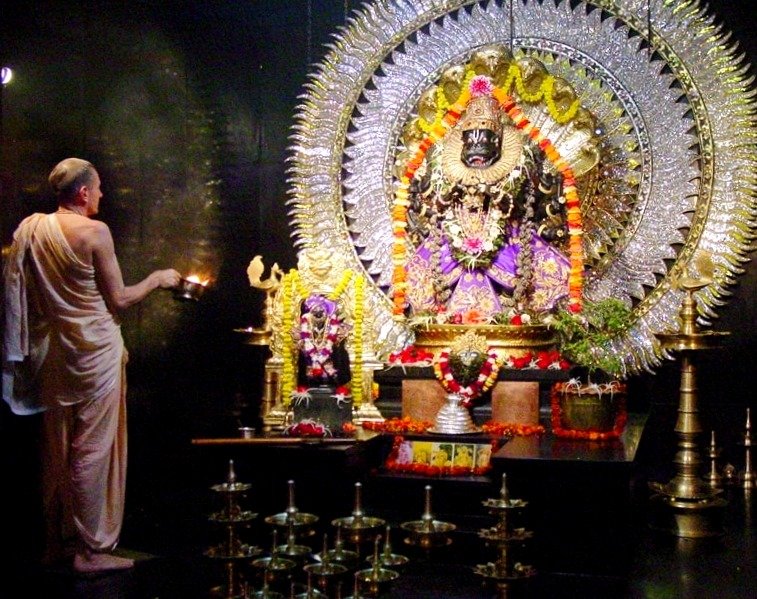
This rare form of Nṛsiṁhadeva is known as “Sthānu-Nṛsiṁha”, and this is the only place where this particular form of Nṛsiṁhadeva is known to be worshipped. With bent knees and in great anger with reddish eyes, He is ready to spring out of the pillar to attack the demons and protect His devotees. The Lord has eight arms. In six of His hands, He holds a sword, lotus flower, disc, conch, club and shield, and to keep the promise of Brahmā, His two front hands wield no weapons.
The Appearance of Lord Nṛsiṁhadeva in Māyāpur
Information – On the 24th of March, 1984, at 12:20 a.m., thirty-five dacoits (thieves) armed with weapons and bombs attacked Sri Mayapur Chandrodaya Mandir. They harassed the devotees and treated them with derision. But the greatest shock came when the dacoits decided to steal the Deities of Srila Prabhupada and Srimati Radharani. Fearlessly, the devotees challenged the attackers. How could they see Srila Prabhupada and Srimati Radharani carried away? Shots were fired, a few dacoits fell, and their plans were foiled. Srila Prabhupada was rescued, but that beautiful form of Srimati Radharani would no longer grace the main altar.
This incident really disturbed the minds of the devotees. Those involved in management were especially concerned to make some permanent solution. This was not the first time the devotees had faced violence and harassment in Mayapur. Bhavananda Dasa, who was the co-director of ISKCON Mayapur, suggested that Lord Nrsimhadeva be installed. When the dacoits had threatened devotees at the Yoga-Pitha, Srila Bhaktivinode Thakura and his son, Srila Bhaktisiddhanta Sarasvati Thakura, had promptly installed Sri Sri Laksmi Nrsimhadeva. There had been no further disturbances. Other devotees in Mayapur were not so keen to follow so closely in these footsteps. The pujari must be a naisthika-brahmacari (celibate from birth) and the worship of Lord Nrsimhadeva must be very strict and regulated…..
Source: The Appearance of Lord Nrsimhadeva in Mayapur, Page 8.
The installation of Lord Nṛsiṁhadeva took place over a three-day period, from July 28th to 30th, 1986.
The Extraordinary Story of ISKCON Māyāpur’s Divine Protector
For nearly four decades, Lord Prahlāda-Nṛsiṁhadeva has lovingly protected the devotees of Śrī Māyāpur-dhāma.
Every evening, thousands gather before His magnificent form to sing the famous Nṛsiṁha prayers taught by Śrīla Prabhupāda. Pilgrims pray for strength, protection, courage, and unwavering devotion, just as Prahlāda Mahārāja did thousands of years ago.
Yet few visitors know the remarkable story of how Lord Nṛsiṁhadeva came to Śrī Māyāpur.
It is a story filled with faith, determination, unexpected obstacles, miraculous events, and unmistakable signs of the Lord’s own divine arrangement.
A Need for Divine Protection
In the early hours of 24 March 1984, armed dacoits attacked the ISKCON Māyāpur temple.
The devotees bravely defended the temple and rescued the Deity of Śrīla Prabhupāda, but the violent attack deeply affected the community. It became clear that Māyāpur needed the special protection of Lord Nṛsiṁhadeva, the eternal guardian of His devotees.
Senior devotees remembered that when similar disturbances had occurred at Yogapīṭha many years earlier, Śrīla Bhaktivinoda Ṭhākura and Śrīla Bhaktisiddhānta Sarasvatī Ṭhākura had installed Śrī Śrī Lakṣmī-Nṛsiṁhadeva. After that, peace prevailed.
Inspired by this example, ISKCON Māyāpur resolved to invite Lord Nṛsiṁhadeva to His own temple.
Reference: “Lord Nṛsiṁhadeva Comes to Māyāpur,” pp. 6–7.
Designing the Protector
The devotees wanted a unique form of Lord Nṛsiṁhadeva.
They envisioned Him standing alert, with bent knees, powerful arms, curling fingers, and a searching glance—as if stepping from the pillar at the very moment He appeared to protect Prahlāda Mahārāja.
Artists prepared sketches based on these descriptions, and the design was enthusiastically approved.
Pankajanghrī Prabhu agreed to worship the Deity, while a generous devotee sponsored the carving.
Everything seemed ready.
Or so everyone thought.
Reference: pp. 6–7.
No Sculptor Would Accept the Work
Finding a sculptor proved almost impossible.
Master sthapatis throughout South India politely but firmly refused to carve such a fierce form.
Again and again the answer was simply:
“No.”
Months passed.
Finally, one renowned hereditary sculptor agreed to explain why.
Opening the ancient Śilpa-śāstras, he read descriptions of Lord Nṛsiṁhadeva:
• His flaming mane
• His searching glance
• His bent knees
• One foot stepping forward from the pillar
To everyone’s amazement, the scriptures described exactly the form the devotees had envisioned.
Although impressed by the design, the sculptor still declined to carve Him.
Reference: pp. 7–8.
The Guru’s Astonishing Dream
Before accepting the commission, the sculptor sought guidance from his spiritual master, the Śaṅkarācārya of Kāñcipuram.
The reply was immediate:
“Don’t do it.”
The guru explained that this particular form—Sthānu Nṛsiṁhadeva, the moment the Lord emerges from the pillar—was among the most powerful and rarely manifested forms of the Lord.
Such a Deity required extraordinary standards of worship.
A few days later something extraordinary happened.
The sculptor dreamed that his guru appeared and said:
“For ISKCON you can carve Sthānu Nṛsiṁhadeva.”
The following morning, a letter arrived from the Śaṅkarācārya.
At the bottom was a handwritten note repeating exactly the same instruction.
The sculptor immediately accepted the commission.
For everyone involved, it felt as though Lord Nṛsiṁhadeva Himself had removed the greatest obstacle.
Reference: pp. 8–9.
Searching for a Living Stone
The devotees expected carving to begin immediately.
Instead, another unexpected delay arose.
The sculptor refused to begin until he found the proper stone.
Not just any granite would do.
According to traditional temple architecture, only a “living stone” could become a Deity.
The stone had to pass ancient tests described in the scriptures.
When struck, it had to produce specific musical tones.
It also had to show signs of natural life within the stone itself.
Only then could the Lord’s beautiful expression fully manifest.
The search continued for months until the perfect stone was finally discovered.
Reference: pp. 9–10.
Every Detail Was Carved with Devotion
Once the stone had been found, everything changed.
The sculptor spent days simply sitting before the stone in meditation.
He hardly spoke.
He refused to let assistants begin carving until the Lord’s form had become clear in his heart.
Gradually the beautiful features emerged.
Every ornament…
Every expression…
Every finger…
Every curl of the mane…
was patiently carved by hand.
Although originally expected to take only six months, the work continued for more than a year until the sculptor was completely satisfied.
Reference: pp. 10–11.
A Miracle Before Departure
Soon after the Deity was completed, the sculptor locked Lord Nṛsiṁhadeva safely inside a thatched workshop and left to visit friends.
Only days later, disaster struck.
The workshop caught fire.
When the sculptor returned, the building had been completely destroyed.
Everything had burned.
Everything…
except Lord Nṛsiṁhadeva.
Standing untouched amid the ashes, the Deity remained completely unharmed.
The sculptor immediately contacted the devotees.
“Please come and take your Deity.
He has made it clear He wants to go now.”
It became one of the most cherished miracles in the history of Lord Nṛsiṁhadeva’s arrival in Māyāpur.
Reference: p. 11.
The Journey to Māyāpur
Transporting a one-ton stone Deity across India was no simple task.
Special permits were required from numerous government departments.
Normally such approvals would take weeks.
Instead, something remarkable happened.
Each official insisted on seeing the Deity.
After offering respectful obeisances, they signed the documents without delay.
Within twenty-four hours, every required permission had been granted.
The devotees felt certain that Lord Nṛsiṁhadeva Himself was clearing the way for His journey.
Reference: p. 11.
The Lord Was Already Present
Traditionally, the sculptor opens the Deity’s eyes during the installation ceremony.
This time was different.
Before the journey even began, the sculptor had already performed the sacred Netra-nimilana ceremony.
He had also personally performed Prāṇa-pratiṣṭhā, inviting the Lord to manifest within His Deity form.
Reflecting on the smooth journey to Māyāpur, Atma-tattva dāsa later concluded:
“The Lord was already present.
And who would dare say no to Lord Nṛsiṁhadeva?”
Reference: p. 11.
Installation in Śrī Māyāpur
From 28–30 July 1986, devotees gathered for the installation festival.
The ceremonies lasted three days.
Powerful kīrtana filled the temple.
The atmosphere was charged with devotion.
Atma-tattva dāsa remembered that although he had worried whether everything had been done properly, all anxiety disappeared as the holy name resounded throughout the temple.
Lord Nṛsiṁhadeva, the eternal protector of the saṅkīrtana movement, had finally arrived in Śrī Māyāpur.
Reference: pp. 11–12.
Did You Know?
Lord Nṛsiṁhadeva came to Māyāpur after the 1984 dacoit attack to protect the devotees.
Reference: pp. 6–7.
The first sculptors refused to carve such a powerful form.
Reference: pp. 7–8.
The Śaṅkarācārya first prohibited, then personally authorized, the carving after a remarkable dream.
Reference: pp. 8–9.
The sculptor searched for months before finding a suitable “living stone.”
Reference: pp. 9–10.
Lord Nṛsiṁhadeva’s workshop burned down, yet the Deity remained completely unharmed.
Reference: p. 11.
The Deity weighs approximately one tonne.
Reference: p. 11.
Every government official who inspected the Deity quickly approved the transport permits.
Reference: p. 11.
Lord Nṛsiṁhadeva was installed in ISKCON Māyāpur from 28–30 July 1986.
Reference: pp. 11–12.
Explore the Complete Story
The story of Lord Prahlāda-Nṛsiṁhadeva’s arrival in Śrī Māyāpur is a remarkable account of devotion, perseverance, and divine protection. The highlights shared here offer only a glimpse into the many memorable events surrounding His manifestation.
To discover more rare historical photographs, firsthand memories from Atma-tattva dāsa, and the complete story of Lord Nṛsiṁhadeva’s journey from South India to Māyāpur, we invite you to explore the beautifully illustrated flipbook:
Śrīla Prabhupāda Audio
Hear the original words of Śrīla Prabhupāda.
So Kṛṣṇa has got two businesses. One, to give protection to the devotee, and the other is to kill the demon. Just like Kṛṣṇa appeared as keśava dhṛta narahari-rūpa (Śrī Daśāvatāra Stotra 4), Nṛsiṁha-deva, and Narahari, Nṛsiṁha-deva, one side He was blessing Prahlāda Mahārāja, the devotee, and the other side He was killing his atheist father, Hiraṇyakaśipu. You have seen the picture. So Kṛṣṇa, when He has got the fighting spirit . . .
Because Kṛṣṇa is the source of everything, janmādy asya yataḥ (SB 1.1.1). Here in this world also, you find two things: friendship and hostility. Just like modern political atmosphere, sometimes there is conference of friendship, and sometimes there is fight with lethal weapons. So this duality is visible in this material world, but in the spiritual world there is no duality. There is absolute peace. . . (break).
So when He wants to fight, He comes here, because here there are many demons, so His fighting spirit is satisfied. Otherwise, for killing the demons, Kṛṣṇa does not require to descend. There are many agents of Kṛṣṇa. For example, this city, Visakhapatnam, on the seashore, if Kṛṣṇa desires, this whole city can be killed in a second, simply by overflooding the sea, or by storm. He has got many agents, parasya śaktir vividhaiva śruyate (Śvetāśvatara Upaniṣad’ 6.8, CC Madhya 13.65, purport). Or the material agent, Durgā devī, she can all . . . do all these things.
So Kṛṣṇa does not require to descend for killing the demons, but when He feels . . . just like a rich man sometimes feels to contest with some wrestler, that does not mean he requires it. That is the Kṛṣṇa spirit. He is all-blissful. So when Kṛṣṇa comes, descends, there are many demons. He especially comes for the devotee. But when He fights with the demon, that is also His favor, because anyone killed by Kṛṣṇa, he immediately attains liberation. Therefore Kṛṣṇa is absolute. Either He fights or blesses, the result is the same.
(720220 – Lecture SB 01.02.05 – Visakhapatnam)
So Prahlāda Mahārāja, he was such a nice devotee. And to protect him when he was just going to be killed by his father . . . and his father was very polit . . . good politician. He took benediction from Brahmā that he will not be killed by anyone. By policy he took benediction from Brahmā that, "I shall not be killed by man." "Oh, yes." "I shall not be killed by demigods." "That's all right." "I shall not be killed by any animal." "That's all right." "I shall not be killed in day." "That's all right." "You shall . . . I shall not be killed at night." "That's all right." "I shall not be killed by any weapon." "That's all right."
And he said: "Now it is finished. Everything is now secure. I cannot be killed in day. I cannot be killed at night. No man can kill him (me). No demigod can kill me. No animal can kill me. Then where is the killing? Everything finished." But God is so, cunning that He assumed neither man nor animal, and no weapons. He killed him with the nails. He never expected that "I will be killed by the nails." This is the definition by negation, defective definition. There the . . . in argument, if you define negatively, "This is not this. This is not this. This is not this," then something will come that will, I mean to say, nullify all your arguments. You see? So he protected himself in all negative ways, "This will not. This will not. This will not. This will not." Something came which was not in his power. So this Nṛsiṁhāvatāra.
(661220 - Lecture CC Madhya 20.294-298 - New York)