
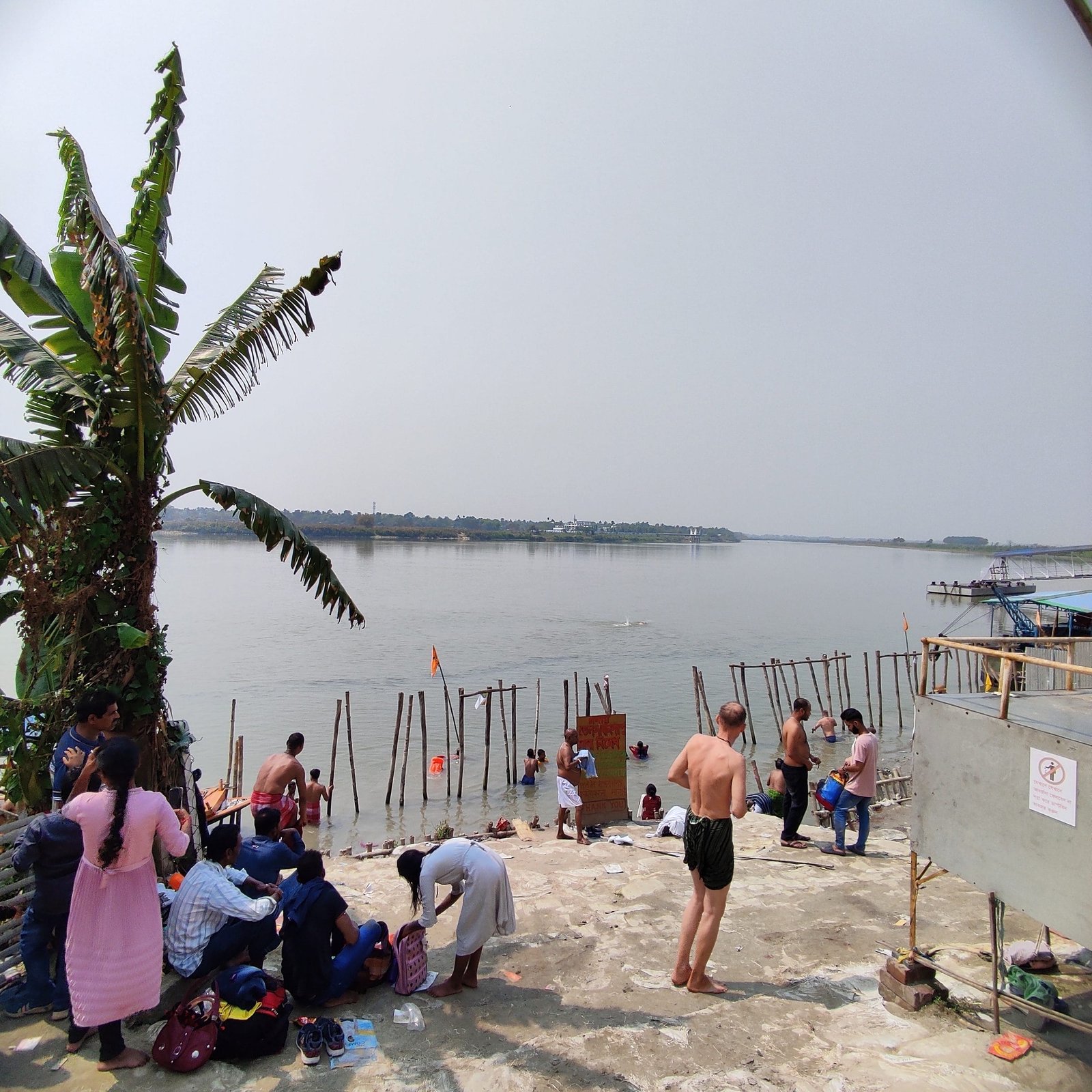
Bathing
Śrīla Prabhupāda Audio
Hear the original words of Śrīla Prabhupāda.
So there is a process of worshiping the river Ganges. And what is that? After you take your bath, you stand up to your waist filled up with water and take little water from the Ganges water and you offer, "Mother Ganges, I am offering this respect." This is the process.
Now, suppose you take a handful of water from the Ganges. What is the loss of Ganges water? And if you offer some handful of water in the Ganges, where is the gain? So this patraṁ puṣpaṁ phalaṁ toyam, a bit of flower, a bit of, I mean, a fruit and a bit of leaf, if you offer to the Supreme, do you mean to say He gains something? Or if you take it out of nature's—you are taking so many things—is He in loss? So He has no gain or loss. It is for your interest. When God accepts, He says: "Yes, I . . ." Aśnāmi: "I eat."
(661216 - Lecture BG 09.26-27 - New York)
So in Calcutta also, the . . . there are so many jute mills and factories on the riverside. All the night soil, they are thrown into the Ganges. So still the Ganges is so powerful that it keeps clear. Hundreds and thousands people, still they take bath in the Ganges, and they keep very good health, those who are taking bath regularly in the Ganges. And cities and town, there must be a river. In India you'll find, all the important cities in India, they are on the bank of the Ganges, on the bank of the Yamunā, on the bank of the Narmadā, Kṛṣṇā, Kāverī, like that, all the important cities. And Cāṇakya Paṇḍita says that "Don't go to a town and city where there is no river and where there is no friend and there is no temple. Don't go to that city. If there is no river, no friend and no temple, then that is . . . a great city is a great forest." So that is forbidden.
(741020 - Lecture SB 01.08.40 - Mayapur)
Of purifiers I am the wind, of the wielders of weapons I am Rāma, of fishes I am the shark, and of flowing rivers I am the Ganges.
(BG 10.31)
It has actually been seen that anyone who regularly worships mother Ganges simply by bathing in her water keeps very good health and gradually becomes a devotee of the Lord. This is the effect of bathing in the water of the Ganges. Bathing in the Ganges is recommended in all Vedic śāstras, and one who takes to this path will certainly be completely freed from all sinful reactions. The practical example of this is that the sons of Mahārāja Sagara went to the heavenly planets when water from the Ganges merely touched the ashes of their burnt bodies.
(Śrīmad-Bhāgavatam 9.9.14)
Lord Jagannātha is the Supreme Lord Himself in the form of wood, and the river Ganges is the Supreme Lord Himself in the form of water.
(CC Madhya 15.135)
Our Kṛṣṇa consciousness movement has therefore established two very large centers, one in Vṛndāvana and another in Māyāpur, Navadvīpa. There one may bathe in the Ganges or Yamunā, chant the Hare Kṛṣṇa mantra and thus become perfect and return home, back to Godhead.
(SB 6.5.27-28 purport)
In this regard there is the story of Vāmana, who, when He took three steps, stuck His foot through the covering of this universe. Water from the Causal Ocean flowed through the hole that His foot made, and it is said that that water became the river Ganges. Therefore the Ganges is accepted as the most sacred water of Viṣṇu and is worshiped by all Hindus, from the Himalayas down to the Bay of Bengal.
(CC Introduction)
That liberation attained by Brahman realization at other holy places is obtained simply by bathing in the Ganges at Navadvipa.
(Sri Navadvipa Dham Mahatmaya, Chapter one)
On the Phalguni Purnima, one who fasts, takes bath in the Ganges here, and worships Gauranga will cross over the material ocean along with his ancestors. Along with one thousand ancestors, he attains Goloka after death no matter where he dies.
(Sri Navadvipa-Dhama-Mahatmya, Chapter 6)
Having fallen upon the matted locks of Lord Siva, who is decorated with a garland of skulls, the Ganges takes on the appearance of millions of gleaming fish as her droplets glitter with the light reflected from the crescent moon on Siva's head.
Having emanated from the two lotus feet of the Lord, the pleasant, sweet streams of the Ganges purifies the universe as she flows forward in all directions. Indeed, the chaste Ganges has yielded within her spotless waters the most exalted place, Navadvīpa.
Though liquid in form, the Ganges dries up the ocean of material suffering; though white in color, she is famous for refreshing blackish Kṛṣṇa with her waters; though flowing on the earth, she is called by a heavenly name; and though she removes the confusion of the living entities, she is filled with whirlpools and eddies. Having attained the taste of the Lord's lotus feet, her waves and currents become agitated. Taking up her residence in Navadvipa she adds glory to that tract of land.
(Sri Navadvipa-Dhama-Mahatmya, Pramana-Khanda, Chapter 5)
This forgetfulness was so overwhelming that Advaita Prabhu was convinced that no one but Lord Kṛṣṇa Himself could enlighten people about devotional service to the Supreme Lord. Therefore Advaita requested Lord Kṛṣṇa to appear as Lord Caitanya. Offering tulasī leaves and Ganges water, He cried for the Lord’s appearance. The Lord, being satisfied by His pure devotees, descends to satisfy them. As such, being pleased by Advaita Ācārya, Lord Caitanya appeared.
(CC Adi 3 Summary)
“‘The greatness of mother Ganges always brilliantly exists. She is the most fortunate because she emanated from the lotus feet of Śrī Viṣṇu, the Personality of Godhead. She is a second goddess of fortune, and therefore she is always worshiped both by demigods and by humanity. Endowed with all wonderful qualities, she flourishes on the head of Lord Śiva.’”
(CC Adi 16.41)
To the southwest, the Ganges and Yamuna, considering their own good fortune, twist like a serpent as they flow. They come to serve Gaura, the jewel of the twice-born. Upon the Ganges’s banks are many ghātas, gardens, and temples of deities such as Praudha Maya and Vṛddha Siva.
(Sri Navadvipa Bhava-taranga)
The Ganges River, who was born from the lotus feet of Lord Visnu, appeared in Lord Caitanya's pastimes as Srimati Ganga-devi, the daughter of Lord Nityananda. Her husband, Sri Madhava, had formerly been Maharaja Santanu.
(Gaura-gaṇoddeśa-dīpikā 69)
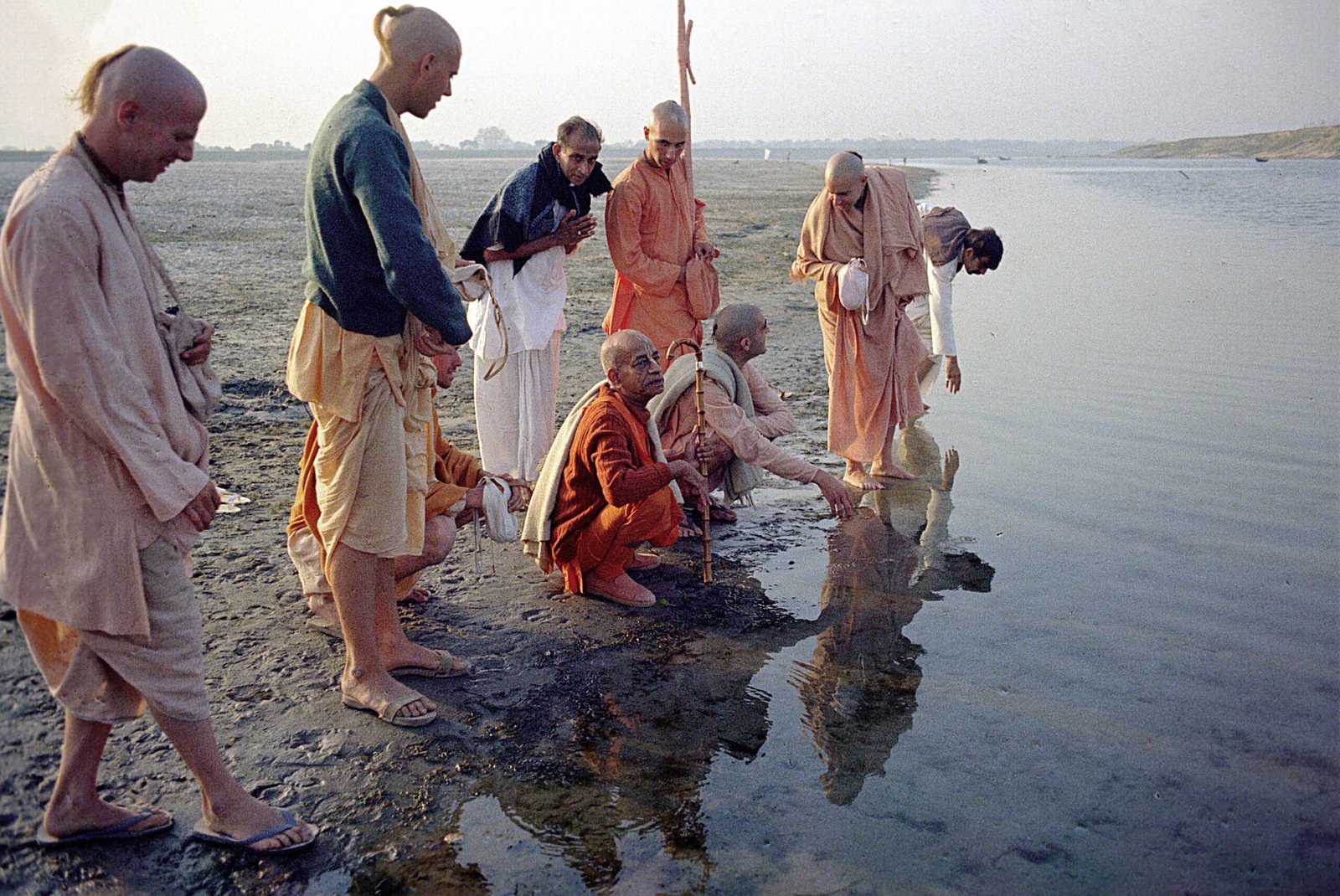
GAÑGĀ SNĀNA MANTRA
Adya me sarphalaṁ janma jīvitaṁ ca sujīvitaṁ
Because I am able to see you, the water form of Brahman, my birth is now fruitful and my life has been lived in a right manner.
Devī tvad-darśanād eva mahā-pātakino mama
O Devī, I am a great sinner. By your mere sight, the sins that I have committed in millions of lives have been destroyed.
Sadya pāṭaka-saṁhantrī sadyo duḥkha-vināśinī
sukhadā mokṣadā Gaṅgā gaṅgaiva parama-gatiḥ
Mother Gaṅgā removes all the sins instantly and destroys all the miseries. She bestows happiness and liberation, and she’s the ultimate refuge or destination.
*Then one should offer one’s most respectful obeisances (Sāṣṭaṅga Dandavat) to Mother Gaṅgā. Take little water and sprinkle it on one’s head. Thereafter one should pray with folded hands.
Gaṅge devi jagad-dhātrī pādābhyāṁ salilaṁ tava / spṛśāmi-ityaparādhaṁ me prasannā kṣantuṁ arhasi
O Goddess Gaṅgā! O Mother of the universe! May you be very kind and forgive my offense of touching (you) with my feet.
Svarga-rohaṇa-sopānaṁ tvadīyaṁ udakaṁ śubham / āpaḥ spṛśāmi pādābhyāṁ gaṅge devi namo namaḥ
O Goddess Gaṅgā! Your auspicious water is the ladder to ascend to heaven. I touch your water with my feet. I bow to you again & again.
*Then one should utter the holy name of Mother Gaṅgā “Śrī Gaṅge Śrī Gaṅge” and entering into the water, one should take a little Gaṅgā mud and smear it on one’s body and chant the following śloka.
Tvat-kardamair etaiḥ snigdhaiḥ sarva-pāpa-praṇāśanaiḥ / mayā samlipyate gātraṁ mātar me hara pātakam
Mother! I smear my body with this smooth mud from you. Please, take away my sins.
*Then one should utter the following verses before taking one’s bath.
Viṣṇu-pādābja-saṁbhūte gaṅge tripatha-gāminī / dharma-drave ’ti vikhyātā pāpaṁ me hara jāhnavī
O Gaṅgā, born from the lotus feet of Lord Viṣṇu, you traverses the three worlds. Your auspicious flowing waters are well known. O daughter of Jahnu, please remove my sins.
* Then one should take bath by chanting the following mantras.
Viṣṇu-pādaprasūtāsi vaiṣṇavī viṣṇu-pūjitā / trāhi mām enasaḥ tasmāt ajanma maraṇāntakāt
You were born from the lotus feet of Lord Viṣṇu, you are devotee of lord Viṣṇu and also worshiped by Lord Viṣṇu. Therefore, protect me from sins that binds me to the endless cycle of birth and death.
Śraddhayā dharma-saṁpūrṇe śrīmatā rājasā caite / amṛtena mahādevi bhāgīrathī puniṣa māṁ
O Bhāgīrathī, the great goddess full of auspiciousness, purify me with love by your nectarine and powerful dust.
Tribhiḥ ślokavarair etair yaḥ snāyāj jāhnavī-jale / janma-koṭi-kṛtāt pāpān mucyate nātra saṁśayaḥ
Anyone who takes bath in the water of Gaṅgā reciting these three great verses is undoubtedly freed from all the sins committed in millions of lifetimes.