
Śrī Śrī Pañca-tattva
As you navigate through the Altar, use these arrows to pause and offer your heart’s prayers to the Deities.
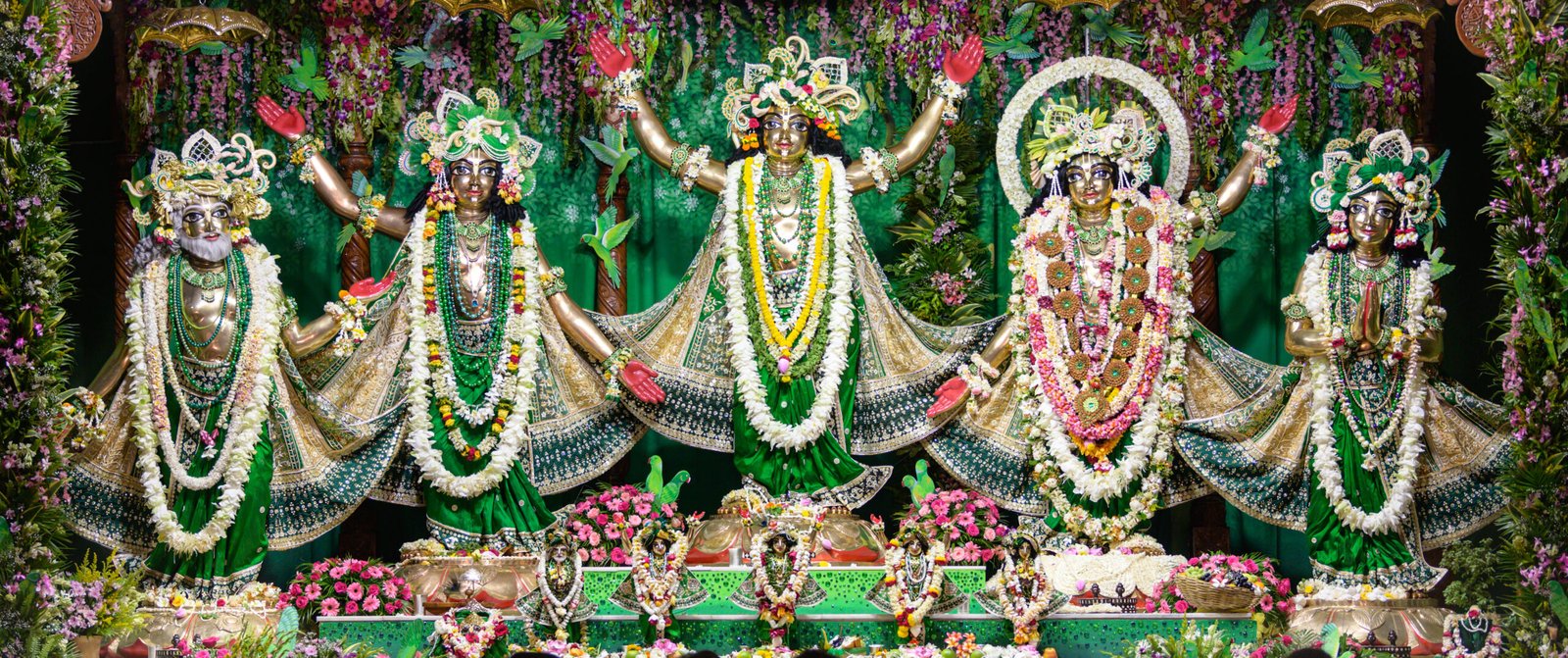
Lord Kṛṣṇa Caitanya surrounded (from left to right) by His avatāra (Advaita Ācārya), His expansion (Lord Nityānanda), His manifest internal energy (Śrī Gadādhara), and His perfect devotee (Śrī Śrīvāsa).
śrī-kṛṣṇa-caitanya prabhu-nityānanda
śrī-advaita gadādhara śrīvāsādi-gaura-bhakta vṛnda
All glories to Lord Śrī Kṛṣṇa Caitanya Mahāprabhu, Lord Nityānanda, Advaita Ācārya, Gadādhara Paṇḍita Prabhu, Śrīvāsa Ṭhākura and all those devotees who follow in their footsteps.
Sri Caitanya Mahaprabhu is always accompanied by His plenary expansion Sri Nityananda Prabhu, His incarnation Sri Advaita Prabhu, His internal potency Sri Gadadhara Prabhu, and His marginal potency Srivasa Prabhu. He is in the midst of them as the Supreme Personality of Godhead. One should know that Sri Caitanya Mahaprabhu is always accompanied by these other tattvas. Therefore our obeisances to Sri Caitanya Mahaprabhu are complete when we say, sri-krishna-caitanya prabhu nityananda sri-advaita gadadhara srivasadi-gaura-bhakta-vrinda. As preachers of the Krishna consciousness movement, we first offer our obeisances to Sri Caitanya Mahaprabhu by chanting this Panca-tattva mantra; then we say,
hare kṛṣṇa hare kṛṣṇa kṛṣṇa kṛṣṇa hare hare
hare rāma hare rāma rāma rāma hare hare
namo mahā-vadānyāya kṛṣṇa-prema-pradāya te
kṛṣṇāya kṛṣṇa-caitanya- nāmne gaura-tviṣe namaḥ
O most munificent incarnation! You are Kṛṣṇa Himself appearing as Śrī Kṛṣṇa Caitanya Mahāprabhu. You have assumed the golden color of Śrīmatī Rādhārāṇī, and You are widely distributing pure love of Kṛṣṇa. We offer our respectful obeisances unto You.
(CC Madhya 19.53)
pañca-tattvātmakaṁ kṛṣṇaṁ bhakta-rūpa-svarūpakam
bhaktāvatāraṁ bhaktākhyaṁ namāmi bhakta-śaktikam
I offer my obeisances unto the Supreme Lord, Kṛṣṇa, who is nondifferent from His features as a devotee, devotional incarnation, devotional manifestation, pure devotee and devotional energy.
(CC Adi 1.14)
kṛṣṇa-varṇaṁ tviṣākṛṣṇaṁ sāṅgopāṅgāstra-pārṣadam
yajñaiḥ saṅkīrtana-prāyair yajanti hi su-medhasaḥ
“In the Age of Kali, people who are endowed with sufficient intelligence will worship the Lord, who is accompanied by His associates, by performance of saṅkīrtana-yajña.” (SB 11.5.32) Śrī Caitanya Mahāprabhu is always accompanied by His plenary expansion Śrī Nityānanda Prabhu, His incarnation Śrī Advaita Prabhu, His internal potency Śrī Gadādhara Prabhu and His marginal potency Śrīvāsa Prabhu. He is in the midst of them as the Supreme Personality of Godhead.
(CC Adi 7.4 purport)
Lord Śrī Kṛṣṇa Caitanya is Kṛṣṇa [Vrajendra-kumāra], the embodiment of rasas. He is amorous love personified. (CC Adi 4.222)
Balarāma appeared with Him as Lord Nityānanda. (CC Adi 5.6)
Lord Advaita Ācārya is the incarnation of Mahā-Viṣṇu. (CC Ādi 6.4)
Gadādhara Paṇḍita is simultaneously an incarnation of Śrīmatī Rādhārāṇī and Lalitā-sakhī. (CC Adi 10.15)
Śrīvāsa Paṇḍita was an incarnation of Nārada Muni. (CC Adi 12.65)
Śrī Gaurāṅga, Śrī Nityānanda, Śrī Advaita, Śrī Gadādhara and Śrīvāsa are all on the same platform, but in spiritually distinguishing between them one should understand that Śrī Caitanya Mahāprabhu is the form of a devotee, Nityānanda Prabhu appears in the form of a devotee’s spiritual master, Advaita Prabhu is the form of a bhakta (devotee) incarnation, Gadādhara Prabhu is the energy of a bhakta, and Śrīvāsa is a pure devotee.
(CC Adi 7.5 purport)
The characteristics of Kṛṣṇa are understood to be a storehouse of transcendental love. Although that storehouse of love certainly came with Kṛṣṇa when He was present, it was sealed. But when Śrī Caitanya Mahāprabhu came with His associates of the Pañca-tattva, they broke the seal and plundered the storehouse to taste transcendental love of Kṛṣṇa. The more they tasted it, the more their thirst for it grew.
(CC Adi 7.20-21)
Śrī Pañca-tattva themselves danced again and again and thus made it easier to drink nectarean love of Godhead. They danced, cried, laughed and chanted like madmen, and in this way they distributed love of Godhead.
(CC Adi 7.22)
In distributing love of Godhead, Caitanya Mahāprabhu and His associates did not consider who was a fit candidate and who was not, nor where such distribution should or should not take place. They made no conditions. Wherever they got the opportunity, the members of the Pañca-tattva distributed love of Godhead. Although the members of the Pañca-tattva plundered the storehouse of love of Godhead and ate and distributed its contents, there was no scarcity, for this wonderful storehouse is so complete that as the love is distributed, the supply increases hundreds of times.
(CC Adi 7.23 – 7.24)
When the five members of the Pañca-tattva saw the entire world drowned in love of Godhead and the seed of material enjoyment in the living entities completely destroyed, they all became exceedingly happy. The more the five members of the Pañca-tattva cause the rains of love of Godhead to fall, the more the inundation increases and spreads all over the world.
(CC Adi 7.27 – 7.28)
In his Anubhāṣya, Śrī Bhaktisiddhānta Sarasvatī Ṭhākura, describing the truth about the Pañca-tattva, explains that we should understand that Lord Śrī Caitanya Mahāprabhu is the supreme predominator and that Nityānanda Prabhu and Advaita Prabhu are His subordinates but are also predominators. Lord Śrī Caitanya Mahāprabhu is the Supreme Lord, and Nityānanda Prabhu and Advaita Prabhu are manifestations of the Supreme Lord. All of Them are viṣṇu-tattva, the Supreme, and are therefore worshipable by the living entities. Although the other two tattvas within the category of Pañca-tattva—namely, śakti-tattva and jīva-tattva, represented by Gadādhara and Śrīvāsa—are worshipers of the Supreme Lord, they are in the same category because they eternally engage in the transcendental loving service of the Lord.
(CC Adi 7.15 purport)
Śrī Kṛṣṇa Caitanya Mahāprabhu and His associates of the Pañca-tattva distributed the holy name of the Lord to invoke love of Godhead throughout the universe, and thus the entire universe was thankful.
(CC Adi 7.163)
By remembering the lotus feet of the Pañca-tattva, a dumb man can become a poet, a lame man can cross mountains, and a blind man can see the stars in the sky.
(CC Adi 8.5)
The yogīs should contemplate with full devotion the compassionate glances frequently cast by the Lord’s eyes, for they soothe the most fearful threefold agonies of His devotees. His glances, accompanied by loving smiles, are full of abundant grace.
(SB 3.28.31)
In verses 296 through 301 the emotional devoted service of Śrī Nityānanda, Śrī Advaita Prabhu and others has been fully described. Describing such individual service, the Gaura-gaṇoddeśa-dīpikā (11-16) declares that although Lord Caitanya Mahāprabhu appeared as a devotee, He is none other than the son of Nanda Mahārāja. Similarly, although Śrī Nityānanda Prabhu appeared as Lord Caitanya’s assistant, He is none other than Baladeva, the carrier of the plow. Advaita Ācārya is the incarnation of Sadāśiva from the spiritual world. All the devotees headed by Śrīvāsa Ṭhākura are His marginal energy, whereas the devotees headed by Gadādhara Paṇḍita are manifestations of His internal potency.
(CC Adi 17.301 purport)
So all these persons associated with Kṛṣṇa, Śrī Kṛṣṇa Caitanya, Śrī Nityānanda, Śrī Advaita, and Gadādhara and Śrīvāsa, all of them, they are one. One in this sense: they are all interested how to push on Kṛṣṇa consciousness. Śrī Kṛṣṇa Caitanya Mahāprabhu, He’s trying personally, the Supreme Personality of Godhead. And Nityānanda Prabhu, Advaita Prabhu, Śrīvāsa, Gadādhara, they are trying to help. So . . . and to approach all these five supreme persons, you require the help of guru. Therefore the guru is offered first the respectful prayers, vande gurūn. And gurūn, bahu-vacana, plural number, that many gurus. But they are not many; they are one, guru-tattva. Just like Kṛṣṇa has many forms, but that does not mean Kṛṣṇa is different. No. Kṛṣṇa is one. Similarly, guru, there may be many gurus, it doesn’t matter, but their philosophy must be one: to teach everyone that Kṛṣṇa is the Supreme Personality of Godhead.
(750325 – Lecture CC Adi 01.01 – Mayapur)
Information –
In Srila Prabhupāda’s Centennial Year, 1996, Māyāpur Candrodaya Mandir would undergo another change in Deity worship with the arrival of Sri Pañca-tattva, and the temple expanded yet again to accommodate Them. Their worship commenced on Gaura-pūrnima of that year.
But the most amazing change was yet to come: the arrival in 2004 of the big Pañca-tattva Deities. That event saw a new era commence in ISKCON.
“When Radha-Madhava were installed, there were definitely feelings of transcendence,” Jananivāsa says. “When we went up to instal the chakra after They were installed, you could feel They were manifesting something. But nothing like the installation of Pañca-tattva. Even before They were installed, there was so much mercy there.”
Both installations were many years apart. Was this, then, a maturation of devotional sentiment, or the mercy of the Lord?
“I would say it was an act of mercy, of Their sweet will,” Jananivāsa says. “We had fulfilled a desire of Śrīla Prabhupāda’s to bring these Deities, and the overwhelming feelings that everyone experienced was Śrī Pañca-tattva manifesting Their presence.”
Worldwide, devotees felt that merciful glance of Śrīla Caitanya Mahāprabhu and His associates; they experienced the abundant grace that emanates from the Deity form of the Lord, and all were swept up in an unmistakable shower of love of God.
Jananivāsa concludes, “It’s not something you can create. It’s something that, no matter how hard you try, you can’t produce it. Grace comes of it’s own accord.”
Śrīla Prabhupāda Audio
Hear the original words of Śrīla Prabhupāda.
Śrī Kṛṣṇa Caitanya Mahāprabhu is practically teaching us with His five associates: Advaita, Nityānanda, Gadādhara and śrīvāsādi gaura-bhakta-vṛnda. Therefore if we want to approach the Absolute Truth, it is our duty to offer our respect to these five features of the Lord.
śrī-kṛṣṇa-caitanya prabhu-nityānanda
śrī-advaita gadādhara śrīvāsādi-gaura-bhakta-vṛnda
Therefore, in our Kṛṣṇa consciousness movement, we first of all worship the Pañca-tattva: śrī-kṛṣṇa-caitanya prabhu-nityānanda śrī-advaita gadādhara—then we chant Hare Kṛṣṇa mahā-mantra. Then it will be successful. Without going through the Pañca-tattva, with the mercy, nobody can understand Kṛṣṇa. It will remain a myth. Therefore Kṛṣṇa says:
manuṣyāṇāṁ sahasreṣu
kaścid yatati siddhaye
yatatām api siddhānāṁ
kaścid vetti māṁ tattvataḥ
(BG 7.3)
You cannot understand Kṛṣṇa without the mercy of these Pañca-tattva. Therefore Kṛṣṇa, although He came personally, He taught the teachings of Bhagavad-gītā and asked people, sarva-dharmān parityajya mām ekaṁ śaraṇaṁ vraja (BG 18.66). But because we are mūḍhas, we misunderstood Kṛṣṇa. We could not take the last instruction of Kṛṣṇa. Therefore Kṛṣṇa again came as Śrī Caitanya Mahāprabhu to teach us how to approach Kṛṣṇa. If we read the life of Caitanya Mahāprabhu, His acceptance of sannyāsa order, His preaching all over India, His chanting and dancing, His living at Jagannath Purī, His activities, His meeting with the devotees, His Guṇḍicā-mārjana, His Ratha-yātrā kīrtana—if we study all these activities of Śrī Caitanya Mahāprabhu, immediately you understand Kṛṣṇa.
(740303 - Lecture CC Adi 07.03 - Mayapur)
Śrī Caitanya Mahāprabhu appeared here at Māyāpur, this very place where you are now sitting, with all these five features: Nityānanda Prabhu, Śrī Advaita Prabhu and Gadādhara Prabhu, Śrīnivāsa Prabhu. So He Himself, Kṛṣṇa, and Nityānanda Prabhu is immediate expansion of His personal self—Advaita Prabhu is incarnation of Kṛṣṇa, or Viṣṇu, Mahāviṣṇu, three; and Gadādhara Prabhu is the expansion of spiritual energy; and Śrīnivāsa Prabhu is the expansion of His marginal potency, marginal energy, jīva-tattva. Jīva-tattva, śakti-tattva, prakāśa-tattva, and avatāra-tattva, and He Himself. This pañca-tattva.
(740303 - Lecture CC Adi 07.03 - Mayapur)
Just like Lord Caitanya Mahāprabhu, His personal expansion is Nityānanda Prabhu and Advaita Prabhu. And Śrīvāsādi, they are separated expansion.
Although they are associates, but Śrīvāsa, jīva-tattva; and Nityānanda Prabhu and Advaita Prabhu, viṣṇu-tattva. And Gadādhara is śakti-tattva. So in this way, God is person, and His personal expansions are innumerable, unlimited. The viṣṇu-tattva, They are worshipable. And other tattva, śakti-tattva and jīva-tattva, they are meant for service. But all together taken, that is one. That is Absolute Truth.
(721002 - Lecture SB 01.03.27 - Los Angeles)
pañca-tattvātmakaṁ kṛṣṇaṁ
bhakta-rūpa-svarūpakam
bhaktāvatāraṁ bhaktākhyaṁ
namāmi bhakta-śaktikam
(CC Adi 1.14)
So Śrī Kṛṣṇa Caitanya Mahāprabhu has five features. Kṛṣṇa has five features. Kṛṣṇa means these five features. What are those? Kṛṣṇa, Kṛṣṇa’s manifestation, Kṛṣṇa’s incarnation, Kṛṣṇa’s different potencies, in this way. And Kṛṣṇa, the source of devotional service, He is Kṛṣṇa Caitanya, bhakta-śaktikam. To advance in devotional service requires spiritual strength. It is not so easy thing. That spiritual strength is also Kṛṣṇa, bhakta-śaktikam. There is nothing except Kṛṣṇa. Ekaṁ brahmā dvitīya-nāsti. So we have to understand Him especially in these five features for advancing in devotional service. Therefore His name is pañca-tattvātmakam, with five features, kṛṣṇam, bhakta-rūpa-svarūpakam. Kṛṣṇa is so kind upon us that He is coming as He is, Kṛṣṇa’s original, and trying to convince us about the necessity of our life, or the goal of our life. Prayojana. Prayojana: it is necessary. It is not optional—compulsory. If you don’t take to Kṛṣṇa consciousness, then you will continue to suffer; therefore it is necessity. It is not that if you like, you can take it; if you don’t like, you reject it. If you reject it, then you will suffer. And if you take it, then actually you will enjoy life.
(750407 – Lecture CC Adi 01.14 – Mayapur)
The best thing is . . . because Śrī Caitanya Mahāprabhu appeared in His five different features, therefore the ācāryas, they worship all of them at a time. That is our prayer:
śrī-kṛṣṇa-caitanya prabhu-nityānanda
śrī-advaita gadādhara śrīvāsādi-gaura-bhakta-vṛnda
This is the varieties, transcendental varieties, different taste. Nityānanda Prabhu is guru-tattva, and Caitanya Mahāprabhu is sevya-tattva. The guru is teaching; Nityānanda Prabhu is teaching how to worship Śrī Caitanya Mahāprabhu.
bhaja gaurāṅga kaha gaurāṅga laha gaurāṅgera nāme
ye jana gaurāṅga bhaje sei amāra prāṇa re
This is Nityānanda Prabhu's business. Narottama dāsa Ṭhākura says that gaurāṅgera balite habe, pulaka śarīre, hari hari balite, nayane ba'be nīra. Gaurāṅga.
So to become immediately in ecstasy of transcendental love, if we chant this śrī-kṛṣṇa-caitanya prabhu-nityānanda, it is easier. There is no offense in chanting this pañca-tattva, but there is offense if you do not properly chant Hare Kṛṣṇa mantra. There are ten kinds of offenses, you know. But in chanting śrī-kṛṣṇa-caitanya prabhu-nityānanda, there is no aparādha. You chant in any way, you'll get the result. This is the difference, taste. This is variety. Although there is no difference by chanting śrī-kṛṣṇa-caitanya prabhu-nityānanda and Hare Kṛṣṇa mantra, mahā-mantra, but still, by chanting this pañca-tattva, you'll get immediately, quickly, result. Therefore our process is to chant the holy names of the Pañca-tattva and then we chant Hare Kṛṣṇa mahā-mantra. That is perfect.
(740307 - Lecture CC Adi 07.05 - Mayapur)
This philosophy, acintya-bhedābheda, simultaneously one and different, is our philosophy, inaugurated by Śrī Caitanya Mahāprabhu, although it is in the Vedānta-sūtras. So everything is simultaneously one and different from the Supreme Lord. But there are two classes of philosophers. One class says that God and the living entities are different, and there is another philosopher, monist philosopher; they say God and the living entities are one.
So this acintya-bhedābheda philosophy adjusts that, "God and the living creatures, they are simultaneously one and different." They are one in quality, just like the energy and the energetic, the sun globe and the sunshine. In quality, in sunshine there is heat, there is illumination, light. In the sun globe also, there is heat, there is illumination. But the degrees are quite different. You can bear the heat and illumination of the sunshine, but you cannot go to the sun globe, or you can bear the heat and temperature there. The scientist says that so many millions miles away, if somebody goes or some planet goes near the sun globe, it will immediately burn into ashes.
Similarly, God and ourself, Kṛṣṇa and living entities, they are qualitatively one, but quantitatively, we are very minute.
(690827 - Lecture Initiation - Hamburg)
Suppose we are worshiping here. The Māyāvādī will say: "They are worshiping a brass, metal Deity." So are we so fools that we are spending so much money for worshiping a lump of metal? That they do not know. This is acintya-bhedābheda. And fact is there. Kṛṣṇa is omnipotent. He can accept your service in any way, as He likes. This is called arcā-vigraha. As Kṛṣṇa's avatāra is there, here is also another avatāra, arcā-vigraha. He is so kind. You cannot see Kṛṣṇa, you cannot touch Kṛṣṇa at the present moment, but Kṛṣṇa is so kind that He appears before you as you can touch, you can dress, you can offer your respect, you can see. That is Kṛṣṇa's mercies. But don't think that Kṛṣṇa has become metal. No. And even if He becomes metal, there is no difference. And what is this metal? That is Kṛṣṇa's energy. We have to understand in that way. So this acintya-bhedābheda-tattva.
(740307 - Lecture CC Adi 07.05 - Mayapur)