
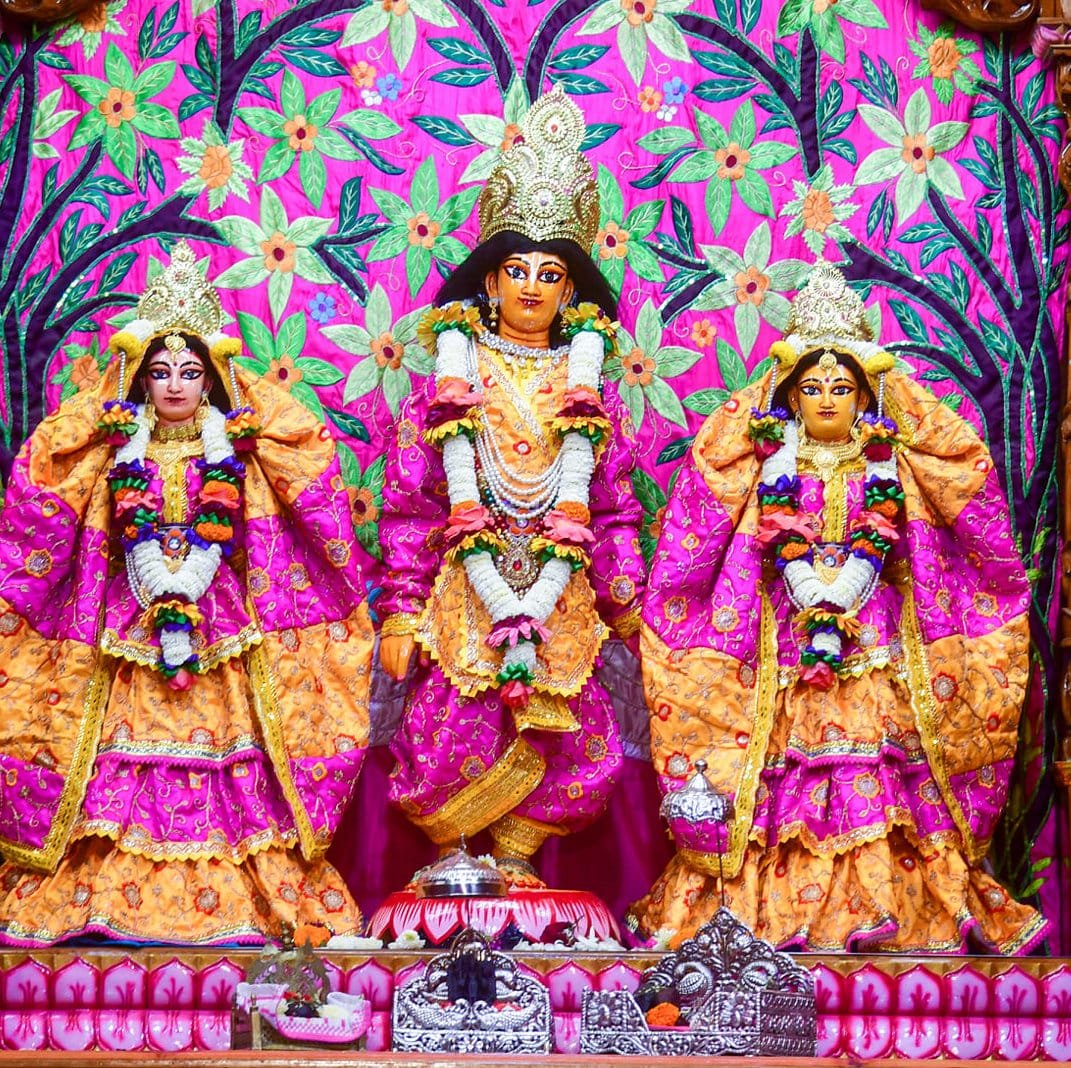
Sri Gaur Sundar & Sri Laksmipriyadevi & Sri Visnupriyadevi
Information – On the middle altar is Gaura Narayana along with His two consorts. On His right is Lakshmipriyadevi and on His left is Vishnupriyadevi.
My worshipable Lord eternally resides at Māyāpur, situated on the east bank of the Ganges. Although in the eyes of common people, Viśvambhara took sannyāsa and left Navadvīpa to go elsewhere, actually My Gaurāṅga never gives up Māyāpur or Navadvīpa. The devotees can perceive His daily pastimes. You, Jīva, will also see Gaurāṅga dancing.
(Sri Navadvipa-Dhama-Mahatmya, Chapter 5)
Lord Śrī Caitanya Mahāprabhu, the great apostle of love of God and the father of the congregational chanting of the holy name of the Lord, advented Himself at Śrīdhāma Māyāpura, a quarter in the city of Navadvīpa in Bengal, on the Phālgunī Pūrṇimā evening in the year 1407 Śakābda (corresponding to February 1486 by the Christian calendar).
His father, Śrī Jagannātha Miśra, a learned brāhmaṇa from the district of Sylhet, came to Navadvīpa as a student because at that time Navadvīpa was considered to be the center of education and culture. He domiciled on the banks of the Ganges after marrying Śrīmatī Śacīdevī, a daughter of Śrīla Nīlāmbara Cakravartī, the great learned scholar of Navadvīpa.
Jagannātha Miśra had a number of daughters by his wife, Śrīmatī Śacīdevī, and most of them expired at an early age. Two surviving sons, Śrī Viśvarūpa and Viśvambhara, became at last the object of their paternal affection. The tenth and youngest son, who was named Viśvambhara, later became known as Nimāi Paṇḍita and then, after accepting the renounced order of life, Lord Śrī Caitanya Mahāprabhu.
Lord Śrī Caitanya Mahāprabhu exhibited His transcendental activities for forty-eight years and then disappeared in the year 1455 Śakābda at Purī.
For His first twenty-four years He remained at Navadvīpa as a student and householder. His first wife was Śrīmatī Lakṣmīpriyā, who died at an early age when the Lord was away from home. When He returned from East Bengal He was requested by His mother to accept a second wife, and He agreed. His second wife was Śrīmatī Viṣṇupriyā Devī, who bore the separation of the Lord throughout her life because the Lord took the order of sannyāsa at the age of twenty-four, when Śrīmatī Viṣṇupriyā was barely sixteen years old.
(SB introduction)
O my Lord! You are eternally existing—in the past, present, and future—yet You are the son of Śrī Jagannātha Miśra. I offer my repeated obeisances unto You along with Your associates (Your devotee servants), Your sons (Your Gosvāmī disciples or the processes of devotional service, such as the congregational chanting of the holy name), and Your consorts (who, according to regulative principles, refer to Viṣṇupriyā, who is Bhū-śakti, Lakṣmīpriyā, who is Śrī-śakti, and Navadvīpa, which is Nīlā, Līlā, or Durgā, and, according to devotional principles, refer to the two Gadādharas, Narahari, Rāmānanda, Jagadānanda, and others).
(Śrī Caitanya-bhāgavata, Ādi-khaṇḍa 1.2)
We offer our respectful obeisances unto the lotus feet of the Lord, upon whom one should always meditate. He left His householder life, leaving aside His eternal consort, whom even the denizens of heaven adore. He went into the forest to deliver the fallen souls, who are put into illusion by material energy.” To accept sannyāsa means to commit civil suicide, but sannyāsa is compulsory, at least for every brāhmaṇa, every first-class human being. Śrī Caitanya Mahāprabhu had a very young and beautiful wife and a very affectionate mother. Indeed, the affectionate dealings of His family members were so pleasing that even the demigods could not expect such happiness at home. Nevertheless, for the deliverance of all the fallen souls of the world, Śrī Caitanya Mahāprabhu took sannyāsa and left home when He was only twenty-four years old. He lived a very strict life as a sannyāsī, refusing all bodily comforts.
(SB 6.10.8)
One day a girl of the name Lakṣmī, the daughter of Vallabhācārya, came to the bank of the Ganges to take bath in the river and worship the demigods.
PURPORT
According to the Gaura-gaṇoddeśa-dīpikā, verse 45, Lakṣmī was formerly Jānakī, the wife of Lord Rāmacandra, and Rukmiṇī, the wife of Lord Kṛṣṇa in Dvārakā. The same goddess of fortune descended as Lakṣmī to become the wife of Lord Caitanya Mahāprabhu.
(CC Adi 14.62)
Seeing Lakṣmīdevī, the Lord became attached to her, and Lakṣmī, upon seeing the Lord, felt great satisfaction within her mind. Their natural love for one another awakened, and although it was covered by childhood emotions, it became apparent that they were mutually attracted. They both enjoyed natural pleasure in seeing each nother, and under the pretext of demigod worship they manifested their feelings. The Lord told Lakṣmī, “Just worship Me, for I am the Supreme Lord. If you worship Me, certainly you will get the benediction you desire.” On hearing the order of the Supreme Lord, Śrī Caitanya Mahāprabhu, Lakṣmī immediately worshiped Him, offering sandalwood pulp and flowers for His body, garlanding Him with mallikā flowers, and offering prayers. Being worshiped by Lakṣmī, the Lord began to smile. He recited a verse from Śrīmad-Bhāgavatam and thus accepted the emotion she expressed. “My dear gopīs, I accept your desire to have Me as your husband and thus worship Me. I wish your desire to be fulfilled because it deserves to be so.” After thus expressing their feelings to each other, Lord Caitanya and Lakṣmī returned home. Who can understand the grave pastimes of Lord Caitanya Mahāprabhu?
(CC Adi 14.63 – 14.70)
One day when the Lord was coming back from school He accidentally saw the daughter of Vallabhācārya on the way to the Ganges. When the Lord and Lakṣmīdevī met, their relationship awakened, having already been settled, and coincidentally the marriage-maker Vanamālī came to see Śacīmātā.
(CC Adi 15.28 – 15.29)
Because the Lord was engaged in various ways in preaching work in East Bengal, His wife, Lakṣmīdevī, was very unhappy at home in separation from her husband. The snake of separation bit Lakṣmīdevī, and its poison caused her death. Thus she passed to the next world. She went back home, back to Godhead. Lord Caitanya knew about the disappearance of Lakṣmīdevī because He is the Supersoul Himself. Thus He returned home to solace His mother, Śacīdevī, who was greatly unhappy about the death of her daughter-in-law. When the Lord returned home, bringing with Him great wealth and many followers, He spoke to Śacīdevī about transcendental knowledge to relieve her of the grief she was suffering.
(CC Adi 16.20 – 16.23)
Prabhupāda: Yes. Caitanya Mahāprabhu went to East Bengal for teaching, and actually, the girl felt too much separation, and she died. And figuratively it is used that the separation took the form of a serpent and bitten her, and she died. And when He came back His mother requested that “You should marry for the second time,” and He agreed. And so next marriage was with Viṣṇupriyā.
(690804 – Conversation on Lord Caitanya Play – Los Angeles)
The Ādi-khaṇḍa describes the disappearance of Lakṣmīpriyā and the Lord’s second marriage with the daughter of the Rāja Paṇḍita.
COMMENTARY
The Lord’s first wife was Lakṣmīpriyādevī. The word vijaya in this verse indicates that she gave up her body and returned to her own abode. The Lord then married Śrī Viṣṇupriyādevī, the daughter of Sanātana Miśra, who was the king’s priest.
(Śrī Caitanya-bhāgavata, Ādi-khaṇḍa 1.110)
Śrī Sanātana Miśra took birth in the family of Rāja-paṇḍitas. Poets headed by Jayadeva, the author of Śrī Gīta-govinda, were renowned as Rāja-paṇḍitas. Lakṣmīdevī, the daughter in the family of Rāja-paṇḍitas, incarnated to serve Śrī Śrī Gaura-Nārāyaṇa. On seeing Śrī Gaura- Nārāyaṇa’s display of vipralambha rather than opulence, Śrī Lakṣmī could not remain steady. In order to serve the Lord’s vipralambha pastimes, she abandoned all the opulence of Vaikuṇṭha and manifested a mood of subordination to Lord Caitanya’s feelings of separation in the pastimes of Śrī Caitanya. In order to demonstrate that the feelings of separation, which enhance the concept of conjugal pastimes, that Lord Kṛṣṇa exhibited in His Gaura pastimes are supremely relevant for unfortunate people, Gaurasundara became the life and soul of the Rājapaṇḍita’s daughter. May those pastimes be glorified.
(Śrī Caitanya-bhāgavata, Madhya-khaṇḍa 13.254 Commentary)
Such a wonderful effulgence constantly emanated from the house that mother Śacī could not even see properly.
COMMENTARY
By the arrival of Śrīmatī Lakṣmīpriyā-devī, who is the direct personification of one of the Supreme Lord’s internal potencies, known as Śrī-śakti, the house of Śrī Śacī actually became the effulgent Vaikuṇṭha abode of the Supreme Lord.
(Śrī Caitanya-bhāgavata, Adi-khaṇḍa 10.121 Commentary)
Some days Lakṣmī would sit and hold the Lord’s feet for hours.
COMMENTARY
In order to reveal within this world the glories and opulences of serving the lotus feet of Gaura-Nārāyaṇa, Lakṣmīpriyā-devī, who is attached to service in the mood of awe and reverence, often exhibited pastimes as the maidservant of Gaura, by holding the Lord’s lotus feet on her lap.
(Śrī Caitanya-bhāgavata, Adi-khaṇḍa 14.45 Commentary)
The Lord told His mother, “Dear mother, I will go on a journey for a few days.” Śrī Gaurasundara then said to Lakṣmī, “You should constantly serve mother.”
(Śrī Caitanya-bhāgavata, Adi-khaṇḍa 14.50-51)
Meanwhile, in Navadvīpa, Lakṣmī was in great distress due to separation from the Lord. She did not reveal this to anyone. She kept always engaged in the service of mother Śacī without eating anything since the Lord’s departure. She accepted some rice only in name, for she was deeply distressed in separation from the Lord. She passed the nights alone, crying incessantly. Her heart found no relief for even a moment. Eventually Lakṣmī could no longer tolerate separation from the Lord, and she desired to go join Him. Lakṣmī left a replica body on the bank of the Ganges in this world and went invisibly to the side of the Lord. She thus took the lotus feet of the Lord in her heart and in deep meditation departed to the bank of the Ganges. I cannot describe mother Śacī’s grief; even wood melted on hearing her cry. Since I am unable to narrate such distressful pastimes, I have described them only in brief. All the devotees were grief-stricken on hearing about Lakṣmī’s disappearance, and they duly performed her last rites.
(Śrī Caitanya-bhāgavata, Adi-khaṇḍa 14.99 – 14.108)
For further reading, please refer to:
Śrī Caitanya-bhāgavata, Ādi-khaṇḍa : Chapter Ten: entitled, “Marriage with Śrī Lakṣmīpriyā”
Śrī Caitanya-bhāgavata, Ādi-khaṇḍa : Chapter Fifteen, entitled, “The Marriage of Śrī Viṣṇupriyā”