
Childhood of Śrī Caitanya Mahāprabhu
Chaitanya Mahaprabhu was born in Mayapur in the town of Nadia, just after sunset on the evening of the 23rd Falgoon 1407 Sakabda, answering to the 18th February 1486 of the Christian Era. The moon was eclipsed at the time of His birth, and the people of Nadia were then engaged, as is usual on such occasions, in bathing in the Bhagirathi with loud cheers of Haribol. His father, Jagannath Misra, was a poor Brahmin of the Vaidic order, and His mother, Sachi Devi, was a model good woman, both descended from Brahmin stocks originally residing in Sylhet. Mahaprabhu was a beautiful child and the ladies of the town came to see Him with presents. His mother’s father, Pandit Nilambar Chakravarti, a renowned astrologer, foretold that the Child would be a great personage in time; and he, therefore, gave Him the name Vishwambhar. The ladies of the neighbourhood styled Him Gour Hari on account of His golden complexion, and His mother called Him Nimai on account of the Nim tree near which He was born. Beautiful as the Lad was, everyone heartily loved to see Him every day. As He grew up He became a whimsical and frolicsome Lad. After His fifth year, He was admitted into a school where He picked up Bengali in a very short time.
Most of His contemporary biographers have mentioned certain anecdotes regarding Chaitanya which are simply records of His early miracles. It is said that when He was an infant in His mother’s arms, He wept continually, and when the neighbouring ladies and His mother cried Haribol! He used to stop. Thus there was a continuation of the utterance of Haribol in the house, foreshowing the future mission of the Hero. It has also been stated that when His mother once gave Him sweetmeats to eat, He ate clay instead of the food. His mother asking for the reason, He stated that as every sweetmeat was nothing but clay transformed, He could eat clay as well. His mother, who was the consort of a pandit, explained that every article in a special state was adapted to a special use. Earth, while in the state of a jug, could be used as a water pot, but in the state of a brick such a use was not possible. Clay, therefore, in the form of sweetmeats was usable as food and not clay in its other states. The Lad was convinced and admitted His stupidity in eating clay, and agreed to avoid the mistake in future.
Another miraculous act has been related. It is said that a Brahmin on pilgrimage became a guest in His house, and cooked his food and read his grace with meditation on Krishna. In the meantime, the Lad came and ate up the cooked rice. The Brahmin, astonished at the Lad’s act, cooked again at the request of Jagannath Misra. The Lad again ate up the cooked rice while the Brahmin was offering the rice to Krishna with meditation. The Brahmin was persuaded to cook for a third time. This time all the inmates of the house had fallen asleep, and the Lad showed Himself as Krishna to the traveller, and blessed him. The Brahmin was then lost in ecstasy at the appearance of the Object of his worship.
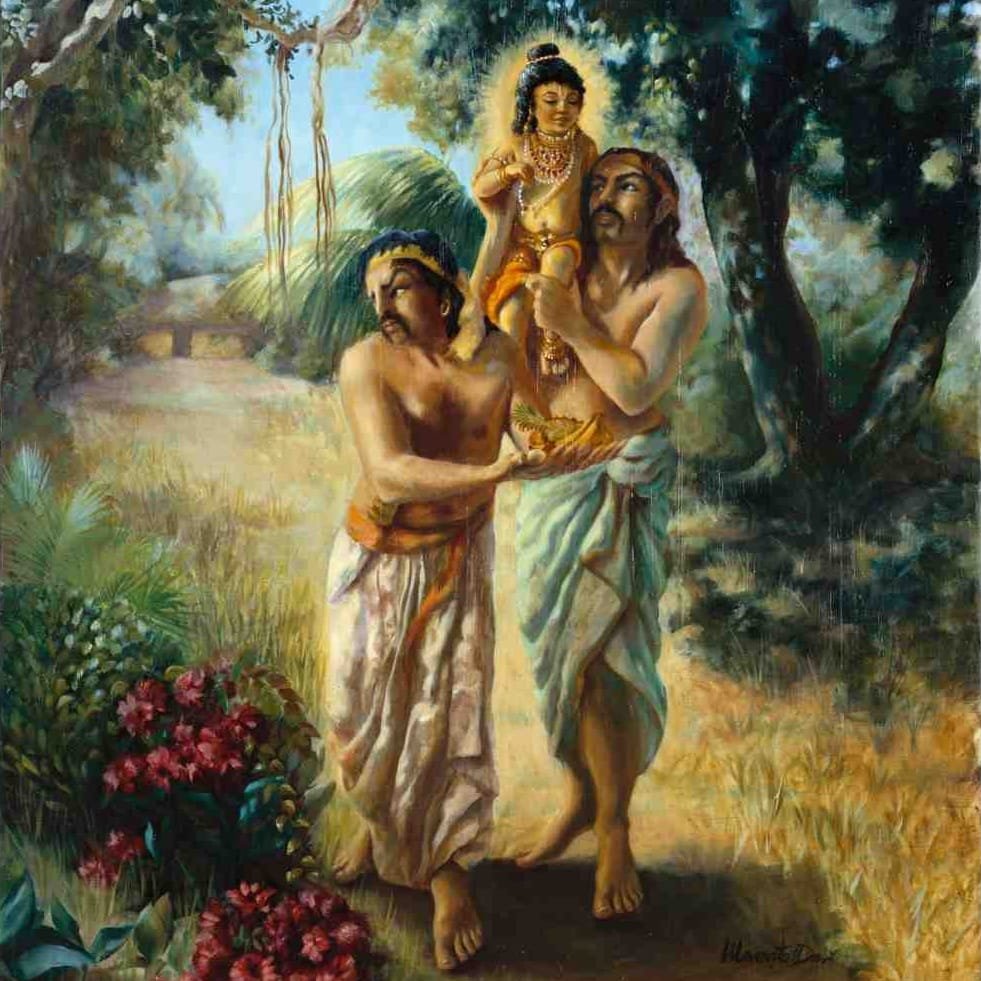
It has also been stated that two thieves stole away the Lad from His father’s door with a view to purloin His jewels and gave Him sweetmeats on the way. The Lad exercised His illusory energy and deceived the thieves back towards His own house. The thieves, for fear of detection, left the Boy there and fled.
Another miraculous act has been described of the Lad’s demanding and getting from Hiranya and Jagadisha all the offerings they had collected for worshipping Krishna on the day of Ekadashi. When only four years of age He sat on rejected cooking pots which were considered unholy by His mother. He explained to His mother that there was no question of holiness and unholiness as regards earthen pots thrown away after the cooking was over. These anecdotes relate to the tender age up to the fifth year.
(Teachings of Lord Chaitanya Prologue)
In His childhood, when the Lord was crying, He would stop immediately upon hearing the holy names Kṛṣṇa and Hari. All the friendly ladies who came to see the child would chant the holy names, “Hari, Hari!” as soon as the child would cry. When all the ladies saw this fun, they enjoyed laughing and called the Lord “Gaurahari.” Since then, Gaurahari became another of His names.
(CC Adi 13.23 – 13.25)
The Lord caused all the ladies to chant the holy names of the Hare Kṛṣṇa mahā-mantra on the plea of His crying, and while they chanted the Lord would smile.
PURPORT
In the Caitanya-bhāgavata this pastime is described as follows: “The Lord, with His beautiful eyes, would cry, but He would stop immediately upon hearing the Hare Kṛṣṇa mahā-mantra. When the ladies, understanding the fun of the Lord, discovered that He would cry and then stop upon hearing the chanting of the Hare Kṛṣṇa mantra, they all took it as a clue to chant Hare Kṛṣṇa as soon as the Lord cried. Thus it became a regular function. The Lord would cry, and the ladies would begin chanting the Hare Kṛṣṇa mahā-mantra, clapping their hands. In this way all the ladies of the neighboring houses would assemble in the home of Śacīmātā to join in the saṅkīrtana movement twenty-four hours a day. As long as the ladies continued to chant the Hare Kṛṣṇa mahā-mantra, the Lord would not cry but very pleasingly smile upon them.”
(CC Adi 14.22)
After some days the Lord began to crawl on His knees, and He caused various wonderful things to be seen.
PURPORT
The Caitanya-bhāgavata describes that one day while the Lord was crawling upon His knees, the bells on His waist ringing very sweetly, a snake came out to crawl in the yard of the Lord, who captured the snake like a curious child. Immediately the snake coiled over Him. The Lord as a child then rested on the snake, and after some time the snake went away, leaving aside the Lord.
(CC Adi 14.21)
One day while the Lord was enjoying His playful sports with the other little children, mother Śacī brought a dish filled with fused rice and sweetmeats and asked the child to sit down and eat them. But when she returned to her household duties, the child hid from His mother and began to eat dirt. Seeing this, mother Śacī hastily returned and exclaimed, “What is this! What is this!” She snatched the dirt from the hands of the Lord and inquired why He was eating it. Crying, the child inquired from His mother, “Why are you angry? You have already given Me dirt to eat. What is My fault? “Fused rice, sweetmeats and all other eatables are but transformations of dirt. This is dirt, that is dirt. Please consider. What is the difference between them? “This body is a transformation of dirt, and the eatables are also a transformation of dirt. Please reflect upon this. You are blaming Me without consideration. What can I say?” Astonished that the child was speaking Māyāvāda philosophy, mother Śacī replied, “Who has taught You this philosophical speculation that justifies eating dirt?” Replying to the Māyāvāda idea of the child philosopher, mother Śacī said, “My dear boy, if we eat earth transformed into grains, our body is nourished, and it becomes strong. But if we eat dirt in its crude state, the body becomes diseased instead of nourished, and thus it is destroyed. “In a waterpot, which is a transformation of dirt, I can bring water very easily. But if I poured water on a lump of dirt, the lump would soak up the water, and my labor would be useless.” The Lord replied to His mother, “Why did you conceal self-realization by not teaching Me this practical philosophy in the beginning? “Now that I can understand this philosophy, no more shall I eat dirt. Whenever I am hungry I shall suck your breast and drink your breast’s milk.” After saying this, the Lord, smiling slightly, climbed on the lap of His mother and sucked her breast.
(CC Adi 14.24 – 14.35)
On one occasion the Lord ate the food of a brāhmaṇa guest three times, and later, in confidence, the Lord delivered that brāhmaṇa from material engagement.
PURPORT
The story of the deliverance of this brāhmaṇa is as follows. One brāhmaṇa who was touring all over the country, traveling from one place of pilgrimage to another, reached Navadvīpa and became a guest in the house of Jagannātha Miśra. Jagannātha Miśra gave him all ingredients for cooking, and the brāhmaṇa prepared his food. When the brāhmaṇa was offering the food to Lord Viṣṇu in meditation, the child Nimāi came before him and began to eat it, and because of this the brāhmaṇa thought the whole offering spoiled. Therefore by the request of Jagannātha Miśra he cooked for a second time, but when he was meditating the child again came before him and began to eat the food, again spoiling the offering. By the request of Jagannātha Miśra the brāhmaṇa cooked for a third time, but for a third time the Lord came before him and began to eat the food, although the child had been locked within a room and everyone was sleeping because it was late at night. Thus, thinking that on that day Lord Viṣṇu was not willing to accept his food and that he was therefore ordained to fast, the brāhmaṇa became greatly agitated and cried aloud, hāya hāya: “What has been done! What has been done!”. When Lord Caitanya Mahāprabhu saw the brāhmaṇa in that agitated state, He told him, “Formerly I was the son of mother Yaśodā. At that time you also became a guest in the house of Nanda Mahārāja, and I disturbed you in this way. I am very much pleased by your devotion. Therefore I am eating the food you have prepared.” Understanding the favor offered to him by the Lord, the brāhmaṇa was greatly pleased, and he was overwhelmed with love of Kṛṣṇa. He was thankful to the Lord, for he felt himself greatly fortunate. Then the Lord asked the brāhmaṇa not to disclose the incident to anyone else. This is very elaborately explained in the Caitanya-bhāgavata, Ādi-līlā, Chapter Three.
(CC Adi 14.37)
In His childhood the Lord was taken away by two thieves outside His home. The Lord, however, got up on the shoulders of the thieves, and while they were thinking they were safely carrying the child to rob His ornaments, the Lord misled them, and thus instead of going to their own home the thieves came back to the home of Jagannātha Miśra.
PURPORT
In His childhood the Lord was profusely decorated with gold ornaments. Once upon a time He was playing outside His house, and two thieves passing on the street saw the opportunity to rob the Lord and therefore took Him on their shoulders, pleasing Him by offering Him some sweetmeats. The thieves thought they would carry the child to the forest and then kill Him and take away the ornaments. The Lord, however, expanded His illusory energy upon the thieves, so much so that instead of carrying Him to the forest they came right back in front of His house. When they came before His house they became afraid because everyone from the house of Jagannātha Miśra and all the inhabitants of that quarter were busy searching for the child. Therefore the thieves, thinking it dangerous to remain, went away and left Him. The child was brought within the house and given to mother Śacī, who was in great anxiety, and she became satisfied. This incident is also very elaborately explained in the Ādi-līlā of Caitanya-bhāgavata, Third Chapter.
(CC Adi 14.38)
Pretending to be sick, the Lord asked some food from the house of Hiraṇya and Jagadīśa on the Ekādaśī day.
PURPORT
The Caitanya-bhāgavata, Ādi-līlā, Chapter Six, fully describes the Lord’s accepting viṣṇu-prasāda on the Ekādaśī day at the house of Jagadīśa and Hiraṇya. Regular prasāda is offered to Lord Viṣṇu on Ekādaśī because, while fasting is recommended for devotees on Ekādaśī, it is not recommended for Lord Viṣṇu. Once on Ekādaśī in the house of Jagadīśa and Hiraṇya Paṇḍita there were arrangements for preparing special prasāda for Lord Viṣṇu, and Lord Caitanya Mahāprabhu asked His father to go there to ask for the viṣṇu-prasāda because He was feeling sick. The house of Jagadīśa and Hiraṇya Paṇḍita was situated about two miles from the house of Jagannātha Miśra. Therefore when Jagannātha Miśra, on the request of Śrī Caitanya Mahāprabhu, came to ask Jagadīśa and Hiraṇya for the prasāda, they were a little astonished. How could the boy understand that special prasāda was being prepared for Lord Viṣṇu? They immediately concluded that the boy Nimāi must have supernatural mystic power. Otherwise how could He understand that they were preparing special prasāda? Therefore they immediately sent the food to Lord Caitanya Mahāprabhu through His father, Jagannātha Miśra. Nimāi was feeling sick, but immediately after eating the viṣṇu-prasāda He was cured, and He also distributed the prasāda among His playmates.
(CC Adi 14.39)
(CC Adi 14.40 – 14.44)
There is a nice description of the faults of Śrī Caitanya Mahāprabhu in His childhood in the Caitanya-bhāgavata, Ādi-līlā, Chapter Three, where it is said that as a child the Lord used to steal all kinds of eatables from the houses of neighboring friends. In some houses He would steal milk and drink it, and in others He would steal and eat prepared rice. Sometimes He would break cooking pots. If there were nothing to eat but there were small babies, the Lord would tease the babies and make them cry. Sometimes a neighbor would complain to Śacīmātā, “My child is very small, but your child puts water in his ears and makes him cry.”
(CC Adi 14.44 purport)
Once the child, Caitanya Mahāprabhu, chastised His mother with His soft hand, and His mother pretended to faint. Seeing this, the Lord began to cry. The neighboring ladies told Him, “Dear child, please bring a coconut from somewhere, and then Your mother will be cured.” He then immediately went outside the house and brought two coconuts. All the ladies were astonished to see such wonderful activities.
(CC Adi 14.45 – 14.47)
Although He is the maintainer of the entire universe, once the Lord sat upon some rejected pots in the pit where the remnants of food were thrown, after the pots had been used for cooking. When mother Śacī saw her boy sitting on the rejected pots, she protested, “Why have You touched these untouchable pots? You have now become impure. Go and bathe in the Ganges.” Hearing this, Lord Caitanya Mahāprabhu taught His mother about absolute knowledge. Although amazed by this, His mother forced Him to take a bath.
(CC Adi 14.73 – 14.75)
(CC Adi 14.77 – 14.82)