
Panchatattva & Nrsimhadeva
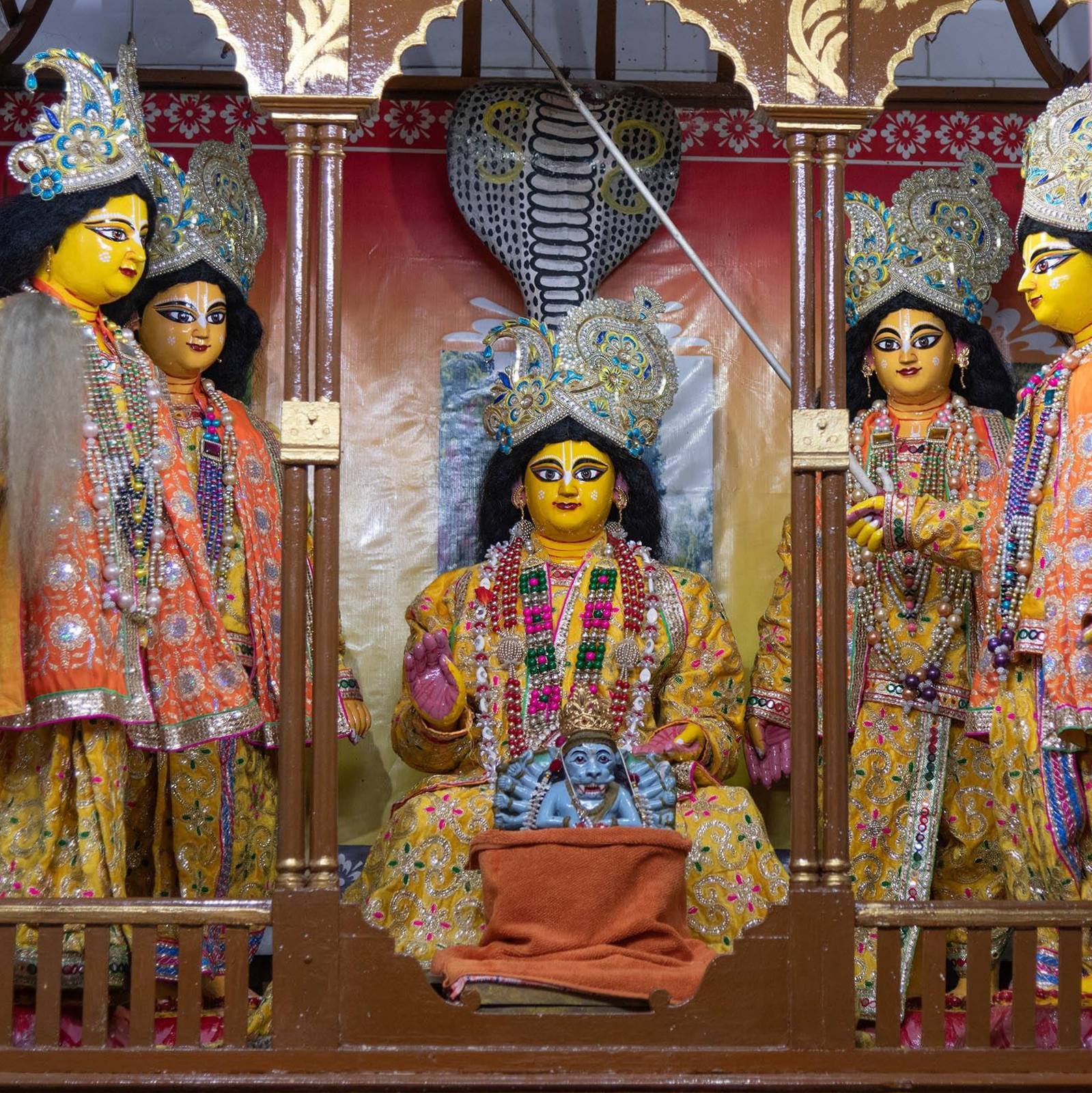
Information – Srivasa Pandita is holding an umbrella over Lord Sri Caitanya Mahaprabhu.
dakhine nitaicand, bame gadadhara
nikate adwaita, srinivasa chatra-dhara
(2) On Lord Caitanya’s right side is Lord Nityananda, and on His left is Sri Gadadhara. Nearby stands Sri Advaita, and Srivasa Thakura is holding an umbrella over Lord Caitanya’s head.
(Jaya Jaya Goracander Arotik)
Information – One of the few temples where the Deity of Śrī Caitanya Mahāprabhu is depicted sitting, reflecting the Mahā-prakāśa-līlā that took place here.
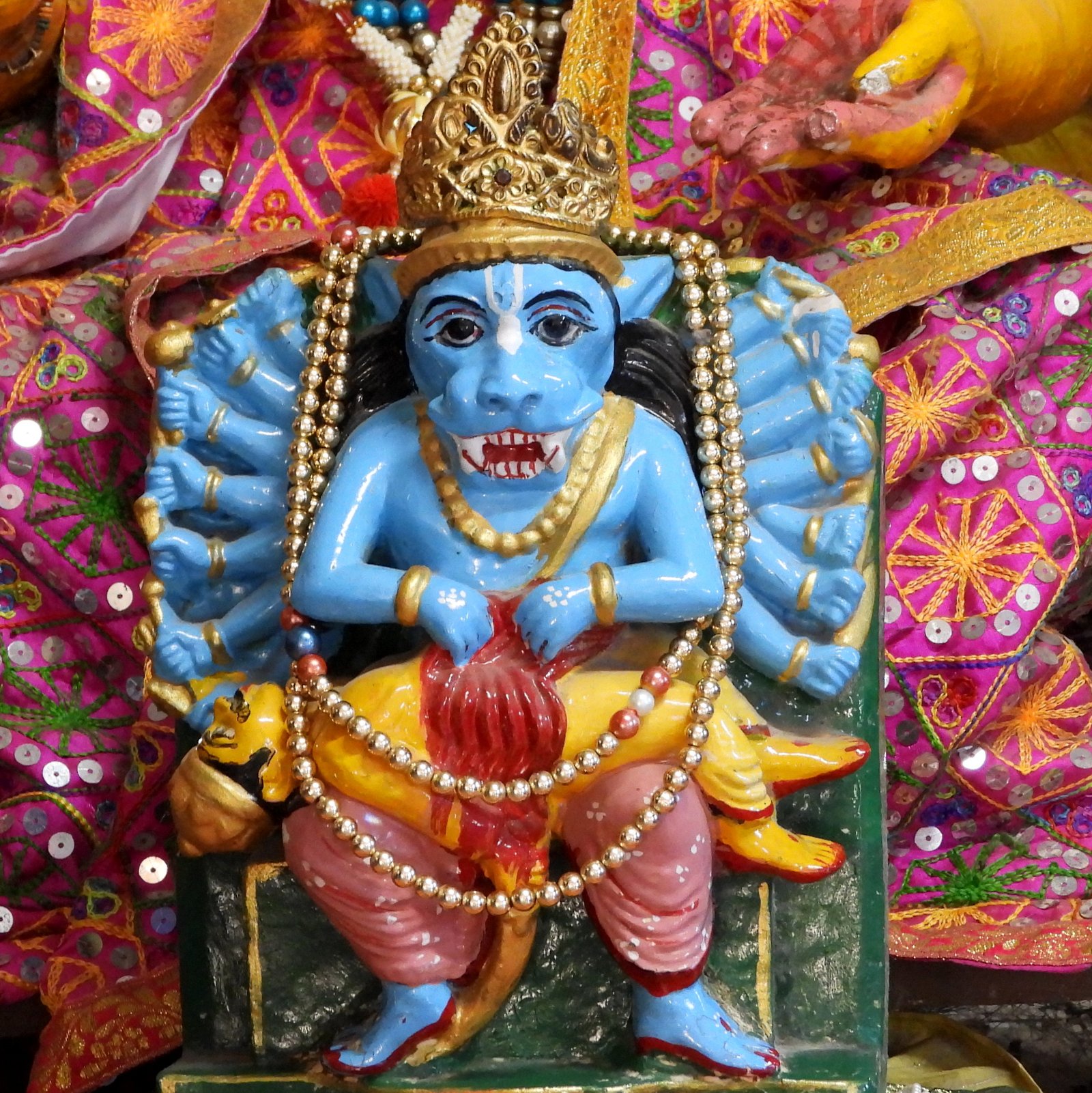
The Kazi said, “When I went to the Hindu’s house, broke the drum and forbade the performance of congregational chanting, in my dreams that very night I saw a greatly fearful lion, roaring very loudly, His body like a human being’s and His face like a lion’s.”
(CC Ādi 17.178-179)
As he read the thousand names of the Lord, in due course the holy name of Lord Nṛsiṁha appeared. When Caitanya Mahāprabhu heard the holy name of Lord Nṛsiṁha, He became fully absorbed in thought. In the mood of Lord Nṛsiṁhadeva, Lord Caitanya ran through the city streets, club in hand, ready to kill all the atheists. Seeing Him appearing very fierce in the ecstasy of Lord Nṛsiṁha, people ran from the street and fled here and there, afraid of His anger. Seeing the people so afraid, the Lord came to His external senses and thus returned to the house of Śrīvāsa Ṭhākura and threw away the club. The Lord became morose and said to Śrīvāsa Ṭhākura, “When I adopted the mood of Lord Nṛsiṁhadeva, people were greatly afraid. Therefore I stopped, since causing fear among people is an offense.” Śrīvāsa Ṭhākura replied, “Anyone who takes Your holy name vanquishes ten million of his offenses immediately. “There was no offense in Your appearing as Nṛsiṁhadeva. Rather, any man who saw You in that mood was immediately liberated from the bondage of material existence.”After saying this, Śrīvāsa Ṭhākura worshiped the Lord, who was then greatly satisfied and returned to His own home.
(CC Adi 17.91 – 17.98)
As he read the thousand names of the Lord, in due course the holy name of Lord Nṛsiṁha appeared. When Caitanya Mahāprabhu heard the holy name of Lord Nṛsiṁha, He became fully absorbed in thought.
PURPORT
The Caitanya-maṅgala, Madhya-khaṇḍa, describes this incident as follows: Śrīvāsa Paṇḍita was performing the śrāddha ceremony for his father, and as is customary, he was hearing the thousand names of Lord Viṣṇu. At that time Gaurahari (Lord Caitanya) appeared on the scene, and He also began to hear the thousand names of Viṣṇu with full satisfaction. When He thus heard the holy name of Lord Nṛsiṁha, Lord Caitanya became absorbed in thought, and He became angry like Nṛsiṁha Prabhu in His angry mood. His eyes became red, His bodily hairs stood on end, all the parts of His body trembled, and He made a thundering sound. All of a sudden He took up a club, and people became greatly afraid, thinking, “We do not know what kind of offense we have now committed!” But then Śrī Caitanya Mahāprabhu adjusted His thoughts and sat down on His seat.
(CC Adi 17.91)
Śrī Kṛṣṇa Caitanya Mahāprabhu is practically teaching us with His five associates: Advaita, Nityānanda, Gadādhara and śrīvāsādi gaura-bhakta-vṛnda. Therefore if we want to approach the Absolute Truth, it is our duty to offer our respect to these five features of the Lord.
śrī-kṛṣṇa-caitanya prabhu-nityānanda
śrī-advaita gadādhara śrīvāsādi-gaura-bhakta-vṛnda
Therefore, in our Kṛṣṇa consciousness movement, we first of all worship the Pañca-tattva: śrī-kṛṣṇa-caitanya prabhu-nityānanda śrī-advaita gadādhara—then we chant Hare Kṛṣṇa mahā-mantra. Then it will be successful. Without going through the Pañca-tattva, with the mercy, nobody can understand Kṛṣṇa. It will remain a myth. Therefore Kṛṣṇa says:
manuṣyāṇāṁ sahasreṣu
kaścid yatati siddhaye
yatatām api siddhānāṁ
kaścid vetti māṁ tattvataḥ
(BG 7.3)
You cannot understand Kṛṣṇa without the mercy of these Pañca-tattva. Therefore Kṛṣṇa, although He came personally, He taught the teachings of Bhagavad-gītā and asked people, sarva-dharmān parityajya mām ekaṁ śaraṇaṁ vraja (BG 18.66). But because we are mūḍhas, we misunderstood Kṛṣṇa. We could not take the last instruction of Kṛṣṇa. Therefore Kṛṣṇa again came as Śrī Caitanya Mahāprabhu to teach us how to approach Kṛṣṇa. If we read the life of Caitanya Mahāprabhu, His acceptance of sannyāsa order, His preaching all over India, His chanting and dancing, His living at Jagannath Purī, His activities, His meeting with the devotees, His Guṇḍicā-mārjana, His Ratha-yātrā kīrtana—if we study all these activities of Śrī Caitanya Mahāprabhu, immediately you understand Kṛṣṇa.
(740303 - Lecture CC Adi 07.03 - Mayapur)
Śrī Caitanya Mahāprabhu appeared here at Māyāpur, this very place where you are now sitting, with all these five features: Nityānanda Prabhu, Śrī Advaita Prabhu and Gadādhara Prabhu, Śrīnivāsa Prabhu. So He Himself, Kṛṣṇa, and Nityānanda Prabhu is immediate expansion of His personal self—Advaita Prabhu is incarnation of Kṛṣṇa, or Viṣṇu, Mahāviṣṇu, three; and Gadādhara Prabhu is the expansion of spiritual energy; and Śrīnivāsa Prabhu is the expansion of His marginal potency, marginal energy, jīva-tattva. Jīva-tattva, śakti-tattva, prakāśa-tattva, and avatāra-tattva, and He Himself. This pañca-tattva.
(740303 - Lecture CC Adi 07.03 - Mayapur)
Just like Lord Caitanya Mahāprabhu, His personal expansion is Nityānanda Prabhu and Advaita Prabhu. And Śrīvāsādi, they are separated expansion.
Although they are associates, but Śrīvāsa, jīva-tattva; and Nityānanda Prabhu and Advaita Prabhu, viṣṇu-tattva. And Gadādhara is śakti-tattva. So in this way, God is person, and His personal expansions are innumerable, unlimited. The viṣṇu-tattva, They are worshipable. And other tattva, śakti-tattva and jīva-tattva, they are meant for service. But all together taken, that is one. That is Absolute Truth.
(721002 - Lecture SB 01.03.27 - Los Angeles)
pañca-tattvātmakaṁ kṛṣṇaṁ
bhakta-rūpa-svarūpakam
bhaktāvatāraṁ bhaktākhyaṁ
namāmi bhakta-śaktikam
(CC Adi 1.14)
So Śrī Kṛṣṇa Caitanya Mahāprabhu has five features. Kṛṣṇa has five features. Kṛṣṇa means these five features. What are those? Kṛṣṇa, Kṛṣṇa’s manifestation, Kṛṣṇa’s incarnation, Kṛṣṇa’s different potencies, in this way. And Kṛṣṇa, the source of devotional service, He is Kṛṣṇa Caitanya, bhakta-śaktikam. To advance in devotional service requires spiritual strength. It is not so easy thing. That spiritual strength is also Kṛṣṇa, bhakta-śaktikam. There is nothing except Kṛṣṇa. Ekaṁ brahmā dvitīya-nāsti. So we have to understand Him especially in these five features for advancing in devotional service. Therefore His name is pañca-tattvātmakam, with five features, kṛṣṇam, bhakta-rūpa-svarūpakam. Kṛṣṇa is so kind upon us that He is coming as He is, Kṛṣṇa’s original, and trying to convince us about the necessity of our life, or the goal of our life. Prayojana. Prayojana: it is necessary. It is not optional—compulsory. If you don’t take to Kṛṣṇa consciousness, then you will continue to suffer; therefore it is necessity. It is not that if you like, you can take it; if you don’t like, you reject it. If you reject it, then you will suffer. And if you take it, then actually you will enjoy life.
(750407 – Lecture CC Adi 01.14 – Mayapur)
The best thing is . . . because Śrī Caitanya Mahāprabhu appeared in His five different features, therefore the ācāryas, they worship all of them at a time. That is our prayer:
śrī-kṛṣṇa-caitanya prabhu-nityānanda
śrī-advaita gadādhara śrīvāsādi-gaura-bhakta-vṛnda
This is the varieties, transcendental varieties, different taste. Nityānanda Prabhu is guru-tattva, and Caitanya Mahāprabhu is sevya-tattva. The guru is teaching; Nityānanda Prabhu is teaching how to worship Śrī Caitanya Mahāprabhu.
bhaja gaurāṅga kaha gaurāṅga laha gaurāṅgera nāme
ye jana gaurāṅga bhaje sei amāra prāṇa re
This is Nityānanda Prabhu's business. Narottama dāsa Ṭhākura says that gaurāṅgera balite habe, pulaka śarīre, hari hari balite, nayane ba'be nīra. Gaurāṅga.
So to become immediately in ecstasy of transcendental love, if we chant this śrī-kṛṣṇa-caitanya prabhu-nityānanda, it is easier. There is no offense in chanting this pañca-tattva, but there is offense if you do not properly chant Hare Kṛṣṇa mantra. There are ten kinds of offenses, you know. But in chanting śrī-kṛṣṇa-caitanya prabhu-nityānanda, there is no aparādha. You chant in any way, you'll get the result. This is the difference, taste. This is variety. Although there is no difference by chanting śrī-kṛṣṇa-caitanya prabhu-nityānanda and Hare Kṛṣṇa mantra, mahā-mantra, but still, by chanting this pañca-tattva, you'll get immediately, quickly, result. Therefore our process is to chant the holy names of the Pañca-tattva and then we chant Hare Kṛṣṇa mahā-mantra. That is perfect.
(740307 - Lecture CC Adi 07.05 - Mayapur)
This philosophy, acintya-bhedābheda, simultaneously one and different, is our philosophy, inaugurated by Śrī Caitanya Mahāprabhu, although it is in the Vedānta-sūtras. So everything is simultaneously one and different from the Supreme Lord. But there are two classes of philosophers. One class says that God and the living entities are different, and there is another philosopher, monist philosopher; they say God and the living entities are one.
So this acintya-bhedābheda philosophy adjusts that, "God and the living creatures, they are simultaneously one and different." They are one in quality, just like the energy and the energetic, the sun globe and the sunshine. In quality, in sunshine there is heat, there is illumination, light. In the sun globe also, there is heat, there is illumination. But the degrees are quite different. You can bear the heat and illumination of the sunshine, but you cannot go to the sun globe, or you can bear the heat and temperature there. The scientist says that so many millions miles away, if somebody goes or some planet goes near the sun globe, it will immediately burn into ashes.
Similarly, God and ourself, Kṛṣṇa and living entities, they are qualitatively one, but quantitatively, we are very minute.
(690827 - Lecture Initiation - Hamburg)
Suppose we are worshiping here. The Māyāvādī will say: "They are worshiping a brass, metal Deity." So are we so fools that we are spending so much money for worshiping a lump of metal? That they do not know. This is acintya-bhedābheda. And fact is there. Kṛṣṇa is omnipotent. He can accept your service in any way, as He likes. This is called arcā-vigraha. As Kṛṣṇa's avatāra is there, here is also another avatāra, arcā-vigraha. He is so kind. You cannot see Kṛṣṇa, you cannot touch Kṛṣṇa at the present moment, but Kṛṣṇa is so kind that He appears before you as you can touch, you can dress, you can offer your respect, you can see. That is Kṛṣṇa's mercies. But don't think that Kṛṣṇa has become metal. No. And even if He becomes metal, there is no difference. And what is this metal? That is Kṛṣṇa's energy. We have to understand in that way. So this acintya-bhedābheda-tattva.
(740307 - Lecture CC Adi 07.05 - Mayapur)