
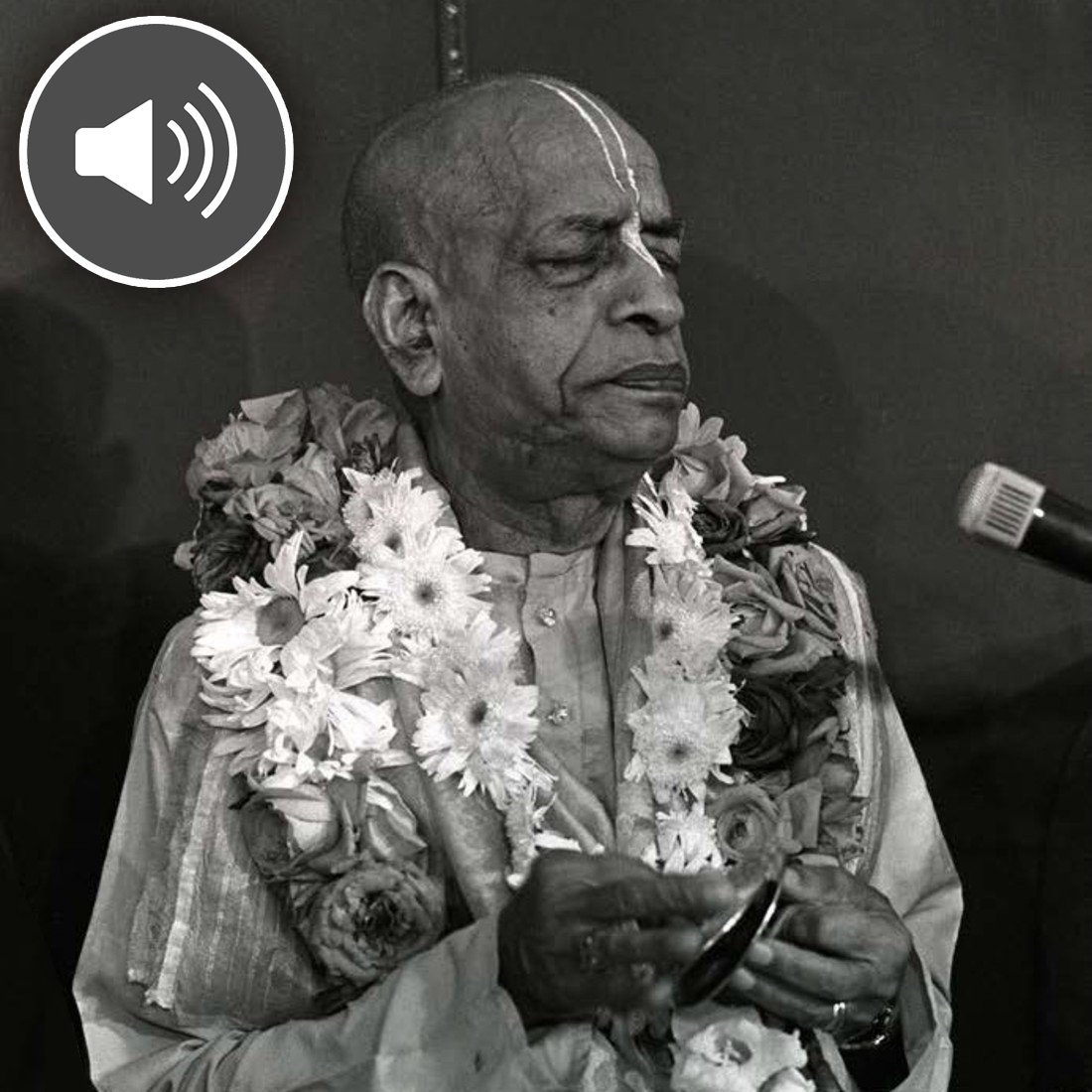
Srila Prabhupada
Śrīla Prabhupāda Audio
Hear the original words of Śrīla Prabhupāda.
So sāṅgopāṅgāstra-pārṣadam. This is the description of the God, Kṛṣṇa, in this age. That is Caitanya Mahāprabhu. Kṛṣṇa-varṇaṁ tviṣākṛṣṇaṁ sāṅgopāṅgāstra-pārṣadam (SB 11.5.32). And how to worship Him? What is the process? Yajñaiḥ saṅkīrtanaiḥ. That's all. You keep Caitanya Mahāprabhu's Deity and chant and dance—your life is successful. So easy. We are worshiping Rādhā-Kṛṣṇa. That is very difficult. But if we keep Caitanya Mahāprabhu with His associates, this Pañca-tattva, Gaura-Nitāi, Gaura-Gadādhara, or Pañca-tattva, and worship Him according to the śāstra description . . . the śāstra description is yajñaiḥ saṅkīrtanaiḥ. This is yajña. Life is meant for performing yajña. In the Bhagavad-gītā it is said, yajñārthe karma. You are very busy. Yes, you should be busy always, twenty-four hours. For what purpose? Yajñārthe, not for your sense gratification. That is devotional life.
(750310 - Lecture BG 07.02 - London)
Whenever Caitanya Mahāprabhu is present, there are so many devotees. Gaura-bhakta-vṛnda. So sāṅgopāṅgāstra-pārṣadam. This is the incarnation of Kali.
So yajñaiḥ saṅkīrtana-prāyair yajanti hi su-medhasaḥ (SB 11.5.32). Those who have got brain substance, not dull, filled up with cow dung, they cannot understand what is the saṅkīrtana-yajña. But śāstra says, yajñaiḥ saṅkīrtana-prāyair yajanti hi su-medhasaḥ: “Those who have got nice brain substance, they can perform this yajña, saṅkīrtana-yajña.” Then it fulfills the injunction of the Bhagavad-gītā, yajña-dāna-tapaḥ-kriyāḥ (BG 17.24). So for this saṅkīrtana movement, saṅkīrtana-yajña, in this age, before the Deity of Lord Caitanya Mahāprabhu and associated with Nityānanda, Advaita, others . . . if not all, at least Nityānanda or Gadādhara. Gaura-Gadādhara or Gaura-Nityānanda, or all of them, five. Śrī-kṛṣṇa-caitanya prabhu-nityānanda.
(730905 – Lecture Festival Appearance Day, Srimati Radharani, Radhastami – London)
Śrīla Prabhupāda Audio
Hear the original words of Śrīla Prabhupāda.
Just like Sārvabhauma Bhaṭṭācārya. You know, Sārvabhauma Bhaṭṭācārya was a great scholar and . . . Māyāvādī scholar, but Caitanya Mahāprabhu made him surrender unto Him. He became Caitanya Mahāprabhu's admirer, follower, after being defeated in Vedānta-sūtra understanding. That story is there in the TLC. (Teachings of Lord Caitanya)
So Sārvabhauma Bhaṭṭācārya became convinced that Śrī Caitanya Mahāprabhu is Kṛṣṇa. He wrote hundred verses about Caitanya Mahāprabhu, out of two verses are available in the Caitanya-caritāmṛta. He composed—he was a very learned scholar—he composed one hundred verses about Caitanya Mahāprabhu, and handed it over. But in all those verses he admitted that, "You are Kṛṣṇa."
So Caitanya Mahāprabhu, of course He was very much pleased that Sārvabhauma Bhaṭṭācārya understood, but because He was playing the part of an ācārya, He, externally He became, "What you have written all these things?" He immediately torn out and throw it away. But the devotees saved only two. That two verses are there:
vairāgya-vidyā-nija-bhakti-yoga-
śikṣārtham ekaḥ puruṣaḥ purāṇaḥ
śrī (kṛṣṇa) caitanya mahāprabhu (śarīra-dhāri)
kṛpāmbudhir yas tam ahaṁ prapadye
(CC Madhya 6.254)
You'll find that verse that, "You are the same Śrī Kṛṣṇa. You have come to teach us vairāgya-vidyā." Vairāgya-vidyā means how to become unattached with this material world. That is called vairāgya-vidyā. Because our . . . we are accepting different types of body on account of our attachment. Because we are attached to this material world, we want to enjoy. That is illusion. We cannot enjoy, we are simply suffering, but we are accepting it as enjoyment.
(710731 - Lecture BS 5.35 - New York)
Our, this Gauḍīya-sampradāya, Caitanya Mahāprabhu's, Caitanya Mahāprabhu's descendants, our line of God-realization is that separation, feeling of separation. Not that we have got Kṛṣṇa within our hand. No. This feeling of separation, worship of Kṛṣṇa by feeling of separation, is better than the worship by directly meeting. Vipralambha-sevā.
So this vairāgya-vidyā, renunciation . . . vairāgya-vidyā-nija-bhakti-yoga (CC Madhya 6.254). Bhakti-yoga means vairāgya-vidyā. Vairāgya-vidyā means no more attachment for this material world. That is vairāgya. So bhakti-yoga means vairāgya-vidyā. So this Sārvabhauma Bhaṭṭācārya said, vairāgya-vidyā-nija-bhakti-yogam. This vairāgya-vidyā means bhakti-yogam . . . śikṣārtham ekaḥ puruṣaḥ purāṇaḥ. So Kṛṣṇa, the supreme original personality, He has come down to teach us this vairāgya-vidyā.
Vairāgya-vidyā-nija-bhakti-yoga-śikṣārtham ekaḥ puruṣaḥ purāṇaḥ, śrī-kṛṣṇa-caitanya-śarīra-dhārī (CC Madhya 6.254). Śrī-kṛṣṇa-caitanya. Śrī Kṛṣṇa has appeared in the form of Lord Śrī Kṛṣṇa Caitanya. So Sārvabhauma Bhaṭṭācārya says, "My respectful obeisances unto Him."
(680202 - Lecture CC Madhya 06.254 - Los Angeles)
Śrīla Prabhupāda Audio
Hear the original words of Śrīla Prabhupāda.
So Kṛṣṇa understanding is not so easy. It is very difficult. Kṛṣṇa says. But by the grace of Kṛṣṇa, because He wanted to distribute Himself, Caitanya Mahāprabhu giving us Kṛṣṇa freely . . . kṛṣṇa-prema-pradāya te (CC Madhya 19.53). Rūpa Gosvāmī says that namo mahā-vadānyāya. Kṛṣṇa was also not so liberal. He simply asked us, "Surrender," but He did not distribute Himself. But in the form of Caitanya Mahāprabhu He distributed Himself, "Take Me, Take Me, Take Me. Without any price, take Me."
This is Caitanya Mahāprabhu, who is Kṛṣṇa, and He has come in the form of Caitanya, Kṛṣṇa Caitanya, to distribute Himself. Therefore He is recognized, namo mahā-vadānyāya, "The most munificent." No other incarnation, even Rāmacandra or Bhagavān Kṛṣṇa, They were not so liberal. But Caitanya Mahāprabhu is so liberal. Pāpī tāpī jata chilo hari-nāme uddhārilo (Hari Hari Bifale 3). They distributed Himself through the chanting of Hare Kṛṣṇa mantra.
(721031 - Lecture SB 01.02.20 - Vrndavana)
Śrīla Prabhupāda Audio
Hear the original words of Śrīla Prabhupāda.
Jayadeva Gosvāmī, has offered this prayer, pralaya-payodhi-jale-dhṛtavān asi vedam. He says: “My dear Lord, when there was devastation within this universe, everything was filled with water. At that time You saved the Vedas, stacked in a boat. And You held the boat from being drowned in the water, in the shape of a big fish.”
This fish first of all was caught in the water pot just like a small fish. Then it enlarged, and the fish was kept in a bigger water reservoir. In this way the fish was increasing. Then the fish informed that, “Devastation is coming. You just save all the Vedas on a boat, and I shall protect it.” So Jayadeva Gosvāmī is offering prayer, “My Lord, You saved the Vedas when there was devastation in the shape of fish.”
(700218 – Lecture Festival Appearance Day, Lord Varaha, Varaha-dvadasi and Purport Dasavatara-stotra – Los Angeles)