
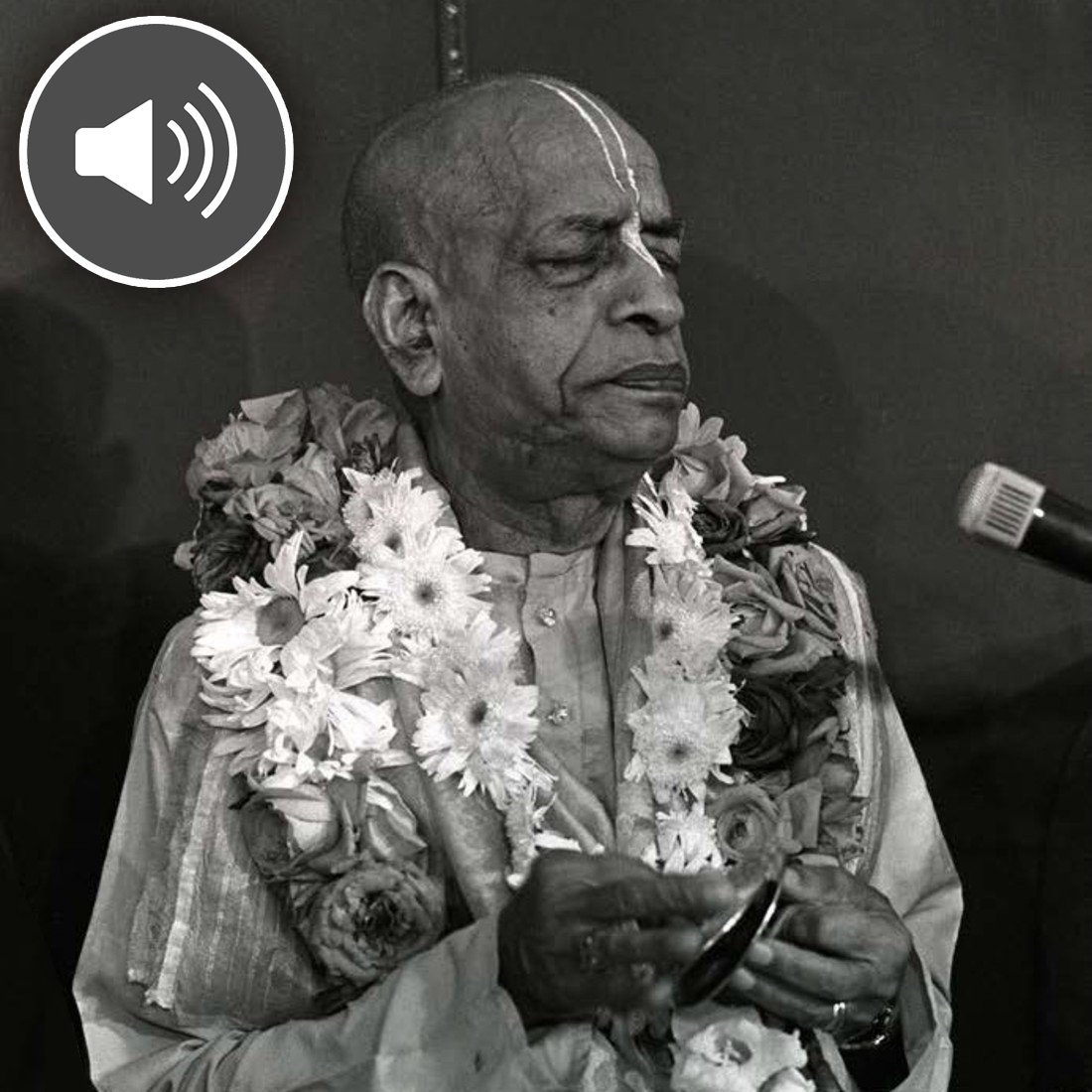
Srila Prabhupada
Prabhupāda: …that Bhaktivinoda Ṭhākura’s aspiration that the Europeans, Americans, and Indians all together dance jubilantly and chanting “Gaura Hari.” So this temple, Māyāpur Chandrodaya temple, is meant for transcendental United Nation. What the United Nation has failed, that will be achieved here by the process recommended by Śrī Caitanya Mahāprabhu,
pṛthivīte āche yata nagarādi grāma
sarvatra pracāra haibe mora nāma
So you have come from all parts of the world and living together in this temple. So train these small boys. I am very glad, especially, to see that the small children from all other countries, and Indian, Bengalis, all together, forgetting their bodily consciousness. That is the greatest achievement in this movement, that everyone forgets the bodily conception of life. Nobody thinks here as "European," "American," "Indian," "Hindu," "Muslim," "Christian." They forget all these designation, and simply they are ecstatic in chanting Hare Kṛṣṇa mantra. So kindly what you have begun, do not break it. Continue it very jubilantly. And Caitanya Mahāprabhu, the master of Māyāpur, He will be very much pleased upon you, and ultimately you will go back to home, back to Godhead.
(760115 – Lecture Excerpt – Mayapur)
Prabhupāda: "Europeans and Americans will come, and they will dance here with the chanting, ' Jaya Śacīnandana!' " So that is being done.
So when they chant and dance, I simply remember Bhaktivinoda Ṭhākura. That's all. I pray to Bhaktivinoda Ṭhākura, "Now they have come to your shelter. Give them protection." That's all. What can I do more? I cannot do anything more.
(740306 - Morning Walk - Mayapur)
The cows, oh, as soon as they see Kṛṣṇa, they become . . . they lick up His feet and body, and every cow has got a different name. As soon as He will call, the cow will come immediately, and dropping milk. And those cows are also spiritual. Surabhī. It is described in the Brahma-saṁhitā, surabhīr abhipālayantam (Bs 5.29).
Surabhī. Surabhī cow means nonexhaustive. You can milk as much milk you want and as many times. In the material world the cow is limited. There is time that you can milk, morning and evening, and so much quantity, not more than that. But surabhīr means you can milk those cows anytime you like, and you can draw milk as many as you like, as much as you like. This is called surabhī. urabhīr . . . in the description of Brahma-saṁhitā: cintāmaṇi-prakara-sadmasu kalpa-vṛkṣa-lakṣāvṛteṣu surabhīr abhipālayantam. Surabhīr abhipālayantam. So therefore He is Govinda. He gives . . . He is pleasure for everyone.
(661211 - Lecture CC Madhya 20.152-154 - New York)
Especially if we are human being, the cow is supplying us milk, the most important foodstuff. So instead of giving protection to the cow, if we kill, do you think that is very sensible thing? No. I am supplying something very nice, and if you kill me, is that very good gratitude?
So at least in human life, these senses should be there. Cow protection is recommended in the Vedic literature because it is giving the most valuable foodstuff, milk. Apart from other sentiments, it is supplying, and in exchange of nothing. She simply eats some grasses from the ground. That's all. You don't have to provide cows with foodstuff. The things which you refuse, you take the grains and you supply the skin.
You take the fruit pulp, you supply the skin. You take the, I mean to say, from paddy. You take the rice. You supply the straw, and she delivers you a very nice foodstuff. And I have discussed all these point in my Śrīmad-Bhāgavatam, that human economic problem can be solved simply by having some land and some cows. That's all.
(680504 - Lecture SB 05.05.01-3 - Boston)
The Hindus were so foolish that if a Muhammadan sprinkled some water in this way, so he becomes Muhammadan and he is rejected. In this way the Muhammadan population was there.
Anyway, that was done in the case of Buddhimanta Khān. The Nawab called him one day and took little water from his pot and sprinkled, and it was the law, “He has become Muhammadan, he has become Muhammadan.” So he went to a bhaṭṭācārya, “So what is the atonement? Now I have become Muhammadan.” Just see the conception. And the bhaṭṭācārya said that “You drink one pound of molten lead.” “How it is possible?” “That is the atonement.” So in this way he was baffled. He went to Caitanya Mahāprabhu. He was very respectable man. And Caitanya Mahāprabhu laughed, that “This the condition of the Hindu society.” So He said that “I tell you that you give up your family life. You go to Vṛndāvana and chant there Hare Kṛṣṇa. That’s all. That will be the . . .”
So at the present moment that is the only atonement. Whatever we have done and whatever we are doing, the atonement is chant Hare Kṛṣṇa mantra. So we haven’t got to go to Vṛndāvana. We have brought Vṛndāvana, Nabadwīp, here in Hawaii, in this temple. So you take this process of atonement, but don’t commit sinful life any more.
(750615 – Lecture SB 06.01.07 – Honolulu)
The best thing is . . . because Śrī Caitanya Mahāprabhu appeared in His five different features, therefore the ācāryas, they worship all of them at a time. That is our prayer:
śrī-kṛṣṇa-caitanya prabhu-nityānanda
śrī-advaita gadādhara śrīvāsādi-gaura-bhakta-vṛnda
This is the varieties, transcendental varieties, different taste. Nityānanda Prabhu is guru-tattva, and Caitanya Mahāprabhu is sevya-tattva. The guru is teaching; Nityānanda Prabhu is teaching how to worship Śrī Caitanya Mahāprabhu.
bhaja gaurāṅga kaha gaurāṅga laha gaurāṅgera nāme
ye jana gaurāṅga bhaje sei amāra prāṇa re
This is Nityānanda Prabhu's business. Narottama dāsa Ṭhākura says that gaurāṅgera balite habe, pulaka śarīre, hari hari balite, nayane ba'be nīra. Gaurāṅga.
So to become immediately in ecstasy of transcendental love, if we chant this śrī-kṛṣṇa-caitanya prabhu-nityānanda, it is easier. There is no offense in chanting this pañca-tattva, but there is offense if you do not properly chant Hare Kṛṣṇa mantra. There are ten kinds of offenses, you know. But in chanting śrī-kṛṣṇa-caitanya prabhu-nityānanda, there is no aparādha. You chant in any way, you'll get the result. This is the difference, taste. This is variety. Although there is no difference by chanting śrī-kṛṣṇa-caitanya prabhu-nityānanda and Hare Kṛṣṇa mantra, mahā-mantra, but still, by chanting this pañca-tattva, you'll get immediately, quickly, result. Therefore our process is to chant the holy names of the Pañca-tattva and then we chant Hare Kṛṣṇa mahā-mantra. That is perfect.
(740307 - Lecture CC Adi 07.05 - Mayapur)
Prabhupāda: Harihara, Harihara means Kṛṣṇa who takes away all, I mean to say, undesirable things. Kṛṣṇa takes away from the devotee all undesirable things. Thank you, go on. Hara, hara means who takes away, harati. Or in other words he takes away all miseries, Hare Kṛṣṇa, hari haraye namaḥ kṛṣṇa yādavāya namaḥ, (Nāma Saṅkīrtana 1)
(710717 – Lecture Initiation Excerpt – Detroit)
Prabhupāda: If you become devotee of Kṛṣṇa, all your desires will be fulfilled. That is also fact.
akāmaḥ sarva-kāmo vā
mokṣa-kāma udāra-dhiḥ
tīvreṇa bhakti-yogena
yajeta paramaṁ puruṣa
(SB 2.3.10)
It is not that . . . sometimes we think like that, that "If we become devotee of God, then I'll become poor." Because Vaiṣṇavas are generally appear to be poor, so those who are after material happiness, they do not like to become Vaiṣṇavas. They become devotee of Lord Śiva, because by the grace of Lord Śiva they get all material facilities. Therefore generally people are very much fond of becoming devotee of Lord Śiva.
That . . . this question was discussed between Yudhiṣṭhira Mahārāja . . . not, Parīkṣit Mahārāja and Śukadeva Gosvāmī. Parīkṣit Mahārāja inquired this, that "Lord Viṣṇu is the master of goddess of fortune, but generally we find the Vaiṣṇavas are poor. And Lord Śiva, he hasn't got even a house, so still, his devotees are very prosperous." So the explanation was given that Lord Śiva is the master of these material opulences, Durgā-devī. Durgā-devī is his wife, the material nature. So devotees of Lord Viṣṇu . . . er, Lord Śiva can get all material facilities.
And Lord Viṣṇu . . . because he is going to be transferred to the spiritual world, therefore gradually his material affection is curtailed.
(681211 - Lecture BG 02.27-38 - Los Angeles)
So Kṛṣṇa has got two businesses. One, to give protection to the devotee, and the other is to kill the demon. Just like Kṛṣṇa appeared as keśava dhṛta narahari-rūpa (Śrī Daśāvatāra Stotra 4), Nṛsiṁha-deva, and Narahari, Nṛsiṁha-deva, one side He was blessing Prahlāda Mahārāja, the devotee, and the other side He was killing his atheist father, Hiraṇyakaśipu. You have seen the picture. So Kṛṣṇa, when He has got the fighting spirit . . .
Because Kṛṣṇa is the source of everything, janmādy asya yataḥ (SB 1.1.1). Here in this world also, you find two things: friendship and hostility. Just like modern political atmosphere, sometimes there is conference of friendship, and sometimes there is fight with lethal weapons. So this duality is visible in this material world, but in the spiritual world there is no duality. There is absolute peace. . . (break).
So when He wants to fight, He comes here, because here there are many demons, so His fighting spirit is satisfied. Otherwise, for killing the demons, Kṛṣṇa does not require to descend. There are many agents of Kṛṣṇa. For example, this city, Visakhapatnam, on the seashore, if Kṛṣṇa desires, this whole city can be killed in a second, simply by overflooding the sea, or by storm. He has got many agents, parasya śaktir vividhaiva śruyate (Śvetāśvatara Upaniṣad’ 6.8, CC Madhya 13.65, purport). Or the material agent, Durgā devī, she can all . . . do all these things.
So Kṛṣṇa does not require to descend for killing the demons, but when He feels . . . just like a rich man sometimes feels to contest with some wrestler, that does not mean he requires it. That is the Kṛṣṇa spirit. He is all-blissful. So when Kṛṣṇa comes, descends, there are many demons. He especially comes for the devotee. But when He fights with the demon, that is also His favor, because anyone killed by Kṛṣṇa, he immediately attains liberation. Therefore Kṛṣṇa is absolute. Either He fights or blesses, the result is the same.
(720220 – Lecture SB 01.02.05 – Visakhapatnam)
So Prahlāda Mahārāja, he was such a nice devotee. And to protect him when he was just going to be killed by his father . . . and his father was very polit . . . good politician. He took benediction from Brahmā that he will not be killed by anyone. By policy he took benediction from Brahmā that, "I shall not be killed by man." "Oh, yes." "I shall not be killed by demigods." "That's all right." "I shall not be killed by any animal." "That's all right." "I shall not be killed in day." "That's all right." "You shall . . . I shall not be killed at night." "That's all right." "I shall not be killed by any weapon." "That's all right."
And he said: "Now it is finished. Everything is now secure. I cannot be killed in day. I cannot be killed at night. No man can kill him (me). No demigod can kill me. No animal can kill me. Then where is the killing? Everything finished." But God is so, cunning that He assumed neither man nor animal, and no weapons. He killed him with the nails. He never expected that "I will be killed by the nails." This is the definition by negation, defective definition. There the . . . in argument, if you define negatively, "This is not this. This is not this. This is not this," then something will come that will, I mean to say, nullify all your arguments. You see? So he protected himself in all negative ways, "This will not. This will not. This will not. This will not." Something came which was not in his power. So this Nṛsiṁhāvatāra.
(661220 - Lecture CC Madhya 20.294-298 - New York)