
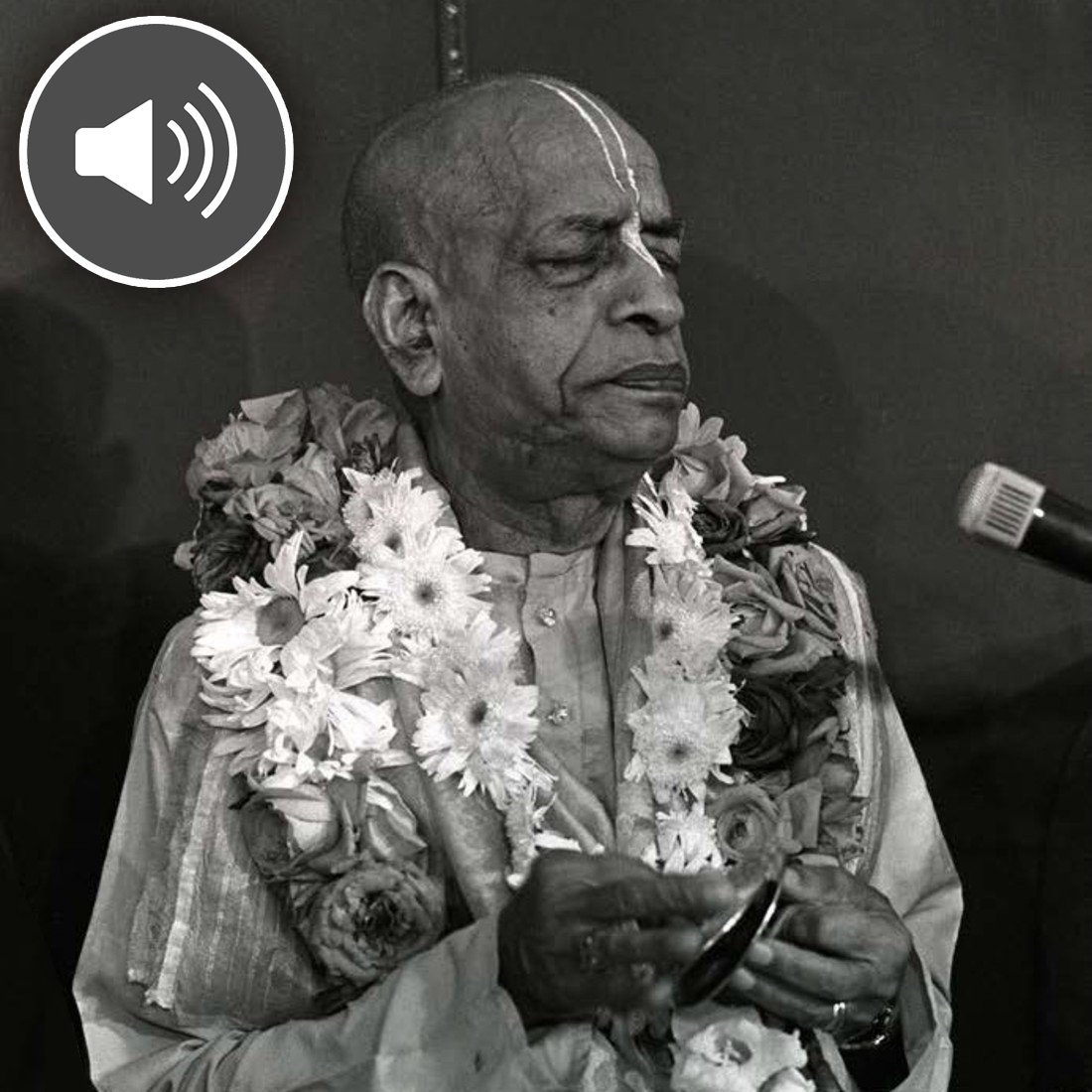
Srila Prabhupada Vani
The transcendental vibration from the mouth of a pure devotee is so powerful that it can revive the living entity’s memory of his eternal relationship with the Supreme Personality of Godhead…As expressed in a song by Ṭhākura Bhaktivinoda, Lord Caitanya says, jīva jāga, jīva jāga. The Lord asks every sleeping living entity to get up and engage in devotional service so that his mission in this human form of life may be fulfilled. This awakening voice comes through the mouth of a pure devotee.
(SB 4.20.25 purport)
Srila Prabhupada Audio for 9 islands
So especially in India, the atmosphere is very good. It is especially meant, within this universe, this plot of land known as Bhārata-varṣa, India, is the most sacred place within this universe. And of the whole land Bhārata-varṣa, in Bengal, it is very sacred. And the whole of Bengal, this Nadia district is very sacred. And in the whole Nadia district, this spot is very sacred, Māyāpur-candrodaya Temple. So by Kṛṣṇa’s grace, you have got this opportunity to live here. Take advantage, full advantage of this opportunity, spiritual opportunity. This is the statement of Bhaktivinoda Ṭhākura.
(750408 – Lecture CC Adi 01.15 – Mayapur)
Bhaktivinoda Ṭhākura's aspiration that the Europeans, Americans and Indians all together dance jubilantly and chanting "Gaura Hari."
So this temple, Māyāpur Chandrodaya temple, is meant for transcendental United Nation. What the United Nation has failed, that will be achieved here by the process recommended by Śrī Caitanya Mahāprabhu,
pṛthivīte āche yata nagarādi grāma
sarvatra pracāra haibe mora nāma
(CB Antya-khaṇḍa 4.126)
So you have come from all parts of the world and living together in this temple. So train these small boys. I am very glad, especially, to see that the small children from all other countries, and Indian, Bengalis, all together, forgetting their bodily consciousness. That is the greatest achievement in this movement, that everyone forgets the bodily conception of life. Nobody thinks here as "European," "American," "Indian," "Hindu," "Muslim," "Christian." They forget all these designation, and simply they are ecstatic in chanting Hare Kṛṣṇa mantra. So kindly what you have begun, do not break it. Continue it very jubilantly. And Caitanya Mahāprabhu, the master of Māyāpur, He will be very much pleased upon you, and ultimately you will go back to home, back to Godhead.
(760115 - Lecture Excerpt - Mayapur)
So we have established this temple, Māyāpur-candrodaya. So this is the idea, that Śrī Caitanya Mahāprabhu is just like moon. Śrī Caitanya Mahāprabhu, He appeared in this land of Māyāpur; therefore He is said here as "the moon." Therefore we say candra, Māyāpur-candra. Now, as Śrī Māyāpur-candra is rising . . . rising. Rising means He is to distribute the moonshine all over the world. This is the idea, moonshine. Śreyaḥ-kairava candrikā-vitaraṇam. Śreyaḥ-kairava. Caitanya Mahāprabhu personally said. Don't keep Śrī Caitanya Mahāprabhu compact in your room and take some monetary profit. This is not required. This is not required.
You must allow Śrī Caitanya Mahāprabhu to rise more and more so that this sun, moonshine, may be distributed all over the world. That is wanted. Therefore this temple is situated. Of course, we shall try to construct a very nice temple for Śrī Caitanya Mahāprabhu. This morning we were thinking of this. So from this place, this moon, Śrī Kṛṣṇa Caitanya Mahāprabhu, will distribute. Śreyaḥ-kairava-candrikā-vitaraṇaṁ vidyā-vadhū-jīvanam. The Śrī Caitanya Mahāprabhu's Hare Kṛṣṇa movement . . . paraṁ vijāyate śrī-kṛṣṇa-saṅkīrtanam. This is spoken by Śrī Caitanya Mahāprabhu Himself. Ceto-darpaṇa-mārjanam bhava-mahā-dāvāgni-nirvāpaṇaṁ śreyaḥ-kairava-candrikā-vitaraṇaṁ vidyā-vadhū-jīvanam (CC Antya 20.12). Vidyā-vadhū-jīvanam. This is real enlightenment. People all over the world, they are in darkness. The moonshine will enlighten them.
(750330 - Lecture CC Adi 01.06 - Mayapur)
So go on cooperating in this way, and I am sure this mission of Caitanya Mahāprabhu will be successful. It must be successful, because Śrī Caitanya Mahāprabhu wanted it to be done. Simply we, the workers, the servitors, must be very sincere. Then Caitanya Mahāprabhu will give us more and more facilities so that we can work very well. So keep this mission always in view and do your best. That is my only request. Thank you very much.
(740927 - Lecture Arrival - Mayapur)
Śrī Caitanya Mahāprabhu appeared here at Māyāpur, this very place where you are now sitting, with all these five features: Nityānanda Prabhu, Śrī Advaita Prabhu and Gadādhara Prabhu, Śrīnivāsa Prabhu. So He Himself, Kṛṣṇa, and Nityānanda Prabhu is immediate expansion of His personal self—Advaita Prabhu is incarnation of Kṛṣṇa, or Viṣṇu, Mahāviṣṇu, three; and Gadādhara Prabhu is the expansion of spiritual energy; and Śrīnivāsa Prabhu is the expansion of His marginal potency, marginal energy, jīva-tattva. Jīva-tattva, śakti-tattva, prakāśa-tattva, and avatāra-tattva, and He Himself. This pañca-tattva.
(740303 - Lecture CC Adi 07.03 - Mayapur)
Just like Lord Caitanya Mahāprabhu, His personal expansion is Nityānanda Prabhu and Advaita Prabhu. And Śrīvāsādi, they are separated expansion.
Although they are associates, but Śrīvāsa, jīva-tattva; and Nityānanda Prabhu and Advaita Prabhu, viṣṇu-tattva. And Gadādhara is śakti-tattva. So in this way, God is person, and His personal expansions are innumerable, unlimited. The viṣṇu-tattva, They are worshipable. And other tattva, śakti-tattva and jīva-tattva, they are meant for service. But all together taken, that is one. That is Absolute Truth.
(721002 - Lecture SB 01.03.27 - Los Angeles)
pañca-tattvātmakaṁ kṛṣṇaṁ
bhakta-rūpa-svarūpakam
bhaktāvatāraṁ bhaktākhyaṁ
namāmi bhakta-śaktikam
(CC Adi 1.14)
So Śrī Kṛṣṇa Caitanya Mahāprabhu has five features. Kṛṣṇa has five features. Kṛṣṇa means these five features. What are those? Kṛṣṇa, Kṛṣṇa’s manifestation, Kṛṣṇa’s incarnation, Kṛṣṇa’s different potencies, in this way. And Kṛṣṇa, the source of devotional service, He is Kṛṣṇa Caitanya, bhakta-śaktikam. To advance in devotional service requires spiritual strength. It is not so easy thing. That spiritual strength is also Kṛṣṇa, bhakta-śaktikam. There is nothing except Kṛṣṇa. Ekaṁ brahmā dvitīya-nāsti. So we have to understand Him especially in these five features for advancing in devotional service. Therefore His name is pañca-tattvātmakam, with five features, kṛṣṇam, bhakta-rūpa-svarūpakam. Kṛṣṇa is so kind upon us that He is coming as He is, Kṛṣṇa’s original, and trying to convince us about the necessity of our life, or the goal of our life. Prayojana. Prayojana: it is necessary. It is not optional—compulsory. If you don’t take to Kṛṣṇa consciousness, then you will continue to suffer; therefore it is necessity. It is not that if you like, you can take it; if you don’t like, you reject it. If you reject it, then you will suffer. And if you take it, then actually you will enjoy life.
(750407 – Lecture CC Adi 01.14 – Mayapur)
Vṛndāvana means Rādhā-Kṛṣṇa's activities, pastimes. So that is the destiny of life. That is the real goal. As Śrī Caitanya . . . Narottama dāsa Ṭhākura says, that manuṣya janama pāiyā, rādhā-kṛṣṇa nā bhajiyā, jāniyā śuniyā viṣa khāinu. One who has got this human form of life, if he does not understand what is Rādhā-Kṛṣṇa, his life is spoiled. Jāniyā śuniyā viṣa khāinu: knowingly they're eating poison. Because by coming in contact with Rādhā and Kṛṣṇa they can go back to home, back to Godhead, and there will be no more janma-mṛtyu-jarā-vyādhi (BG 13.9). Such opportunity is human life, simply to understand Rādhā Kṛṣṇa. And therefore Śrī Caitanya Mahāprabhu is mahā-vadānyāvatāra, because He is teaching about the love of Rādhā-Kṛṣṇa and teaching everyone kṛṣṇa-prema-pradāya te, real destination of life, how to achieve kṛṣṇa-prema, and He's personally teaching. Namo mahā-vadānyāya. Rūpa Gosvāmī understood it: "Here is namo mahā-vadānyāya, most magnanimous incarnation." Similarly, Locana dāsa Ṭhākura has sung:
parama karuṇa, pahū dui-jana
nitāi-gauracandra
saba avatāra, sāra śiromaṇi
kevala ānanda-kanda
Kevala ānanda-kanda, parama-karuṇa: "There are many incarnation, but no better incarnation, no magnanimous incarnation, like Śrī Caitanya Mahāprabhu, Nityānanda Prabhu." Nityānanda Prabhu is always . . . vrajenda-nandana yei, śaci-suta haila sei, balarāma haila nitāi.
(740301 - Lecture CC Adi 07.01 - Mayapur)
Kṛṣṇa is one, but when Kṛṣṇa wants to enjoy, He must expand His pleasure potency. That is Rādhārāṇī. Rādhā kṛṣṇa-praṇaya-vikṛtir. Kṛṣṇa cannot enjoy anything material. The original spiritual potency, pleasure potency, is Rādhārāṇī. So first of all He expanded, then again He combined together. That is Śrī Kṛṣṇa Caitanya Mahāprabhu. This is the study of the Gosvāmī. Rādhā kṛṣṇa-praṇaya-vikṛtir hlādinī.
Therefore Caitanya Mahāprabhu is given seat along with Kṛṣṇa. He's combination of Rādhā and Kṛṣṇa. We may not misunderstand that Caitanya Mahāprabhu is . . . imitating Caitanya Mahāprabhu, there are so many so-called avatāras. But this is approved by the śāstra. Kṛṣṇa-varṇaṁ tviṣākṛṣṇam (SB 11.5.32). Caitanya Mahāprabhu is Kṛṣṇa, same category, kṛṣṇa-varṇaṁ. Just like we say varṇa: brāhmaṇa varṇa, kṣatriya varṇa, śūdra varṇa, vaiśya varṇa. Varṇa means the same category, varṇa. Or kṛṣṇa-varṇaṁ means who is always describing Kṛṣṇa. Just like Caitanya Mahāprabhu is passing on the road, He's chanting,
kṛṣṇa kṛṣṇa kṛṣṇa kṛṣṇa kṛṣṇa kṛṣṇa kṛṣṇa he
kṛṣṇa kṛṣṇa kṛṣṇa kṛṣṇa kṛṣṇa kṛṣṇa kṛṣṇa he
kṛṣṇa kṛṣṇa kṛṣṇa kṛṣṇa kṛṣṇa kṛṣṇa pāhi māṁ
(CC Madhya 7.96)
Therefore kṛṣṇa-varṇaṁ is He; iti kṛṣṇa. Kṛṣṇa is describing Himself: kṛṣṇa-varṇaṁ tviṣākṛṣṇam. But by His complexion, He is not black—very fair complexion.
(730306 - Lecture BG 10.01-3 - Calcutta)
So under the direction of Jagannātha dāsa Bābājī Mahārāja, this present Yogapīṭha was ascertained to be the birth site of Śrī Caitanya Mahāprabhu. So Bhaktivinoda Ṭhākura in the beginning wanted to develop this place very gloriously, befitting the holy name of Śrī Caitanya Mahāprabhu. So he started this movement of developing Māyāpur. He could not finish it, so it was handed down to Bhaktisiddhānta Sarasvatī Ṭhākura. So under his effort, assisted by his disciples, this place has gradually developed, and our attempt is also to develop this place. Therefore we have named this temple Māyāpur Chandrodaya. We have got great ambition to develop this place nicely and gloriously, and fortunately we are now connected with foreign countries, especially with the Americans. Bhaktivinoda Ṭhākura's great desire was that the Americans would come here and develop this place, and they would chant and dance along with the Indians.
So his dream, as well as Caitanya Mahāprabhu's foretelling,
pṛthivīte āche yata nagarādi grāma
sarvatra pracāra haibe mora nāma
(CB Antya-khaṇḍa 4.126)
(760221 - Lecture Festival Appearance Day, Bhaktisiddhanta Sarasvati - Mayapur)
Caitanya Mahāprabhu's student life was known as Nimāi Paṇḍita. His mother gave a very beloved name, Nimāi, because He took His birth underneath a tree, nim tree. So His name was Nimāi Paṇḍita.
(740108 - Lecture SB 01.16.11 - Los Angeles)
If we take the path of Śrī Caitanya Mahāprabhu, then—we are embarrassed in so many ways—we can get the light. We can get the light. We can reform our life. Śrī Caitanya Mahāprabhu's teaching is so nice. Of course, the great author Kavirāja Gosvāmī has depicted the activities and teachings of Lord Caitanya Mahāprabhu, and this Māyāpur is the birth site of Śrī Caitanya Mahāprabhu. Five hundred years . . . 488 years ago, Śrī Caitanya Mahāprabhu traveled on this street. Now, still, that memory is going to be revived by this Kṛṣṇa consciousness movement all over the world because Caitanya Mahāprabhu wanted this.
pṛthivīte āche yata nagarādi grāma
sarvatra pracāra haibe mora nāma
(CB Antya-khaṇḍa 4.126)
So His prediction is coming to be true...Now you European and American, African and Australian, so many, all parts of the world, you have come. This is due to Śrī Caitanya Mahāprabhu's desire. He wanted it. Pṛthivīte āche yata nagarādi grāma (CB Antya-khaṇḍa 4.126). He wanted to be famous, to become famous, and people should thank Him. He wanted that. He told that that, "When they will know My philosophy"—that is the desire of Śrī Caitanya—"they'll thank Me."And actually you are already thanking Him by getting the sublime instruction of Śrī Caitanya Mahāprabhu.
(740301 - Lecture CC Adi 07.01 - Mayapur)
Bhaktivinoda Ṭhākura's aspiration that the Europeans, Americans and Indians all together dance jubilantly and chanting "Gaura Hari."
So this temple, Māyāpur Chandrodaya temple, is meant for transcendental United Nation. What the United Nation has failed, that will be achieved here by the process recommended by Śrī Caitanya Mahāprabhu,
pṛthivīte āche yata nagarādi grāma
sarvatra pracāra haibe mora nāma
(CB Antya-khaṇḍa 4.126)
So you have come from all parts of the world and living together in this temple. So train these small boys. I am very glad, especially, to see that the small children from all other countries, and Indian, Bengalis, all together, forgetting their bodily consciousness. That is the greatest achievement in this movement, that everyone forgets the bodily conception of life. Nobody thinks here as "European," "American," "Indian," "Hindu," "Muslim," "Christian." They forget all these designation, and simply they are ecstatic in chanting Hare Kṛṣṇa mantra. So kindly what you have begun, do not break it. Continue it very jubilantly. And Caitanya Mahāprabhu, the master of Māyāpur, He will be very much pleased upon you, and ultimately you will go back to home, back to Godhead.
(760115 - Lecture Excerpt - Mayapur).
Prabhupāda: Then Lord Caitanya's saṅkīrtana organization in the house of Śrīnivāsa. Śrīnivāsācārya. The saṅkīrtana movement was . . . they were all chanting together Hare Kṛṣṇa, and Caitanya Mahāprabhu asked the devotees that, "Hello, My dear friends. What do you want to eat?" So some of them said . . .
That was out of season, and still some of them asked that, "We shall be very glad if You give us some mangoes." (laughs) So Lord Caitanya said that "All right. You just bring one seed of mango."
So in Bengal there is . . . seed of mango is available always, because the people in the village, they eat mango and throw it in the ground, they say they come out as creep, creeper. So it is not very difficult. So he brought some creeper like that, and he sowed it, and at once it became a tree, and there was sufficient quantity of mango fruits. So all the devotees were distributed. And that mango tree remained there, and they were taking mango every day.
(670405-6 - Conversation on Lord Caitanya Play - San Francisco)
So Advaita, Advaita Ācārya, did it. He inaugurated this Kṛṣṇa consciousness movement. When He saw that the people are so much misled that simply they are busy for the bodily necessities of life and completely have forgotten Kṛṣṇa, He became sympathetic. That is Vaiṣṇava behavior. Vaiṣṇavas, they are the best friend of the society, best friend, Vaiṣṇava. Patitānāṁ pāvanebhyo vaiṣṇavebhyo namo namaḥ. The Vaiṣṇava is always thinking how to deliver these fallen souls who are so much captivated with this false philosophy of hedonism—"Eat, drink, be merry and enjoy." This is called hedonism. So they are always thinking how to deliver them. Advaita Prabhu did it; therefore He is īśvara. Prahlāda Mahārāja did it. Any Vaiṣṇava who is actually feeling for the poor conditioned souls, he must make arrangement for delivering these rascals from the death knell of ignorance.
(750405 - Lecture CC Adi 01.12 - Mayapur)
So sāṅgopāṅgāstra-pārṣadam. This is the description of the God, Kṛṣṇa, in this age. That is Caitanya Mahāprabhu. Kṛṣṇa-varṇaṁ tviṣākṛṣṇaṁ sāṅgopāṅgāstra-pārṣadam (SB 11.5.32). And how to worship Him? What is the process? Yajñaiḥ saṅkīrtanaiḥ. That's all. You keep Caitanya Mahāprabhu's Deity and chant and dance—your life is successful. So easy. We are worshiping Rādhā-Kṛṣṇa. That is very difficult. But if we keep Caitanya Mahāprabhu with His associates, this Pañca-tattva, Gaura-Nitāi, Gaura-Gadādhara, or Pañca-tattva, and worship Him according to the śāstra description . . . the śāstra description is yajñaiḥ saṅkīrtanaiḥ. This is yajña. Life is meant for performing yajña. In the Bhagavad-gītā it is said, yajñārthe karma. You are very busy. Yes, you should be busy always, twenty-four hours. For what purpose? Yajñārthe, not for your sense gratification. That is devotional life.
(750310 - Lecture BG 07.02 - London)
Just like Caitanya Mahāprabhu. There was a devotee of Caitanya Mahāprabhu. His name was Murāri Gupta. He was physician to the then Nawab, Muslim Nawab. Now, they were sitting. The Nawab was going some hunting excursion or something like that, but he was Nawab's physician. He was to accompany him. So they were sitting on the back of the elephant. In the meantime, that Murāri Gupta saw one peacock, and as soon as he saw the peacock, the feather, he at once remembered Kṛṣṇa and at once fainted and fall down. This is called ālambana. This is called ālambana. Ālambana means anything to the context, immediately he remembers his Lord and becomes ecstatic. This is the first-class stage of Kṛṣṇa consciousness. So there are many instances. Caitanya Mahāprabhu showed this manifestation in His life.
(670317 - Lecture SB 07.07.32-35 - San Francisco)
Although there is no difference between Rāma and Kṛṣṇa, some devotees are attracted with rāma-mūrti and some devotees are attracted with kṛṣṇa-mūrti. But factually there is no difference.
But in the śāstras it is said that if you chant the name of Viṣṇu, viṣṇu-sahasra-nāma, by chanting one thousand times Lord Viṣṇu's name is equal to one name of Rāma. And by chanting three times the name of Lord Rāma it is equal to one name of Kṛṣṇa. This is the verdict of the śāstra. So when we chant Hare Kṛṣṇa, Rāma is there already, three times. It is not that because we are chanting Hare Kṛṣṇa we are neglecting Rāma. No. With each Kṛṣṇa name there are three times Rāma name. That is the verdict of the śāstra.
Besides that, we are chanting also Hare Rāma. Hare Rāma and Sītā-Rāma the same thing. Hare Kṛṣṇa, Hare Kṛṣṇa or Hare Rāma, Hare Rāma, there is no difference. This is also rāma-dhun, Hare Rāma, Hare Rāma, Rāma Rāma, Hare Hare. In the śāstras it is recommended, Agni Purāṇa, Brahmāṇḍa Purāṇa, Kali-santaraṇa Upaniṣad the:
Hare Kṛṣṇa Hare Kṛṣṇa Kṛṣṇa Kṛṣṇa Hare Hare
Hare Rāma Hare Rāma Rāma Rāma Hare Hare
Besides that, when we chant Kṛṣṇa's name, we chant also Lord Rāma's name. Just like in the prayer offered by Śrī Caitanya Mahāprabhu:
kṛṣṇa kṛṣṇa kṛṣṇa kṛṣṇa
kṛṣṇa kṛṣṇa kṛṣṇa he
kṛṣṇa kṛṣṇa kṛṣṇa kṛṣṇa
kṛṣṇa kṛṣṇa kṛṣṇa he
kṛṣṇa kṛṣṇa kṛṣṇa kṛṣṇa
kṛṣṇa kṛṣṇa rakṣa mām
kṛṣṇa kṛṣṇa kṛṣṇa kṛṣṇa
kṛṣṇa kṛṣṇa pāhi mām
rāma rāghava rāma rāghava
rāma rāghava rakṣa mām
kṛṣṇa keśava kṛṣṇa keśava
kṛṣṇa keśava pāhi mām
So devotees, they always chant together Kṛṣṇa's name and Rāma's name.
(740401 - Lecture BG 04.12 Appearance Day, Lord Ramacandra - Bombay)
I think by the beginning of December, 1936, I wrote one letter to Guru Mahārāja. I knew he was little kind upon me, so I wrote that "Guru Mahārāja, you have got many disciples. I am also one of them. But they are doing direct service to you. There some of them are brahmacārīs, some of them sannyāsīs, but I am a householder. I cannot . . ." Of course, I was giving sometimes some monetary help, but I could not give any direct service, so I asked him that, "If there is any particular service I can do for you?"
So that letter was replied in 13th December, dated 13th December, from Purī. And he passed away on the 31st December. Just a fortnight before. So the reply was the same as he wanted me to do this preaching work in 1922, when I first met him that, "You try to preach whatever you have learned from me, the English-knowing people in English. That will do good to you and to the people to whom you shall preach. That is my instruction." So I took up that . . . and then he passed away in 1936, 31st December.
(690207 - Lecture Festival Appearance Day, Bhaktisiddhanta Sarasvati - Los Angeles)
So Śrī Caitanya Mahāprabhu was a great scholar. There is no doubt of it. But in spite of His becoming a great scholar, He is presenting Himself as a great fool. He says: “My Guru Mahārāja saw Me a great . . .” Even one is very great scholar, he has to abide by the decision of his spiritual master. Even one is very great scholar, and if his spiritual master says that “You are a great fool,” he should accept it. This is called full surrender. For example, I’ll give you a practical . . . my Guru Mahārāja was very great scholar, and his Guru Mahārāja, from literary point of view, he could not even sign his name, Gaura-kiśora dāsa Bābājī Mahārāja. And Bhaktivinoda Ṭhākura asked Bhaktisiddhānta Sarasvatī Ṭhākura to accept Gaura-kiśora dāsa Bābājī Mahārāja as his . . . as his spiritual master, that “You go and take your initiation from Gaura-kiśora dāsa Bābājī Mahārāja.” So he thought that “I am a great scholar, and I am son of a magistrate, Bhaktivinoda Ṭhākura, and great Vaiṣṇava. He’ll be very much pleased to accept me.” Of course, he was very much pleased. But in the beginning he refused. He refused. Because . . . of course, that is only show—he was not proud—just to teach us. Bhaktisiddhānta Sarasvatī explained that, “I was little proud. So I was thrice refused by Guru Mahārāja,” although he was the only disciple.
So the scholarship is not a qualification of becoming devotee. That is Caitanya Mahāprabhu’s teaching. Scholarship may help, but it is not necessary. Real necessary is that one should be humble and meek and follow the instruction of the spiritual master. This is real qualification.
(740313 – Lecture CC Adi 07.91-2 – Vrndavana)
There are many devotees, they’re illiterate practically. They do not know what is Vedānta-sūtra. But still, by their sincere devotional service they’re very much elevated. What to speak of others, Gaura-kiśora dāsa Bābājī Mahārāja. Gaura-kiśora dāsa Bābājī Mahārāja, he was illiterate. He could not sign even his name. But he was so spiritually elevated that my spiritual master, who was the topmost scholar of his time, he accepted him as spiritual master.
What is the reason? The reason is that this transcendental science does not depend on academic qualification. It is . . . it is not that because one is very . . . academically very qualified, he’ll become a devotee. No. The secret is . . . that is given in the Vedic literature (SB 5.18.12) yasyāsti bhaktir bhagavaty akiñcanā. No.
yasya deve parā bhaktir
yathā deve tathā gurau
tasyaite kathitā hy arthāḥ
prakāśante mahātmanaḥ
(Svetasvatara Upanisad 6.23)
The transcendental knowledge becomes revealed. To whom it becomes revealed? It becomes revealed to such person who has got unflinching love for Kṛṣṇa and for the spiritual master. Caitanya-caritāmṛta also says, guru-kṛṣṇa-kṛpāya pāya bhakti-latā-bīja (CC Madhya 19.151). One can come to the spiritual perfectional stage, or come to the spiritual platform, by the mercy of Kṛṣṇa and the spiritual master.
(690610 – Lecture SB 01.05.11-12 – New Vrindaban, USA)
So one may question that, "Your Guru Mahārāja was sitting on the ground in a municipal lavatory . . ." Because he did not like that, "Anybody should disturb me," he was sitting by the side of municipal lavatory. Because so many people will come for darśana and āśīrvāda, he did not like it. He did not like to be disturbed by these āśīrvāda. You see? "They will not take any spiritual instruction. They are thinking that, 'Here is a saintly person, and he'll bless me. So I have got now one thousand; I'll tell ten thousand.' That's all. Therefore they come. They do not come to take any spiritual instruction. Therefore it is botheration. It is botheration." So Gaura-kiśora dāsa Bābājī Mahārāja did not like this botheration. He was sitting by the side of a municipal lavatory so that "These rascal will not come out of the bad smell and will not disturb me." You see?
So Mahārāja Maṇīndrānandī, he was one of the . . . he had organized one saṅkīrtana festival. So he came to Gaura-kiśora dāsa Bābājī Mahārāja and to invite him. So after many requests, Gaura-kiśora dāsa Bābājī Mahārāja said, "Mahārāja, you have got many tenants. You are Mahārāja. Why you are trying to make me your tenant? Because you are rich man, you also want . . . as your tenants carries your order, so you also want me. So why you are . . .?" "No, sir, no. You are my lord. Whatever you say, I shall carry out." "Will you carry out?" "Why not?" So he said that, "Don't go home. Sit down here. Chant Hare Kṛṣṇa." He fled away. (laughs) You see. So he was very humorous also, Gaura-kiśora dāsa Bābājī, that "If you are so obedient, then I ask you, 'Don't go home. Better give up your dress and chant Hare Kṛṣṇa here.' "
(741006 - Lecture SB 01.08.26 - Mayapur)
Because Kṛṣṇa, Caitanya Mahāprabhu, does not give anything else. Simply directly gives you Kṛṣṇa and His love. And to award this greatest benediction to the human society, He took sannyāsa at the age of twenty-four years only, in this land of Māyāpur, Navadvīpa. It is very glorified place. It is not ordinary place. Therefore Narottama dāsa Ṭhākura says, gauḍa maṇḍala bhūmi, yeba jane cintāmaṇi tara hoy vrajabhūme vāsa. Anyone who understands gauḍa maṇḍala bhūmi in Bengal—this Navadvīpa, Navadvīpa-candra, Śrī Caitanya Mahāprabhu—if anyone understands the spiritual value of this land, he lives in Vrajabhūmi, in Vṛndāvana. There is no difference between Vṛndāvana and this Gaura-maṇḍala-bhūmi. That is the verdict of the śāstra.
(740302 - Lecture CC Adi 07.02 - Mayapur)
And I was dreaming that, "Bhaktisiddhānta Sarasvatī Ṭhākura is calling me, 'Please come out with me!' " (break) So I was sometimes horrified, "Oh, what is this? I have give up my family life? Bhaktisiddhānta Sarasvatī Ṭhākura is calling me? I have to take sannyāsa?" Oh, I was horrified. But I saw several times, calling me. So anyway, it is by his grace I was forced to give up my family life and so-called business life. And he brought me some way or other in preaching his gospel.
So this is a memorable day. What he desired, I am trying little bit, and you are all helping me. So I have to thank you more. You are actually representative of my Guru Mahārāja (starts to cry) . . . because you are helping me in executing the order of my Guru Mahārāja. Thank you very much.
(731213 - Lecture Festival Disappearance Day, Bhaktisiddhanta Sarasvati - Los Angeles)
The sādhu, a saintly person, does not like that anyone should be killed, even an ant.” That is sādhu. A sādhu does not want to kill even an ant. But in the case of vṛścika-sarpa-hatyā, they are happy. They are happy. Vṛścika, scorpion, and sarpa.
So long, long ago, sometimes in the year 1933 in this Caitanya Maṭha, there was a big snake came out in my front. I was taking bath. So everyone was looking what to do. So Guru Mahārāja was on the upstair. He immediately ordered, “Kill him.” So it was killed. So at that time, 1933, I was newcomer. So I thought, “How that Guru Mahārāja ordered this snake to be killed?” I was little surprised. But later on, when I saw this verse, I was very glad. Modeta sādhur api vṛścika-sarpa-hatyā (SB 7.9.14). It remained a doubt, “How Guru Mahārāja ordered a snake to be killed?” But when I read this verse I was very much pleased, that these creatures, or creatures like the snake, they should not be shown any mercy. No. And Cāṇakya Paṇḍita said there are two kinds of cruel creatures. One kind is a sarpaḥ krūraḥ. The snake is very cruel. Sarpaḥ krūraḥ, khalaḥ krūraḥ. And khala, a person who has awakened the quality like snake . . . then there is no fault. Why a snake is called so cruel? Because unnecessarily they bite. If somebody commits some offense unto you, if you bite me, that is reasonable. But I have no fault, but you are biting me. The vṛścika, scorpion, and snake, they do that, without any offense. A man is passing, an animal is passing—unnecessarily it bites, without offense. A man is sleeping—it bites. Therefore they are very dangerous. Similarly, there are men also like the snake—without any fault they bite. Without any fault. If I do something faulty, you can punish me, bite. But without any fault, if you bite me . . . so therefore Cāṇakya Paṇḍita says, sarpaḥ krūraḥ-khalaḥ krūraḥ sarpāt krūrataraḥ khalaḥ. Such person is called khala, envious, jealous.
(760221 – Lecture SB 07.09.14 – Mayapur)
Now these same two brothers have again descended, as Śrī Kṛṣṇa Caitanya-Nityānanda. Sahoditau: simultaneously They have appeared. Not that one is appeared, another is not there. No. Both of Them, sahoditau. And They are compared with the sun and moon. The business of sun and moon is to dissipate darkness. The sun rises during daytime, and the moon rises at night. But this sun and moon, wonderful sun and moon, citrau, They have appeared together. But the business is the same, tamo-nudau. Business is to dissipate darkness, because we are in darkness. We, anyone who is in this material world, he's in darkness. Darkness means ignorant, no knowledge. They are mostly animals. "Why they are animals, so civilized men, so well dressed and university education degrees? Why they are in darkness?" Yes, they are in darkness. "What is the proof?" The proof is that they are not Kṛṣṇa conscious. This is the proof.
(750326 - Lecture CC Adi 01.02 - Mayapur)
Just like Jayadeva kavi, the Vaisnava poet, Jayadeva. He is worshiping Lord Kṛṣṇa, thanking Him for His accepting the incarnation of Lord Buddha: keśava dhṛta-buddha-śarīra jaya jagadīśa hare (Gītā Govinda, Daśāvatāra-stotra 9). A devotee, in whatever form the Lord is there, because he is devotee he gives glorify, all glories to the Lord, keśava dhṛta-mīna-śarīra (Gītā Govinda, Daśāvatāra-stotra 1). When Kṛṣṇa appeared as a big fish, so the devotee is glorifying, keśava dhṛta-mīna-śarīra jaya jagadīśa hare (Gītā Govinda, Daśāvatāra-stotra 1). When Kṛṣṇa appeared as the boar, this Vaiṣṇava is also glorifying: keśava dhṛta-śūkara-rūpa jaya jagadīśa hare (Gītā Govinda, Daśāvatāra-stotra 3). So similarly, there are so many glorification of daśāvatāra by Jayadeva.
(760517 - Lecture about Mayavada Philosophy - Honolulu)
So Śrī Caitanya Mahāprabhu appeared on this part 488 years ago to, I mean to say, hand the same two principles, paritrāṇāya sādhūnāṁ vināśāya ca duṣkṛtām. He . . . vināśāya duṣkṛtām. He killed Jagāi-Mādhāi not by the body, but by their atrocious activities, stopped that. So Śrī Caitanya Mahāprabhu's mission is to kill the demon—not by life but by their heinous activities. Anyone who comes to be killed by Śrī Caitanya Mahāprabhu, his heinous, nefarious activities becomes killed and he becomes a Vaiṣṇava, just like Jagāi-Mādhāi. So at the present moment, the whole world is full of Jagāi-Mādhāi, their four principles. Jagāi-Mādhāi means illicit sex, meat-eating, intoxication and gambling. This is Jagāi-Mādhāi. So this movement, Kṛṣṇa consciousness movement, is killing these Jagāi-Mādhāi principles: no illicit sex, no intoxication, no gambling and no meat-eating. So one side, killing the Jagāi-Mādhāi principle, and other side protection, chanting Hare Kṛṣṇa mahā-mantra.
(740303 - Lecture CC Adi 07.03 - Mayapur)
So the scholars there first of all decided that, "Let this Keśava Kāśmīrī talk with Nimāi Paṇḍita. So if Nimāi Paṇḍita fails to conquer over him, then we should challenge that 'He is a boy. Now let us come. You come to us.' " But even the boy, Nimāi Paṇḍita, He defeated that Keśava Kāśmīrī. That is mentioned in the Caitanya-caritāmṛta, how He was digvijaya, Śrī Caitanya Mahāprabhu. This Keśava Kāśmīrī was a very learned scholar, and he was requested by Śrī Caitanya Mahāprabhu that "You are sitting on the bank of the Ganges. You can compose some prayers for the Mother Ganges." So he was very learned scholar, immediately he composed one hundred ślokas. So out of that one hundred ślokas, He found some fault in the sixty-fourth verse. So Caitanya Mahāprabhu said that you was such a learned scholar but, "We are simply student, grammarian. We cannot understand your poetic and literary magnitude of knowledge. So will you kindly explain the sixty-fourth verse, which We cannot understand very nicely." So immediately he was astonished. He thought that, "I have composed these hundred ślokas like wind, immediately. And He catch up . . . He catches up, with sixty-four, one particular śloka. What kind of boy this is?" Then in that śloka, there were so many literary fault. Literary fault. Formerly, amongst the learned scholar, any nonsense you write will not be accepted as poetry. It must be according to the rules and regulation of literary perfection. So there were some literary imperfection, and Śrī Caitanya Mahāprabhu pointed out, and He was also learned scholar. He admitted that, "He is a wonderful boy." So therefore it is said that, "You make your enemy a learned man, but don't make your friend a fool and rascal." Because an enemy, even though he is enemy, if he is learned, he will not make injustice. That he cannot. Any learned scholar cannot make any injustice. So he admitted his defeat, because he is learned scholar. That is scholarship.
(740108 - Lecture SB 01.16.11 - Los Angeles)
Jagat means moving. And Jagat-nātha, nātha means the proprietor—master, proprietor. So Jagannātha means the proprietor or the master of all these movements, He is Jagannātha. And Balabhadra, Balarāma, bala means strength, and rāma means enjoyment. So Balarāma means who gives you spiritual strength for enjoying eternal blissful life. He is Balarāma. And Subhadrā, su means auspicious, and bhadra means well-being. Subhadrā, Jagannātha and Balarāma combined together are present before you to reclaim you all from your miserable condition of life. That is the purport of this Ratha-yātrā Festival. If anyone sees on the cart Jagannātha, Subhadrā and Baladeva, then he does not take birth again in this material world. Ratheja vamanaṁ dṛṣṭa.
(700705 - Lecture Festival Ratha-yatra - San Francisco)
If you want actual happiness, then you have to undergo austerity, tapasya. Tapo divyaṁ putrakā yena śuddhyet yasmād brahma-saukhyam anantam. You are hankering after happiness. That happiness, brahma-sukha, eternal happiness, you will get by practicing tapasya. So don't believe, don't make friendship with your restless mind. This is the instruction. Don't make friendship. Simply beat the mind with shoes and broomstick, otherwise cannot bring in control. And other alternative is kevalayā bhaktyā. So if you can engage your mind at the lotus feet of Kṛṣṇa, then it is possible. Sa vai manaḥ kṛṣṇa-padāravindayoḥ ((SB 9.4.18). Then Kṛṣṇa will control. Kṛṣṇa means light. Darkness . . . you are suffering in the darkness. So somehow or other if you bring a light, there is no darkness.
kṛṣṇa-sūrya-sama; māyā haya andhakāra
yāhāṅ kṛṣṇa, tāhāṅ nāhi māyāra adhikāra
(CC Madhya 22.31)
If you keep always within your mind Kṛṣṇa, Kṛṣṇa's lotus feet . . . you can see Kṛṣṇa's lotus feet, Deity, Baladeva, Balarāma, how He is nicely standing. You can see the nice lotus feet. Don't try to see the face all of a sudden. Try, practice to see the lotus feet constantly. Sa vai manaḥ kṛṣṇa-padāra . . . this is a chance. This temple means to practice how to think of Kṛṣṇa's lotus feet, Balarāma's lotus feet, always. Man-manā bhava mad-bhaktaḥ (BG 18.65). Immediately you become bhakta. And as soon as you become a bhakta, kecit kevalayā bhaktyā vāsudeva-parāyaṇāḥ, dhunvanti aghaṁ kṛtsnam (SB 6.1.15): all kinds of disturbances will be subsided, dhunvanti.
(761125 - Lecture SB 05.06.03 - Vrndavana)
You will be surprised to know that Lord Caitanya had a very poor friend. In His childhood He had a poor friend. His name was Śrīdhara. His income was daily, in those days, five hundred years before, his income was, say, about five cent daily. And not even that. Suppose five cent. So out of that five cent, he would spend two-half cent for gaṅgā-pūjā, for worshiping mother Ganges.
And with the balance two-half cent, he will maintain his family. So similarly, there are many instances. So it doesn't matter what is your income—five cent or five hundred dollars. You must try to satisfy according to your capacity the Supreme Lord. That should be.
(670326 - Lecture SB 01.02.12-14 and Installation of Jagannatha Deities - San Francisco)
Prabhupāda: Actually devotee’s never in distress. People may see that he is in distress. Just like there is a very good example—you are going to Māyāpur, you’ll find—his name was Śrīdhara, Kolaveca Śrīdhara. His income was very poor. At night he would chant Hare Kṛṣṇa mantra very loudly: “Hare Kṛṣṇa, Hare Kṛṣṇa . . .” His neighboring friends would say, “This man has no income, and because he is hungry now he is chanting ‘Hare Kṛṣṇa, Hare Kṛṣṇa.’ He’s hungry.” So one day Caitanya Mahāprabhu . . . Caitanya Mahāprabhu used to take away his possession, flowers. He was selling, making business, making some donā, donā. What is called, donā?
Devotee: Cups.
Prabhupāda: Cup, yes, that was his business. So Caitanya Mahāprabhu take away some of his fruits and donā, as a friend. So one day Caitanya Mahāprabhu said that, “Śrīdhara, you take benediction from Me.” So he said, “What benediction, Sir?” “Well, you are so poor that your house is not even properly repaired. There are so many holes in the roof.” He, “Still, I have got a nice house, because it is better than the bird’s nest. They have no roof. (laughter) They have no roof, and they live on the tree. I have got a shelter. What is the difficulty? There is no difficulty.” In this way Caitanya Mahāprabhu wanted to offer him so many thing, and he said that, “No, I have no trouble for this. If You want to benedict me, please give me pure devotion on Your lotus feet.“
Guest: Bhakti.
Prabhupāda: Bhakti. So that is pure devotion. That we should hanker after, how to fix up our mind always in the service of the Lord. That we are trying to teach, that’s all.
(720223 – Lecture SB 01.02.06 – Calcutta)
Even when Caitanya Mahāprabhu was preaching this Hare Kṛṣṇa mantra . . . He was chanting Hare Kṛṣṇa mantra very loudly. Some brāhmins from Navadvīpa, they lodged complaint to the magistrate, Kazi that, "This Nimāi Paṇḍita has discovered a new type of religion, chanting loudly Hare Kṛṣṇa. This is the period of . . . sleeping period of Nārāyaṇa, and He's chanting so loudly. So Nārāyaṇa will be disturbed and there will be so much catastrophe. So kindly stop this chanting Hare Kṛṣṇa loudly." And Kazi, he took steps. He first of all warned the disciples of Caitanya Mahāprabhu to stop chanting. But when Caitanya Mahāprabhu disregarded the order, then the . . . some constables came and broke the mṛdaṅga. Then Caitanya Mahāprabhu started the civil disobedience movement. About one lakh of people, chanting Hare Kṛṣṇa mantra, reached the house of Kazi, and there was some compromise.
(721114 - Lecture NOD - Vrndavana)
So Caitanya Mahāprabhu also accepted sannyāsa in very young age, when He was only twenty-four years. So why? Tyaktvā tūrṇam, rājya-lakṣmīṁ dharmiṣṭha ārya-vacasā yad agād araṇyam (SB 11.5.34). Caitanya Mahāprabhu was very, very well situated. He was born in a very respectable high brāhmaṇa family, Jagannātha Miśra, and mother's side, the Nīlāmbara Cakravartī, he was very respectable brāhmaṇa. And Caitanya Mahāprabhu's learning, nobody could excel Him, He was so learned scholar. And when He was sixteen years old, He defeated one of the most learned scholar of India, Keśava Bhāratī. So learning, family . . . And wife? Personally goddess of fortune, Lakṣmīpriyā and Viṣṇupriyā, most beautiful and young. Viṣṇupriyā was His second wife; so faithful, so beautiful, personally goddess of fortune, such wife. And mother, most affectionate. There is no comparison with Śacī-mātā. So this was . . . And influence? When He was twenty years old, He could, by His command, gather 100,000 people to protest against Kazi, He was so popular. So popularity, born in high family, having good wife and good mother, everything complete—still, He took sannyāsa. Therefore it is said, pūrvatamair mahadbhiḥ. Why? Now, just to show mercy to the fallen souls. Māyā-mṛgaṁ dayitayā (SB 11.5.34). Just to show mercy to the fallen souls. This is the meaning of sannyāsa. One must be very merciful. Vaiṣṇavas, they are merciful. All devotees of God, Vaiṣṇava, they are merciful.
(750721 - Lecture Initiation Sannyasa - San Francisco)
Although there is no difference between Rāma and Kṛṣṇa, some devotees are attracted with rāma-mūrti and some devotees are attracted with kṛṣṇa-mūrti. But factually there is no difference.
But in the śāstras it is said that if you chant the name of Viṣṇu, viṣṇu-sahasra-nāma, by chanting one thousand times Lord Viṣṇu's name is equal to one name of Rāma. And by chanting three times the name of Lord Rāma it is equal to one name of Kṛṣṇa. This is the verdict of the śāstra. So when we chant Hare Kṛṣṇa, Rāma is there already, three times. It is not that because we are chanting Hare Kṛṣṇa we are neglecting Rāma. No. With each Kṛṣṇa name there are three times Rāma name. That is the verdict of the śāstra.
Besides that, we are chanting also Hare Rāma. Hare Rāma and Sītā-Rāma the same thing. Hare Kṛṣṇa, Hare Kṛṣṇa or Hare Rāma, Hare Rāma, there is no difference. This is also rāma-dhun, Hare Rāma, Hare Rāma, Rāma Rāma, Hare Hare. In the śāstras it is recommended, Agni Purāṇa, Brahmāṇḍa Purāṇa, Kali-santaraṇa Upaniṣad the:
Hare Kṛṣṇa Hare Kṛṣṇa Kṛṣṇa Kṛṣṇa Hare Hare
Hare Rāma Hare Rāma Rāma Rāma Hare Hare
Besides that, when we chant Kṛṣṇa's name, we chant also Lord Rāma's name. Just like in the prayer offered by Śrī Caitanya Mahāprabhu:
kṛṣṇa kṛṣṇa kṛṣṇa kṛṣṇa
kṛṣṇa kṛṣṇa kṛṣṇa he
kṛṣṇa kṛṣṇa kṛṣṇa kṛṣṇa
kṛṣṇa kṛṣṇa kṛṣṇa he
kṛṣṇa kṛṣṇa kṛṣṇa kṛṣṇa
kṛṣṇa kṛṣṇa rakṣa mām
kṛṣṇa kṛṣṇa kṛṣṇa kṛṣṇa
kṛṣṇa kṛṣṇa pāhi mām
rāma rāghava rāma rāghava
rāma rāghava rakṣa mām
kṛṣṇa keśava kṛṣṇa keśava
kṛṣṇa keśava pāhi mām
So devotees, they always chant together Kṛṣṇa's name and Rāma's name.
(740401 - Lecture BG 04.12 Appearance Day, Lord Ramacandra - Bombay)
Nityānanda means prakāśa, svayaṁ-prakāśa, Balarāma. Balarāma is, I mean to say, presenting Kṛṣṇa. Therefore Balarāma is guru-tattva. Guru is representative of Balarāma, of Nityānanda, Guru Nityānanda, because He is exhibiting Kṛṣṇa. He is presenting Kṛṣṇa, prakāśa. Just like when there is sunshine you can see everything very correctly. That is called prakāśa. In the darkness everything is covered. At night we cannot see, but during daytime, when there is prakāśa, illumination, then we can see everything. So Nityānanda Prabhu is Balarāma. Balarāma is prakāśa-tattva. He's manifesting Kṛṣṇa. Balarāma hoila nitāi. So vande śrī . . . Śrī Kṛṣṇa Caitanya is the Supreme Absolute Personality of Godhead, and next, Nityānanda, or, yes, Nityānanda, is exhibiting Him. When Nityānanda was preaching in Bengal, He first of all delivered the Jagāi and Mādhāi. That was his first business.
(750326 - Lecture CC Adi 01.02 - Mayapur)
Prabhupāda: …that Bhaktivinoda Ṭhākura’s aspiration that the Europeans, Americans, and Indians all together dance jubilantly and chanting “Gaura Hari.” So this temple, Māyāpur Chandrodaya temple, is meant for transcendental United Nation. What the United Nation has failed, that will be achieved here by the process recommended by Śrī Caitanya Mahāprabhu,
pṛthivīte āche yata nagarādi grāma
sarvatra pracāra haibe mora nāma
So you have come from all parts of the world and living together in this temple. So train these small boys. I am very glad, especially, to see that the small children from all other countries, and Indian, Bengalis, all together, forgetting their bodily consciousness. That is the greatest achievement in this movement, that everyone forgets the bodily conception of life. Nobody thinks here as "European," "American," "Indian," "Hindu," "Muslim," "Christian." They forget all these designation, and simply they are ecstatic in chanting Hare Kṛṣṇa mantra. So kindly what you have begun, do not break it. Continue it very jubilantly. And Caitanya Mahāprabhu, the master of Māyāpur, He will be very much pleased upon you, and ultimately you will go back to home, back to Godhead.
(760115 – Lecture Excerpt – Mayapur)
Prabhupāda: "Europeans and Americans will come, and they will dance here with the chanting, ' Jaya Śacīnandana!' " So that is being done.
So when they chant and dance, I simply remember Bhaktivinoda Ṭhākura. That's all. I pray to Bhaktivinoda Ṭhākura, "Now they have come to your shelter. Give them protection." That's all. What can I do more? I cannot do anything more.
(740306 - Morning Walk - Mayapur)
The cows, oh, as soon as they see Kṛṣṇa, they become . . . they lick up His feet and body, and every cow has got a different name. As soon as He will call, the cow will come immediately, and dropping milk. And those cows are also spiritual. Surabhī. It is described in the Brahma-saṁhitā, surabhīr abhipālayantam (Bs 5.29).
Surabhī. Surabhī cow means nonexhaustive. You can milk as much milk you want and as many times. In the material world the cow is limited. There is time that you can milk, morning and evening, and so much quantity, not more than that. But surabhīr means you can milk those cows anytime you like, and you can draw milk as many as you like, as much as you like. This is called surabhī. urabhīr . . . in the description of Brahma-saṁhitā: cintāmaṇi-prakara-sadmasu kalpa-vṛkṣa-lakṣāvṛteṣu surabhīr abhipālayantam. Surabhīr abhipālayantam. So therefore He is Govinda. He gives . . . He is pleasure for everyone.
(661211 - Lecture CC Madhya 20.152-154 - New York)
Especially if we are human being, the cow is supplying us milk, the most important foodstuff. So instead of giving protection to the cow, if we kill, do you think that is very sensible thing? No. I am supplying something very nice, and if you kill me, is that very good gratitude?
So at least in human life, these senses should be there. Cow protection is recommended in the Vedic literature because it is giving the most valuable foodstuff, milk. Apart from other sentiments, it is supplying, and in exchange of nothing. She simply eats some grasses from the ground. That's all. You don't have to provide cows with foodstuff. The things which you refuse, you take the grains and you supply the skin.
You take the fruit pulp, you supply the skin. You take the, I mean to say, from paddy. You take the rice. You supply the straw, and she delivers you a very nice foodstuff. And I have discussed all these point in my Śrīmad-Bhāgavatam, that human economic problem can be solved simply by having some land and some cows. That's all.
(680504 - Lecture SB 05.05.01-3 - Boston)
The Hindus were so foolish that if a Muhammadan sprinkled some water in this way, so he becomes Muhammadan and he is rejected. In this way the Muhammadan population was there.
Anyway, that was done in the case of Buddhimanta Khān. The Nawab called him one day and took little water from his pot and sprinkled, and it was the law, “He has become Muhammadan, he has become Muhammadan.” So he went to a bhaṭṭācārya, “So what is the atonement? Now I have become Muhammadan.” Just see the conception. And the bhaṭṭācārya said that “You drink one pound of molten lead.” “How it is possible?” “That is the atonement.” So in this way he was baffled. He went to Caitanya Mahāprabhu. He was very respectable man. And Caitanya Mahāprabhu laughed, that “This the condition of the Hindu society.” So He said that “I tell you that you give up your family life. You go to Vṛndāvana and chant there Hare Kṛṣṇa. That’s all. That will be the . . .”
So at the present moment that is the only atonement. Whatever we have done and whatever we are doing, the atonement is chant Hare Kṛṣṇa mantra. So we haven’t got to go to Vṛndāvana. We have brought Vṛndāvana, Nabadwīp, here in Hawaii, in this temple. So you take this process of atonement, but don’t commit sinful life any more.
(750615 – Lecture SB 06.01.07 – Honolulu)
The best thing is . . . because Śrī Caitanya Mahāprabhu appeared in His five different features, therefore the ācāryas, they worship all of them at a time. That is our prayer:
śrī-kṛṣṇa-caitanya prabhu-nityānanda
śrī-advaita gadādhara śrīvāsādi-gaura-bhakta-vṛnda
This is the varieties, transcendental varieties, different taste. Nityānanda Prabhu is guru-tattva, and Caitanya Mahāprabhu is sevya-tattva. The guru is teaching; Nityānanda Prabhu is teaching how to worship Śrī Caitanya Mahāprabhu.
bhaja gaurāṅga kaha gaurāṅga laha gaurāṅgera nāme
ye jana gaurāṅga bhaje sei amāra prāṇa re
This is Nityānanda Prabhu's business. Narottama dāsa Ṭhākura says that gaurāṅgera balite habe, pulaka śarīre, hari hari balite, nayane ba'be nīra. Gaurāṅga.
So to become immediately in ecstasy of transcendental love, if we chant this śrī-kṛṣṇa-caitanya prabhu-nityānanda, it is easier. There is no offense in chanting this pañca-tattva, but there is offense if you do not properly chant Hare Kṛṣṇa mantra. There are ten kinds of offenses, you know. But in chanting śrī-kṛṣṇa-caitanya prabhu-nityānanda, there is no aparādha. You chant in any way, you'll get the result. This is the difference, taste. This is variety. Although there is no difference by chanting śrī-kṛṣṇa-caitanya prabhu-nityānanda and Hare Kṛṣṇa mantra, mahā-mantra, but still, by chanting this pañca-tattva, you'll get immediately, quickly, result. Therefore our process is to chant the holy names of the Pañca-tattva and then we chant Hare Kṛṣṇa mahā-mantra. That is perfect.
(740307 - Lecture CC Adi 07.05 - Mayapur)
Prabhupāda: Harihara, Harihara means Kṛṣṇa who takes away all, I mean to say, undesirable things. Kṛṣṇa takes away from the devotee all undesirable things. Thank you, go on. Hara, hara means who takes away, harati. Or in other words he takes away all miseries, Hare Kṛṣṇa, hari haraye namaḥ kṛṣṇa yādavāya namaḥ, (Nāma Saṅkīrtana 1)
(710717 – Lecture Initiation Excerpt – Detroit)
Prabhupāda: If you become devotee of Kṛṣṇa, all your desires will be fulfilled. That is also fact.
akāmaḥ sarva-kāmo vā
mokṣa-kāma udāra-dhiḥ
tīvreṇa bhakti-yogena
yajeta paramaṁ puruṣa
(SB 2.3.10)
It is not that . . . sometimes we think like that, that "If we become devotee of God, then I'll become poor." Because Vaiṣṇavas are generally appear to be poor, so those who are after material happiness, they do not like to become Vaiṣṇavas. They become devotee of Lord Śiva, because by the grace of Lord Śiva they get all material facilities. Therefore generally people are very much fond of becoming devotee of Lord Śiva.
That . . . this question was discussed between Yudhiṣṭhira Mahārāja . . . not, Parīkṣit Mahārāja and Śukadeva Gosvāmī. Parīkṣit Mahārāja inquired this, that "Lord Viṣṇu is the master of goddess of fortune, but generally we find the Vaiṣṇavas are poor. And Lord Śiva, he hasn't got even a house, so still, his devotees are very prosperous." So the explanation was given that Lord Śiva is the master of these material opulences, Durgā-devī. Durgā-devī is his wife, the material nature. So devotees of Lord Viṣṇu . . . er, Lord Śiva can get all material facilities.
And Lord Viṣṇu . . . because he is going to be transferred to the spiritual world, therefore gradually his material affection is curtailed.
(681211 - Lecture BG 02.27-38 - Los Angeles)
So Kṛṣṇa has got two businesses. One, to give protection to the devotee, and the other is to kill the demon. Just like Kṛṣṇa appeared as keśava dhṛta narahari-rūpa (Śrī Daśāvatāra Stotra 4), Nṛsiṁha-deva, and Narahari, Nṛsiṁha-deva, one side He was blessing Prahlāda Mahārāja, the devotee, and the other side He was killing his atheist father, Hiraṇyakaśipu. You have seen the picture. So Kṛṣṇa, when He has got the fighting spirit . . .
Because Kṛṣṇa is the source of everything, janmādy asya yataḥ (SB 1.1.1). Here in this world also, you find two things: friendship and hostility. Just like modern political atmosphere, sometimes there is conference of friendship, and sometimes there is fight with lethal weapons. So this duality is visible in this material world, but in the spiritual world there is no duality. There is absolute peace. . . (break).
So when He wants to fight, He comes here, because here there are many demons, so His fighting spirit is satisfied. Otherwise, for killing the demons, Kṛṣṇa does not require to descend. There are many agents of Kṛṣṇa. For example, this city, Visakhapatnam, on the seashore, if Kṛṣṇa desires, this whole city can be killed in a second, simply by overflooding the sea, or by storm. He has got many agents, parasya śaktir vividhaiva śruyate (Śvetāśvatara Upaniṣad’ 6.8, CC Madhya 13.65, purport). Or the material agent, Durgā devī, she can all . . . do all these things.
So Kṛṣṇa does not require to descend for killing the demons, but when He feels . . . just like a rich man sometimes feels to contest with some wrestler, that does not mean he requires it. That is the Kṛṣṇa spirit. He is all-blissful. So when Kṛṣṇa comes, descends, there are many demons. He especially comes for the devotee. But when He fights with the demon, that is also His favor, because anyone killed by Kṛṣṇa, he immediately attains liberation. Therefore Kṛṣṇa is absolute. Either He fights or blesses, the result is the same.
(720220 – Lecture SB 01.02.05 – Visakhapatnam)
So Prahlāda Mahārāja, he was such a nice devotee. And to protect him when he was just going to be killed by his father . . . and his father was very polit . . . good politician. He took benediction from Brahmā that he will not be killed by anyone. By policy he took benediction from Brahmā that, "I shall not be killed by man." "Oh, yes." "I shall not be killed by demigods." "That's all right." "I shall not be killed by any animal." "That's all right." "I shall not be killed in day." "That's all right." "You shall . . . I shall not be killed at night." "That's all right." "I shall not be killed by any weapon." "That's all right."
And he said: "Now it is finished. Everything is now secure. I cannot be killed in day. I cannot be killed at night. No man can kill him (me). No demigod can kill me. No animal can kill me. Then where is the killing? Everything finished." But God is so, cunning that He assumed neither man nor animal, and no weapons. He killed him with the nails. He never expected that "I will be killed by the nails." This is the definition by negation, defective definition. There the . . . in argument, if you define negatively, "This is not this. This is not this. This is not this," then something will come that will, I mean to say, nullify all your arguments. You see? So he protected himself in all negative ways, "This will not. This will not. This will not. This will not." Something came which was not in his power. So this Nṛsiṁhāvatāra.
(661220 - Lecture CC Madhya 20.294-298 - New York)
Just like in the Brahma-saṁhitā, we are giving respect to all the demigods. We are giving respect to Lord Śiva, we are giving respect to Durgā, we are giving respect to Gaṇeśa, we are giving respect to the sun-god. They are very big demigods, Lord Śiva or Durgā, Gaṇeśa and Brahmā and . . .
We don't disrespect. We give respect even to the ant, why not to Lord Śiva or Lord Brahmā? They should have their due respect. But that does not mean we consider them as the Supreme Lord. That is the mistake of the karmīs and the impersonalists. No. We know that nobody can be greater than or equal to Kṛṣṇa, or viṣṇu-tattva, Nārāyaṇa.
(690524 - Lecture SB 01.05.08-9 - New Vrindaban, USA)
So Lord Caitanya, taking compassion on these poor fellows, He taught love of Godhead. If you love Kṛṣṇa, then you will feel pleasure. Ānandamayo 'bhyāsāt (Vedānta-sūtra 1.1.12). In the Vedānta-sūtra it is said that "Every living creature is searching after pleasure." Pleasure. Therefore we have presented this small booklet, that Kṛṣṇa is the Reservoir of Pleasure.
If you can love Kṛṣṇa, then you will get pleasure. Otherwise, there is no pleasure. You will be frustrated. This is a fact. If you take it, it is nice. If you don't take it, then that is your misfortune.
So Lord Caitanya taught this love of Kṛṣṇa. Therefore one of His first disciples, Rūpa Gosvāmī, when he first met Lord Caitanya at Prayag, Allahabad, he offered his respects by composing one verse in Sanskrit:
namo mahā-vadānyāya
kṛṣṇa-prema-pradāya te
kṛṣṇāya kṛṣṇa-caitanya-
nāmne gaura-tviṣe namaḥ
(CC Madhya 19.53)
He said: "My dear Lord Caitanya, You are the most magnanimous personality in this world, most munificent, charitable. You are giving the most nice thing. What is that? Kṛṣṇa-prema, love of Kṛṣṇa." There are many charitable institution and foundation, they are giving charities to many institution and many function. But here Lord Caitanya's charity, giving free the love of Kṛṣṇa, that was very much appreciated by Rūpa Gosvāmī, and therefore he said, namo mahā-vadānyāya kṛṣṇa-prema-pradāya te, kṛṣṇāya kṛṣṇa-caitanya-nāmne. And this love of Kṛṣṇa cannot be bestowed by anyone else except Kṛṣṇa Himself.
(661225 - Lecture CC Madhya 20.334–341 - New York)
So all the great sages . . . even the father of Śukadeva Gosvāmī, Vyāsadeva, who is the compiler of so many Vedic literature, he also came there to hear his sixteen-years-old boy. He was so elevated. It does not matter whether a man is old or young, it is the question of knowledge. So Śukadeva Gosvāmī was so elevated that so many persons assembled there. And the Sūta Gosvāmī, who spoke the Śrīmad-Bhāgavatam for the second time amongst the sages of Naimiṣāraṇya, he was also present in that meeting, and he heard from Śukadeva Gosvāmī, and he repeated to the sages of Naimiṣāraṇya.
So, śrī-kṛṣṇa-śravaṇādhi-prāyeṇa parama-praśna kṛta eṣa tu varīyan (SB 2.1.1). Śukadeva Gosvāmī is congratulating Mahārāja Parīkṣit that, "You have raised the question of Kṛṣṇa, understanding Kṛṣṇa. It is very welcome." Yaḥ praśno 'pi śrotavyAdiṣu paraṁ: "Such kind of question is the topmost question. Topmost question. There is no more better question than this." In other words, when you become inquisitive to understand the Kṛṣṇa consciousness, then that very questions will elevate you to the highest perfectional stage.
(680620 - Lecture SB 01.04.25 - Montreal)
This tract of land, Navadvīpa, is the place of highly educated brāhmaṇas from time immemorial. So Śrī Caitanya Mahāprabhu belonged to a very respectable brāhmaṇa family, the son of Jagannātha Miśra; His grandfather, Nīlāmbara Cakravartī. Very respectful, respectable persons. He took birth in that family. Personally He was very beautiful; therefore His another name is Gaurasundara. And He was very learned scholar also; therefore His another name is Nimāi Paṇḍita. So . . . and in His family life He had very nice, beautiful young wife, Viṣṇupriyā, and very affectionate mother, and He was very influential. You know that. In one day He collected about one hundred thousand followers to protest against the Kazi's order. So in this way His social position was very favorable. Personal position was very favorable. Still, He took sannyāsa, left home. Why? Dayitaye: in order to favor, in order to show mercy to the fallen souls of the world.
So He left a legacy that anyone who has taken birth in India,
bhārata-bhūmite manuṣya-janma haila yāra
janma sārthaka kari' kara para-upakāra
(CC Adi 9.41)
So He exhibited personally how to do para-upakāra, welfare to others, fallen souls. So this sannyāsa means following the order of Śrī Caitanya Mahāprabhu that,
āmāra ājñāya guru hañā tara' ei deśa
yāre dekha tāre kaha 'kṛṣṇa'-upadeśa
(CC Madhya 7.128)
So not only . . . we are trying to create a position that not only the Indians have got this responsibility, but according to Śrī Caitanya Mahāprabhu, anyone—pṛthivīte āche yata nagarādi grāma (CB Antya-khaṇḍa 4.126)—they should take up this missionary work. And I am so much obliged to you, you American boys and girls also, that you have taken this Kṛṣṇa consciousness movement very seriously.
(760205 - Lecture Initiation Sannyasa Excerpt - Mayapur)
So Caitanya Mahāprabhu also accepted sannyāsa in very young age, when He was only twenty-four years. So why? Tyaktvā tūrṇam, rājya-lakṣmīṁ dharmiṣṭha ārya-vacasā yad agād araṇyam (SB 11.5.34). Caitanya Mahāprabhu was very, very well situated. He was born in a very respectable high brāhmaṇa family, Jagannātha Miśra, and mother's side, the Nīlāmbara Cakravartī, he was very respectable brāhmaṇa. And Caitanya Mahāprabhu's learning, nobody could excel Him, He was so learned scholar. And when He was sixteen years old, He defeated one of the most learned scholar of India, Keśava Bhāratī. So learning, family . . . And wife? Personally goddess of fortune, Lakṣmīpriyā and Viṣṇupriyā, most beautiful and young. Viṣṇupriyā was His second wife; so faithful, so beautiful, personally goddess of fortune, such wife. And mother, most affectionate. There is no comparison with Śacī-mātā. So this was . . . And influence? When He was twenty years old, He could, by His command, gather 100,000 people to protest against Kazi, He was so popular. So popularity, born in high family, having good wife and good mother, everything complete—still, He took sannyāsa. Therefore it is said, pūrvatamair mahadbhiḥ. Why? Now, just to show mercy to the fallen souls. Māyā-mṛgaṁ dayitayā (SB 11.5.34). Just to show mercy to the fallen souls. This is the meaning of sannyāsa. One must be very merciful. Vaiṣṇavas, they are merciful. All devotees of God, Vaiṣṇava, they are merciful.
(750721 - Lecture Initiation Sannyasa - San Francisco)
That is the mission of Śrī Caitanya Mahāprabhu. His mission is, especially to the Indians He says,
bhārata-bhūmite haila manuṣya-janma yāra
janma sārthaka kari' kara para-upakāra
(CC Adi 9.41)
Para-upakāra, just to do something good for others, for upakāra. So Caitanya Mahāprabhu says anyone who has taken birth in India, he should, bhārata-bhūmite manuṣya-janma haila yāra (CC Adi 9.41), anyone who has taken birth in India, for every one of them, it is the duty. Janma sārthaka kari': first of all make your life successful, janma sārthaka kari' kara para-upakāra, then you begin the welfare activities for all others. The idea is that India is enriched with Vedic knowledge, and those who are born in India, they should take advantage of this facility, especially those who are in the higher, topmost ranks, the brāhmaṇas, the kṣatriyas, the vaiśyas. Especially the brāhmaṇas. Take this education perfectly well, make your life perfect, and distribute the knowledge all over the world. This is your duty. That is the order of Śrī Caitanya Mahāprabhu.
(760620 - Lecture BG 09.03 - Toronto)
So under the direction of Jagannātha dāsa Bābājī Mahārāja, this present Yogapīṭha was ascertained to be the birth site of Śrī Caitanya Mahāprabhu. So Bhaktivinoda Ṭhākura in the beginning wanted to develop this place very gloriously, befitting the holy name of Śrī Caitanya Mahāprabhu. So he started this movement of developing Māyāpur. He could not finish it, so it was handed down to Bhaktisiddhānta Sarasvatī Ṭhākura. So under his effort, assisted by his disciples, this place has gradually developed, and our attempt is also to develop this place. Therefore we have named this temple Māyāpur Chandrodaya. We have got great ambition to develop this place nicely and gloriously, and fortunately we are now connected with foreign countries, especially with the Americans. Bhaktivinoda Ṭhākura's great desire was that the Americans would come here and develop this place, and they would chant and dance along with the Indians.
So his dream, as well as Caitanya Mahāprabhu's foretelling,
pṛthivīte āche yata nagarādi grāma
sarvatra pracāra haibe mora nāma
(CB Antya-khaṇḍa 4.126)
(760221 - Lecture Festival Appearance Day, Bhaktisiddhanta Sarasvati - Mayapur)
Prabhupāda: Parama koruṇa, pahū dui jana, nitāi gauracandra. This is a song by Locana dāsa Ṭhākura, a great devotee and ācārya of the Gauḍīya-sampradāya. He is declaring that pahū dui jana. Pahū means lords. Dui jana means two. Who are the two Lords? Nitāi Gauracandra. One is Lord Nitāi, Nityānanda; another is Lord Śrī Caitanya Mahāprabhu.
So he says that, “These two Lords are very merciful.” Parama koruṇa, pahū dui jana. Parama koruṇa means very merciful. Nitai Gauracandra. Saba avatāra, sāra śiromaṇi. Avatāra means incarnation, and saba means all. “They are the essence of all incarnations.” Saba avatāra, sāra śiromaṇi, kevala ānanda-kanda: “And the specific significance of these incarnations is that to prosecute Their ways of self-realization is simply joyful,” ānanda-kanda.
They introduced chanting and dancing. No other incarnation . . . there are many incarnation, just like Lord Rāma. Even Kṛṣṇa, He taught Bhagavad-gītā. That requires knowledge, understanding. But here Lord Caitanya, Nityānanda, introduced some process which is simply joyful: simply chant and dance. Kevala ānanda-kanda. Saba avatāra, sāra śiromaṇi, kevala ānanda-kanda.
Therefore he requests everyone, bhajo bhajo bhāi, caitanya nitāi: “My dear brothers, I request you. Just you worship Lord Caitanya and Nityānanda” sudṛḍha biśwāsa kori’, “with firm conviction and faith” Don’t think that this chanting and dancing will not lead you to the desired goal. It will, because there is assurance of Lord Caitanya Mahāprabhu that you will get all perfection by this process. Therefore Locana dāsa Ṭhākura says that "You must have firm faith and conviction." It will act.
(690104 – Lecture Purport to Parama Koruna – Los Angeles)
So we have to keep ourself always in the fire of Kṛṣṇa consciousness; then everything is all right. (laughs) Otherwise, it will become dull, and it will be simply idol worship. That's all. That is the difference between idol worship and Deity worship. If there is no life, then it is idol worship, hedonism. And when there is life, feeling, "Where is Kṛṣṇa? Here is Kṛṣṇa. Oh, I have to serve Kṛṣṇa, I have to dress Him, I have to serve Rādhārāṇī, She is here. Oh, I must do it very nicely. And as far as possible decorate Her to the best capacity," in this way, if you always feel Kṛṣṇa conscious, then you are fire.
The same example, keeping with the fire. And if you think it is a brass-made doll, I mean to say, idol . . . ye yathā māṁ prapadyante tāṁs tathaiva bhajāmy aham (BG 4.11). If you think this is a brass-made idol, then it will remain a brass-made idol to you forever. But if you elevate yourself to higher platform of Kṛṣṇa consciousness, then Kṛṣṇa, this Kṛṣṇa, will talk with you. This Kṛṣṇa will talk with you.
There is a Vaṁsīdāsa Bābājī Mahārāja, he was talking with his Deity. And Kṛṣṇa . . . just like Madana-mohana, He was talking with Sanātana Gosvāmī. Madana-mohana . . . Sanātana Gosvāmī at that time had no temple; he was hanging his Deity on the tree. So Madana-mohana was talking with him, "Sanātana, you are bringing all these dry chapatis, and it is stale, and you don't give Me even little salt. How can I eat?" Sanātana Gosvāmī said, "Sir, where shall I go? Whatever I get I offer You. You kindly accept. I cannot move; old man." You see.
So Kṛṣṇa had to eat that. (chuckles) Because the bhakta is offering, He cannot refuse. Ye māṁ bhaktyā prayacchati. Real thing is bhakti. What you can offer to Kṛṣṇa? Everything belongs to Kṛṣṇa. What you have got? What is your value? And what is the value of your things? It is nothing. Therefore real thing is bhaktyā; real thing is your feeling. "Kṛṣṇa, kindly take it. I have no qualification. I am most rotten, fallen, but (weeps) I have brought this thing for you. Please take." This will be accepted. Don't be puffed up. Always be careful. You are dealing with Kṛṣṇa.
That is my request. Thank you very . . .
(690716 - Lecture Festival Installation, Sri Sri Rukmini Dvarakanatha - Los Angeles)
So sāṅgopāṅgāstra-pārṣadam. This is the description of the God, Kṛṣṇa, in this age. That is Caitanya Mahāprabhu. Kṛṣṇa-varṇaṁ tviṣākṛṣṇaṁ sāṅgopāṅgāstra-pārṣadam (SB 11.5.32). And how to worship Him? What is the process? Yajñaiḥ saṅkīrtanaiḥ. That's all. You keep Caitanya Mahāprabhu's Deity and chant and dance—your life is successful. So easy. We are worshiping Rādhā-Kṛṣṇa. That is very difficult. But if we keep Caitanya Mahāprabhu with His associates, this Pañca-tattva, Gaura-Nitāi, Gaura-Gadādhara, or Pañca-tattva, and worship Him according to the śāstra description . . . the śāstra description is yajñaiḥ saṅkīrtanaiḥ. This is yajña. Life is meant for performing yajña. In the Bhagavad-gītā it is said, yajñārthe karma. You are very busy. Yes, you should be busy always, twenty-four hours. For what purpose? Yajñārthe, not for your sense gratification. That is devotional life.
(750310 - Lecture BG 07.02 - London)
Whenever Caitanya Mahāprabhu is present, there are so many devotees. Gaura-bhakta-vṛnda. So sāṅgopāṅgāstra-pārṣadam. This is the incarnation of Kali.
So yajñaiḥ saṅkīrtana-prāyair yajanti hi su-medhasaḥ (SB 11.5.32). Those who have got brain substance, not dull, filled up with cow dung, they cannot understand what is the saṅkīrtana-yajña. But śāstra says, yajñaiḥ saṅkīrtana-prāyair yajanti hi su-medhasaḥ: “Those who have got nice brain substance, they can perform this yajña, saṅkīrtana-yajña.” Then it fulfills the injunction of the Bhagavad-gītā, yajña-dāna-tapaḥ-kriyāḥ (BG 17.24). So for this saṅkīrtana movement, saṅkīrtana-yajña, in this age, before the Deity of Lord Caitanya Mahāprabhu and associated with Nityānanda, Advaita, others . . . if not all, at least Nityānanda or Gadādhara. Gaura-Gadādhara or Gaura-Nityānanda, or all of them, five. Śrī-kṛṣṇa-caitanya prabhu-nityānanda.
(730905 – Lecture Festival Appearance Day, Srimati Radharani, Radhastami – London)
Just like Sārvabhauma Bhaṭṭācārya. You know, Sārvabhauma Bhaṭṭācārya was a great scholar and . . . Māyāvādī scholar, but Caitanya Mahāprabhu made him surrender unto Him. He became Caitanya Mahāprabhu's admirer, follower, after being defeated in Vedānta-sūtra understanding. That story is there in the TLC. (Teachings of Lord Caitanya)
So Sārvabhauma Bhaṭṭācārya became convinced that Śrī Caitanya Mahāprabhu is Kṛṣṇa. He wrote hundred verses about Caitanya Mahāprabhu, out of two verses are available in the Caitanya-caritāmṛta. He composed—he was a very learned scholar—he composed one hundred verses about Caitanya Mahāprabhu, and handed it over. But in all those verses he admitted that, "You are Kṛṣṇa."
So Caitanya Mahāprabhu, of course He was very much pleased that Sārvabhauma Bhaṭṭācārya understood, but because He was playing the part of an ācārya, He, externally He became, "What you have written all these things?" He immediately torn out and throw it away. But the devotees saved only two. That two verses are there:
vairāgya-vidyā-nija-bhakti-yoga-
śikṣārtham ekaḥ puruṣaḥ purāṇaḥ
śrī (kṛṣṇa) caitanya mahāprabhu (śarīra-dhāri)
kṛpāmbudhir yas tam ahaṁ prapadye
(CC Madhya 6.254)
You'll find that verse that, "You are the same Śrī Kṛṣṇa. You have come to teach us vairāgya-vidyā." Vairāgya-vidyā means how to become unattached with this material world. That is called vairāgya-vidyā. Because our . . . we are accepting different types of body on account of our attachment. Because we are attached to this material world, we want to enjoy. That is illusion. We cannot enjoy, we are simply suffering, but we are accepting it as enjoyment.
(710731 - Lecture BS 5.35 - New York)
So Kṛṣṇa understanding is not so easy. It is very difficult. Kṛṣṇa says. But by the grace of Kṛṣṇa, because He wanted to distribute Himself, Caitanya Mahāprabhu giving us Kṛṣṇa freely . . . kṛṣṇa-prema-pradāya te (CC Madhya 19.53). Rūpa Gosvāmī says that namo mahā-vadānyāya. Kṛṣṇa was also not so liberal. He simply asked us, "Surrender," but He did not distribute Himself. But in the form of Caitanya Mahāprabhu He distributed Himself, "Take Me, take Me, take Me. Without any price, take Me."
This is Caitanya Mahāprabhu, who is Kṛṣṇa, and He has come in the form of Caitanya, Kṛṣṇa Caitanya, to distribute Himself. Therefore He is recognized, namo mahā-vadānyāya, "The most munificent." No other incarnation, even Rāmacandra or Bhagavān Kṛṣṇa, They were not so liberal. But Caitanya Mahāprabhu is so liberal. Pāpī tāpī jata chilo hari-nāme uddhārilo (Hari Hari Bifale 3). They distributed Himself through the chanting of Hare Kṛṣṇa mantra.
(721031 - Lecture SB 01.02.20 - Vrndavana)
Jayadeva Gosvāmī, has offered this prayer, pralaya-payodhi-jale-dhṛtavān asi vedam. He says: “My dear Lord, when there was devastation within this universe, everything was filled with water. At that time You saved the Vedas, stacked in a boat. And You held the boat from being drowned in the water, in the shape of a big fish.”
This fish first of all was caught in the water pot just like a small fish. Then it enlarged, and the fish was kept in a bigger water reservoir. In this way the fish was increasing. Then the fish informed that, “Devastation is coming. You just save all the Vedas on a boat, and I shall protect it.” So Jayadeva Gosvāmī is offering prayer, “My Lord, You saved the Vedas when there was devastation in the shape of fish.”
(700218 – Lecture Festival Appearance Day, Lord Varaha, Varaha-dvadasi and Purport Dasavatara-stotra – Los Angeles)
Śivānanda, one of His very exalted devotee, he was taking care of all devotees who were coming to Caitanya Mahāprabhu to visit during Ratha-yātrā. So his wife came and offered Caitanya Mahāprabhu obeisances, and he saw that the wife is pregnant. So immediately asked, "Śivānanda, your wife is pregnant?" "Yes". "All right, when she gives birth to a child, you keep his name like that." Now see. One man, simply he saw with lusty desire to a young man (woman); he was rejected. And one man has his wife pregnant; He adored him: "That's all right." So sex life is not forbidden in this movement, but hypocrisy is forbidden. If you become hypocrite, then there is nowhere to . . . that is Caitanya Mahāprabhu's teaching. Choṭa Haridāsa, he presented himself as a brahmacārī and he was looking after a young woman. Then He understood, "He is a hypocrite. Reject him." And Śivānanda Sena, he was gṛhastha. Gṛhastha must have children. What is wrong there? He said, "Yes, my remnants of foodstuff should be given." This is Caitanya Mahāprabhu's movement.
So our request is, don't be hypocrite.
(760523 - Lecture SB 06.01.23 - Honolulu)
Caitanya Mahāprabhu, He introduced. Saṅkīrtanaika-pitarau. Gaura and Nityānanda is the father of the saṅkīrtana movement. Therefore Vṛndāvana dāsa Ṭhākura has offered his prayer, saṅkīrtanaika-pitarau ājānu-lambita-bhujau kanakāvadātau, saṅkīrtanaika-pitarau kamalāyatākṣau (CB Ādi-khaṇḍa 1.1), vande mahā-puruṣa te caraṇāravindam. So Kṛṣṇa is teaching. Kṛṣṇa is so kind. He's personally teaching, that is, "Perform yajña." He's personally chanting, dancing, Caitanya Mahāprabhu. The picture is in our front. Personally He's teaching us, "Perform this yajña, you rascal, and you'll get everything. You'll get everything." Now, where is the proof? The proof is Kṛṣṇa consciousness movement. We are simply chanting Hare Kṛṣṇa mahā-mantra and spending crores of rupees.
(740928 - Lecture SB 01.08.18 - Mayapur)
Vṛndāvana dāsa Ṭhākura is one of the ācāryas. He has written Caitanya-Bhāgavata. As there is Śrīmad-Bhāgavata, he has written Caitanya-Bhāgavata. Perhaps you have heard the name. So his opinion is, muci haya śuci haya yadi kṛṣṇa bhaje.
Muci and śuci, just opposite. Muci means the most nasty cobbler. He eats everything and does all nonsense. He is called muci. Muci means cobbler. In India, when a cow or bull dies, these muci class are called to take away the carcass. So they take it away and they take out the skin and tan it for . . . this is the original system of shoe-making. And make some shoes and sell in the market. But not by killing cows. When it dies. So this business is done by the muci class. And they take the flesh also. After taking out the skin, the flesh they take. Therefore they are considered very low class, muci. And śuci means brahmin.
So Vṛndāvana dāsa Ṭhākura says, muci haya śuci haya. A cobbler, muci, can become a śuci, yadi kṛṣṇa bhaje, if he's Kṛṣṇa conscious. That's all. If he's Kṛṣṇa conscious, never mind he is a cobbler, he becomes immediately brahmin. Muci haya śuci haya yadi kṛṣṇa bhaje. Śuci haya muci haya yadi kṛṣṇa tyaje. And even if he's born in a brahmin family, if he gives up Kṛṣṇa consciousness, he's immediately cobbler.
(break) So don't lose this opportunity. Always remember Kṛṣṇa, Kṛṣṇa, Kṛṣṇa. (laughter) Don't become cobbler. (break)
(691226 - Lecture Initiation - Boston)
Similar devotee was Vāsudeva Datta, Lord Caitanya's . . . he requested the Lord that, "You have come. Kindly deliver all these people now present on this earth, and take them to Vaikuṇṭha. And if You think that they are so sinful that they cannot be delivered, then please transfer all their sins unto me. I shall suffer. You take them." This is Vaiṣṇava, "So for all their sins I shall suffer. You take them."
This philosophy is also expressed in Bible, Lord Jesus Christ, that he agreed to suffer himself for the sins of the all people. But that does not mean that Jesus Christ or Vāsudeva Datta should make a contract for ourself, and we shall go on committing sins. This is most heinous proposal. A Vaiṣṇava and a devotee suffers for the whole humanity, human race.
But that does not mean that human race or the particular follower should take advantage of this facility and go on committing sins. That is not a good proposal. They should take rather seriously that, "Lord Jesus Christ or Vāsudeva Datta who has suffered for us so much, we shall stop committing sins now." That is sane proposal. Otherwise, if I think, "Well, there is Vāsudeva Datta and Lord Jesus Christ. He will suffer for us and let us go on merry-making. That's all . . ." A most heinous life.
Anyway, everyone is responsible for his sinful activities. That's a fact.
(710724 - Lecture SB 06.01.08-13 - New York)
So one devotee of Caitanya Mahāprabhu, Vāsudeva Datta, he prayed to Caitanya Mahāprabhu, "Sir, You have come. You deliver all these fallen souls, conditioned souls within the universe. Your kindness can do that. And if You think they are so sinful they cannot be delivered, then I am prepared to take all their sins. I shall remain here alone to suffer. You kindly deliver them." This is Vaiṣṇava desire. Vaiṣṇava is not selfish. He is . . . Vaiṣṇava's real qualification is para-duḥkha-duḥkhī: he is unhappy by seeing others unhappy. Personally he has no unhappiness. Why he should be unhappy? He has got Kṛṣṇa. But as he has become happy by getting Kṛṣṇa, so he wants others also to become happy, and therefore he tries to spread Kṛṣṇa consciousness. This is called para-duḥkha-duḥkhī. He knows that all these conditioned souls, they are, I mean to say, rotting in this material world and suffering. And the only remedy is Kṛṣṇa consciousness. That's a fact.
(750115 - Lecture SB 03.26.40 - Bombay)
Because every name being identical with God, every name of God is as powerful as God. As powerful, because identical. Identical. Therefore every name has got the same power and potency as the Supreme Person, God, has got. Nāmnām akāri bahudhā nija sarva śaktis. Nija sarva śaktis: all potencies are there. Tatrārpitā. There is; it is already endowed with all the potencies.
So Caitanya Mahāprabhu says, etādṛśī tava kṛpā bhagavān mamāpi durdaivam īdṛśam ihājani nānurāgaḥ: "My dear Lord, You have sent in this age Your name, which is full of potency, as much potencies You have got. Still, I am so unfortunate that I cannot chant even Your holy name." It is so nice. You haven't got to do anything; simply try to chant the holy name of God. Then gradually everything will evolve within you, because within you everything is there. Simply you have to accept the process and everything will come out. Ceto-darpaṇa-mārjanam (CC Antya 20.12). Our misunderstanding is due to dirty things within our hearts. So first benefit of chanting Hare Kṛṣṇa mahā-mantra will be that all the dirty things within your heart will be cleansed.
(730216 - Lecture BG 07.01 - Sydney)
Prabhupāda: Śaṁbhu is another name of Lord Śiva, Śaṁbhu. Svayaṁbhur nāradaḥ śaṁbhuḥ (SB 6.3.20). He is called Svayaṁbhuḥ, and Śiva is called Śaṁbhu. Vaiṣṇavānām yathā śaṁbhuḥ. Svayaṁbhur nāradaḥ śaṁbhuḥ kumārāḥ kapilo manuḥ. Kumārāḥ. There is a sampradāya from Kumāra, four Kumāras, brahmacārīs. They were sons of Brahmā. When they were born, Lord Brahmā said that, "You now make . . . marry and produce. We want population."
In the creation, in the beginning. So they refused. "Oh, we are not going to marry. We shall remain brahmacārī, devotee." Then Lord Brahmā was angry, "Oh, you are refusing your father's order?" So from when he was angry, his eyes became red. From that, Śiva was born. Therefore his name is Rudra. Rudra. Rudra means anger. So when Lord Śiva becomes angry, the whole thing is finished.
(690514 - Conversation with Allen Ginsberg - Columbus)
prabhu kahe-śuna, śrīpāda, ihāra kāraṇa
guru more mūrkha dehki' karila śāsana
(CC Adi 7.71)
"Yes. You are right, My dear Prakāśānanda Sarasvatī. You are right. But there is reason why do I do it. Now I can explain to you. When I took sannyāsa from My Guru Mahārāja, from My spiritual master, he found Me a rascal and fool number one, rascal." So guru more mūrkha dekhi' karila śāsana: "So, because he found Me a foolish person, therefore he has chastised Me."
Why? What is that? "He said mūrkha tumi: 'You are foolish. You have no education. You are illiterate.' " Tomāra nāhika vedāntādhikāra (CC Adi 7.72): "'It is not possible for You to understand Vedānta.'" 'Kṛṣṇa-mantra' japa sadā—ei mantra-sāra:" 'Therefore, You simply chant Hare Kṛṣṇa, Hare Kṛṣṇa, Kṛṣṇa Kṛṣṇa, Hare Hare. That will make You all right.'"
Now here is the point, that was Caitanya Mahāprabhu a foolish person? No. He was not a foolish person. In His childhood He was known as Nimāi Pandit, the greatest learned man. Even when He was sixteen years old, He defeated another very learned fellow from Kashmir. So He was reputed scholar, and He was known. And Prakāśānanda Sarasvatī knew it that Caitanya Mahāprabhu, even in His gṛhastha āśrama or in His householder life, He was a teacher of nyāya, logic, and He's great learned man. He knew it.
But Caitanya Mahāprabhu says that, "My spiritual master found Me a rascal, a fool. Therefore he said that 'You have no chance for understanding Vedānta. Therefore You take to this principle: chant simply Hare Kṛṣṇa, Hare Kṛṣṇa, Kṛṣṇa Kṛṣṇa, Hare Hare.' " What is this purpose of presenting Himself as fool and rascal? The idea is that in this age, 99.9% are fools and rascals; therefore it is very difficult for them to understand what is the purpose of Vedānta. He's representing Himself as one of the fools and rascals.
(670208 - Lecture CC Adi 07.69-75 - San Francisco)
They know Śaṅkarācārya, what he is. Śaṅkarācārya is the incarnation of Lord Śaṅkara, Lord Śiva. Lord Śiva. Vaiṣṇavānāṁ yathā śambhuḥ. He is the topmost Vaiṣṇava. So the devotees know that Śaṅkarācārya was at heart a Vaiṣṇava, but he had to preach like a vaiṣṇava because he had to drive away Buddhism from India. That was the mission. So therefore he made something compromise with the Buddhist philosophies. Therefore Caitanya Mahāprabhu said he wanted to accept Vedas against Buddhism, who did not accept the Vedas, but he preached this atheism under the shadow of Vedas. He said therefore that veda nā māniyā buddha haila nāstika, vedāśraye vāda nāstika ke adhika. So these are the discussion. One has to learn very cautiously how, what is the purpose of why Lord Buddha came, why Lord Śiva and Śaṅkarācārya came, why other ācāryas came, why Caitanya Mahāprabhu came. It requires thorough study under able guidance. Then one can understand.
(750919 - Lecture SB 06.02.16 - Vrndavana)