
Procedure for Navadvipa-dhama Parikrama
That person who once visits Mayapur is easily freed from the bondage of māyā. One who walks throughout Mayapur is freed from the influence of maya and the repetition of birth.
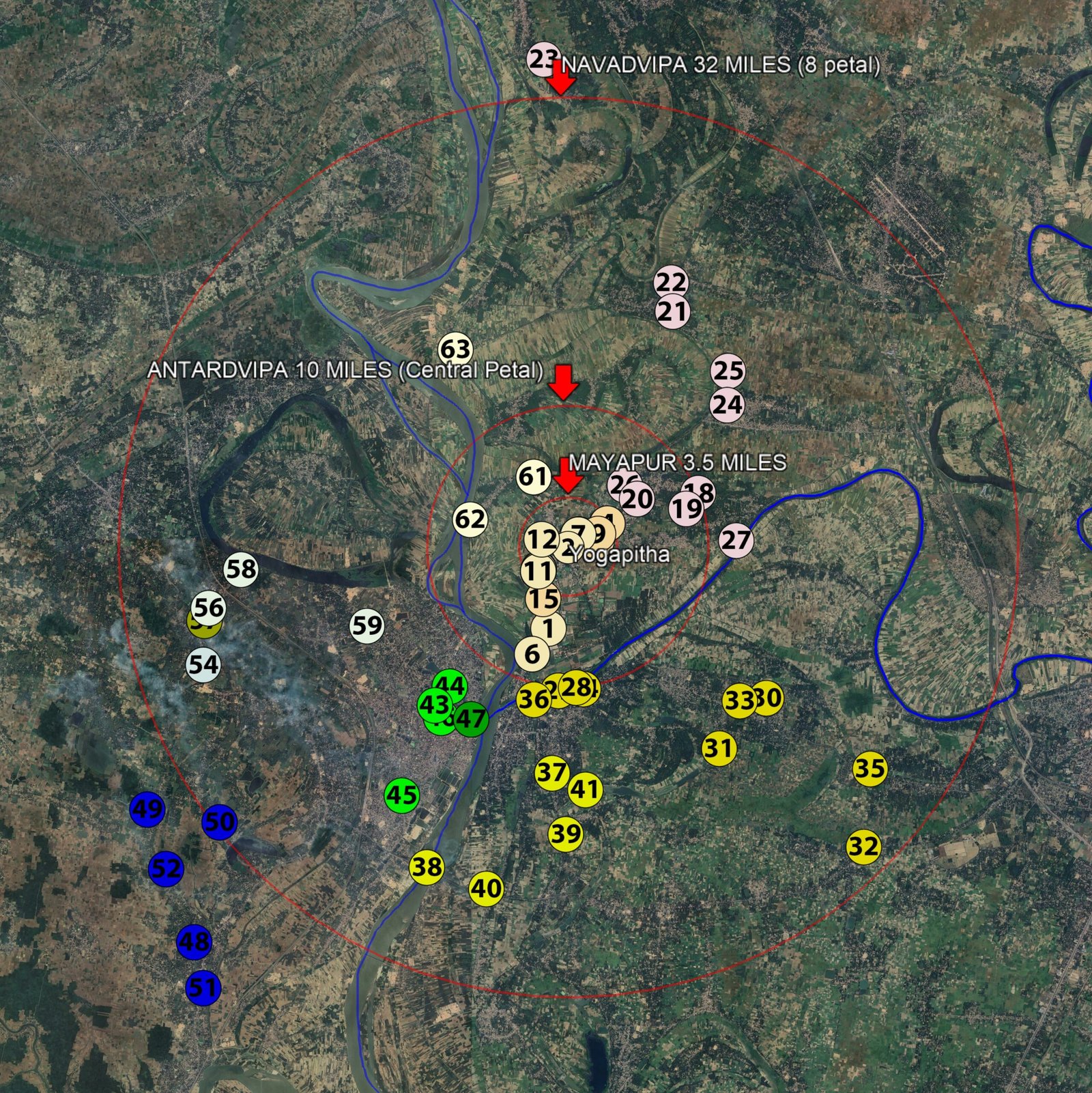
North of Mayapur lies Sīmantadvīpa. Sadhu and sastra have explained the rules of parikrama. After having darsana of Mayapur in Antardvipa, learned devotees go to Simantadvipa. Next one should go south of Mayapur to Godrumadvipa, then one should joyfully go to Madhyadvipa. After seeing these four islands on the east bank, one should reverently cross the Ganges. Having walked around Koladvipa at leisure, then take darśana of Ritudvipa. After seeing the most beautiful Jahnudvipa, go see Modadrumadvipa and then Rudradvipa. Then again cross the Ganges, and walk back to Mayapur. There, respectfully enter the temple of Jagannatha Misra and Sacidevi and take darśana of the Lord. This is the procedure of parikrama for all times. One who follows this practice will obtain unlimited happiness.
Everyone considers the best time for performing parikramā is from the tithi of Mākara-saptami upto the full moon, or purnimă, of Phalguna. After finishing parikrama, fortunate persons take darsana at Māyāpur on the birthday of Lord Caitanya. Nitai and Caitanya bestow Their mercy and the shade of Their lotus feet on those persons, who thus attain the qualification to execute devotional service.
Briefly I have described the rules for parikrama, and now I will describe everything in detail. Therefore, please listen. Whoever walks around the one hundred sixty-eight miles of Gauda-mandala will quickly obtain the treasure of gaura-prema.
Desiring to obtain the shade of the lotus feet of Jāhnavā and Nitai, Bhaktivinoda reveals these truths.
(Sri Navadvipa-Dhama-Mahatmya, Parikrama-Khanda, Chapter 3)
After that, every Ekādaśī My Lord went on sankirtana, wandering over the sacred islands. Sometimes He wandered over the five krosas of Antardvipa, and sometimes, according to His desire, He wandered eight krosas.
“From His house, He went first to Bārakoṇā-ghāṭa, then around Ballal-dighi, and then to Sridhara’s house. From there, He would go to the edge of Antardvipa and thus easily complete a five krosa tour. From Simuliya, He would go to the Kazi’s house. After talking to Sridhara, He would go to Gadigacha (Godruma) and then to Majidā (Madhyadvīpa). Crossing the Ganges at that point, He would go up to Pāradanga and Chinaḍāngā, on the bank of the Ganges. Then, crossing the Ganges again, He would return home, completing eight krosas.
“The complete parikramā is sixteen krosas, and if that is done, the Lord is pleased. This is the tour I am taking you on. There is no equal to this. Within this tour you will see the twelve forests of Vṛndāvana extending over sixteen krosas. This tour ends after nine nights and is thus called navaratra-parikramā in the scripture. One does the five krosa parikrama in one day, and the eight krosa parikramā is completed after three nights. The first night is spent in Mayapur, the second night in Godruma, and the third night at Pulina, the opposite bank of the Ganges.”
Hearing this instruction on the method of parikramā, Jīva Mahāśaya could not contain his love.
Desiring to attain the lotus feet of Nitai and Jahnavā, this worthless pauper describes the glories of Nadia.
(Sri Navadvipa-Dhama-Mahatmya, Chapter 10)
Sri Navadvipa Dhama Mahatmya Parikrama Khanda” by Srila Bhaktivinoda Thakura is a spiritual guide that leads readers through the divine journey of circumambulating the holy land of Navadvipa. Within his writings, he illuminates the divine journey where Lord Nityananda takes Jiva Gosvami around Navadvipa and shows him the wonderful places of the Lord’s pastimes. It reveals the significance of each sacred site, narrating the glories of Lord Chaitanya’s pastimes, encouraging devotees to undertake this transformative pilgrimage for spiritual enrichment and devotion.
O devotees, now listen attentively to the Caitanya Upanisad’s statement which glorifies Navadvipa:
Again he (Pippalāyana) asked a question. “O Lord, how can the people of Kali-yuga who are immersed in sinful life attain liberation? Please tell me who is the worshipable Lord and what is the mantra for Kali-yuga.”
He (Brahma) replied, “Listen, as I speak this confidential knowledge to you. On the bank of the Ganges in Navadvipa-dhāma, which is nondifferent from Goloka, the all-pervading Supreme Personality of Godhead, Govinda, will appear in His two-armed form as Lord Gaura, a great saint and powerful mystic who is above the three modes of nature and is the emblem of transcendental activity. He will preach the cult of devotion throughout the world.
(Sri Navadvipa-Dhama-Mahatmya, Pramana-Khanda, Chapter 1)
In the Gaura-gaṇoddeśa-dīpikā (195) it is said that Śrīla Jīva Gosvāmī was formerly Vilāsa-mañjarī gopī. From his very childhood Jīva Gosvāmī was greatly fond of Śrīmad-Bhāgavatam. He later came to Navadvīpa to study Sanskrit, and, following in the footsteps of Śrī Nityānanda Prabhu, he circumambulated the entire Navadvīpa-dhāma.
(CC Adi 10.85 purport)
Lord Śrī Caitanya Mahāprabhu ‘s pastimes are all uncommon. Whoever listens to His activities becomes glorious, and his life becomes perfect.
(CC Madhya 16.201)
Vīracandra, accepted the sannyāsa order and established a Deity of Lord Caitanya Mahāprabhu in Katwa. These two sons of Rāmamohana were known as Baḍa Prabhu and Choṭa Prabhu, and they inaugurated the circumambulation of Navadvīpa-dhāma. One may refer to the Vaiṣṇava-mañjuṣā for the complete genealogical table of Advaita Prabhu in the line of Kṛṣṇa Miśra.
(CC Adi 12.18)
Srila Bhaktivinoda Thakura instructed Srila Bhaktisiddhanta Sarasvati Thakura, “Try to begin the parikramā of Śrīdhāma Navadvipa as soon as possible. Thereby everyone in the universe can receive Krsna-bhakti.”
(Śrīla Bhaktivinoda Thakura manobhista to Sri Siddhanta Sarasvati)
One krośa equals two square miles.
(NOI 8 purport)
Information – 5 krosas ~ 10 square miles ~ 16 km approx.
16 krosas ~ 32 square miles ~ 51 km approx.
In Antardvīpa, the Lord Himself described to Brahmā the significance of Gaurāṅga’s incarnation. And you saw the attractive form of the Lord at Simantadvīpa.
Close by is Mathurā, where Kaṁsa took birth in Kali-yuga in the family of yāvanas. After purifying Kaṁsa through His kīrtana and discussions, Gaurasundara went to twelve tīrthas on the Ganges and then to Śrīdhara’s house, which is the same as Sudāmā’s house. O Pārvatī, in that place is a pond called Viśāma-kuṇḍa.
Then going to Mayāmārī, Gaurāṅga witnessed the prowess of Balarāma. Passing from there, the Lord danced in kīrtana at the fort of Suvarna Sena. O Pārvatī, Gaurāṅga then went to Devapallī, where He flooded the devatās headed by Sūrya with the blissful chanting of Kṛṣṇa’s name.
Having visited Harihara-kṣetra and Kāśī, which give liberation, the Lord arrived at Godrumadvīpa, which is eternally worshiped by Surabhi. There He danced before Mṛkaṇḍeya Ṛṣi in great ecstasy. Then He went to Naimiśa-tīrtha (Naimiśāraṇya) in Madhyadvīpa and danced with Nityānanda and His other associates in the mandapa of the seven ṛṣis. Going to Puṣkara-tīrtha, which is worshiped by the brāhmaṇas, He inundated Kurukṣetra of Brahmāvarta with kīrtana.
Crossing the Ganges at Mahā-Prayāga, the confluence of the five holy rivers, Gaurāṅga arrived at Koladvīpa. After chanting the holy name in the kingdom of Samudra Sena, where the Ganges and ocean meet, He proceeded to Campahaṭṭa. Arriving at Ṛtudvīpa and seeing the splendid forest, the son of Śacī remembered Rādhā-kuṇḍa and began to weep.
Enjoying the bliss of kīrtana, the Lord and His associates saw Vidyānagara, where Vedic knowledge resides. After going to Jahnudvīpa and seeing the place where Jahnu Muni performed austerities, the Lord went to Modadrumadvīpa and became blissful remembering the pastimes Rāmacandra performed there. The Lord saw Niśreyasa forest within Vaikuṇṭhapura and Brahmanagara across the Virajā River, and then He went to Mahāpurā.
After seeing the auspicious Kamyavana, where the Pāṇḍavas resided in exile, and Pañcāvatī, the Lord went to Śaṅkarapura. Arriving at Pulina, Gaurāṅga, chanting the name of Kṛṣṇa, saw that place as nondifferent from Vṛndāvana. Seeing the place of the rāsa-līlā along with His associates, He began to sing appropriate verses from the Bhāgavatam. O Devī, at the Rāsa-maṇḍala in Pulina, the Lord attained the state of mahābhāva while remembering the rāsa-līlā of Kṛṣṇa. At that time drums sounded from the sky and showers of flowers fell to the earth. The sages chanted the Chāndogya Upaniṣad and other Vedic verses. Finally when the name of Kṛṣṇa was chanted in His ear, the long-armed Lord recovered and loudly chanted Hare Kṛṣṇa! He then went off to the bank of the Ganges.
“Crossing the Ganges, the son of Śacī and His associates performed kīrtana all over Rudradvīpa. The Lord of the universe then went to Bilvapakṣa and flooded the devotee brāhmaṇas and Kāñcipuram with love of God. After going to the āśrama of Bharadvāja and chanting the holy names, the Lord entered Māyāpur.
“O Pārvatī, anyone who hears with devotion how Lord Gaurāṅga traversed Navadvīpa with His kīrtana party will never again fall into the ocean of material existence. O Pārvatī, you will not find any place comparable to Navadvīpa, any form of the Lord comparable to Gaurāṅga, nor anything comparable to kṛṣṇa-prema. The success of life, particularly for Vaiṣṇavas, is attained in Navadvīpa by worshiping the Lord following the path of the inhabitants of Vraja.
(Sri Navadvipa-Dhama-Mahatmya, Pramana-Khanda, Chapter 4)
The Ten Offenses to the Holy Dhama
We should be very much respectful to Vṛndāvana dhāma; otherwise we’ll be offender, dhāmāparādha. Dhāmāparādha. If we remain in Vṛndāvana we should know that we are living with Kṛṣṇa. And how much we should be cautious, how much we should be careful if we are actually understand what is dhāma. Dhāma is also Kṛṣṇa. If in the dhāma we commit sinful activities, then we are, what is called, suiciding, committing suicide. It is a fact.
(721031 – Lecture NOD – Vrndavana)
1) Contempt and disrespect towards the guru who is the revealer of the dhama to his disciple.
2) To think that the holy dhama is temporary.
3) To commit violence towards any of the residents of the holy dhama or to any of the pilgrims who come there, or to think that they are ordinary mundane people.
4) Performing mundane activities while living in the holy place.
5) Earning money by and making a business of Deity worship and the chanting of the holy name.
6) To think that the holy dhama belongs to some mundane country or province such as Bengal, to think that the dhama of the Lord is equal to a holy place connected with some demigod, or to attempt to measure the area of the dhama.
7) To commit sinful acts while residing in the dhama.
8) To consider Vrndavana and Navadvipa to be different.
9) To blaspheme the sastras which glorify the dhama.
10) To be faithless and think that the glories of the dhama are imaginary.
(Reference – The Process of Deity Worship (Arcana-Paddhati))