
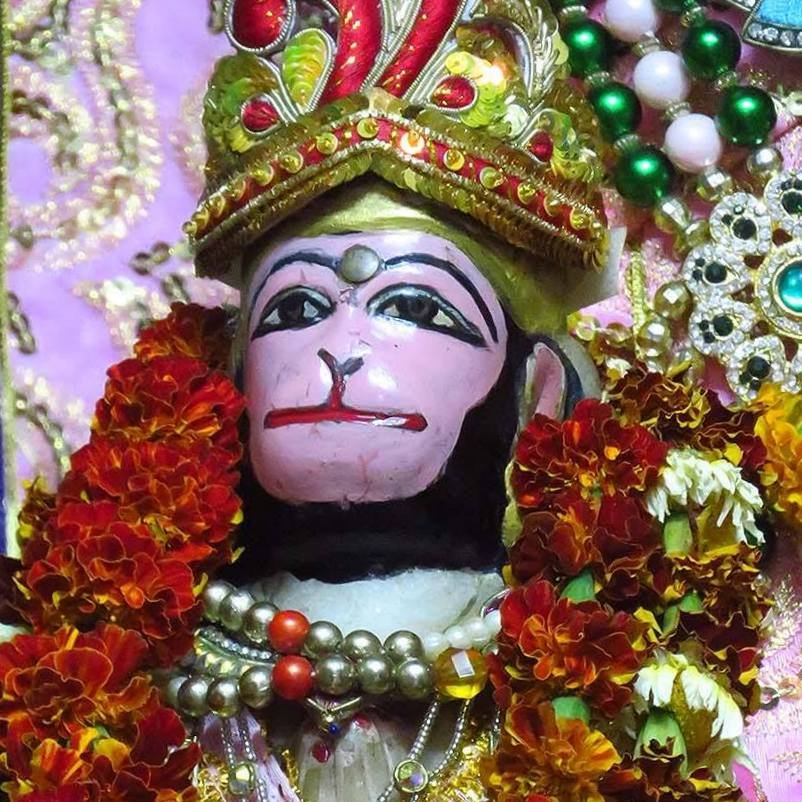
Śrī Murāri Gupta (Hanumān)
śrī-murāri gupta śākhā—premera bhāṇḍāra
prabhura hṛdaya drave śuni’ dainya yāṅra
pratigraha nāhi kare, nā laya kāra dhana
ātma-vṛtti kari’ kare kuṭumba bharaṇa
cikitsā karena yāre ha-iyā sadaya
deha-roga bhāva-roga,—dui tāra kṣaya
Murāri Gupta, the twenty-first branch of the tree of Śrī Caitanya Mahāprabhu, was a storehouse of love of Godhead. His great humility and meekness melted the heart of Lord Caitanya. Śrīla Murāri Gupta never accepted charity from friends, nor did he accept money from anyone. He practiced as a physician and maintained his family with his earnings. As Murāri Gupta treated his patients, by his mercy both their bodily and spiritual diseases subsided.
(CC Adi 10.49 – 51)
Śrī Murāri Gupta wrote a book called Śrī Caitanya-carita. He belonged to a vaidya physician family of Śrīhaṭṭa, the paternal home of Lord Caitanya, and later became a resident of Navadvīpa. He was among the elders of Śrī Caitanya Mahāprabhu. Lord Caitanya exhibited His Varāha form in the house of Murāri Gupta, as described in the Caitanya-bhāgavata, Madhya-khaṇḍa, Third Chapter. When Śrī Caitanya Mahāprabhu exhibited His mahā-prakāśa form, He appeared before Murāri Gupta as Lord Rāmacandra. When Śrī Caitanya Mahāprabhu and Nityānanda Prabhu were sitting together in the house of Śrīvāsa Ṭhākura, Murāri Gupta first offered his respects to Lord Caitanya and then to Śrī Nityānanda Prabhu. Nityānanda Prabhu, however, was older than Caitanya Mahāprabhu, and therefore Lord Caitanya remarked that Murāri Gupta had violated social etiquette, for he should have first shown respect to Nityānanda Prabhu and then to Him. In this way, by the grace of Śrī Caitanya Mahāprabhu, Murāri Gupta was informed about the position of Śrī Nityānanda Prabhu, and the next day he offered obeisances first to Lord Nityānanda and then to Lord Caitanya. Śrī Caitanya Mahāprabhu gave chewed pan, or betel nut, to Murāri Gupta. Once Śivānanda Sena offered food to Lord Caitanya that had been cooked with excessive ghee, and the next day the Lord became sick and went to Murāri Gupta for treatment. Lord Caitanya accepted some water from the waterpot of Murāri Gupta, and thus He was cured. The natural remedy for indigestion is to drink a little water, and since Murāri Gupta was a physician, he gave the Lord some drinking water and cured Him.
When Caitanya Mahāprabhu appeared in the house of Śrīvāsa Ṭhākura in His Caturbhuja mūrti, Murāri Gupta became His carrier in the form of Garuḍa, and in these pastimes of ecstasy the Lord then got up on his back. It was the desire of Murāri Gupta to leave his body before the disappearance of Caitanya Mahāprabhu, but the Lord forbade him to do so. This is described in the Caitanya-bhāgavata, Madhya-khaṇḍa, Chapter Twenty. When Śrī Caitanya Mahāprabhu one day appeared in ecstasy as the Varāha mūrti, Murāri Gupta offered Him prayers. He was a great devotee of Lord Rāmacandra, and his staunch devotion is vividly described in the (Caitanya-caritāmṛta, Madhya-līlā), Fifteenth Chapter, verses 137 through 157.
(CC Adi 10.49 purport)
Murāri Gupta was a great devotee of Lord Rāmacandra. When Lord Caitanya heard Lord Rāmacandra’s glories from his mouth, He immediately wrote on his forehead “rāmadāsa” [the eternal servant of Lord Rāmacandra].
(CC Adi 17.69)
Śrī Caitanya Mahāprabhu then embraced Murāri Gupta and began to speak about his firm faith in devotional service. This was heard by all the devotees. Śrī Caitanya Mahāprabhu said, “Previously I induced Murāri Gupta again and again to be allured by Lord Kṛṣṇa. I said to him, ‘My dear Gupta, Lord Śrī Kṛṣṇa, Vrajendra-kumāra, is the supreme sweetness. “‘Kṛṣṇa is the Supreme Personality of Godhead, the origin of all incarnations and the source of everything. He is pure transcendental love itself, and He is the reservoir of all pleasure. “Kṛṣṇa is the reservoir of all transcendental qualities. He is like a mine of gems. He is expert at everything, very intelligent and sober, and He is the summit of all transcendental humors. ‘His character is very sweet, and His pastimes are melodious. He is expert in intelligence, and thus He enjoys all His pastimes and mellows.’ “I then requested Murāri Gupta, ‘Worship Kṛṣṇa and take shelter of Him. But for His service, nothing appeals to the mind.’ “In this way, he heard from Me again and again. By My influence, his mind was a little converted. “Murāri Gupta then replied, ‘I am Your servant and Your order-carrier. I have no independent existence.’ “After this, Murāri Gupta went home and spent the whole night thinking how he would have to give up the association of Raghunātha, Lord Rāmacandra. Thus he was overwhelmed. “Murāri Gupta then began to pray at the lotus feet of Lord Rāmacandra. He prayed that death would come that night because it was not possible for him to give up the service of the lotus feet of Raghunātha. “Thus Murāri Gupta cried the entire night. There was no rest for his mind; therefore he could not sleep but stayed awake the entire night. “In the morning Murāri Gupta came to see Me. Catching hold of My feet and crying, he submitted an appeal. “Murāri Gupta said, ‘I have sold my head unto the lotus feet of Raghunātha. I cannot withdraw my head, for that would give me too much pain.“‘It is not possible for me to give up the service of Raghunātha’s lotus feet. At the same time, if I do not do so I shall break Your order. What can I do?’ “In this way Murāri Gupta appealed to Me, saying, ‘You are all-merciful, so kindly grant me this mercy: Let me die before You so that all my doubts will be finished.’ “Hearing this, I became very happy. I then raised Murāri Gupta and embraced him.“I said to him, ‘All glories to you, Murāri Gupta! Your method of worship is very firmly fixed—so much so that even upon My request your mind did not turn. “‘The servitor must have love and affection for the lotus feet of the Lord exactly like this. Even if the Lord wants separation, a devotee cannot abandon the shelter of His lotus feet. “‘Just to test your firm faith in your Lord, I requested you again and again to change your worship from Lord Rāmacandra to Kṛṣṇa.’ “In this way, I congratulated Murāri Gupta, saying, ‘Indeed, you are the incarnation of Hanumān. Consequently you are the eternal servant of Lord Rāmacandra. Why should you give up the worship of Lord Rāmacandra and His lotus feet?”
Śrī Caitanya Mahāprabhu continued, “I accept this Murāri Gupta as My life and soul. When I hear of his humility, it perturbs My very life.”
(CC Madhya 15.137 – 15.157)
The Lord ordered Murāri, “Behold My form!” and Murāri saw the Lord as Rāmacandra. He saw Viśvambhara was dark like fresh grass, and He sat in the vīrāsana posture as a powerful archer. He saw Sītā and Lakṣmaṇa on the Lord’s left and right. The leaders of the monkeys were offering prayers in the four directions. Murāri realized that he was also one of the monkeys. Seeing the Lord face to face, the best of the doctors lost consciousness. As he lost consciousness, he fell to the ground in Lord Caitanya’s trap. Viśvambhara exclaimed, “O monkey, you forgot how Rāvaṇa, who stole Sītā, burned you. You burnt his entire city and subdued his dynasty. I tell you, I am that Lord. Murāri, get up, get up. You are My life. I am that Rāmacandra, and you are Hanumān. See your life and soul, the son of Sumitrā. You brought Gandamādana Hill to revive His life. Offer your obeisances at the feet of Sītā, whose distress made you cry profusely. Upon hearing Lord Caitanya’s words, Murāri regained his consciousness. Seeing that manifestation, he began to cry in love. Upon hearing Murāri Gupta cry, even dry wood melted, and the hearts of the devotees especially melted. Viśvambhara again said to Murāri, “Ask for any benediction you desire.” Murāri replied, “O Lord, I do not want anything. Simply allow me to sing Your glories. O Lord, I may take birth anywhere, but wherever I take birth let me always remember You. Let me reside in the association of Your servants birth after birth. O Lord, do not put me in a condition in which You are not my master and I am not Your servant. May I remain Your servant wherever You and Your associates incarnate.”
When the Lord said, “I certainly grant you this benediction,” a tumultuous vibration of “Jaya! Jaya!” immediately arose. All the Vaiṣṇavas had great affection for Murāri, who was by nature merciful to all living entities. If Murāri was associated with any place, that place became as sanctified as Vaikuṇṭha. Who can describe the glories of Murāri? In every incarnation, the Lord was the dear friend of Murāri.
Lord Caitanya said, “Listen, everyone, anyone who blasphemes Murāri will not be delivered even if he takes millions of baths in the Ganges. Neither the Ganges nor the holy names of Hari will nullify his sins. Lord Murāri resides in his heart gupte, or secretly, therefore his name, `Murāri Gupta’ is quite appropriate. On seeing the Lord’s mercy on Murāri, all the exalted devotees cried in love while chanting the names of Kṛṣṇa. Anyone who hears the narration of Lord Caitanya bestowing mercy on Murāri attains loving devotional service.
(Sri Caitanya Bhagavata Madhya-khaṇḍa 10.007 – 10.033)
Lord Caitanya said, “Listen, everyone, anyone who blasphemes Murāri will not be delivered even if he takes millions of baths in the Ganges. Neither the Ganges nor the holy names of Hari will nullify his sins. “Lord Murāri resides in his heart gupte, or secretly, therefore his name, `Murāri Gupta’ is quite appropriate.” On seeing the Lord’s mercy on Murāri, all the exalted devotees cried in love while chanting the names of Kṛṣṇa.
(CB Madhya-khaṇḍa 10.029 – 10.032)
Murāri Gupta could not be called even a brahma-bandhu because he was born of a vaidya family and according to the social structure was therefore considered a śūdra. But Kṛṣṇa bestowed special mercy upon Murāri Gupta because he was a beloved devotee of the Lord, as stated by Śrī Caitanya Mahāprabhu. The purport of Śrī Bhaktisiddhānta Sarasvatī Ṭhākura’s elaborate discussion of this subject is that no qualification in this material world can satisfy the Supreme Personality of Godhead, Kṛṣṇa, yet everything becomes successful simply through development of devotional service to the Lord.
The members of the International Society for Krishna Consciousness cannot even call themselves brahma-bandhus. Therefore our only means for satisfying Kṛṣṇa is to pursue the injunctions of Lord Śrī Caitanya Mahāprabhu, who says:
- yāre dekha, tāre kaha ‘kṛṣṇa’-upadeśa
- āmāra ājñāya guru hañā tāra’ ei deśa
“Whomever you meet, instruct him on the teachings of Kṛṣṇa. In this way, on My order, become a spiritual master and deliver the people of this country.” (CC Madhya 7.128) Simply trying to follow the orders of Śrī Caitanya Mahāprabhu, we speak to the people of the world about Bhagavad-gītā. This will make us qualified to satisfy the Supreme Personality of Godhead, Kṛṣṇa.
(CC Adi 17.78 purport)
By adopting only one of these nine principles, the following renowned devotees of the Lord were able to achieve the highest perfection: …. (7) By rendering personal service to the Lord, Hanumān attained the desired result.
(Śrī Īśopaniṣad 17)