
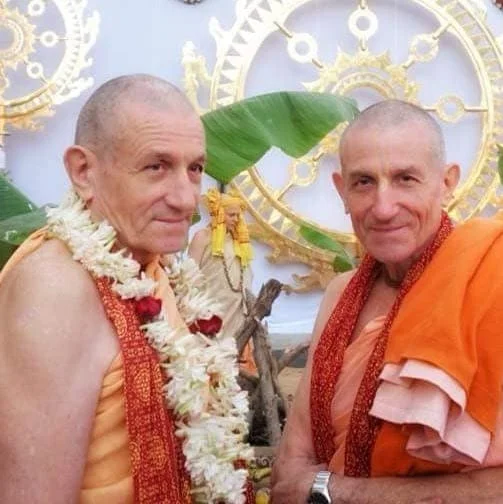
Jananivāsa Dasa & Paṅkajaṅghri Dasa : Twins Seldom Come Alone
Published: Spring 1995
Source: Mayapur Journal, Issue 25
Two days after this Gaura-Pūrṇimā festival, another, much smaller festival took place.
Gaura-Pūrṇimā is a festival to glorify the transcendental birth of Lord Caitanya Mahāprabhu who inaugurated the saṅkīrtana movement. The second festival took place on March 19th, to glorify the births of two very wonderful and humble devotees who appeared as twin brothers to serve Lord Caitanya in His mission: Jananivāsa and Pāṅkajāṅghri Prabhus. Originally from England, they came to India in 1970 to find the truth. They traveled many places but found no satisfaction; they studied esoteric literature but found no answers.
Then, alone in Puri, Jananivāsa one day received Śrīla Prabhupāda’s Bhagavad-gītā. While reading it, he finally found what he was looking for—the Supreme Lord. Jananivāsa then went to Calcutta and received initiation from Prabhupāda on Rāsa-Pūrṇimā in 1971.
In 1972, the first ISKCON Gaura-Pūrṇimā festival took place in Mayapur (see Mayapur Journal 6.1). Their beautiful Lordships Śrī Śrī Rādhā-Mādhava blessed everyone by coming to reside in the holy dhāma. During the festival, Jananivāsa received second initiation, and later he became Śrī Śrī Rādhā-Mādhava’s pūjārī.
Just after the festival, Pāṅkajāṅghri came to see Jananivāsa on their birthday and then left to continue his travels.
In 1973, back in England, he visited the Hare Krishna devotees. After failing to defeat their philosophy by logic, he conceded that they indeed had the Absolute Truth that he had searched for through half the world. He then joined and soon took initiation from Śrīla Prabhupāda. He then returned to India in 1974 for ISKCON’s third Gaura-Pūrṇimā festival, where he joined Jananivāsa on the altar. At this time, Pāṅkajāṅghri received brāhmaṇa initiation.
In those days, the worship of Śrī Śrī Rādhā-Mādhava was very simple, but Their service was still very sweet.
First Pāṅkajāṅghri dressed Lord Gaurāṅga, who had joined Rādhā-Mādhava in 1973 after Gaura-Pūrṇimā. Later, in 1976, when Śrīla Prabhupāda allowed Jananivāsa to begin worshiping ISKCON’s first śālagrāma-śilā, Pāṅkajāṅghri began worshipping Rādhā-Mādhava. He continued serving Them until 1986, when Lord Nṛsiṁhadeva arrived (see Mayapur Journal 6.2).
Last year, in order to celebrate Jananivāsa’s and Pāṅkajāṅghri’s fiftieth birthday—and their more than twenty years of service in Mayapur—the devotees from the Deity department arranged a feast in their honor. It was a surprise and both showed great embarrassment, as all the GBC and many ISKCON sannyāsīs were invited. Keeping their humble mood, they both served all the devotees before being forced to be seated and receive the honor and respect they so rightly deserve. The culmination of the feast was a transcendental fight over the remnants on their plates.
This year, with just a few local sannyāsīs present, the two brothers were again honored with a feast. The swamis, sitting in front of the nicely garlanded brahmacārī brothers, glorified their transcendental qualities and shared early remembrances. Bhakti Charu Mahārāja explained how they helped him at the very beginning of his Krishna conscious life. Bhānu Mahārāja commented on their wonderful quality of niṣṭha (steadiness). He explained that to be able to do the same service day after day, year after year, is a very rare thing. By training, he continued, we can eventually develop an attitude of servitude that qualifies us to enter into the service of the Supreme Lord in the spiritual world. How wonderful it is when someone—while still on this planet—can render direct service to the Lord in the form of the Deity day after day. In their case, they have already achieved the goal of devotional service.
Śrīla Prabhupāda made Mayapur the world headquarters of ISKCON and called it his place of worship. Devotees who visit the dhāma often comment how they sense the deep love and devotion offered to Their Lordships here in Śrī Mayapur. It becomes obvious why Śrīla Prabhupāda entrusted the worship of the Mayapur Deities to these two transcendentally situated brothers—their sincerity and purity are an example for the whole world. Who can imagine how fortunate they are to have performed devotional service in the holy dhāma for more than twenty years? And who can estimate the good fortune of all those who get their transcendental association?