
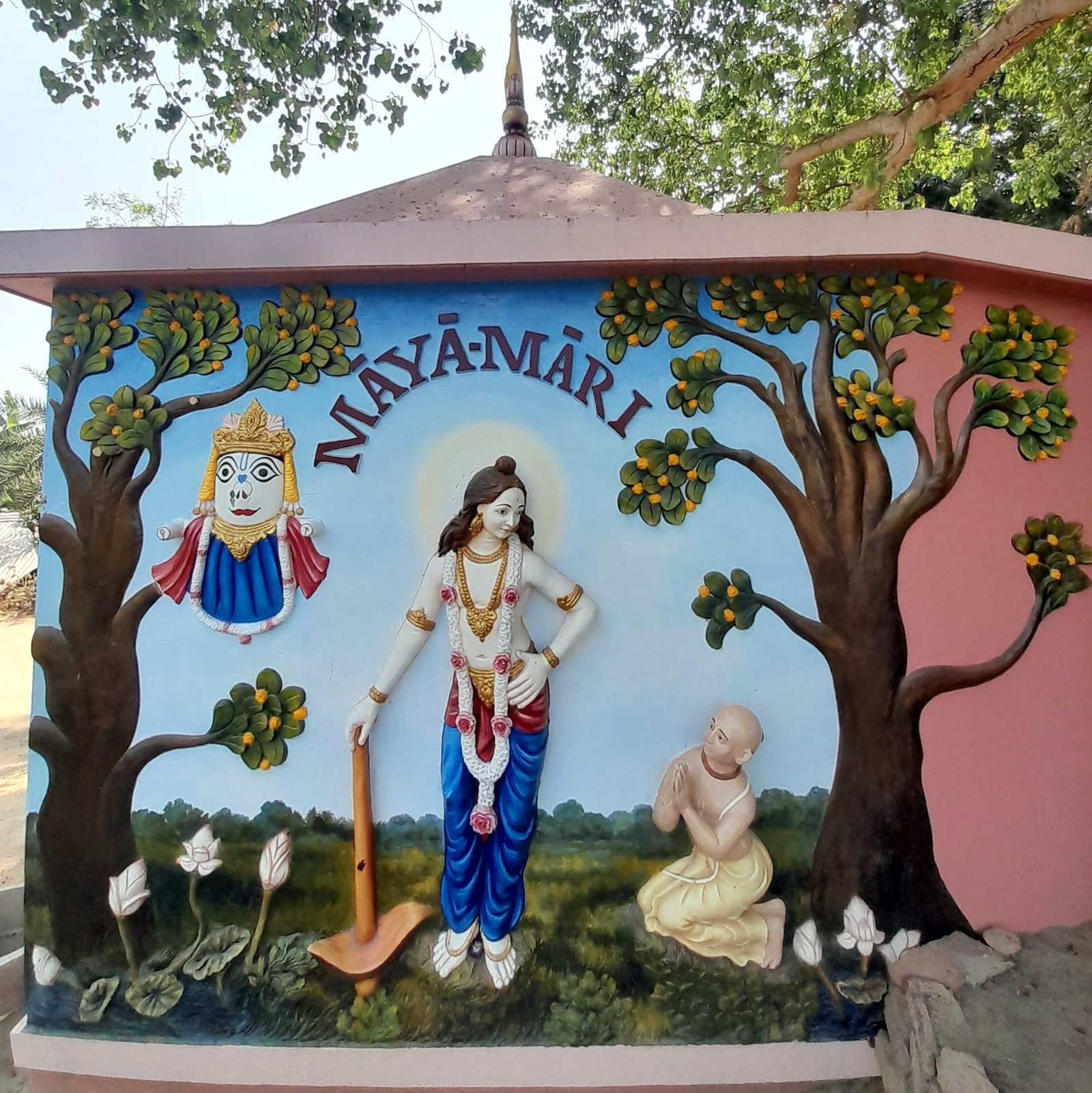
Māyāmāri
Opening Time
Daytime (A small shrine has been constructed at the site, with no Deities installed)
Nearby this place is Mayamari. Listen to the story from the Puranas. When Baladeva was on pilgrimage, He came to Navadvipa to take rest. The brahmanas there told Him about the Mayasura demon. Hearing about the disturbance that the demon was causing, Baladeva quickly came running to meet the demon in the field. A great battle ensued between Balarama and the demon, and at last the demon was killed. Since then the place has been called Mayamari. This is a very old story I am telling you. In Vrindavana, this tirtha is called Talavana, and it is visible to those who are fortunate.
(Sri Navadvipa-Dhama-Mahatmya, Chapter 6)
Balarāma appeared with Him as Lord Nityānanda.
(CC Adi 5.6)
Nityānanda means prakāśa, svayaṁ-prakāśa, Balarāma. Balarāma is, I mean to say, presenting Kṛṣṇa. Therefore Balarāma is guru-tattva. Guru is representative of Balarāma, of Nityānanda, Guru Nityānanda, because He is exhibiting Kṛṣṇa. He is presenting Kṛṣṇa, prakāśa. Just like when there is sunshine you can see everything very correctly. That is called prakāśa. In the darkness everything is covered. At night we cannot see, but during daytime, when there is prakāśa, illumination, then we can see everything. So Nityānanda Prabhu is Balarāma. Balarāma is prakāśa-tattva. He's manifesting Kṛṣṇa. Balarāma hoila nitāi. So vande śrī . . . Śrī Kṛṣṇa Caitanya is the Supreme Absolute Personality of Godhead, and next, Nityānanda, or, yes, Nityānanda, is exhibiting Him. When Nityānanda was preaching in Bengal, He first of all delivered the Jagāi and Mādhāi. That was his first business.
(750326 - Lecture CC Adi 01.02 - Mayapur)
Talavana Pastime in Vṛndāvana
While Kṛṣṇa was thus engaged in exhibiting His internal potency along with the supermost fortunate friends, there occurred another chance for Him to exhibit the superhuman powers of Godhead. His most intimate friends Śrīdāmā, Subala and Stokakṛṣṇa began to address Kṛṣṇa and Balarāma with great love and affection thus: “Dear Balarāma, You are very powerful; Your arms are very strong. Dear Kṛṣṇa, You are very expert in killing all kinds of disturbing demons. Will You kindly note that just near this place there is a big forest of the name Tālavana. This forest is full of palm trees, and all the trees are filled with fruits. Some are falling down, and some of them are very ripe even in the trees. It is a very nice place, but because of a great demon, Dhenukāsura, it is very difficult to go there. No one can reach the trees to collect the fruits. Dear Kṛṣṇa and Balarāma, this demon is present there in the form of an ass, and he is surrounded by similar demon friends who assume the same shape. All of them are very strong, so it is very difficult to approach this place. Dear brothers, You are the only persons who can kill such demons. Other than You, no one can go there for fear of being killed. Not even animals go there, and no birds are sleeping there; they have all left. One can only appreciate the sweet aroma that is coming from that place. It appears that up until now, no one has tasted the sweet fruits there, either on the tree or on the ground. Dear Kṛṣṇa, to tell You frankly, we are very attracted by this sweet aroma. Dear Balarāma, let us all go there and enjoy these fruits. The aroma of the fruits is now spread everywhere. Don’t You smell it from here?”
When Balarāma and Kṛṣṇa were thus petitioned by Their smiling, intimate friends, They were inclined to please them, and They began to proceed towards the forest, surrounded by all Their friends. Immediately upon entering the Tālavana, Balarāma began to yank the trees with His arms, exhibiting the strength of an elephant. Because of this jerking, all the ripe fruits fell down on the ground. Upon hearing the sound of the falling fruits, the demon Dhenukāsura, who was living there in the form of an ass, began to approach with great force, shaking the whole field so that all the trees began to move as if there were an earthquake. The demon appeared first before Balarāma and began to kick His chest with his hind legs. At first, Balarāma did not say anything, but the demon with great anger began to kicked Him again more vehemently. This time Balarāma immediately caught hold of the legs of the ass with one hand and, wheeling him around, threw him into the treetops. While he was being wheeled around by Balarāma, the demon lost his life. Balarāma threw the demon into the biggest palm tree about, and the demon’s body was so heavy that the palm tree fell upon other trees, and several fell down. It appeared as if a great hurricane had passed through the forest, and all the trees were falling down, one after another. This exhibition of extraordinary strength is not astonishing because Balarāma is the Personality of Godhead known as Ananta Śeṣanāga, who is holding all the planets on the hoods of His millions of heads. The whole cosmic manifestation is maintained by Him exactly as two threads hold the weaving of a cloth.
After the demon was thrown into the trees, all the friends and associates of Dhenukāsura immediately assembled and attacked Balarāma and Kṛṣṇa with great force. They were determined to retaliate and avenge the death of their friend. But Kṛṣṇa and Balarāma began to catch each of the asses by the hind legs and, exactly in the same way, wheeled them around. Thus They killed all of them by throwing them into the palm trees. Because of the dead bodies of the asses, there was a panoramic scene. It appeared as if clouds of various colors were assembled in the trees. Hearing of this great incident, the demigods from the higher planets began to shower flowers on Kṛṣṇa and Balarāma and began to beat their drums and offer devotional prayers.
A few days after the killing of Dhenukāsura, people began to come into the Tālavana forest to collect the fruits, and animals began to return without fear to feed on the nice grasses grown there. Just by chanting or hearing these transcendental activities and pastimes of the brothers Kṛṣṇa and Balarāma, one can amass pious activities.
(Kṛṣṇa Book 15)