
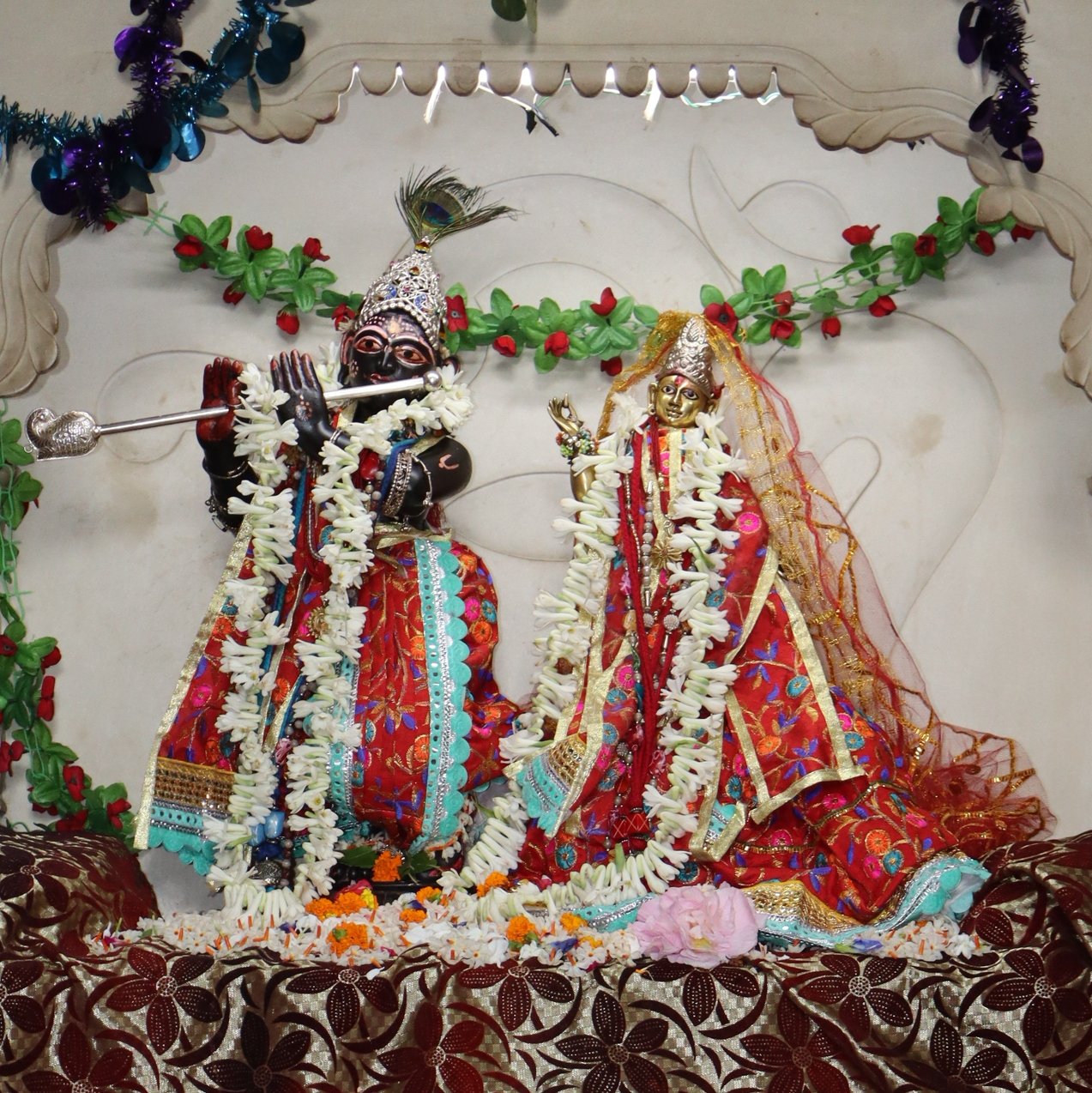
Śrī Kṛṣṇa Rāya (Kāṅcaḍāpāḍā)
Śrīnātha Paṇḍita, the forty-ninth branch, was the beloved recipient of all the mercy of Śrī Caitanya Mahāprabhu. Everyone in the three worlds was astonished to see how he worshiped Lord Kṛṣṇa.
PURPORT
Śrīla Bhaktisiddhānta Sarasvatī Ṭhākura writes in his Anubhāṣya, “About one and a half miles away from Kumārahaṭṭa, or Kāmarhaṭṭa, which is a few miles from Calcutta, is a village known as Kāṅcaḍāpāḍā, which was the home of Śrī Śivānanda Sena. There he constructed a temple of Śrī Gauragopāla. Śrīnātha Paṇḍita established another temple there with Śrī Rādhā-Kṛṣṇa mūrtis. The Deity of that temple is named Śrī Kṛṣṇa Rāya. The temple of Kṛṣṇa Rāya, which was constructed in the year 1708 Śakābda [A.D. 1786] by a prominent zamindar named Nimāi Mullik of Pāthuriyā-ghāṭa in Calcutta, is very large. There is a big courtyard in front of the temple, and there are residential quarters for visitors and good arrangements for cooking prasādam. The entire courtyard is surrounded by very high boundary walls, and the temple is almost as big as the Māheśa temple. Inscribed on a tablet are the names of Śrīnātha Paṇḍita and his father and grandfather and the date of construction of the temple. Śrīnātha Paṇḍita, one of the disciples of Advaita Prabhu, was the spiritual master of the third son of Śivānanda Sena, who was known as Paramānanda Kavi-karṇapūra. It is said that the Kṛṣṇa Rāya Deity was installed during the time of Kavi-karṇapūra. According to hearsay, Vīrabhadra Prabhu, the son of Nityānanda Prabhu, brought a big stone from Murśidābād from which three Deities were carved—namely, the Rādhāvallabha vigraha of Vallabhapura, the Śyāmasundara vigraha of Khaḍadaha and the Śrī Kṛṣṇa Rāya vigraha of Kāṅcaḍāpāḍā. The home of Śivānanda Sena was situated on the bank of the Ganges near an almost ruined temple. It is said that the same Nimāi Mullik of Calcutta saw this broken-down temple of Kṛṣṇa Rāya while he was going to Benares and thereafter constructed the present temple.”
(CC Adi 10.107)
Śrīla Śivānanda Sena has been described by Śrīla Bhaktisiddhānta Sarasvatī Mahārāja as follows: “Śivānanda Sena was a resident of Kumārahaṭṭa, which is also known as Hālisahara, and was a great devotee of the Lord. About one and a half miles from Kumārahaṭṭa is another village, known as Kāṅcaḍāpāḍā, in which there are Gaura-Gopāla Deities installed by Śivānanda Sena, who also established a temple of Kṛṣṇarāya that is still existing. Śivānanda Sena was the father of Paramānanda Sena, who was also known as Purī dāsa or Kavi-karṇapūra. Paramānanda Sena wrote in his Gaura-gaṇoddeśa-dīpikā (176) that two of the gopīs of Vṛndāvana, whose former names were Vīrā and Dūtī, combined to become his father. Śrīla Śivānanda Sena guided all the devotees of Lord Caitanya who went from Bengal to Jagannātha Purī, and he personally bore all the expenses for their journey. This is described in the Caitanya-caritāmṛta, Madhya-līlā, Chapter Sixteen, verses 19 through 27. Śrīla Śivānanda Sena had three sons, named Caitanya dāsa, Rāmadāsa and Paramānanda. As mentioned above, this last son later became Kavi-karṇapūra and wrote the Gaura-gaṇoddeśa-dīpikā. His spiritual master was Śrīnātha Paṇḍita, who was Śivānanda Sena’s priest. Due to Vāsudeva Datta’s lavish spending, Śivānanda Sena was engaged to supervise his expenditures.”
(CC Adi 10.60 purport)
The Lord stayed at Rāghava Paṇḍita ‘s place for only one day. The next morning, He went to Kumārahaṭṭa, where Śrīvāsa Ṭhākura lived.
PURPORT
The present name of Kumārahaṭṭa is Hālisahara. After Śrī Caitanya Mahāprabhu accepted sannyāsa, Śrīvāsa Ṭhākura left Navadvīpa due to separation from Him and went to Hālisahara to live.
From Kumārahaṭṭa, Śrī Caitanya Mahāprabhu went to Kāñcanapallī (also known as Kāṅcaḍāpāḍā), where Śivānanda Sena lived. After staying two days at Śivānanda ‘s house, the Lord went to the house of Vāsudeva Datta. From there He went to the western side of Navadvīpa, to the village called Vidyānagara. From Vidyānagara He went to Kuliyā-grāma and stayed at Mādhava dāsa ‘s house. He stayed there one week and excused the offenses of Devānanda and others. Due to Kavirāja Gosvāmī ‘s mentioning the name of Śāntipurācārya, some people think that Kuliyā is a village near Kāṅcaḍāpāḍā. Due to this mistaken idea, they invented another place known as New Kuliyāra Pāṭa. Actually such a place does not exist. Leaving the house of Vāsudeva Datta, Śrī Caitanya Mahāprabhu went to the house of Advaita Ācārya. From there He went to the western side of Navadvīpa, to Vidyānagara, and stayed at the house of Vidyā-vācaspati. These accounts are given in the Caitanya-bhāgavata, Caitanya-maṅgala, Caitanya-candrodaya-nāṭaka and Caitanya-carita-kāvya. Śrīla Kavirāja Gosvāmī has not vividly described this entire tour; therefore, on the basis of Caitanya-caritāmṛta, some unscrupulous people have invented a place called Kuliyāra Pāṭa near Kāṅcaḍāpāḍā.
(CC Madhya 16.205)
The two brothers Śrīvāsa Paṇḍita and Śrī Rāma Paṇḍita started two branches that are well known in the world.
PURPORT
In the Gaura-gaṇoddeśa-dīpikā (90), Śrīvāsa Paṇḍita (Śrīvāsa Ṭhākura) is described as an incarnation of Nārada Muni, and Śrī Rāma Paṇḍita, his younger brother, is said to be an incarnation of Parvata Muni, a great friend of Nārada’s. Śrīvāsa Paṇḍita’s wife, Mālinī, is celebrated as an incarnation of the nurse Ambikā, who fed Lord Kṛṣṇa with her breast milk, and as already noted, his niece Nārāyaṇī, the mother of Ṭhākura Vṛndāvana dāsa, the author of Śrī Caitanya-bhāgavata, was the sister of Ambikā in kṛṣṇa-līlā. We also understand from the description of Śrī Caitanya-bhāgavata that after Lord Caitanya Mahāprabhu’s acceptance of the sannyāsa order, Śrīvāsa Paṇḍita left Navadvīpa, possibly because of feelings of separation, and domiciled at Kumārahaṭṭa.
(CC Adi 10.8)