
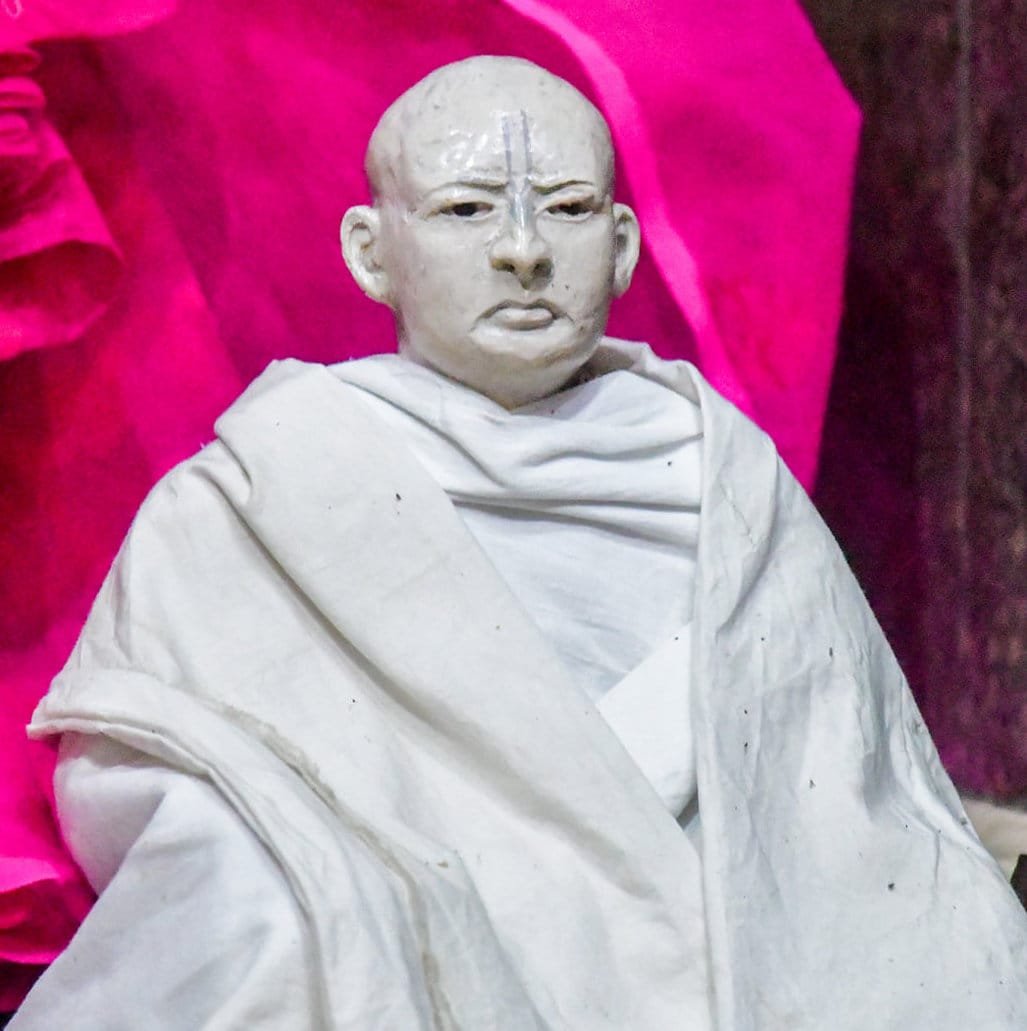
Vṛndāvana dāsa Ṭhākura
Śrīla Vṛndāvana dāsa Ṭhākura was an incarnation of Vedavyāsa and also a friendly cowherd boy named Kusumāpīḍa in kṛṣṇa-līlā. In other words, the author of Śrī Caitanya-bhāgavata, Śrīla Vṛndāvana dāsa Ṭhākura, the son of Śrīvāsa Ṭhākura’s niece Nārāyaṇī, was a combined incarnation of Vedavyāsa and the cowherd boy Kusumāpīḍa.
(CC Adi 11.55 purport)
Vṛndāvana dāsa Ṭhākura is Lord Nityānanda’s favorite devotee, and therefore he is the original Vyāsadeva in describing the pastimes of Śrī Caitanya Mahāprabhu.
(CC Antya 20.82)
Śrīla Vṛndāvana dāsa Ṭhākura is the authorized writer on the pastimes of Lord Caitanya. Without his mercy, therefore, one cannot describe these pastimes.
(CC Adi 8.82)
Actually the authorized compiler of the pastimes of Śrī Caitanya Mahāprabhu is Śrīla Vṛndāvana dāsa, the incarnation of Vyāsadeva. Only upon his orders am I trying to chew the remnants of food that he has left.
(CC Madhya 1.13)
Śrī Vṛndāvana dāsa Ṭhākura’s Śrī Caitanya-bhāgavata was originally entitled Śrī Caitanya-maṅgala, but when Śrīla Locana dāsa Ṭhākura later wrote another book named Śrī Caitanya-maṅgala, Śrīla Vṛndāvana dāsa Ṭhākura changed the name of his own book, which is now therefore known as Śrī Caitanya-bhāgavata. The life of Śrī Caitanya Mahāprabhu is very elaborately described in the Caitanya-bhāgavata, and Kṛṣṇadāsa Kavirāja Gosvāmī has already informed us that in his Śrī Caitanya-caritāmṛta he has described whatever Vṛndāvana dāsa Ṭhākura has not mentioned.
(CC Adi 8.33 purport)
The transcendental pastimes of Lord Caitanya have actually been relished by Śrīla Vṛndāvana dāsa Ṭhākura. I am simply trying to chew the remnants of food left by him.
(CC Adi 13.50)
kṛṣṇa-līlā bhāgavate kahe veda-vyāsa
caitanya-līlāra vyāsa—vṛndāvana-dāsa
As Vyāsadeva has compiled all the pastimes of Lord Kṛṣṇa in Śrīmad-Bhāgavatam, Ṭhākura Vṛndāvana dāsa has depicted the pastimes of Lord Caitanya.
(CC Adi 8.34)
vṛndāvana-dāsa kaila ‘caitanya-maṅgala’
yāṅhāra śravaṇe nāśe sarva amaṅgala
Thakura Vrndavana dasa has composed Sri Caitanya-mangala. Hearing this book annihilates all misfortune.
(CC Adi 8.35)
caitanya-nitāira yāte jāniye mahimā
yāte jāni kṛṣṇa-bhakti-siddhāntera sīmā
By reading Śrī Caitanya-maṅgala one can understand all the glories and truths of Lord Caitanya and Nityānanda and come to the ultimate conclusion of devotional service to Lord Kṛṣṇa.
(CC Adi 8.36)
In Śrī Caitanya-maṅgala [later known as Śrī Caitanya-bhāgavata] Śrīla Vṛndāvana dāsa Ṭhākura has given the conclusion and essence of devotional service by quoting the authoritative statements of Śrīmad-Bhāgavatam.
(CC Adi 8.37)
manuṣye racite nāre aiche grantha dhanya
vṛndāvana-dāsa-mukhe vaktā śrī-caitanya
The subject matter of this book is so sublime that it appears that Sri Caitanya Mahaprabhu has personally spoken through the writings of Sri Vrndavana dasa Thakura.
(CC Adi 8.39)
I offer millions of obeisances unto the lotus feet of Vṛndāvana dāsa Ṭhākura. No one else could write such a wonderful book for the deliverance of all fallen souls.
(CC Adi 8.40)
nārāyaṇī—caitanyera ucchiṣṭa-bhājana
tāṅra garbhe janmilā śrī-dāsa-vṛndāvana
Nārāyaṇī eternally eats the remnants of the food of Caitanya Mahāprabhu. Śrīla Vṛndāvana dāsa Ṭhākura was born of her womb.
(CC Adi 8.41)
tāṅra ki adbhuta caitanya-carita-varṇana
yāhāra śravaṇe śuddha kaila tri-bhuvana
What a wonderful description he has given of the pastimes of Lord Caitanya! Anyone in the three worlds who hears it is purified.
(CC Adi 8.42)
Śrīla Prabhupāda Audio
Hear the original words of Śrīla Prabhupāda.
Caitanya Mahāprabhu, He introduced. Saṅkīrtanaika-pitarau. Gaura and Nityānanda is the father of the saṅkīrtana movement. Therefore Vṛndāvana dāsa Ṭhākura has offered his prayer, saṅkīrtanaika-pitarau ājānu-lambita-bhujau kanakāvadātau, saṅkīrtanaika-pitarau kamalāyatākṣau (CB Ādi-khaṇḍa 1.1), vande mahā-puruṣa te caraṇāravindam. So Kṛṣṇa is teaching. Kṛṣṇa is so kind. He's personally teaching, that is, "Perform yajña." He's personally chanting, dancing, Caitanya Mahāprabhu. The picture is in our front. Personally He's teaching us, "Perform this yajña, you rascal, and you'll get everything. You'll get everything." Now, where is the proof? The proof is Kṛṣṇa consciousness movement. We are simply chanting Hare Kṛṣṇa mahā-mantra and spending crores of rupees.
(740928 - Lecture SB 01.08.18 - Mayapur)
Vṛndāvana dāsa Ṭhākura is one of the ācāryas. He has written Caitanya-Bhāgavata. As there is Śrīmad-Bhāgavata, he has written Caitanya-Bhāgavata. Perhaps you have heard the name. So his opinion is, muci haya śuci haya yadi kṛṣṇa bhaje.
Muci and śuci, just opposite. Muci means the most nasty cobbler. He eats everything and does all nonsense. He is called muci. Muci means cobbler. In India, when a cow or bull dies, these muci class are called to take away the carcass. So they take it away and they take out the skin and tan it for . . . this is the original system of shoe-making. And make some shoes and sell in the market. But not by killing cows. When it dies. So this business is done by the muci class. And they take the flesh also. After taking out the skin, the flesh they take. Therefore they are considered very low class, muci. And śuci means brahmin.
So Vṛndāvana dāsa Ṭhākura says, muci haya śuci haya. A cobbler, muci, can become a śuci, yadi kṛṣṇa bhaje, if he's Kṛṣṇa conscious. That's all. If he's Kṛṣṇa conscious, never mind he is a cobbler, he becomes immediately brahmin. Muci haya śuci haya yadi kṛṣṇa bhaje. Śuci haya muci haya yadi kṛṣṇa tyaje. And even if he's born in a brahmin family, if he gives up Kṛṣṇa consciousness, he's immediately cobbler.
(break) So don't lose this opportunity. Always remember Kṛṣṇa, Kṛṣṇa, Kṛṣṇa. (laughter) Don't become cobbler. (break)
(691226 - Lecture Initiation - Boston)
One must be ready, very eager to carry out the orders of Caitanya Mahāprabhu. Then He will give you instruction. And as soon as you get the favor, mercy of Caitanya Mahāprabhu . . . it is very simple. Simply we must be serious. Caitanya Mahāprabhu says,
āmāra ajñāya guru hañā tara ei deśa
yāre dekha, tāre kaha 'kṛṣṇa'-upadeśa
(CC Madhya 7.128)
This is the sum and substance of Caitanya Mahāprabhu's instruction. And the details are there, but this is the platform. You must be ready to become a guru simply by repeating the instruction of Kṛṣṇa, Bhagavad-gītā. Therefore we have taken Bhagavad-gītā as it is, and following the instruction of Caitanya Mahāprabhu, we are preaching to our best capacity. This is required, that you must be ready, you must be serious. Then Caitanya Mahāprabhu will give you proper instruction, and then you'll be very nice preacher for the benefit of the whole world. Thank you very much.
(760713 - Lecture CC Madhya 20.107 - New York)