Śrī Māyāpur Chandra (Gaurāṅga)
The History of Śrī Māyāpur Chandra
On the second floor of the Lotus Building are the rooms that served as the personal quarters of His Divine Grace A.C. Bhaktivedanta Swami Prabhupāda, Founder-Ācārya of the International Society for Krishna Consciousness (ISKCON), during his stays in Māyāpur in 1973–77. Preserved much as they were during his presence, these rooms remain among the most cherished places of pilgrimage in Śrī Māyāpur-dhāma.
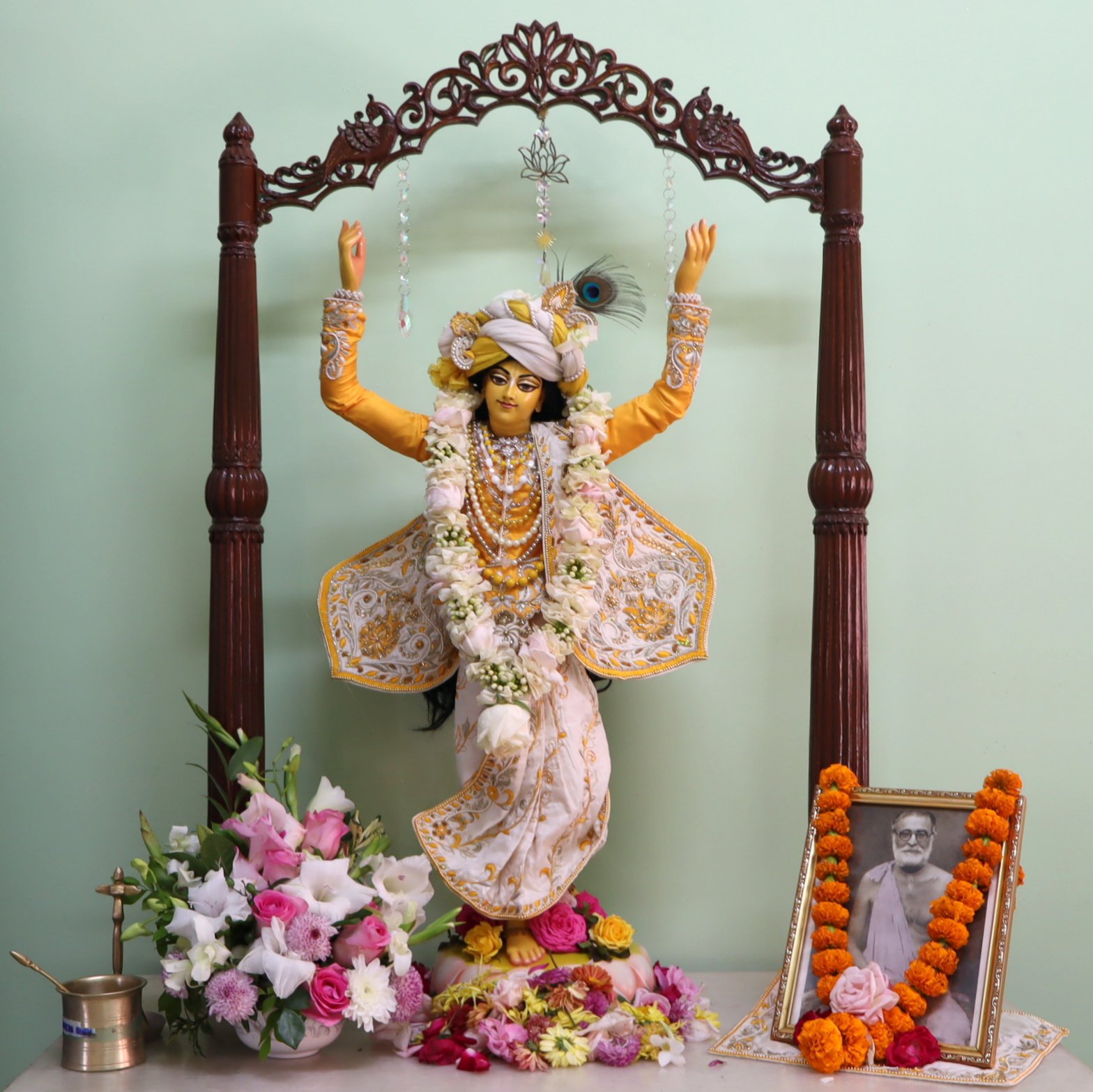
The first room was Śrīla Prabhupāda’s darśana room. In the adjoining room are two sacred treasures: the imprint of Śrīla Prabhupāda’s lotus feet and his personal Gaurāṅga Deity, Śrī Māyāpur Chandra.
The First Gaurāṅga Deity in Māyāpur
Śrī Māyāpur Chandra occupies a unique place in the history of ISKCON. He was the first Deity of Lord Śrī Caitanya Mahāprabhu worshipped in ISKCON Māyāpur, and it was after Him that Śrīla Prabhupāda named the temple Śrī Māyāpur Chandrodaya Mandir.
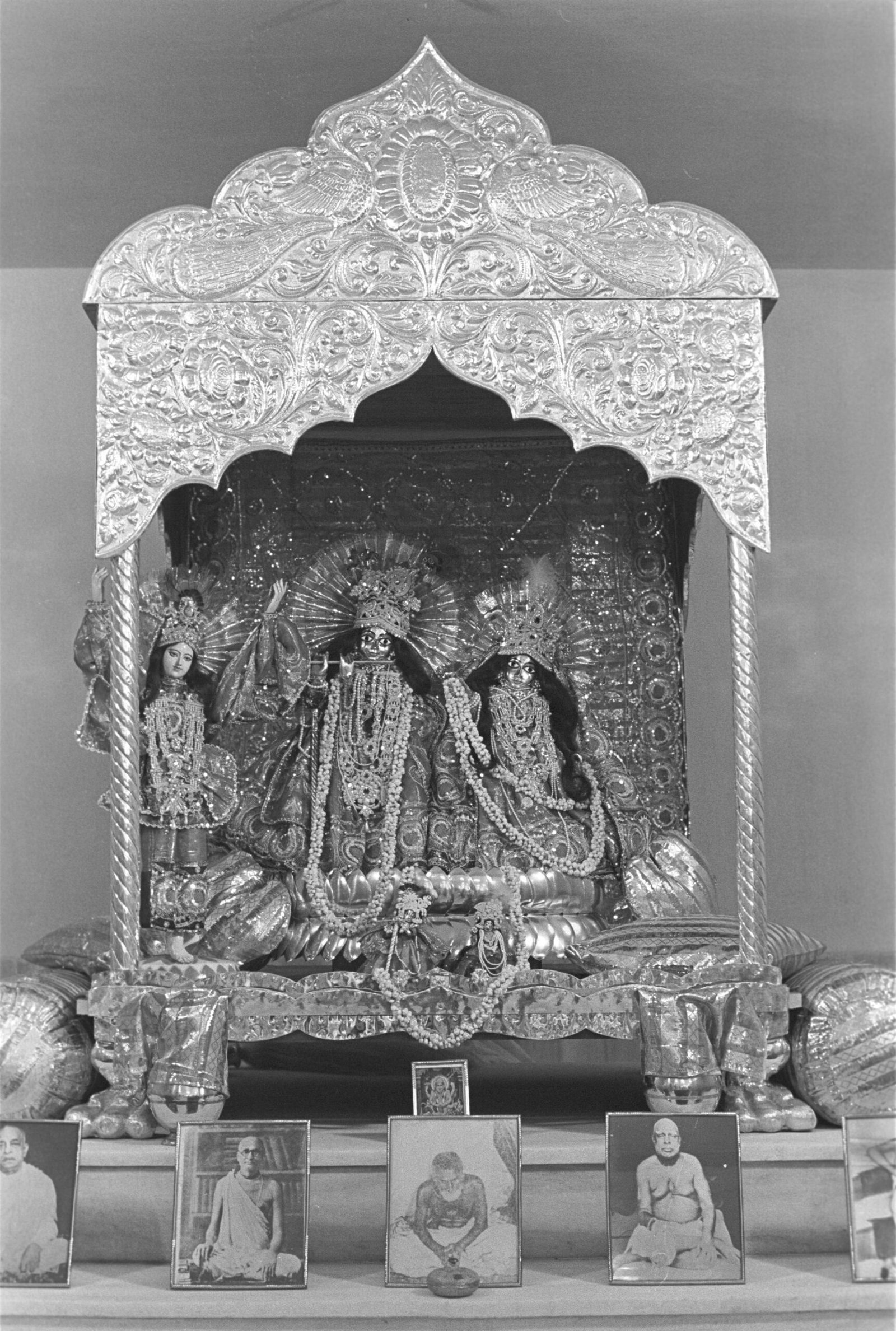
The history of Śrī Māyāpur Chandra has been preserved through the recollections of several of Śrīla Prabhupāda’s direct disciples and other early devotees. When the first small Deities of Śrī Śrī Rādhā Mādhava were worshipped in Śrīla Prabhupāda’s Bhajan Kuṭir, Śrī Māyāpur Chandra stood beside Them on a simple altar.
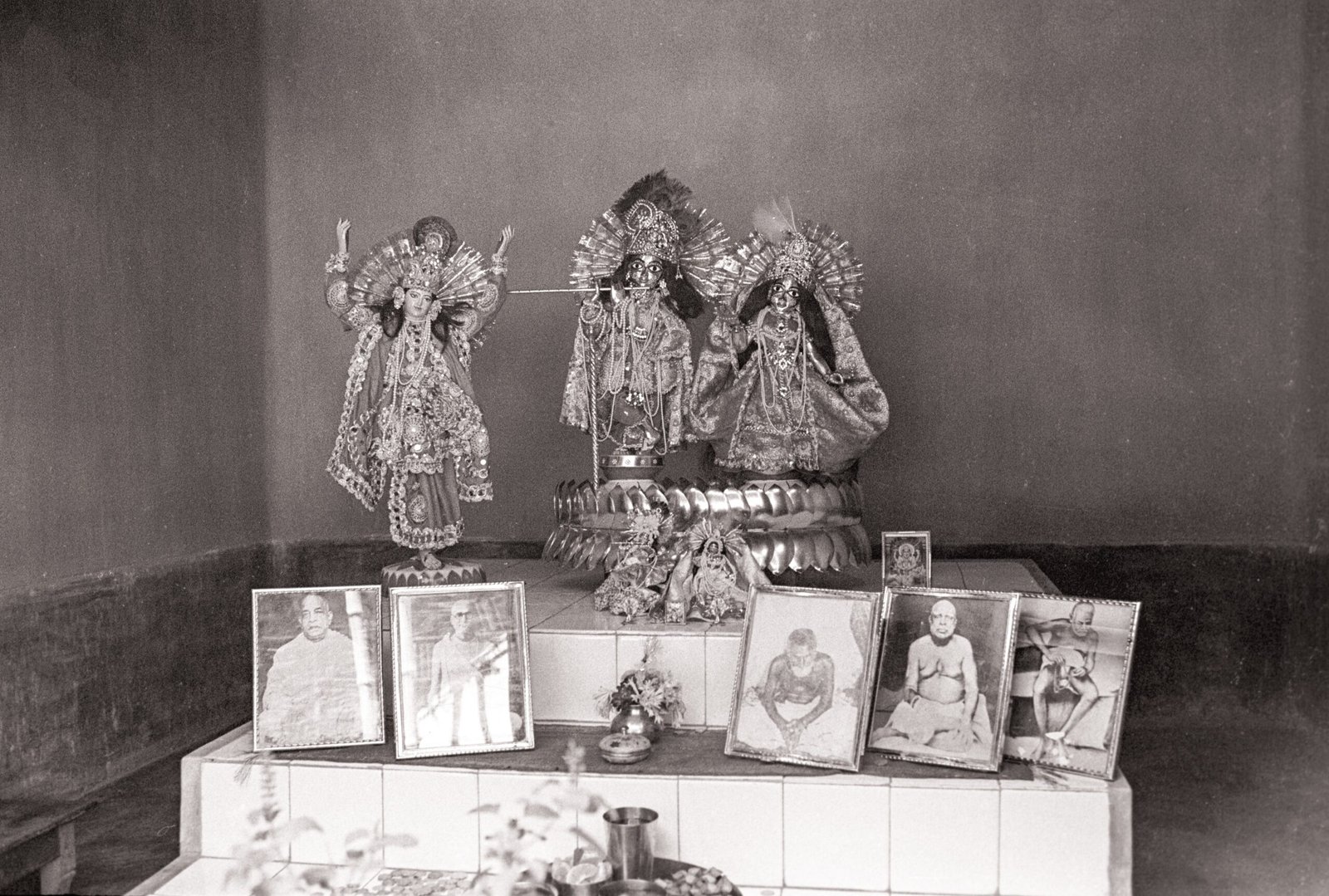
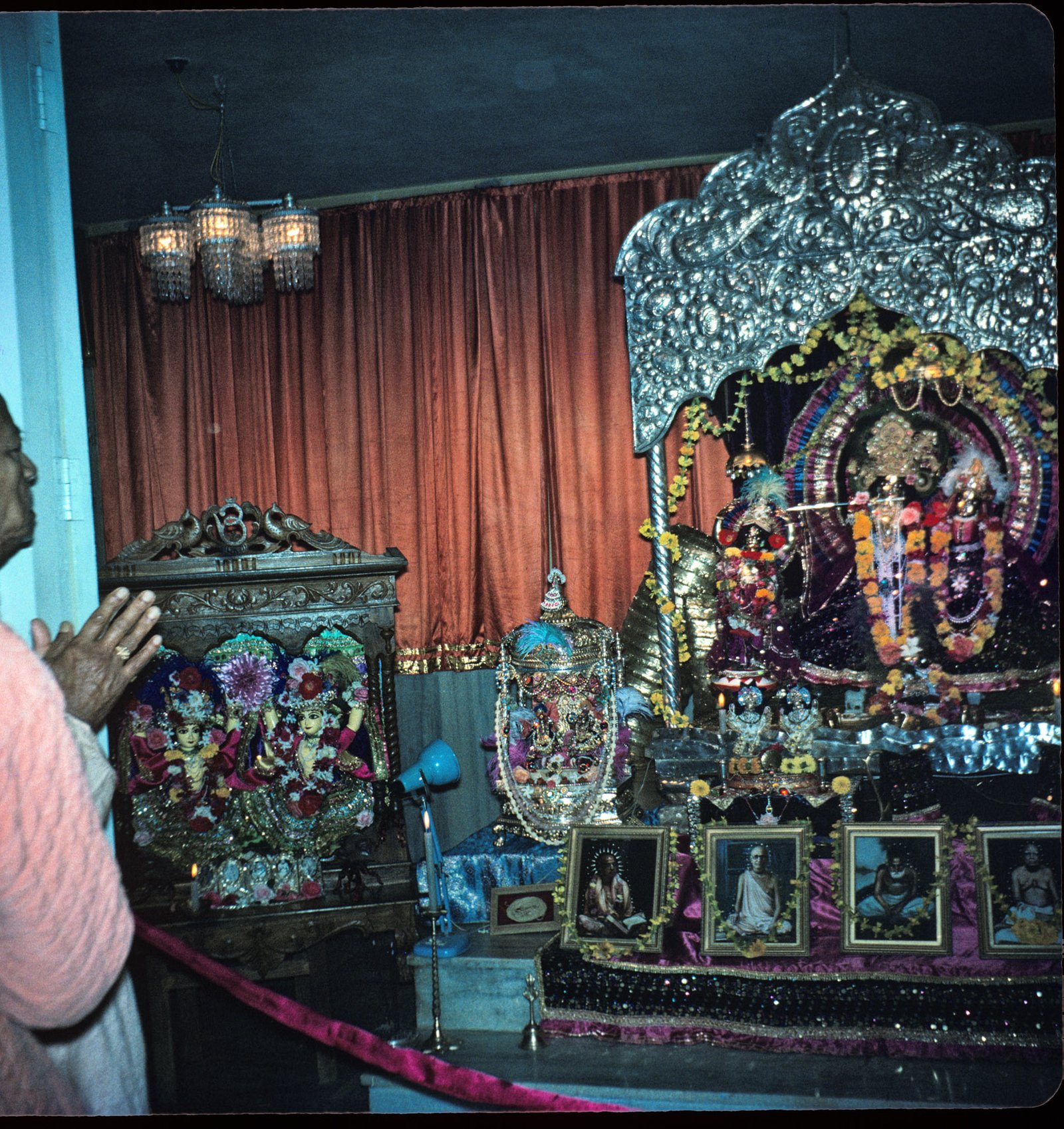
The original altar in Śrīla Prabhupāda’s Bhajan Kuṭir, where Śrī Māyāpur Chandra was worshipped alongside Śrī Śrī Rādhā Mādhava.
According to historical accounts preserved by early devotees, a larger Deity of Lord Caitanya had originally been intended for Māyāpur. However, when placed beside the comparatively small Rādhā Mādhava Deities, His size appeared disproportionate. Śrīla Prabhupāda therefore instructed that this larger Deity be taken to ISKCON Calcutta, where He was installed alongside the larger Śrī Śrī Rādhā Govinda Deities. A smaller Deity of Lord Caitanya was then obtained for worship in Māyāpur.
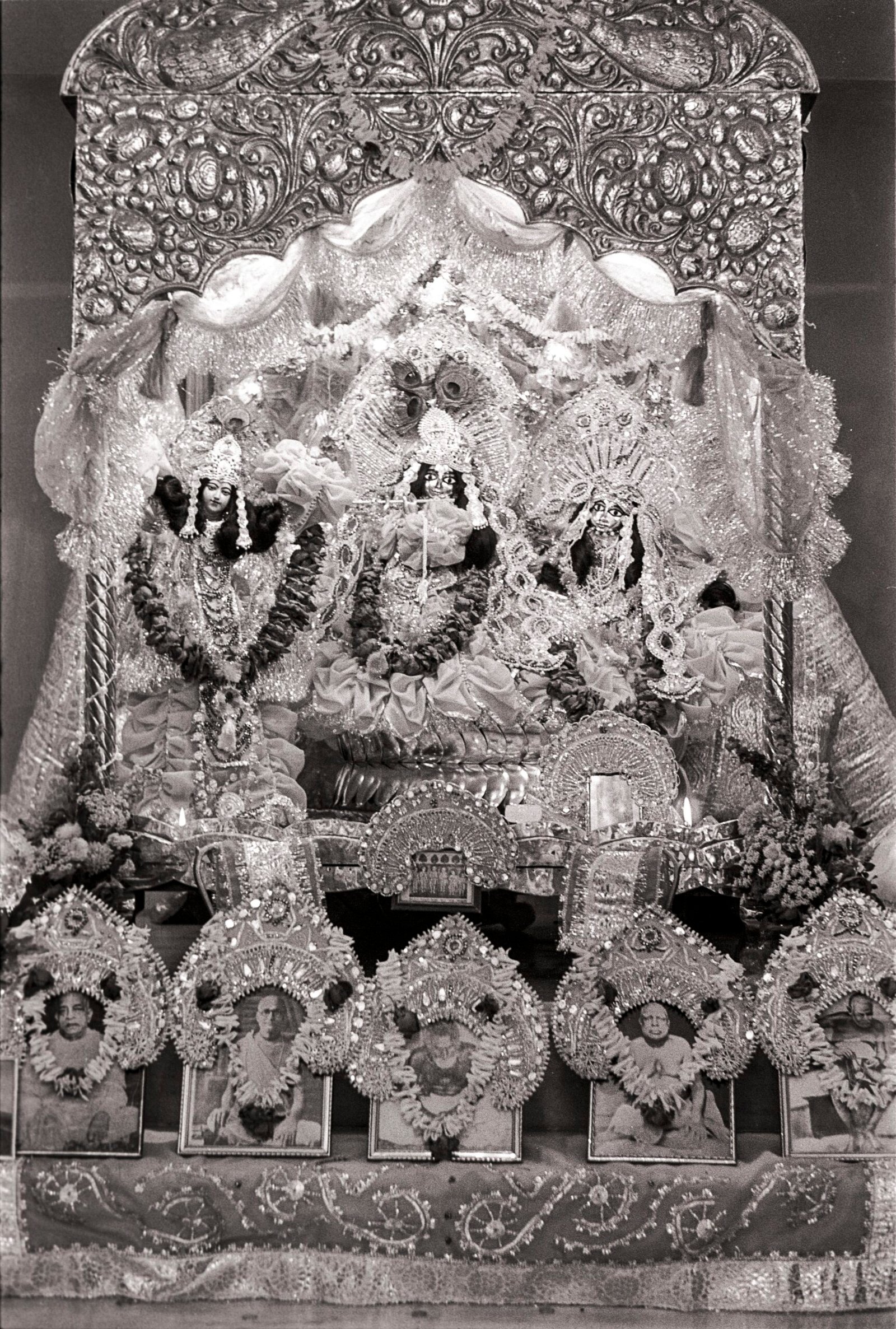
Jananivāsa dāsa (ACBSP) remembered that Śrī Māyāpur Chandra had already arrived in Māyāpur in 1972 and was worshipped until Gaura Pūrṇimā 1973 in Śrīla Prabhupāda’s Bhajan Kuṭir. His recollection is supported by archival footage filmed by ITV in 1973, which shows Śrī Māyāpur Chandra and Śrī Śrī Rādhā Mādhava being worshipped in the Bhajan Kuṭir before Their ceremonial procession to the newly constructed, though still unfinished, Lotus Building temple.
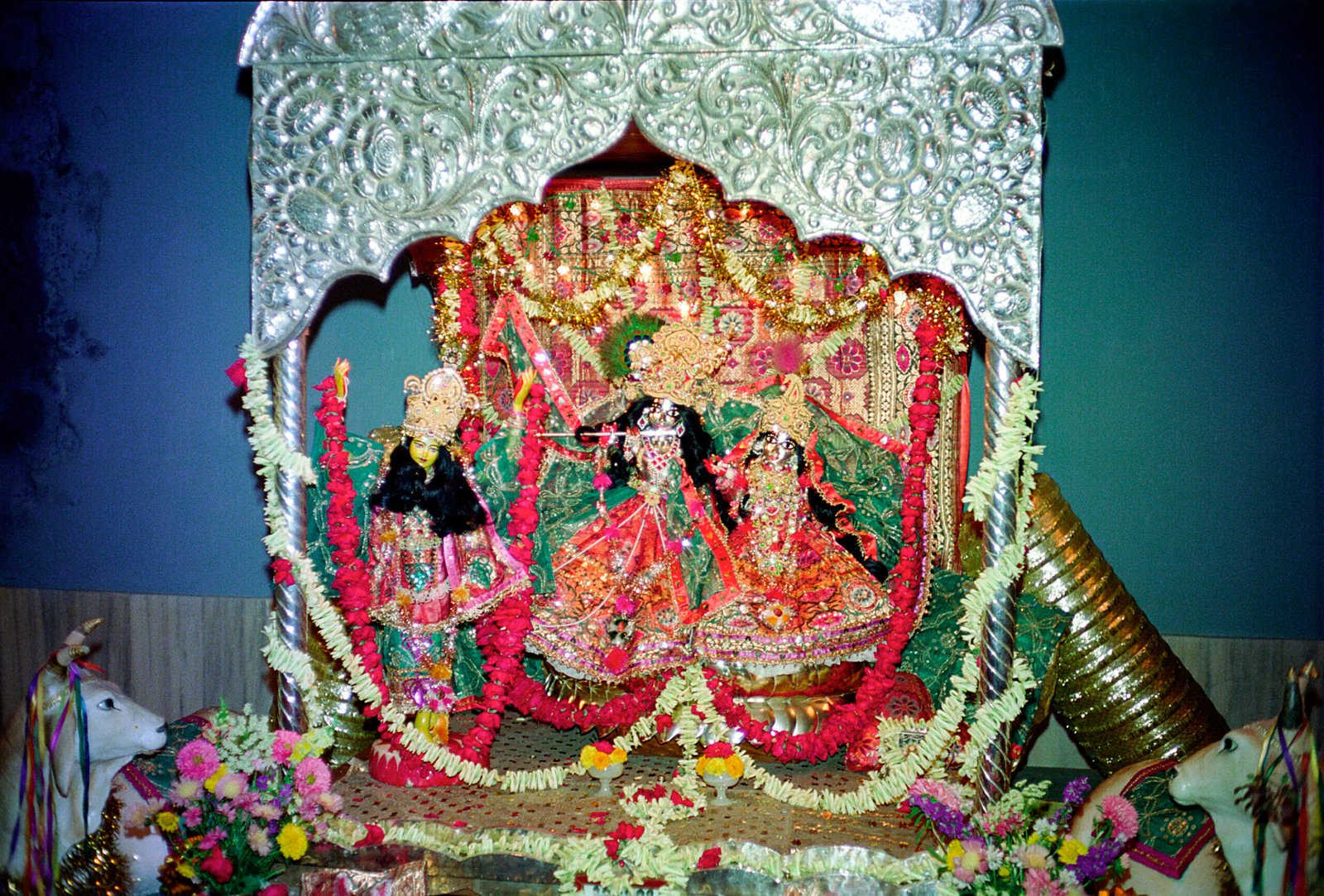
The altar in Lotus Building, where Śrī Māyāpur Chandra was worshipped alongside Śrī Śrī Rādhā Mādhava.
Identity of the Sculptor
One aspect of Śrī Māyāpur Chandra’s history that remains uncertain is the identity of His sculptor.
In a telephone conversation with Śrīmatī Dāsī (ACBSP), Bhavānanda dāsa (ACBSP) recalled that the Deity had been sculpted by Milan as a sample of his artistic work for Śrīla Prabhupāda.
This chronology, however, presents a difficulty. Śrīmatī Dāsī introduced Milan to Śrīla Prabhupāda on 16 March 1973. If Milan was indeed the sculptor, the Deity would most likely have been created after that date. This does not correspond with Jananivāsa dāsa’s recollection that Śrī Māyāpur Chandra was already present in Māyāpur in 1972.
For this reason, the identity of Śrī Māyāpur Chandra’s sculptor remains an open question awaiting further historical evidence.
The Cracks That Changed History
After being worshipped for some time, devotees noticed that the Deity had begun to develop cracks, particularly on the upper arms, ankles, and feet. The Deity is understood to have been fashioned from clay around an internal wire framework and lightly fired in a kiln, making Him susceptible to cracking over time.
Bhavānanda dāsa also remembered discovering cracks in Lord Caitanya’s feet. Concerned about the Deity’s condition, the devotees sought Śrīla Prabhupāda’s guidance.
The Installation of a Brass Deity
Following Śrīla Prabhupāda’s instructions, the original Deity was respectfully replaced.
Bhavānanda dāsa remembered travelling to Navadvīpa, possibly together with Jananivāsa dāsa, where they obtained the brass Deity of Lord Caitanya that continues to stand beside Śrī Śrī Rādhā Mādhava today. Historical accounts indicate that this brass Deity was installed during Gaura Pūrṇimā 1974.
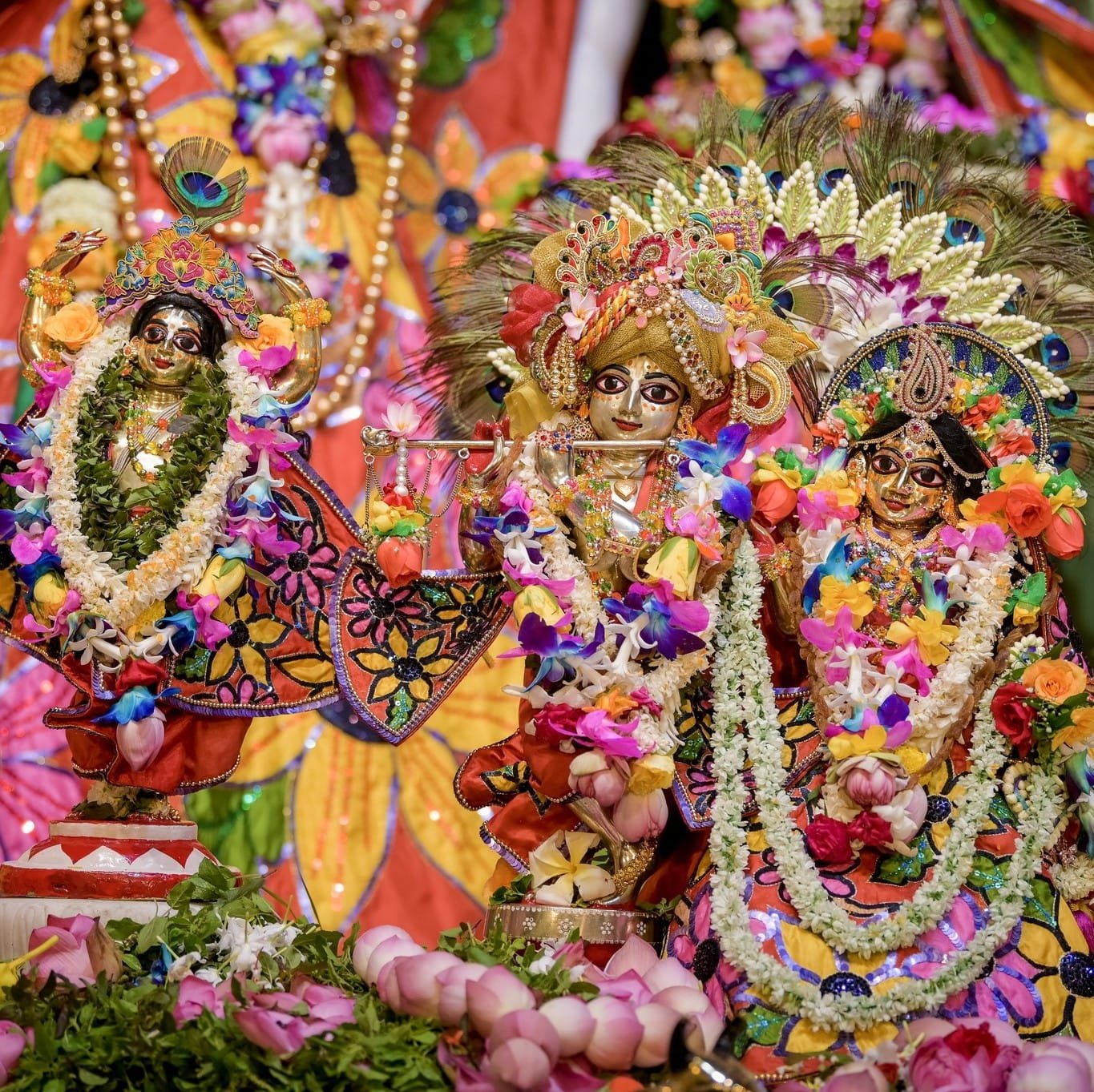
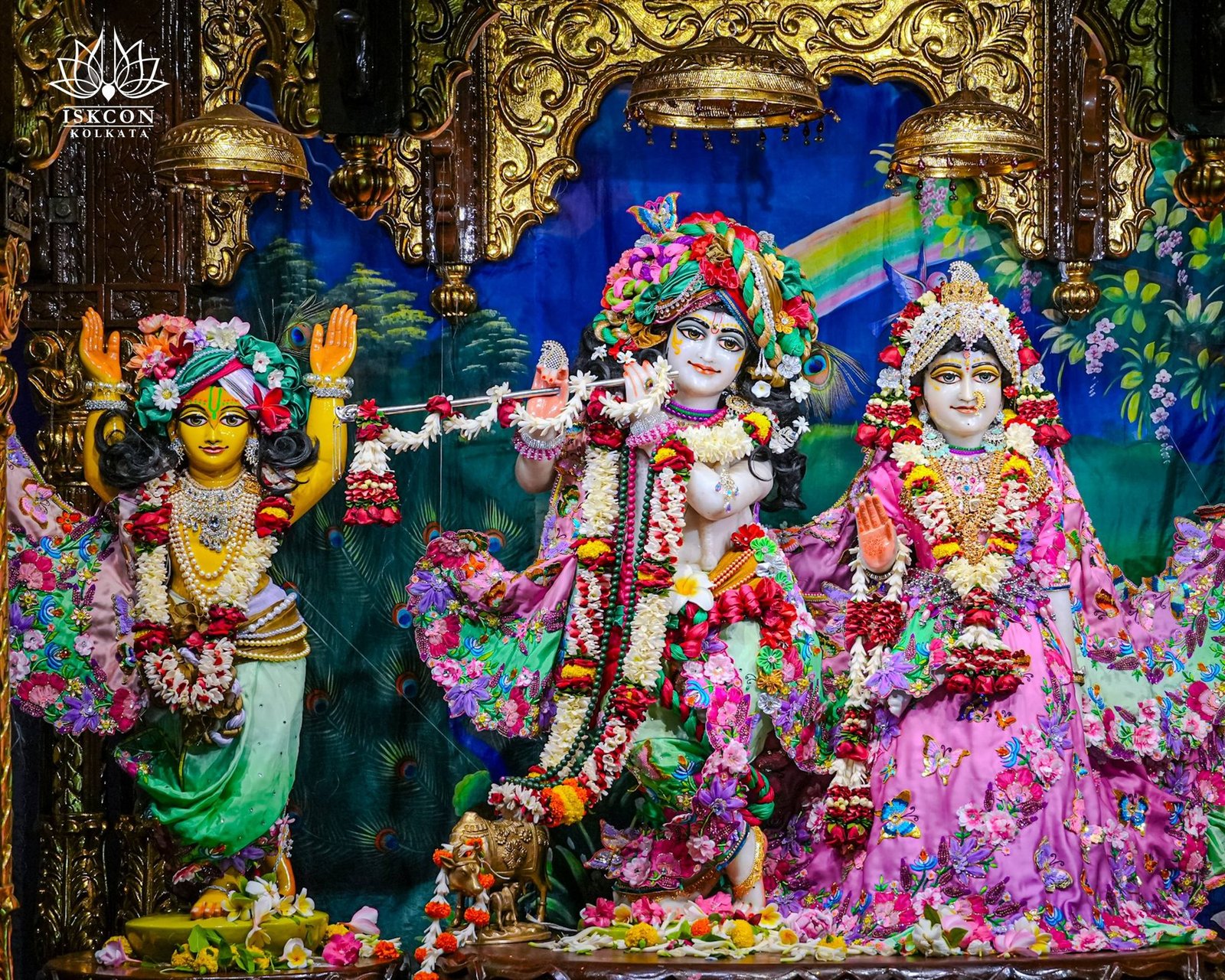
The present brass Deity of Lord Caitanya, installed during Gaura Pūrṇimā 1974, continues to be worshipped beside Śrī Śrī Rādhā Mādhava in the Lotus Building temple.
Śrīla Prabhupāda’s Special Mercy
The most cherished chapter in the history of Śrī Māyāpur Chandra concerns how He came to reside permanently in Śrīla Prabhupāda’s room.
Bhavānanda dāsa remembered that after noticing the cracks, he asked Śrīla Prabhupāda whether the Deity should be taken to the Ganges. Śrīla Prabhupāda simply replied, “No. Take Him to my room.”
Śrīla Prabhupāda personally chose to preserve the original Deity in his own quarters rather than have Him immersed in the Ganges.
By Śrīla Prabhupāda’s mercy, Śrī Māyāpur Chandra remains there to this day and continues to receive daily worship.
A Living Link to ISKCON’s Early Days
Today, visitors to Śrīla Prabhupāda’s rooms in the Lotus Building can offer their prayers before the very first Deity of Lord Śrī Caitanya Mahāprabhu worshipped in ISKCON Māyāpur—the Deity after whom Śrīla Prabhupāda named Śrī Māyāpur Chandrodaya Mandir.
Although certain aspects of His early history remain the subject of differing recollections, the available testimonies preserve a remarkable account of ISKCON Māyāpur’s pioneering years—from His worship beside Śrī Śrī Rādhā Mādhava in Śrīla Prabhupāda’s Bhajan Kuṭir, through His replacement by the present brass Deity, to His permanent residence in Śrīla Prabhupāda’s own room, where devotees continue to receive His darśana today.
Let me take shelter of the Supreme Personality of Godhead, Śrī Kṛṣṇa, who has descended in the form of Lord Caitanya Mahāprabhu to teach us real knowledge, His devotional service and detachment from whatever does not foster Kṛṣṇa consciousness. He has descended because He is an ocean of transcendental mercy. Let me surrender unto His lotus feet.
(CC Madhya 6.254)
As in Vrindavana we have named the temple Krsna-Balaram Temple, similarly I suggest that our Mayapur temple be know as Mayapur Candra temple or Mayapur Candrodaya. Whichever sounds better we should advertise from now.
(730509 – Letter to Jayapataka and Bhavananda written from Los Angeles)
Therefore Prabodhānanda Sarasvatī is teaching us how we should present our case. Dante nidhāya tṛṇakam: “Sir, I have come to you, taking this grass in my teeth.” This is a symbolic representation of becoming very humble in India. They take a grass. Dante nidhāya padayor nipatya: “And I am falling down on your feet.” Kāku-śataṁ kṛtvā: “And I am flattering you: ‘You are very grand,’ ‘You are very nice,’ ‘You are very learned,’ ‘You are . . .’ so on, so on.” If you flatter, people become puffed-up. So, dante nidhāya tṛṇakaṁ padayor nipatya kāku-śatam kṛtvā cāham: “I have one submission.” “What is that?” No . . . he sādhavaḥ: “You are a great learned sādhu. My one request is that whatever you have learned, please forget. Whatever nonsense you have learned, please forget. This is my submission.” “I have learned so many things, and I have to forget? Then what I have to do?” He sādhavaḥ sakalam eva vihāya dūrāt caitanya-candra-caraṇe kurutānurāgam: “You just submit yourself to Caitanya-candra. Then everything will be perfect.”
So our preaching is like that.
(761117 – Lecture SB 05.05.30 – Vrndavana)
To taste the essence of that loving exchange, Kṛṣṇa made His appearance in the same way that the moon appears on the horizon of the sea. Just as the moon was produced by the churning of the sea, by the churning of spiritual loving affairs the moon of Caitanya Mahāprabhu appeared. Indeed, Lord Caitanya’s complexion was golden, just like the luster of the moon. Although this is figurative language, it conveys the meaning behind the appearance of Caitanya Mahāprabhu.
(CC Introduction)
Prabodhānanda Sarasvatī, he was a great devotee of Lord Caitanya. He wrote one book, Caitanya-candrāmṛta, “The Moonlight of Lord Caitanya,” in Sanskrit.
(690524 – Lecture SB 01.05.08-9 – New Vrindaban, USA)
Śrīla Prabhupāda Audio
Hear the original words of Śrīla Prabhupāda.
So we have established this temple, Māyāpur-candrodaya. So this is the idea, that Śrī Caitanya Mahāprabhu is just like moon. Śrī Caitanya Mahāprabhu, He appeared in this land of Māyāpur; therefore He is said here as “the moon.” Therefore we say candra, Māyāpur-candra. Now, as Śrī Māyāpur-candra is rising . . . rising. Rising means He is to distribute the moonshine all over the world. This is the idea, moonshine. Śreyaḥ-kairava candrikā-vitaraṇam. Śreyaḥ-kairava. Caitanya Mahāprabhu personally said. Don’t keep Śrī Caitanya Mahāprabhu compact in your room and take some monetary profit. This is not required. This is not required.
You must allow Śrī Caitanya Mahāprabhu to rise more and more so that this sun, moonshine, may be distributed all over the world. That is wanted. Therefore this temple is situated. Of course, we shall try to construct a very nice temple for Śrī Caitanya Mahāprabhu. This morning we were thinking of this. So from this place, this moon, Śrī Kṛṣṇa Caitanya Mahāprabhu, will distribute. Śreyaḥ-kairava-candrikā-vitaraṇaṁ vidyā-vadhū-jīvanam. The Śrī Caitanya Mahāprabhu’s Hare Kṛṣṇa movement . . . paraṁ vijāyate śrī-kṛṣṇa-saṅkīrtanam. This is spoken by Śrī Caitanya Mahāprabhu Himself. Ceto-darpaṇa-mārjanam bhava-mahā-dāvāgni-nirvāpaṇaṁ śreyaḥ-kairava-candrikā-vitaraṇaṁ vidyā-vadhū-jīvanam (CC Antya 20.12). Vidyā-vadhū-jīvanam. This is real enlightenment. People all over the world, they are in darkness. The moonshine will enlighten them.
(750330 – Lecture CC Adi 01.06 – Mayapur)
Caitanya Mahāprabhu’s one disciple, Prabodhānanda Sarasvatī, he took up a nice principle: dante nidhāya tṛṇakaṁ padayor nipatya kāku-śataṁ kṛtvā cāhaṁ bravīmi (Caitanya-candrāmṛta 8.90). His principle was that he would go to a gentleman, taking a straw in the mouth. According to Indian system, if you take a straw in your mouth and if you go to see somebody, he’ll understand, “He is coming to me with most humble manner,” so he’ll receive you, “He’s surrendered soul.” So he will at least say: “Oh, what do you want to say?” So dante nidhāya. This is the sign. If you want to go to some big man, and if you take one straw in your mouth, he will accept. He will receive you. That is the system.
So dante nidhāya tṛṇakam. So Prabodhānanda Sarasvatī, he says that, “I have taken the straw in my mouth.” Dante nidhāya tṛṇakaṁ padayor nipatya. “And I am falling down at your feet.” Padayor nipatya kāku-śataṁ kṛtvā cāham. “And I am flattering you in hundreds and thousands ways.” Why? Why you are so humble? What is the intention? Kāku-śataṁ kṛtvā cāhaṁ bravīmi: “I want to say something. Please hear.” “All right. Say it. What is that?”
He sādhava: “Oh, you are very learned man and you are very honest man.” He sādhava sakalam eva vihāya dūrād: “For the time being, so long I shall speak, whatever you have learned, please set aside. Please set aside.” Sakalam eva vihāya dūrād caitanya-candra-caraṇe kurutānurāgam: “Kindly hear for some time about the topics which Caitanya Mahāprabhu has presented before you.”
We are servant of Lord Caitanya. So, in the disciplic succession we are trying to present. The Caitanya Mahāprabhu’s topic is yāre dekha tāre kaha kṛṣṇa-upadeśa (CC Madhya 7.128): “Whoever you meet, please try to convince him about Kṛṣṇa consciousness.” So in order to preach Kṛṣṇa consciousness, that Prabodhānanda Sarasvatī, he says that “I have taken straw in my mouth, and I am falling down to your feet and I am flattering you in so many ways. Kindly, for the time being, you forget whatever you have learned. Please try to hear about the Kṛṣṇa consciousness.”
This should be the preaching method. Because you cannot enforce. You cannot enforce. The atheistic party, the godless civilization is so strong. So you are not weak. You are protected by the Supreme. But our mission is not to fight, but our mission is to convince. So this is the method to be accepted by devotees, those who are in Kṛṣṇa consciousness, to preach the philosophy in the world. Thank you very much.
(670123 – Lecture CC Madhya 25.36-40 – San Francisco)
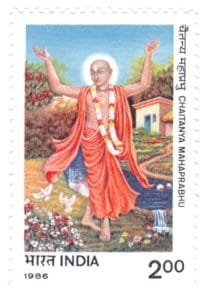
India Post, Government of India (500th Birth Anniversary of Sri Chaitanya Mahaprabhu, 1986)