
Śrī Śrī Rādhā-Mādhava : Their Divine Appearance in Mayapur
Narrated by Two of Their Eternal Servants (Jananivasa Dasa & Paṅkajaṅghri Dasa)
Published: Winter 1995/96
Source: Mayapur Journal, Issue Number 28
Jananivasa Dasa: Generally big deities (darśana mūrtis) have different manifestations of small deities in order to accept different services. They have different names such as utsava, śayana and chota mūrtis and are used for festivals, offering of bhoga (food), parikrama (processions), abhiṣeka (bathing), etc.
In Mayapur, the small Deities appeared before the big ones. The small Rādhā-Mādhava Deities were originally given to Śrīla Prabhupāda in Vṛndāvana by one Mr. Palmir, a life member. Mr. Palmir gave three sets of Deities. One went to Berkeley, one went to Boston, and Prabhupāda kept one with him—Śrī Śrī Rādhā-Mādhava—and travelled with Them when he was touring India. As far as I know, they have been in Jhansi, Allahabad and Benares. It was in Allahabad when Prabhupāda first chanted that by now famous song “Jaya Rādhā-Mādhava” in the presence of these small Deities. There is a description in our songbook (“Songs of the Vaiṣṇava Ācāryas”) how Śrīla Prabhupāda fell into a trance after singing the first two lines. When after some time he came back to external consciousness, he said how nice this song is. “It is a picture of Vṛndāvana. Everything is there: Śrīmatī Rādhārāṇī, Krishna, Govardhana, Yaśodā and all cowherd boys and gopīs.” And ever since that time, before every class, Prabhupāda would first chant this song.
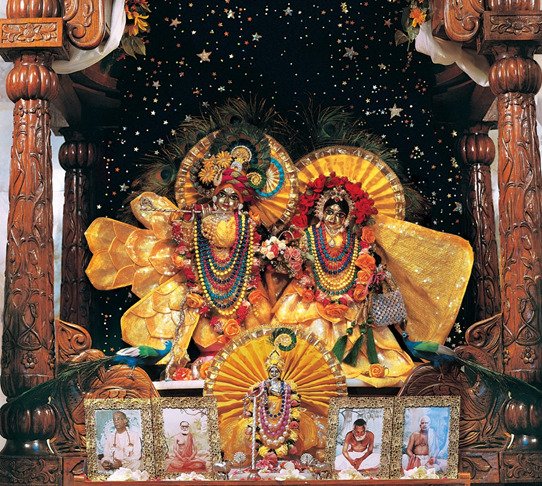
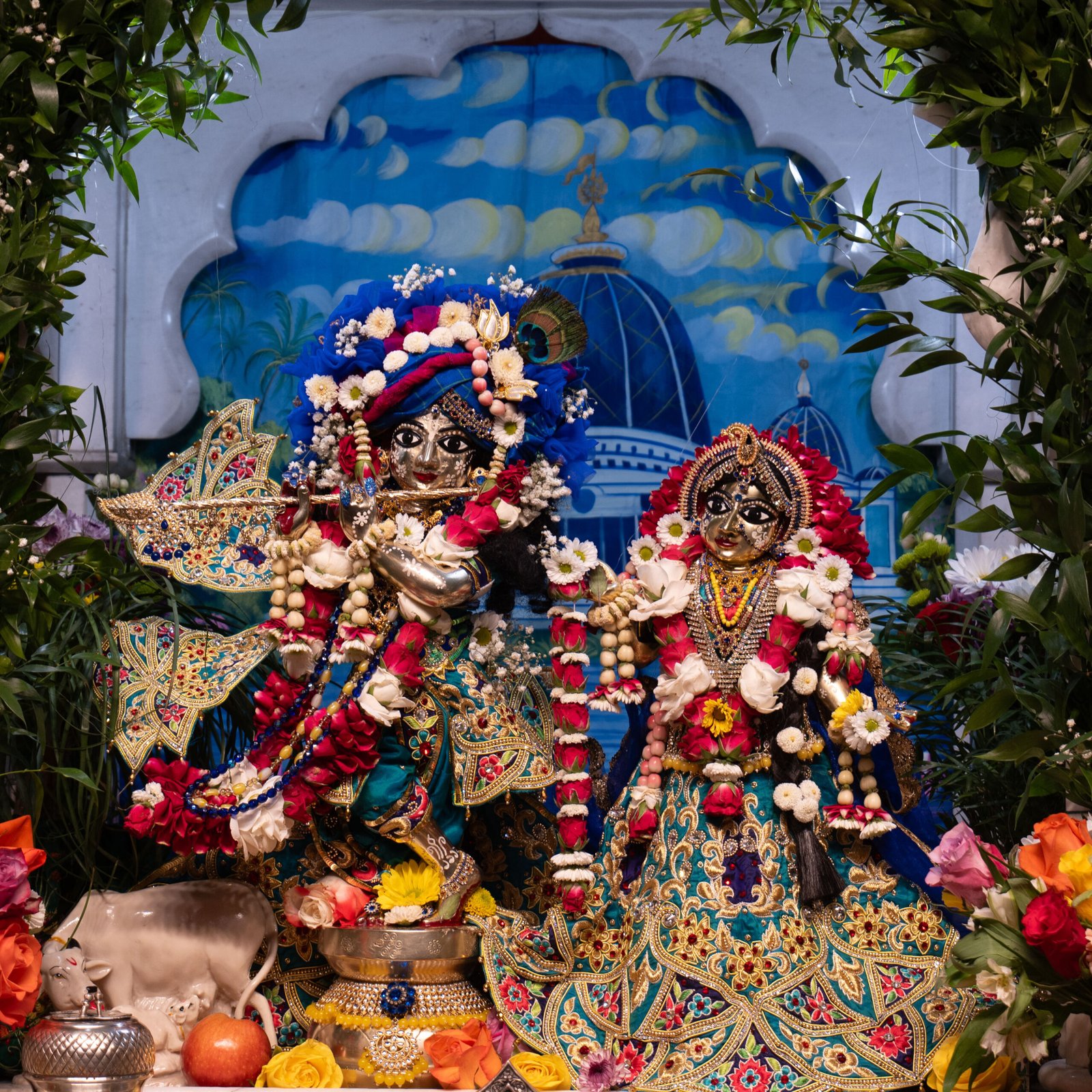
Eventually the party came to Calcutta. At that time, I think, they stayed in the Hindustan Building.
Pañkajaṅghri Dāsa: Was that before Albert Road?
Jananivasa: Yes, before Albert Road.
They arrived late at night and then the devotees who were with Śrīla Prabhupāda took something to eat and wanted to take rest. But Prabhupāda said, “What about the Deities?” They were packed up in a trunk. Tamāla Krishna Mahārāja said, “You know, They are packed up, They are sleeping. Tomorrow we can make some arrangement for Them.” But Prabhupāda said: “No, make an altar for Them now.” So the devotees ran around, trying to find materials to make a proper place for Their Lordships. It took them a few hours—maybe until midnight—and finally they could establish Them on a little altar. Śrīla Prabhupāda then said: “Alright, now we can take rest.” This story is nicely explained by Tamāla Krishna Mahārāja in his book Servant of the Servant.
When we purchased the property in Albert Road, Rādhā-Mādhava moved there. Later, the present Deities of ISKCON Calcutta came: Śrī Śrī Rādhā-Govindaji.
Pañkajaṅghri: When did the Deity of Mahāprabhu come to Calcutta?
Jananivasa: Lord Caitanya came about a year or so later.
Pañkajaṅghri: I heard that this Deity was actually meant for Mayapur . . .
Jananivasa: Yes, that mūrti of Mahāprabhu was made for Mayapur. That was early 1972. But they liked Him so much that they kept Him in Calcutta. So then we got a Gaurāṅga Deity made of clay from Krishnanagar. But the Deity wasn’t well made. After some time the ankles were cracking. We told this to Prabhupāda and he said that we should immediately replace Him and get a metal deity. We then got the other Gaurāṅga mūrti that is here now. Śrīla Prabhupāda thus established Śrī Śrī Rādhā-Mādhava together with Gaurāṅga. Śrīla Bhaktisiddhānta Sarasvatī Ṭhākura introduced this system of having Rādhā-Krishna and Gaurāṅga together to establish the fact of śrī-kṛṣṇa-caitanya, rādhā-kṛṣṇa nahe anya: “Rādhā and Krishna combined together as Śrī Krishna Caitanya.” Śrīla Bhaktisiddhānta was pioneering this in his temples. He had these three Deities in most of his mandirs—just to establish this point.
At ISKCON’s first Gaura-pūrṇimā festival in 1972, Rādhā-Mādhava came to Mayapur. At that time there was only one hut, and so we built some tents to accommodate the devotees and a tent for a kitchen. For the programs, a pandal was constructed. That year about 60 or 70 devotees came, mostly from America. Prabhupāda was there, and the small Rādhā-Mādhava Deities were brought from Calcutta. They were presiding over the program.
When the festival was over, Śrīla Prabhupāda laid the foundation of the Mayapur Chandrodaya Mandir at the site where the elephant house is now. The Deities were actually presiding over that ceremony. Prabhupāda then said They should stay in Mayapur. But we had only a hut where we were living in, Prabhupāda’s Bhajana Kutir. When the festival was over, Rādhā-Mādhava moved in the Bhajana Kutir. All we had for Them was a small table, covered with a cloth. They stayed there for a couple of months until we built a small place just outside the hut. It was opposite the fence where the tulasī garden is. Now there is a little round circle with tulasī plants.
We just had a little shed with a sloping roof. Three sides were covered and the front had two simple doors.
The same year, sometime in November, Śrīla Prabhupāda came to Mayapur and stayed with us in the same hut. At that time, the small Rādhā-Mādhava Deities were still in the same small shed. They stayed there until Gaura-pūrṇimā 1973. At that time, we moved to the new temple on the ground floor of the Lotus Building. The floor was laid but the marble wasn’t polished yet. We nevertheless moved there with Rādhā-Mādhava and Gaurāṅga Mahāprabhu.
Some people were complaining to Prabhupāda: “Why have you put the Deities on the ground floor? You are living above the Deities and the Deities are below. This is not the proper system.” Śrīla Prabhupāda replied: “Actually, Krishna is living everywhere. He is the Supersoul. He is within every atom. He is even under your feet.” And then he said: “Since we have this building and we have the Deities, out of love for Them we have put Them here. They had no place to stay, so we have put Them here in this nice building. There was no other place to put Them. But in the future, we will build a very beautiful temple for Them.”
At that time Prabhupāda, along with devotees from the West, was traveling and preaching all over India. Once, at one program at Hyderabad, they wanted some Deities for the pandal program. First they thought of taking the smaller Deities from Calcutta, which were about 6 inches high. But then they considered Them too small, because hardly anyone could see Them. So they came up with the idea of taking Rādhā-Mādhava from Mayapur, since they had a nice size for darśana. At that time matajis were looking after Them, Kausalya and Malati.
So devotees came to Mayapur and brought small Rādhā-Krishna Deities from Calcutta. Taking Rādhā-Mādhava from Mayapur, they put the other Deities on the altar.
When Śrīla Prabhupāda found out that Rādhā-Mādhava were in Hyderabad, presiding over a program, he said: “Why have you taken Rādhā-Mādhava from Mayapur? You cannot do this.” He was very angry. “You cannot start changing Deities around like this. When They go back, They have to stay in Mayapur. They should remain there. You cannot move Deities around like this!” Śrīla Prabhupāda was really upset.
Sometimes, when Śrīla Prabhupāda came for darśana, he used to make some comments. One time he said that in Mayapur, Rādhā-Mādhava are dancing. On another occasion, he said that when Rādhārāṇī is standing like this, offering tāmbūla (pān) to Krishna with Her right hand, then Krishna cannot leave. When She is applying that special mudrā, with Her lotus hand open, offering Krishna something special, then He can never leave.
Pañkajaṅghri: There was a special incident with Śrīla Prabhupāda’s vyāsāsana in the new temple . . .
Jananivasa: Yes, when we wanted to construct a vyāsāsana for him, at the far end, opposite Rādhā-Mādhava, some devotees were saying that it was too far away. Śrīla Prabhupāda wouldn’t be able to get a proper view of the Deities. They went to Prabhupāda, saying: “You should have your vyāsāsana closer to the Deities so that you will be able to see nicely. Otherwise it is too far away.” But Śrīla Prabhupāda replied: “There is no question of distance between me and Rādhā-Mādhava.”
One time Śrīla Prabhupāda asked me: “How do you worship the Deities?” So I gave him a step-by-step explanation. How we bathe Them, etc. He was just nodding, saying: “Yes, yes.” When I told him that after bathing the Deities we dry Them, he said: “At that time you should offer tulasī leaves to Krishna’s lotus feet.” Generally you read in the pūjā manuals that the time for offering tulasī comes after you offer clothing, ornaments and scents. That is the time when one normally offers flowers and tulasī leaves. But Prabhupāda instructed otherwise. I was thinking that after the bathing is over, when the first offering one makes is tulasī leaves, that this would certainly satisfy Krishna. I actually didn’t know Prabhupāda’s reason for ordering me to do that.
Prabhupāda also asked what mantras I was chanting. “Well, we chant Hare Krishna, the gāyatrī mantra and the Brahma-saṁhitā.” Prabhupāda: “Hmm, gāyatrī mantra—very good, Vedic. Om is there. Very nice.” He also told me that I could say the prayers and mantras in English. “That is your language. You can say prayers to the Deities in English.”
Pañkajaṅghri: I remember in 1974, on the Govardhana Pūjā day after the celebration was finished, everybody was having big kīrtana, running around like mad, circumambulating Rādhā-Mādhava. It was a very ecstatic kīrtana. Lots of children were there from the gurukula. It was a very happy, blissful time. Jananivasa, you were standing in front of the Deities. Suddenly you told me: “Can you see this?” When I looked, I saw that all the colours were spiraling out from the Deity. The whole Deity room was full of different colours.
Jananivasa: Another time, when I was making the offering, I came out from the Deity room to chant the gāyatrī mantra. I then remembered that I forgot to put an extra cup to cool the hot milk. I was thinking that, hopefully, Krishna wouldn’t burn His fingers. Just at that moment, I heard a ‘tink.’ When I went back in after the offering was over, I found that the milk had spilled on the plate and on the table.
The same thing happened some months later. Both of us were standing outside the Deity room when we heard the ‘tink’ again. I said to you: “Last time I heard that noise was when I forgot to offer a cooling cup for Krishna’s milk.” We then waited until the pūjārī came out with the offering. When we lifted the plate cover, we found out that sure enough, he also forgot to put the extra cup, and thus the milk was again spilled on the plate. See how Krishna teaches us!
Jananivasa: Right from the very beginning, Śrīla Prabhupāda told us the size of the Deities. He said there will be big Rādhā-Mādhava. Krishna will be 5 foot 10 and Rādhārāṇī will be 5 foot 6. Krishna will be of black marble and Rādhārāṇī will be of white. And Pañca-tattva will be 7 feet tall made of metal . . .
It was in 1979 when Radhapada Dasa, a life member and devotee from Calcutta, had a dream where a young sādhu came to him and said: “Do you recognize me?” “No, I don’t recognize you.” Then the sādhu said: “Anyway, you gave me some money once. I have come to return it.” And he handed Radhapada some money. But he protested: “Dear sādhu, if I gave you money, I don’t expect it back from you. I don’t expect any money back from a sādhu.” The young sādhu said: “You really don’t recognize me?” “No.” The young sādhu then transformed into an older man . . . “Oh, Prabhupāda! Now I know you, you are Swami Prabhupāda.”
“Yes, I have left this planet. Some of my disciples have experienced some difficulty in the beginning, but after a while everything will be alright. Anyway, you should give them some help, try to help them.”
“But how can I help them?” Prabhupāda: “You can help them construct a big temple and things like this.”
“But what about my wife and family?” Śrīla Prabhupāda then said: “Don’t worry about that. I will take care of them.” When Radhapada awoke, he felt very inspired and immediately went to the Calcutta temple. At that time, both Bhavānanda and Jayapataka Swami were there. Radhapada explained his dream and said he wanted to help. “I would like to buy some Deities.” They said: “Well, Prabhupāda already told us what kind of Deities he wants and the dimension. If you like, we can make the Deities now. They can manifest Themselves whenever They wish.” So they decided to go ahead and make the big Deities.
They came to Mayapur in 1980. They manifested Themselves prematurely—the altar wasn’t even ready. To accommodate Their huge size we had to shift the existing altar by about 10 feet.
Pañkajaṅghri: They were almost touching the ceiling.
Jananivasa: Oh yes. They manifested Themselves early to give us enthusiasm and inspiration to build Their magnificent temple.
The big Deities of Rādhā-Mādhava were made by one Mr. Pandai, a mūrti-vālla from Jaipur. Oṁkāra Prabhu from France was supervising the work. When it was finished, Pandai asked: “Well, what do you think?” Oṁkāra: “Your design is very good, but maybe the eyes are too big.” The deity sculptor got his tape to measure the Deities’ face and eyes. “No, no. It is exactly according to the regulations of the śāstras.”
Some time before, when the Deities were almost done, a wealthy Indian came, and when he saw the Deities, he fell in love with Them. “I want to buy these Deities!” But Pandai said: “You know, I have made them for ISKCON. They are going to come and collect Them.” “No, no. I want these Deities. Let me have them. You make some more for ISKCON. Whatever the price is, I will give you one lakh more [that is Rs. 100,000, which was at that time over US $5,000—a great amount in India].” But Pandai said: “No, no. I cannot do this. I also cannot make another set like this.”
He later also told Oṁkāra: “Actually, these are very special Deities. Usually the white marble is much softer than the black marble, but this white marble of Śrīmatī Rādhārāṇī was equally as hard. And every time we were carving and chipping, there was a beautiful ringing sound coming from this Deity.”
When the Deities were finally completed and we went for inspection, everything was fine, but Bhavānanda said: “Anyway, make a final polish so that They have a very fine finish.” During that final polish, a white line, exactly like a brāhmaṇa thread, appeared all around the body of Mādhava. And on His forehead a faint tilaka appeared. You can see it if you go very close to the Deity—a vertical two-line tilaka is on His forehead.
Pañkajaṅghri: Śrī Śrī Rādhā-Mādhava were installed in 1980 and six years later, in 1986, the new temple was ready. Four of eight gopīs were also finished and installed a few days before Gaura-pūrṇimā. It was a big experience when we moved Rādhā-Mādhava to the new temple along with the gopīs, because these deities are very heavy.
On that afternoon, when the temple was closed, all the strong devotees came. There were these powerful Australians, who had to hike up their dhotis and take off their chadars, in order to help transporting the Deities. We put the Deities on sacks, and slid Them across the floor from the old temple to the new temple. And you know, in the new temple, They are about six feet up from the floor. There are two platforms before you reach the altar. So everybody was anxious to know how we were going to lift Krishna up, because this Deity of Krishna is so heavy and one has to lift Him upright. This means that only about four people could hold Him at that time, because there was no more room to hold Him. You have to hold Him at the bottom of the base. Naturally, everyone was full of anxiety. Somehow or other, we had to do it. Lord Krishna had to get up there. “One, two, three—lift!” And Krishna, astonishing everyone present, just floated, just went up very easily. The same thing happened when the second platform was reached. “Okay: one, two, three—lift!” And again, Krishna just went up. The devotees who did it said afterwards that it was completely mysterious; there was no way to explain how He went up by Himself—just like magic. Effortlessly they could lift Him up!
I also distinctly remember the first darśana. It was really ecstatic. A lot of devotees were there. Oṁkāra and his wife were making all the clothes for the Deities. Before the first darśana, we were all so anxious, because it was a big thing. When the darśana was over, Oṁkāra’s wife came to me. She was so happy and elated, feeling such a relief that finally they had made it. She said to me: “I feel like I felt when I had my first baby.” [Laughter]
Jananivasa: When Krishna was sliding on the sacks from the old temple to the new, He seemed to be just skating—sliding—across the floor. He would turn around and you would get a profile and He would again turn around and look directly at you, and so on. In this way you would see Him always in a different position, a different feature, as He moved ahead. He would seem to be smiling and His face would seem to move and He would look at everyone . . .
Pañkajaṅghri: . . . like He was dancing.
Jananivasa: Yes, it was just like a dance. He was dancing with every step.
Pañkajaṅghri: At that time, only four gopīs were ready, so we decided to install them. We then waited for the other four to be carved. When they finally arrived, they were all damaged from the transport. We couldn’t use them, and so again we had to make another four. It was a gap of several years in between.
Rādhā-Mādhava and four sakhīs moved to the new temple in 1986.
Śrīla Prabhupāda wanted the new temple; he wanted it finished by 1986 for the 500th anniversary of Śrī Caitanya Mahāprabhu. He said: “Take 10 years and spend 10 million dollars.”
Jananivasa: At that time Bhavānanda said to Śrīla Prabhupāda: “Prabhupāda, we are here in the middle of rice fields, and you are talking about building a huge temple . . . Where is all the money going to come from?” Prabhupāda said: “Oh, Bhavānanda is always worrying about money—where is money coming from? You are serving Mādhava. Mādhava, He is the husband of the goddess of fortune. So you just serve Mādhava nicely, and everything will come. You don’t have to worry about money, you simply serve Rādhā-Mādhava nicely.”
Mādhava—there is also another meaning of that word. It also means “one whose name is so sweet that it is very difficult to distinguish its sweetness and the sweetness of honey. Honey is considered the sweetest one can taste. This sweetness of Mādhava is very significant because it is from this temple here in Mayapur that the saṅkīrtana mission spreads all over the world. The chanting of the names of Krishna or Mādhava—the unparalleled sweetness of Their names—can be tasted by everyone all over the world.
There is another interesting aspect: the aṣṭa-sakhīs. Śrīla Prabhupāda actually told Bhavānanda that he wanted Rādhā-Mādhava along with eight sakhīs.
I was not aware of this until the time when we started to get the aṣṭa-sakhīs. Hardly anyone heard it before. But Bhavānanda insisted that Prabhupāda had told him this. Yet a lot of people were questioning where this idea came from: Did Prabhupāda actually say it or not? It only changed recently when Yamuna Devi came to Mayapur.
Pañkajaṅghri: That was in 1994?
Jananivasa: Yes. Since she has not been in Mayapur for a long time, she has never seen Rādhā-Mādhava with all the eight sakhīs. She then said: “I remember now that before installing Krishna-Balarama and Rādhā-Śyāmasundara with Lalita and Visakha in Vṛndāvana, I went to see Prabhupāda in Bombay and he said: ‘I want you to get Rādhā-Krishna along with aṣṭa-sakhī.’”
“But Śrīla Prabhupāda . . .”
“ . . . I want life-size,” Śrīla Prabhupāda continued.
“But Prabhupāda, the altar room and everything is built now. It is not possible to get life-size Deities of the aṣṭa-sakhīs.” Prabhupāda: “Really? Alright, then get smaller deities.”
Yamuna: “Prabhupāda, not even that is possible. The altar is already built, and there is only room for Lalita and Visakha. It is not possible, because . . .” Prabhupāda then didn’t say anything anymore. Yamuna Devi told me that now, when she was here in Mayapur and seeing the life-size Rādhā-Mādhava with the aṣṭa-sakhīs, she understood that this is what Prabhupāda was actually visualizing. He was actually visualizing them in Mayapur, because Mayapur and Vṛndāvana are non-different. Here, in Gupta-Vṛndāvana (“hidden Vṛndāvana”), the desire of Śrīla Prabhupāda has manifested.
Jananivasa: We have seen Rādhā-Mādhava in Prabhupāda’s simple Bhajana Kutir in the middle of rice fields, and now we are seeing Them in a nice, big building. But we will be fully satisfied when we see Rādhā-Mādhava situated on Their jewel siṁhāsana in the adbhuta mandir.
Pañkajaṅghri: We beg all Vaiṣṇavas to kindly bless us so that we can serve Śrī Śrī Rādhā-Mādhava nicely. We are praying that in our next birth we can appear in Śrī Māyāpur and continue devotional service.