
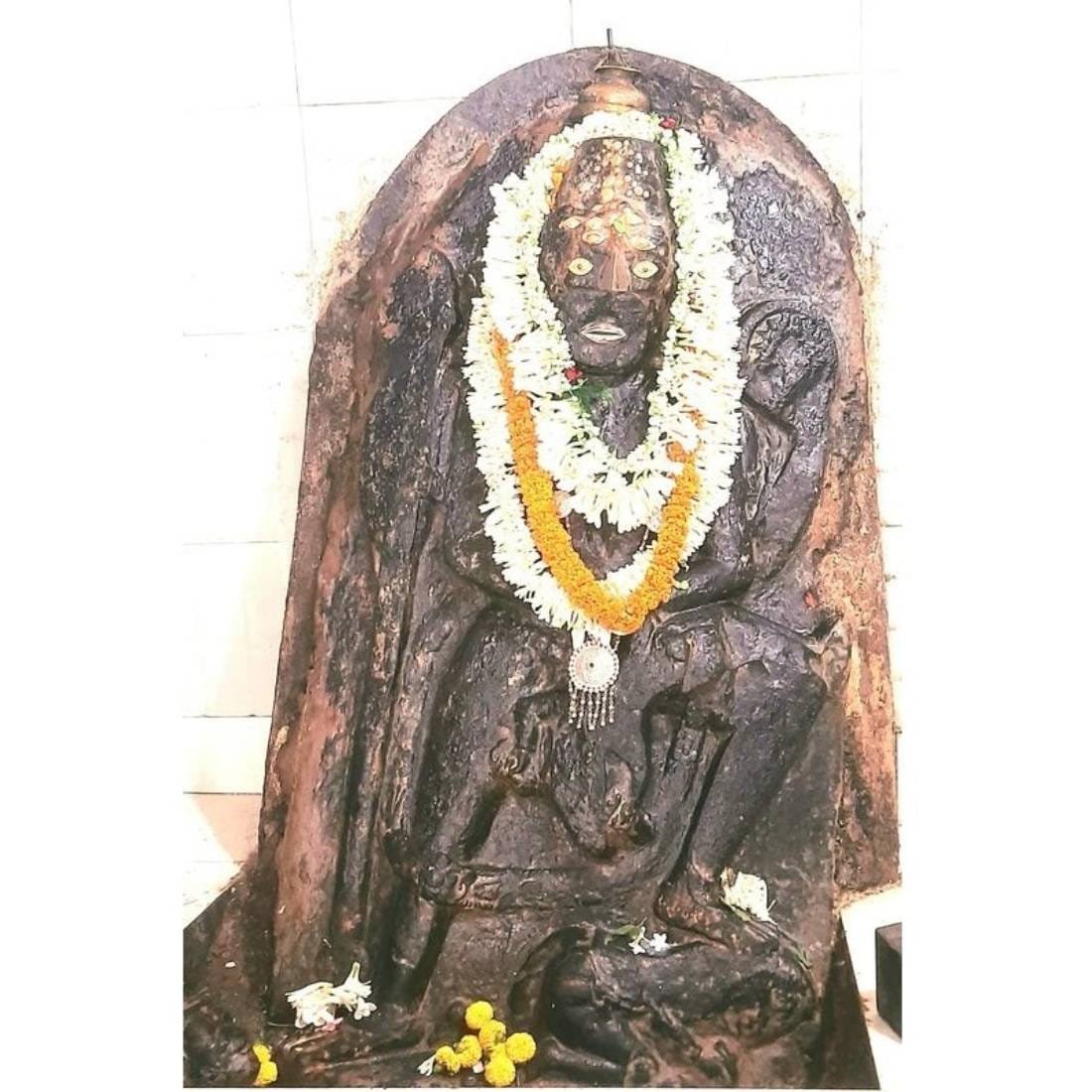
Lord Nrsimhadeva
Deities – Lord Nrsimhadeva with Hiranyakasipu on His lap and Prahlada at His feet.
Southeast of there is Nrsimha Puri, also known as Devapalli. When will I see the beauty of this place? At this abode of Nrsimha I will roll about on the ground in ecstatic love, begging for unalloyed love of Kṛṣṇa.
In my heart reside duplicity, insincerity, the desire for fame. and the six enemies (kama, krodha, mada, moha, matsarya and bhaya-that is, lust, anger, intoxication, illusion, envy, and fear.) beginning with lust. Therefore I will pray at the feet of Lord Nrsimha to purify my heart and give me the desire to serve Kṛṣṇa.
Weeping. I will beg at the lotus feet of Nrsimha that I may worship Radha and Kṛṣṇa in Navadvipa, free from all obstacles. When will that Lord Hari, who strikes fear in fear personified, be pleased and bestow His mercy on me?
Although this form of the Lord is terrible for the evil. He is exceedingly auspicious for the devotees headed by Prahlada. When will He become pleased to mercifully speak to me, a worthless fool, and remove my fears?
“Dear child, stay here happily in Gaura-dhama. Worship Radha and Kṛṣṇa, and develop attraction for the holy name. By the mercy of My devotees, all obstacles are transcended. With a purified heart just worship Radha and Krsna, the abodes of sweet nectar.”
After speaking in this way, when will that Lord joyfully place His feet upon my head? At that moment, by Lord Nrsimha’s mercy. I will exhibit symptoms of ecstatic love for Radha and Kṛṣṇa, and I will roll on the ground by the door of Lord Nrsimha’s temple.
(Sri Navadvipa Bhava-taranga)
Nityānanda spoke: “This is Devapalli, and here is the temple of Nrsimhadeva, well known since Satya-yuga. After bestowing His mercy on Prahlada by killing Hiranyakasipu, the Lord came here to rest.
“Brahma and the other demigods made their houses here and formed a village. This village was established on tilās, hillocks, here on the bank of the Mandākinī River, and all the residents became absorbed in the worship of Nrsimhadeva. According to the scriptures, this village in Navadvīpa, named Śrī Nrsimha-kṣetra, is most purifying.
“See here Surya-ṭilā and Brahmā-ṭilā and to the east was Nrsimha-tilā. The place is now transformed. See there Gaṇeśa-tilā, and over there is Indra-țilā. Though Viśvakarmā built hundreds of jeweled houses here, in time, all were destroyed, and the Mandakini dried up. Now only the hillocks mark the places. See these countless broken stones, the remnants of the temples. Again in the future, one devotee king will receive a drop of Nrsimha’s mercy, and he will make a large temple, reinstall Nrsimha, and take up service to Nrsimha again. This is on the border of the Navadvipa parikrama within the sixteen krosas.“
(Sri Navadvipa-Dhama-Mahatmya, Chapter 7)
“Oh, Bhamini! (After visiting Suvarna-vihara) the Lord went to Devapalli. There he drowned the demigods headed by Surya with the bliss of chanting the holy name of Sri Krishna.”
(Navadvipa-dhama-mahatmya Pramana-khanda 4.38)
In the fourteenth incarnation, the Lord appeared as Nṛsiṁha and bifurcated the strong body of the atheist Hiraṇyakaśipu with His nails, just as a carpenter pierces cane.
(SB 1.3.18)
ugraṁ vīraṁ mahā-viṣṇuṁ
jvalantaṁ sarvatomukham
nṛsiṁhaṁ bhīṣaṇaṁ bhadraṁ
mṛtyor mṛtyuṁ namāmy aham
May my head be protected by the moon colored one, who is the greatest among humans. My obeisances unto the ferocious and powerful, the great Visnu, the fiery one, who's faces are on all sides, the fearful one, Nrsimha, who causes the death of even death personified, (or who can overcome death).
oṁ namo bhagavate narasiṁhāya namas tejas-tejase āvir-āvirbhava
vajra-nakha vajra-daṁṣṭra karmāśayān randhaya randhaya tamo grasa
grasa oṁ svāhā; abhayam abhayam ātmani bhūyiṣṭhā oṁ kṣraum
I offer my respectful obeisances unto Lord Nṛsiṁhadeva, the source of all power. O my Lord who possesses nails and teeth just like thunderbolts, kindly vanquish our demonlike desires for fruitive activity in this material world. Please appear in our hearts and drive away our ignorance so that by Your mercy we may become fearless in the struggle for existence in this material world. (SB 5.18.8)
In the Nṛsiṁha Purāṇa, Lord Nṛsiṁhadeva says, "Anyone who prays unto Me and takes shelter from Me becomes My ward, and I protect him always from all sorts of calamities."
(Nectar of Devotion 11, Aspects of Transcendental Service)
When Lord Nṛsiṁhadeva appeared, Prahlāda Mahārāja was never afraid of Him, whereas his atheist father was immediately faced with death personified and was killed. Therefore, although Lord Nṛsiṁhadeva appears as death for an atheist like Hiraṇyakaśipu, He is always kind and is the reservoir of all pleasure for the devotees like Prahlāda. A pure devotee is not, therefore, afraid of birth, death, old age and disease.
(Kṛṣṇa Book Chapter 87: Prayers by the Personified Vedas)
The Supreme Personality of Godhead in His transcendental form of Narahari, Nṛsiṁhadeva, is always ready to kill the demons, who always create disturbances in the minds of honest devotees. To spread the Kṛṣṇa consciousness movement, devotees have to face many dangers and impediments all over the world, but a faithful servant who preaches with great devotion to the Lord must know that Lord Nṛsiṁhadeva is always his protector.
(SB 7.8.51 purport)
The fourth incarnation is Nṛsiṁha-deva. Nṛsiṁha-deva appeared to save Prahlāda Mahārāja, who was five-years-old boy, and he was being tortured by his atheistic father. So He appeared from the pillar of the palace as a half-man, half-lion. Because this Hiraṇyakaśipu took benediction from Brahmā that he'll not be killed by any man or any animal. So the Lord appeared neither man nor animal.
This is the difference between the Lord's intelligence and our intelligence. We are thinking that we can cheat the Lord by our intelligence, but the Lord is more intelligent than us. This Hiraṇyakaśipu wanted to cheat Brahmā by indirect definition. First of all he wanted to become immortal. Brahmā said: "That is not possible, because even I am not immortal. Nobody in this material world is immortal. That is not possible."
So Hiraṇyakaśipu, the demon—the demons are very intelligent—he thought that, "Roundabout way I shall become immortal." He prayed to Brahmā that, "Please give me the benediction that I shall not be killed by any man or any animal." Brahmā said: "Yes, that is all right." "I shall not be killed in the sky, on the water or on land." Brahmā said: "Oh, yes." "I shall not be killed by any man-made weapons." "That's all right." In this way he utilized his intelligence in so many ways just to come to the conclusion of being immortal.
But the Lord is so cunning that He kept intact all the benediction given by Brahmā; still he was killed. He said that, "I'll not be killed either during daytime or night." Brahmā said: "Yes." So he was killed just in the evening, just in the junction of day and night. You cannot say it is day or night. He took the benediction that, "I shall not be killed in the sky, on the water, on the land." So he was killed on His lap. He took the benediction that, "I shall not be killed by any man-made or any God-made weapons." That was given, "All right." So he was killed by the nails. In this way, all the benedictions were kept intact, still he was killed.
Similarly, we may make plan, we may make very advancement in scientific knowledge, but the killing process of nature will be there. Nobody can escape. By our intelligence we cannot escape. The four principles of material existence means birth, death, old age and disease. We can manufacture many medicines, many weapons, many means, many methods, but you cannot escape these four principles of material existence, however great you may be. That was proved by Hiraṇyakaśipu. Hiraṇyakaśipu was one of the stalwart materialistic, and he wanted to live forever, enjoy, but he also could not live. Everything was finished.
(700218 - Lecture Festival Appearance Day, Lord Varaha, Varaha-dvadasi and Purport Dasavatara-stotra - Los Angeles)
As he read the thousand names of the Lord, in due course the holy name of Lord Nṛsiṁha appeared. When Caitanya Mahāprabhu heard the holy name of Lord Nṛsiṁha, He became fully absorbed in thought.
PURPORT
The Caitanya-maṅgala, Madhya-khaṇḍa, describes this incident as follows: Śrīvāsa Paṇḍita was performing the śrāddha ceremony for his father, and as is customary, he was hearing the thousand names of Lord Viṣṇu. At that time Gaurahari (Lord Caitanya) appeared on the scene, and He also began to hear the thousand names of Viṣṇu with full satisfaction. When He thus heard the holy name of Lord Nṛsiṁha, Lord Caitanya became absorbed in thought, and He became angry like Nṛsiṁha Prabhu in His angry mood. His eyes became red, His bodily hairs stood on end, all the parts of His body trembled, and He made a thundering sound. All of a sudden He took up a club, and people became greatly afraid, thinking, “We do not know what kind of offense we have now committed!” But then Śrī Caitanya Mahāprabhu adjusted His thoughts and sat down on His seat.
(CC Adi 17.91)
Śrī Caitanya Mahāprabhu changed the name of Pradyumna Miśra, or Pradyumna Brahmacārī, to Nṛsiṁhānanda Brahmacārī, for in his heart Lord Nṛsiṁhadeva was manifest. It is said that Lord Nṛsiṁhadeva used to talk with him directly.
(CC Adi 10.35 purport)
The yogīs should contemplate with full devotion the compassionate glances frequently cast by the Lord’s eyes, for they soothe the most fearful threefold agonies of His devotees. His glances, accompanied by loving smiles, are full of abundant grace.
(SB 3.28.31)
Śrīla Prabhupāda Audio
Hear the original words of Śrīla Prabhupāda.
So Kṛṣṇa has got two businesses. One, to give protection to the devotee, and the other is to kill the demon. Just like Kṛṣṇa appeared as keśava dhṛta narahari-rūpa (Śrī Daśāvatāra Stotra 4), Nṛsiṁha-deva, and Narahari, Nṛsiṁha-deva, one side He was blessing Prahlāda Mahārāja, the devotee, and the other side He was killing his atheist father, Hiraṇyakaśipu. You have seen the picture. So Kṛṣṇa, when He has got the fighting spirit . . .
Because Kṛṣṇa is the source of everything, janmādy asya yataḥ (SB 1.1.1). Here in this world also, you find two things: friendship and hostility. Just like modern political atmosphere, sometimes there is conference of friendship, and sometimes there is fight with lethal weapons. So this duality is visible in this material world, but in the spiritual world there is no duality. There is absolute peace. . . (break).
So when He wants to fight, He comes here, because here there are many demons, so His fighting spirit is satisfied. Otherwise, for killing the demons, Kṛṣṇa does not require to descend. There are many agents of Kṛṣṇa. For example, this city, Visakhapatnam, on the seashore, if Kṛṣṇa desires, this whole city can be killed in a second, simply by overflooding the sea, or by storm. He has got many agents, parasya śaktir vividhaiva śruyate (Śvetāśvatara Upaniṣad’ 6.8, CC Madhya 13.65, purport). Or the material agent, Durgā devī, she can all . . . do all these things.
So Kṛṣṇa does not require to descend for killing the demons, but when He feels . . . just like a rich man sometimes feels to contest with some wrestler, that does not mean he requires it. That is the Kṛṣṇa spirit. He is all-blissful. So when Kṛṣṇa comes, descends, there are many demons. He especially comes for the devotee. But when He fights with the demon, that is also His favor, because anyone killed by Kṛṣṇa, he immediately attains liberation. Therefore Kṛṣṇa is absolute. Either He fights or blesses, the result is the same.
(720220 – Lecture SB 01.02.05 – Visakhapatnam)
So Prahlāda Mahārāja, he was such a nice devotee. And to protect him when he was just going to be killed by his father . . . and his father was very polit . . . good politician. He took benediction from Brahmā that he will not be killed by anyone. By policy he took benediction from Brahmā that, "I shall not be killed by man." "Oh, yes." "I shall not be killed by demigods." "That's all right." "I shall not be killed by any animal." "That's all right." "I shall not be killed in day." "That's all right." "You shall . . . I shall not be killed at night." "That's all right." "I shall not be killed by any weapon." "That's all right."
And he said: "Now it is finished. Everything is now secure. I cannot be killed in day. I cannot be killed at night. No man can kill him (me). No demigod can kill me. No animal can kill me. Then where is the killing? Everything finished." But God is so, cunning that He assumed neither man nor animal, and no weapons. He killed him with the nails. He never expected that "I will be killed by the nails." This is the definition by negation, defective definition. There the . . . in argument, if you define negatively, "This is not this. This is not this. This is not this," then something will come that will, I mean to say, nullify all your arguments. You see? So he protected himself in all negative ways, "This will not. This will not. This will not. This will not." Something came which was not in his power. So this Nṛsiṁhāvatāra.
(661220 - Lecture CC Madhya 20.294-298 - New York)