Śrī Māyāpurcandra
History
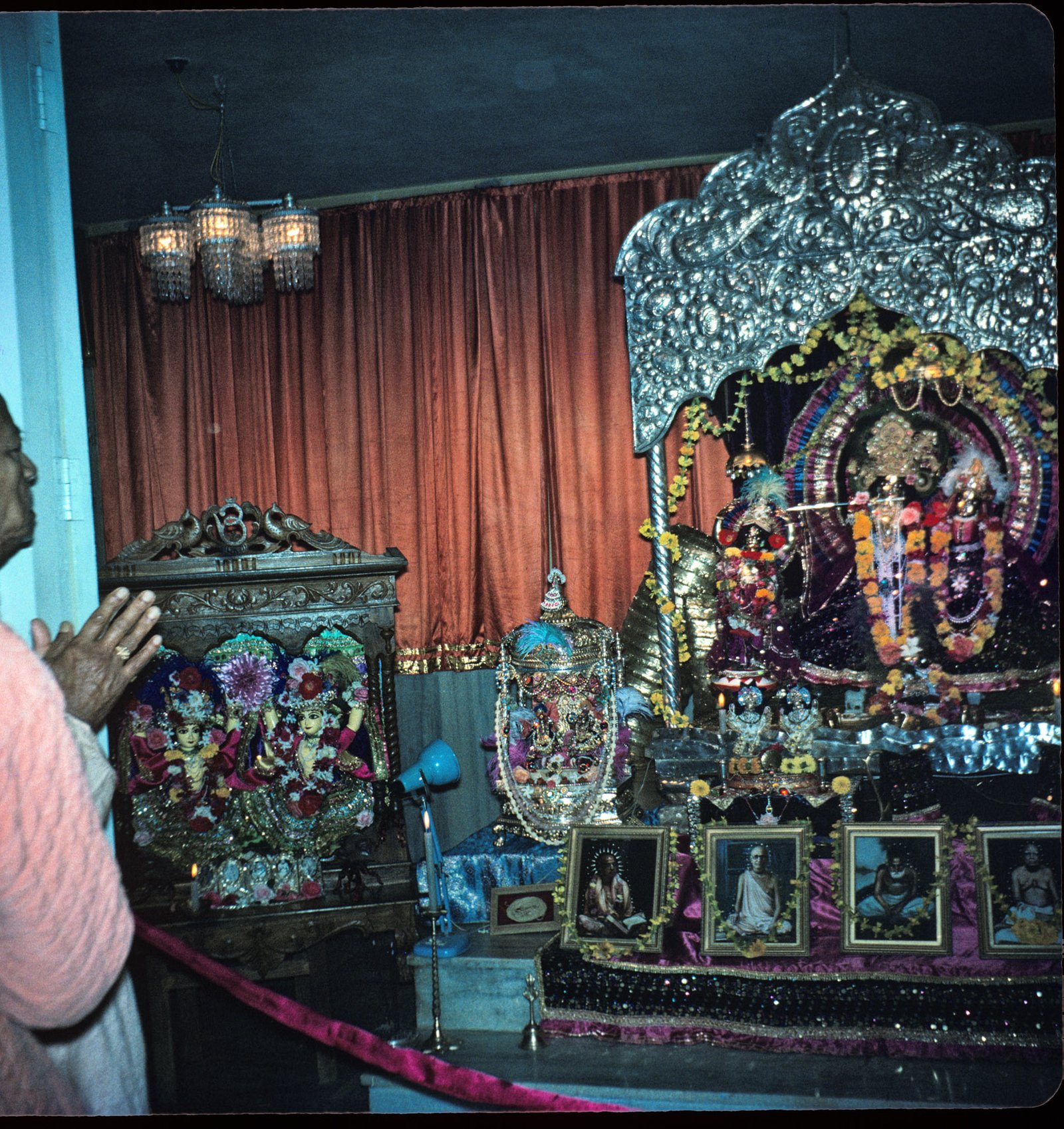
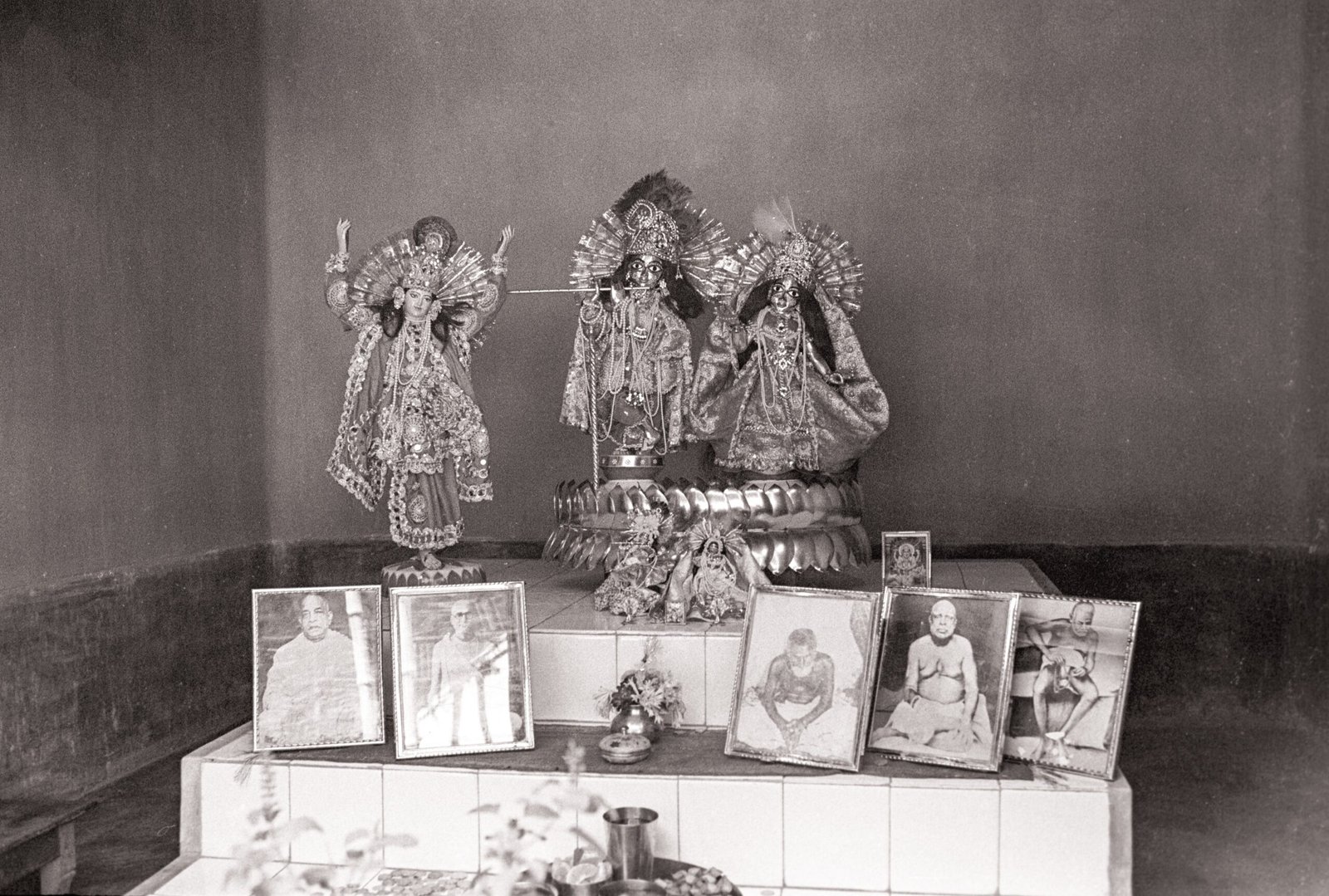
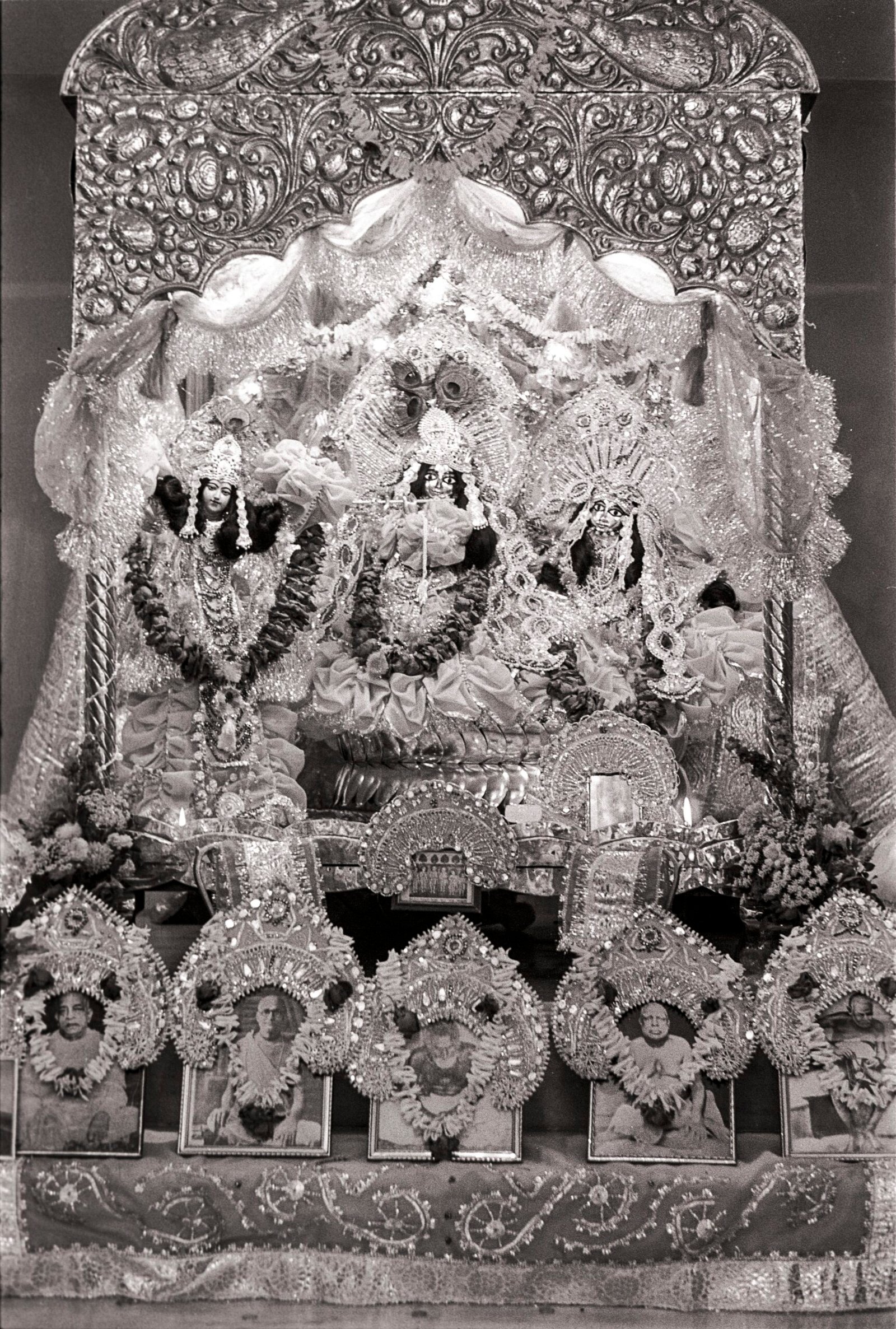
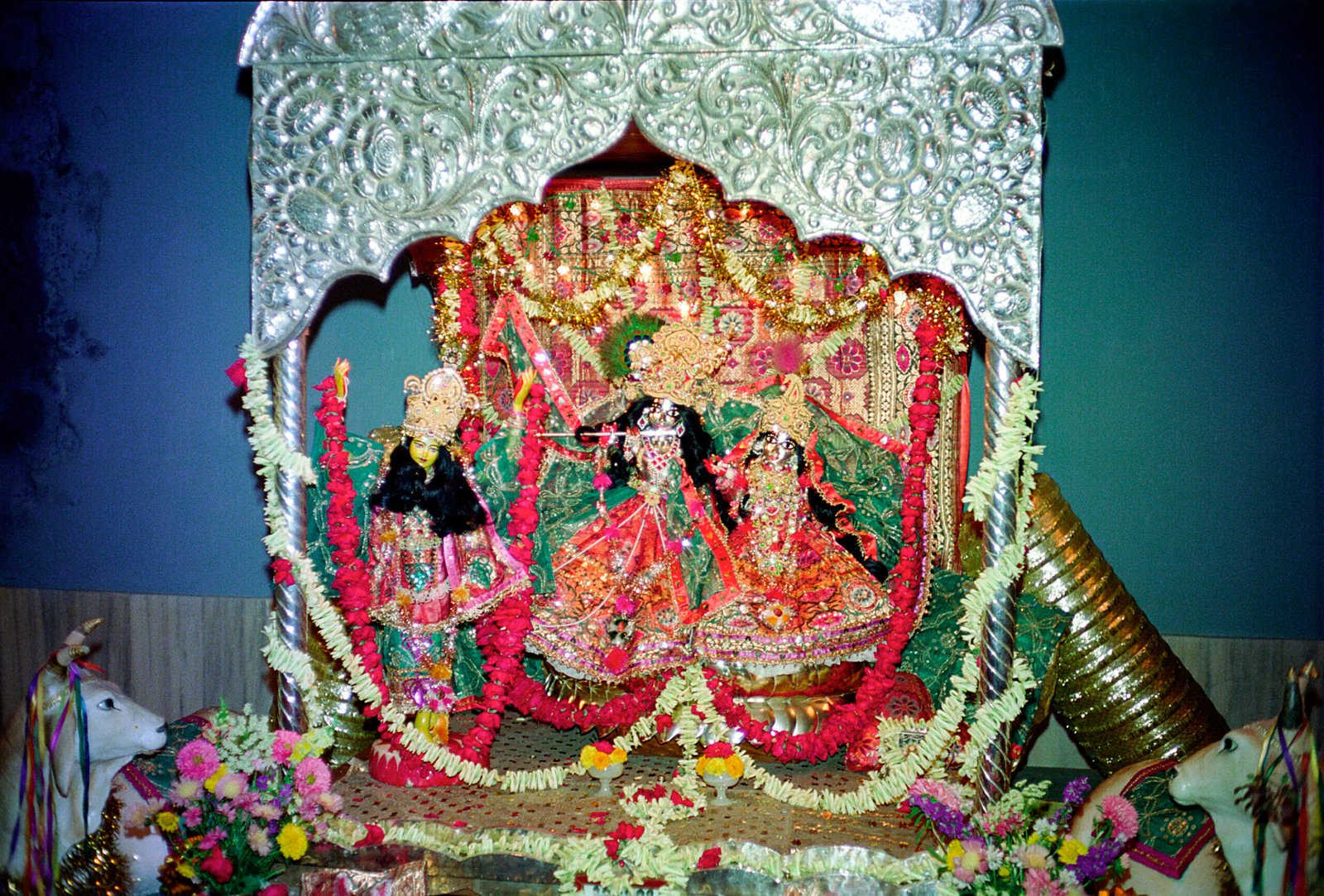
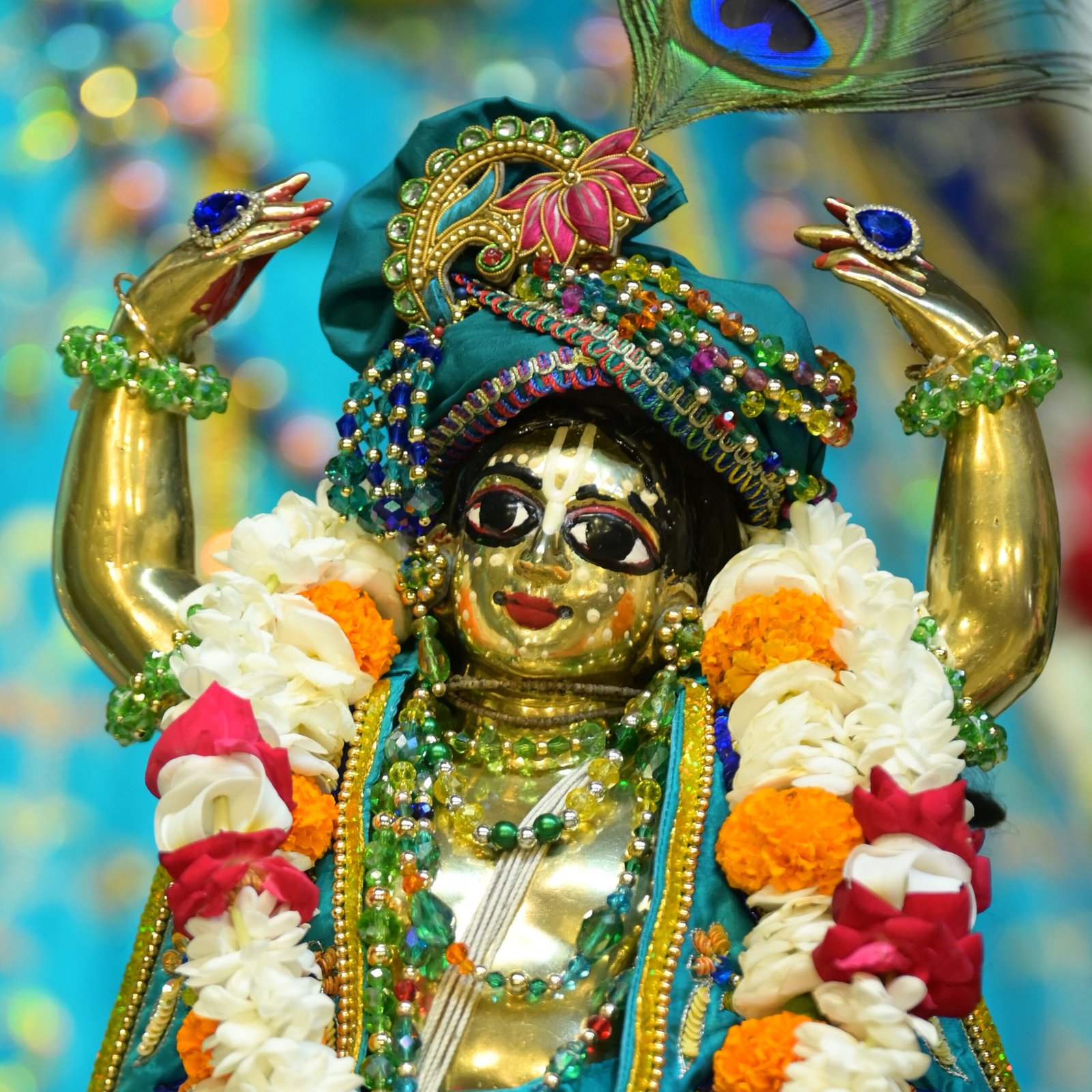
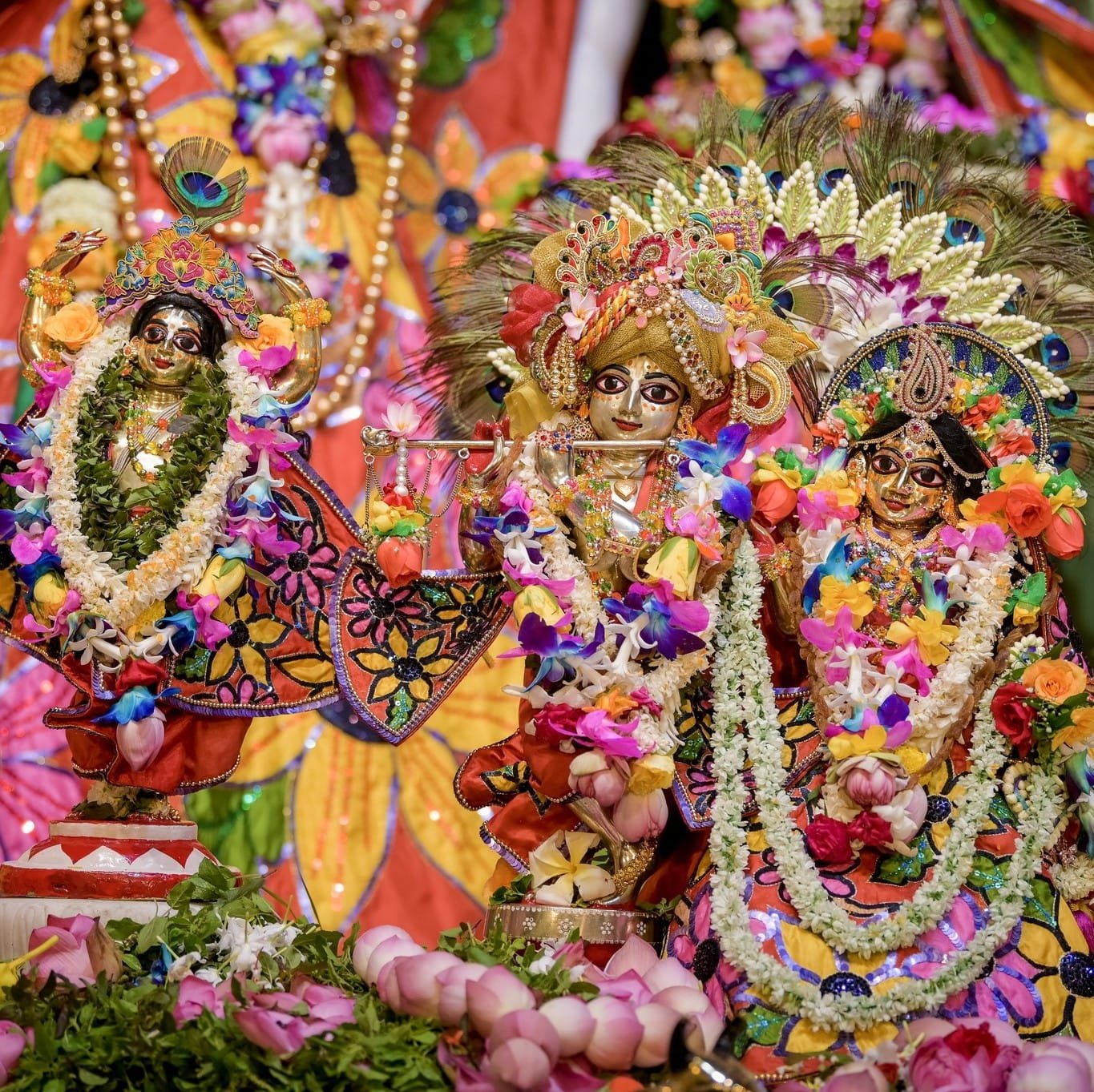
The brass Deity of Lord Śrī Caitanya Mahāprabhu was installed in ISKCON Māyāpur during Gaura Pūrṇimā 1974, replacing the original Deity known as Śrī Māyāpur Chandra. The original Deity had been worshipped alongside the small Śrī Śrī Rādhā Mādhava Deities in Śrīla Prabhupāda’s Bhajan Kuṭīra and later in the Lotus Building temple.
Over time, devotees noticed that Śrī Māyāpur Chandra had developed cracks in His upper arms, ankles, and feet. It is understood that the Deity had been fashioned from clay around an internal wire framework and lightly fired in a kiln, making Him susceptible to cracking over time.
Bhavānanda dāsa (ACBSP) recalled that when the devotees informed Śrīla Prabhupāda about the condition of the Deity, he instructed them to obtain a new brass Deity from Navadvīpa. Following Śrīla Prabhupāda’s order, the devotees brought the brass Deity to Māyāpur, where He was installed during the Gaura Pūrṇimā festival in 1974.
When Bhavānanda dāsa asked Śrīla Prabhupāda what should be done with the original Deity, Śrīla Prabhupāda replied, “No. Take Him to my room.” By Śrīla Prabhupāda’s special mercy, Śrī Māyāpur Chandra continues to reside in Śrīla Prabhupāda’s quarters in the Lotus Building, where He receives daily worship.
Since His installation in 1974, the brass Deity has continued to receive daily worship in ISKCON Māyāpur and has witnessed the remarkable growth of Śrī Māyāpur Chandrodaya Mandir over the decades.
Lord Śrī Kṛṣṇa is the reservoir of all pleasure, and Śrīmatī Rādhārāṇī is the personification of ecstatic love of Godhead. These two forms has combined as one in Śrī Caitanya Mahāprabhu. This being the case, Lord Śrī Caitanya Mahāprabhu revealed His real form to Rāmānanda Rāya.
(CC Madhya 8.282)
The loving affairs of Śrī Rādhā and Kṛṣṇa are transcendental manifestations of the Lord’s internal pleasure-giving potency. Although Rādhā and Kṛṣṇa are one in Their identity, They separated Themselves eternally. Now these two transcendental identities have again united, in the form of Śrī Kṛṣṇa Caitanya. I bow down to Him, who has manifested Himself with the sentiment and complexion of Śrīmatī Rādhārāṇī although He is Kṛṣṇa Himself.
(CC Ādi 1.5)
Let me take shelter of the Supreme Personality of Godhead, Śrī Kṛṣṇa, who has descended in the form of Lord Caitanya Mahāprabhu to teach us real knowledge, His devotional service and detachment from whatever does not foster Kṛṣṇa consciousness. He has descended because He is an ocean of transcendental mercy. Let me surrender unto His lotus feet.
(CC Madhya 6.254)
As in Vrindavana we have named the temple Krsna-Balaram Temple, similarly I suggest that our Mayapur temple be know as Mayapur Candra temple or Mayapur Candrodaya. Whichever sounds better we should advertise from now.
(730509 – Letter to Jayapataka and Bhavananda written from Los Angeles)
To taste the essence of that loving exchange, Kṛṣṇa made His appearance in the same way that the moon appears on the horizon of the sea. Just as the moon was produced by the churning of the sea, by the churning of spiritual loving affairs the moon of Caitanya Mahāprabhu appeared. Indeed, Lord Caitanya’s complexion was golden, just like the luster of the moon. Although this is figurative language, it conveys the meaning behind the appearance of Caitanya Mahāprabhu.
(CC Introduction)
In the beginning of Caitanya-caritāmṛta it is said that Lord Caitanya appeared in order to taste the feelings Rādhārāṇī felt upon seeing Kṛṣṇa. Kṛṣṇa Himself could not understand the ecstatic feelings of Rādhārāṇī toward Him, and therefore He desired to accept the role of Rādhārāṇī and thereby taste these feelings. Lord Caitanya is Kṛṣṇa with the feelings of Rādhārāṇī; in other words, He is a combination of Rādhā and Kṛṣṇa. It is therefore said, śrī-kṛṣṇa-caitanya rādhā-kṛṣṇa nahe anya. By worshiping Śrī Caitanya Mahāprabhu alone, one can relish the loving affairs of Rādhā and Kṛṣṇa together. One should therefore try to understand Rādhā-Kṛṣṇa not directly but through Śrī Caitanya Mahāprabhu and through His devotees.
(CC Adi 13.43 purport)
Radharani is also Krishna. There is no difference between the energy and the energetic. Without energy there is no meaning to energetic, and without the energetic there is no meaning to energy. Similarly, without Radha there is no meaning to Krishna, and without Krishna there is no meaning to Radha. Therefore the Vaishnava philosophy first of all worships the internal pleasure potency of the Supreme Lord. It is always said, “Radha Krishna.” Although the author is going to explain the intricacies of this pleasure potency, he first of all utters the name of Radha. Similarly, those who worship the Name of Narayan first of all utter the name of Lakshmi; those who are worshippers of Lord Rama first of all utter the name of Sita. Sita Rama, Radha Krishna,Lakshmi Narayan—the potency always first.
Radha and Krishna are One. When Krishna desires to enjoy pleasure He manifests Himself. The spiritual exchange of love affair is the display of the internal potency or pleasure potency of Krishna. We say “when” Krishna desires, although just when He did desire, we cannot say. But we speak in this way because in conditional life we take it that everything has some beginning. In the Absolute, or spiritual life, there is no beginning; there is no end. But in order to understand that Radha and Krishna are One, and that They become divided, that question “When?” automatically comes to be asked. When Krishna desired to enjoy His pleasure potency, He manifested Himself in the separate Form of Radharani. Again, when Krishna wanted to understand Himself through the agency of Radha, They became united—and that unification is called Lord Chaitanya.
(Teachings of Lord Chaitanya Introduction)
Śrīla Prabhupāda Audio
Hear the original words of Śrīla Prabhupāda.
So we have established this temple, Māyāpur-candrodaya. So this is the idea, that Śrī Caitanya Mahāprabhu is just like moon. Śrī Caitanya Mahāprabhu, He appeared in this land of Māyāpur; therefore He is said here as “the moon.” Therefore we say candra, Māyāpur-candra. Now, as Śrī Māyāpur-candra is rising . . . rising. Rising means He is to distribute the moonshine all over the world. This is the idea, moonshine. Śreyaḥ-kairava candrikā-vitaraṇam. Śreyaḥ-kairava. Caitanya Mahāprabhu personally said. Don’t keep Śrī Caitanya Mahāprabhu compact in your room and take some monetary profit. This is not required. This is not required.
You must allow Śrī Caitanya Mahāprabhu to rise more and more so that this sun, moonshine, may be distributed all over the world. That is wanted. Therefore this temple is situated. Of course, we shall try to construct a very nice temple for Śrī Caitanya Mahāprabhu. This morning we were thinking of this. So from this place, this moon, Śrī Kṛṣṇa Caitanya Mahāprabhu, will distribute. Śreyaḥ-kairava-candrikā-vitaraṇaṁ vidyā-vadhū-jīvanam. The Śrī Caitanya Mahāprabhu’s Hare Kṛṣṇa movement . . . paraṁ vijāyate śrī-kṛṣṇa-saṅkīrtanam. This is spoken by Śrī Caitanya Mahāprabhu Himself. Ceto-darpaṇa-mārjanam bhava-mahā-dāvāgni-nirvāpaṇaṁ śreyaḥ-kairava-candrikā-vitaraṇaṁ vidyā-vadhū-jīvanam (CC Antya 20.12). Vidyā-vadhū-jīvanam. This is real enlightenment. People all over the world, they are in darkness. The moonshine will enlighten them.
(750330 – Lecture CC Adi 01.06 – Mayapur)
Śrīla Prabhupāda Audio
Hear the original words of Śrīla Prabhupāda.
Kṛṣṇa is one, but when Kṛṣṇa wants to enjoy, He must expand His pleasure potency. That is Rādhārāṇī. Rādhā kṛṣṇa-praṇaya-vikṛtir. Kṛṣṇa cannot enjoy anything material. The original spiritual potency, pleasure potency, is Rādhārāṇī. So first of all He expanded, then again He combined together. That is Śrī Kṛṣṇa Caitanya Mahāprabhu. This is the study of the Gosvāmī. Rādhā kṛṣṇa-praṇaya-vikṛtir hlādinī.
Therefore Caitanya Mahāprabhu is given seat along with Kṛṣṇa. He's combination of Rādhā and Kṛṣṇa. We may not misunderstand that Caitanya Mahāprabhu is . . . imitating Caitanya Mahāprabhu, there are so many so-called avatāras. But this is approved by the śāstra. Kṛṣṇa-varṇaṁ tviṣākṛṣṇam (SB 11.5.32). Caitanya Mahāprabhu is Kṛṣṇa, same category, kṛṣṇa-varṇaṁ. Just like we say varṇa: brāhmaṇa varṇa, kṣatriya varṇa, śūdra varṇa, vaiśya varṇa. Varṇa means the same category, varṇa. Or kṛṣṇa-varṇaṁ means who is always describing Kṛṣṇa. Just like Caitanya Mahāprabhu is passing on the road, He's chanting,
kṛṣṇa kṛṣṇa kṛṣṇa kṛṣṇa kṛṣṇa kṛṣṇa kṛṣṇa he
kṛṣṇa kṛṣṇa kṛṣṇa kṛṣṇa kṛṣṇa kṛṣṇa kṛṣṇa he
kṛṣṇa kṛṣṇa kṛṣṇa kṛṣṇa kṛṣṇa kṛṣṇa pāhi māṁ
(CC Madhya 7.96)
Therefore kṛṣṇa-varṇaṁ is He; iti kṛṣṇa. Kṛṣṇa is describing Himself: kṛṣṇa-varṇaṁ tviṣākṛṣṇam. But by His complexion, He is not black—very fair complexion.
(730306 - Lecture BG 10.01-3 - Calcutta)
There is no difference between Kṛṣṇa and Caitanya Mahāprabhu. Caitanya Mahāprabhu is combination of Rādhā and Kṛṣṇa. That is the verdict of the Gosvāmīs.
rādhā-kṛṣṇa-praṇaya-vikṛtir hlādinī-śaktir asmād
ekātmānāv api (bhuvi purā) deha-bhedaṁ gatau tau
caitanyākhyaṁ prakaṭam adhunā tad-dvayaṁ caikyam āptaṁ
rādhā-bhāva-dyuti-suvalitaṁ naumi kṛṣṇa-svarūpam
(CC Adi 1.5)
So Caitanya Mahāprabhu is combination of Rādhā and Kṛṣṇa. That is the . . . this śloka is made by Svarūpa Dāmodara Gosvāmī, who was personal secretary of Lord Caitanya.
So Caitanya Mahāprabhu is giving us the easiest process to approach Kṛṣṇa.
(710216 - Lecture CC Madhya 06.154 - Gorakhpur)