
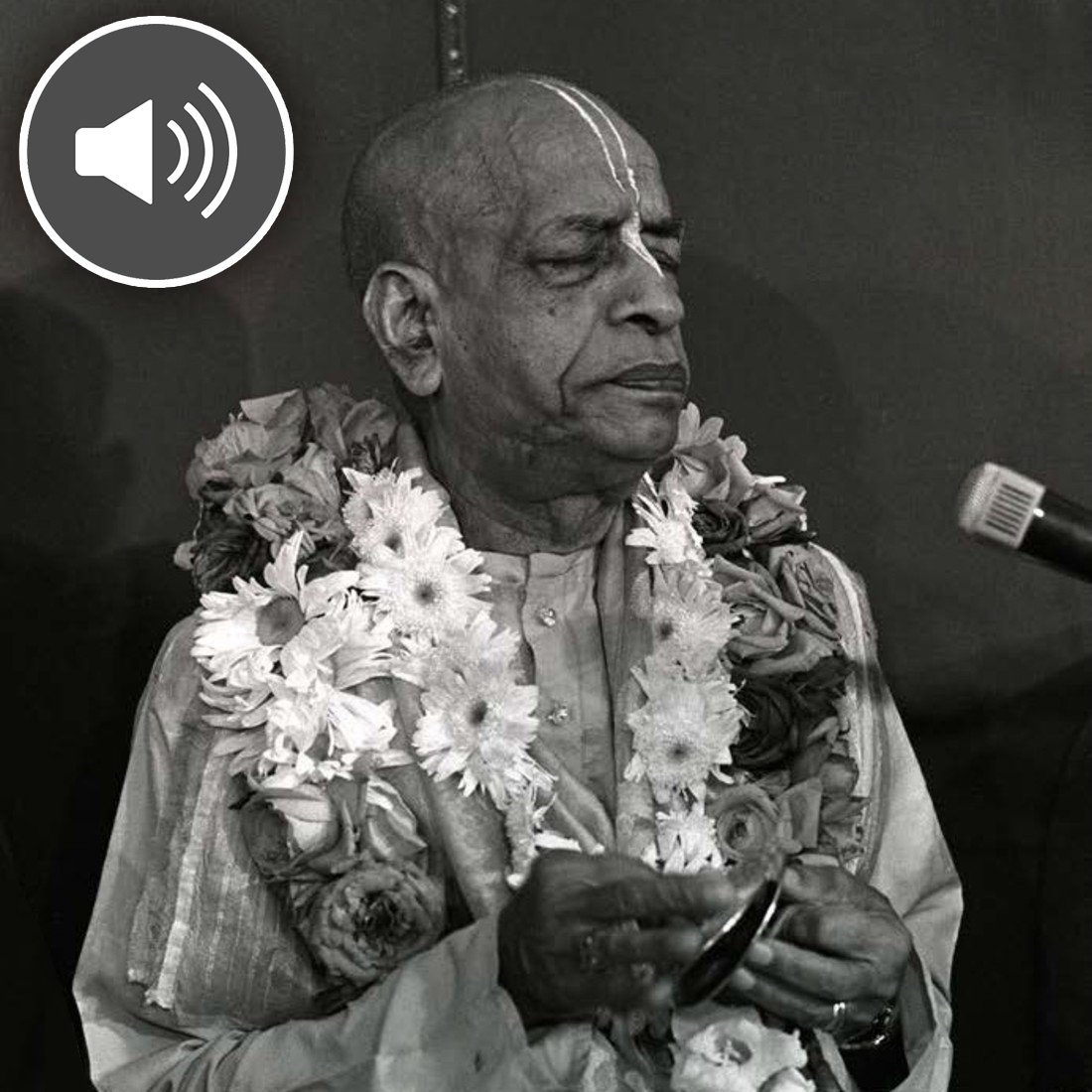
Srila Prabhupada
Śrīla Prabhupāda Audio
Hear the original words of Śrīla Prabhupāda.
This tract of land, Navadvīpa, is the place of highly educated brāhmaṇas from time immemorial. So Śrī Caitanya Mahāprabhu belonged to a very respectable brāhmaṇa family, the son of Jagannātha Miśra; His grandfather, Nīlāmbara Cakravartī. Very respectful, respectable persons. He took birth in that family. Personally He was very beautiful; therefore His another name is Gaurasundara. And He was very learned scholar also; therefore His another name is Nimāi Paṇḍita. So . . . and in His family life He had very nice, beautiful young wife, Viṣṇupriyā, and very affectionate mother, and He was very influential. You know that. In one day He collected about one hundred thousand followers to protest against the Kazi's order. So in this way His social position was very favorable. Personal position was very favorable. Still, He took sannyāsa, left home. Why? Dayitaye: in order to favor, in order to show mercy to the fallen souls of the world.
So He left a legacy that anyone who has taken birth in India,
bhārata-bhūmite manuṣya-janma haila yāra
janma sārthaka kari' kara para-upakāra
(CC Adi 9.41)
So He exhibited personally how to do para-upakāra, welfare to others, fallen souls. So this sannyāsa means following the order of Śrī Caitanya Mahāprabhu that,
āmāra ājñāya guru hañā tara' ei deśa
yāre dekha tāre kaha 'kṛṣṇa'-upadeśa
(CC Madhya 7.128)
So not only . . . we are trying to create a position that not only the Indians have got this responsibility, but according to Śrī Caitanya Mahāprabhu, anyone—pṛthivīte āche yata nagarādi grāma (CB Antya-khaṇḍa 4.126)—they should take up this missionary work. And I am so much obliged to you, you American boys and girls also, that you have taken this Kṛṣṇa consciousness movement very seriously.
(760205 - Lecture Initiation Sannyasa Excerpt - Mayapur)
So Caitanya Mahāprabhu also accepted sannyāsa in very young age, when He was only twenty-four years. So why? Tyaktvā tūrṇam, rājya-lakṣmīṁ dharmiṣṭha ārya-vacasā yad agād araṇyam (SB 11.5.34). Caitanya Mahāprabhu was very, very well situated. He was born in a very respectable high brāhmaṇa family, Jagannātha Miśra, and mother's side, the Nīlāmbara Cakravartī, he was very respectable brāhmaṇa. And Caitanya Mahāprabhu's learning, nobody could excel Him, He was so learned scholar. And when He was sixteen years old, He defeated one of the most learned scholar of India, Keśava Bhāratī. So learning, family . . . And wife? Personally goddess of fortune, Lakṣmīpriyā and Viṣṇupriyā, most beautiful and young. Viṣṇupriyā was His second wife; so faithful, so beautiful, personally goddess of fortune, such wife. And mother, most affectionate. There is no comparison with Śacī-mātā. So this was . . . And influence? When He was twenty years old, He could, by His command, gather 100,000 people to protest against Kazi, He was so popular. So popularity, born in high family, having good wife and good mother, everything complete—still, He took sannyāsa. Therefore it is said, pūrvatamair mahadbhiḥ. Why? Now, just to show mercy to the fallen souls. Māyā-mṛgaṁ dayitayā (SB 11.5.34). Just to show mercy to the fallen souls. This is the meaning of sannyāsa. One must be very merciful. Vaiṣṇavas, they are merciful. All devotees of God, Vaiṣṇava, they are merciful.
(750721 - Lecture Initiation Sannyasa - San Francisco)
bhārata-bhūmite haila manuṣya-janma yāra
janma sārthaka kari' kara para-upakāra
(CC Adi 9.41)
Para-upakāra, just to do something good for others, for upakāra. So Caitanya Mahāprabhu says anyone who has taken birth in India, he should, bhārata-bhūmite manuṣya-janma haila yāra (CC Adi 9.41), anyone who has taken birth in India, for every one of them, it is the duty. Janma sārthaka kari': first of all make your life successful, janma sārthaka kari' kara para-upakāra, then you begin the welfare activities for all others. The idea is that India is enriched with Vedic knowledge, and those who are born in India, they should take advantage of this facility, especially those who are in the higher, topmost ranks, the brāhmaṇas, the kṣatriyas, the vaiśyas. Especially the brāhmaṇas. Take this education perfectly well, make your life perfect, and distribute the knowledge all over the world. This is your duty. That is the order of Śrī Caitanya Mahāprabhu.
(760620 - Lecture BG 09.03 - Toronto)
Śrīla Prabhupāda Audio
Hear the original words of Śrīla Prabhupāda.
So under the direction of Jagannātha dāsa Bābājī Mahārāja, this present Yogapīṭha was ascertained to be the birth site of Śrī Caitanya Mahāprabhu. So Bhaktivinoda Ṭhākura in the beginning wanted to develop this place very gloriously, befitting the holy name of Śrī Caitanya Mahāprabhu. So he started this movement of developing Māyāpur. He could not finish it, so it was handed down to Bhaktisiddhānta Sarasvatī Ṭhākura. So under his effort, assisted by his disciples, this place has gradually developed, and our attempt is also to develop this place. Therefore we have named this temple Māyāpur Chandrodaya. We have got great ambition to develop this place nicely and gloriously, and fortunately we are now connected with foreign countries, especially with the Americans. Bhaktivinoda Ṭhākura's great desire was that the Americans would come here and develop this place, and they would chant and dance along with the Indians.
So his dream, as well as Caitanya Mahāprabhu's foretelling,
pṛthivīte āche yata nagarādi grāma
sarvatra pracāra haibe mora nāma
(CB Antya-khaṇḍa 4.126)
(760221 - Lecture Festival Appearance Day, Bhaktisiddhanta Sarasvati - Mayapur)
Śrīla Prabhupāda Audio
Hear the original words of Śrīla Prabhupāda.
Prabhupāda: Parama koruṇa, pahū dui jana, nitāi gauracandra. This is a song by Locana dāsa Ṭhākura, a great devotee and ācārya of the Gauḍīya-sampradāya. He is declaring that pahū dui jana. Pahū means lords. Dui jana means two. Who are the two Lords? Nitāi Gauracandra. One is Lord Nitāi, Nityānanda; another is Lord Śrī Caitanya Mahāprabhu.
So he says that, “These two Lords are very merciful.” Parama koruṇa, pahū dui jana. Parama koruṇa means very merciful. Nitai Gauracandra. Saba avatāra, sāra śiromaṇi. Avatāra means incarnation, and saba means all. “They are the essence of all incarnations.” Saba avatāra, sāra śiromaṇi, kevala ānanda-kanda: “And the specific significance of these incarnations is that to prosecute Their ways of self-realization is simply joyful,” ānanda-kanda.
They introduced chanting and dancing. No other incarnation . . . there are many incarnation, just like Lord Rāma. Even Kṛṣṇa, He taught Bhagavad-gītā. That requires knowledge, understanding. But here Lord Caitanya, Nityānanda, introduced some process which is simply joyful: simply chant and dance. Kevala ānanda-kanda. Saba avatāra, sāra śiromaṇi, kevala ānanda-kanda.
Therefore he requests everyone, bhajo bhajo bhāi, caitanya nitāi: “My dear brothers, I request you. Just you worship Lord Caitanya and Nityānanda” sudṛḍha biśwāsa kori’, “with firm conviction and faith” Don’t think that this chanting and dancing will not lead you to the desired goal. It will, because there is assurance of Lord Caitanya Mahāprabhu that you will get all perfection by this process. Therefore Locana dāsa Ṭhākura says that "You must have firm faith and conviction." It will act.
(690104 – Lecture Purport to Parama Koruna – Los Angeles)
Śrīla Prabhupāda Audio
Hear the original words of Śrīla Prabhupāda.
So in the Śiva Purāṇa, there was a question by Pārvatī to Lord Śiva. Lord Śiva and Pārvatī, husband and wife. Pārvatī means the material nature. Sṛṣṭi-sthiti-pralaya-sādhana-śaktir ekā chāyeva yasya bhuvanāni bibharti durgā (Bs. 5.44). Durgā-devī.
Durgā-devī is in charge of this material world. It is called durga, durga, just like fort. And the superintendent of this fort is Durgā. You cannot go out of this fort, you are imprisoned. Such Durgā-devī, who is so powerful energy—she can create, annihilate, maintain, sṛṣṭi-sthiti-pralaya-sādhana—she is always sitting by the side of her husband, Lord Śiva, and questioning about spiritual enquiries. Just see. Such powerful deity is also ignorant about spiritual life. So the husband, Lord Śiva, is Vaiṣṇava, and she's always asking, and sitting down underneath a bael tree. She can create so many universes, but for her, no building; only underneath a tree.
So the question was, "Which worship is best?" So Lord Śiva replied, ārādhanānāṁ sarveṣāṁ viṣṇor ārādhanaṁ param (Padma Purāṇa): "My dear Pārvatī, of all methods of worship, Viṣṇu worship is the topmost." There are many demigods' worship, even Lord Śiva's worship, but Lord Śiva says: "Viṣṇu worship is the best." Then he says again, tasmāt parataraṁ devi: "My dear Devi, better than that Viṣṇu worship is tadīyānāṁ aradhanam." Tadīya.
Tadīya means those who are in relationship with Viṣṇu, tadīya. Just like His devotee, tadīya. Tulasī-vṛkṣa. Tulasī is tadīya. Or temple tadīya, preaching tadīya.
(720821 - Lecture SB 01.02.18 - Los Angeles)
Similarly, Māyā has no powers. Kṛṣṇa has given her power to chastise these individual souls who are defying the authority of Kṛṣṇa. They should be punished. It is Māyā's thankless task, but Māyā is obedient servant of Kṛṣṇa. Mama Māyā. He says, "My Māyā."
So Māyā is not degraded. Māyā is faithful servant of Kṛṣṇa. She is faithfully serving. That is stated in the Brahma-saṁhitā. You should read. So many nice books you have got. What is Māyā doing? That is stated in the Brahma-saṁhitā:
sṛṣṭi-sthiti-pralaya-sādhana-śaktir ekā
chāyeva yasya bhuvanāni vibharti durgā
(Bs. 5.44)
Durgā is Māyā. Now what is the position of Māyā? Māyā is so strong that sṛṣṭi-sthiti-pralaya: she can perform creation, maintenance and dissolution of this whole universe. She's so powerful. The material nature is so powerful. So sṛṣṭi-sthiti-pralaya-sādhan a-śaktir ekā. Alone, she can do this as good as Kṛṣṇa, or the Supreme Personality of Godhead.
Sṛṣṭi-sthiti-pralaya-sādhana-śaktir ekā chāyeva. But she is just like shadow. Chāyeva yasya. Chāyeva yasya . . . she is working just like shadow. Just like here is shadow of my hand. If I shake my hand, the shadow also shakes. The Māyā is acting like that. In the Bhagavad-gītā also it is said, mayādhyakṣeṇa prakṛtiḥ sūyate sa-carācaram (BG 9.10): "Under My superintendence, prakṛti, the nature, or Māyā, is acting." Chāyeva yasya bhuvanāni vibharti durgā.
And next line, icchānurūpam api yasya ca ceṣṭate sā, that Māyā is acting under the direction of the Personality. And who is that personality? Govindam adi-puruṣaṁ tam ahaṁ bhajāmi. "That personality is Govinda, the Supreme Person. I am offering my respectful obeisances." So Māyā is acting under the direction of Kṛṣṇa just like the shadow is moving under the movement of the original.
So Māyā's position is not degraded. Don't think like that. Therefore Vaiṣṇava offers all respect to Māyā, because she is working under Kṛṣṇa. She is Vaiṣṇavī.
She is also energy of Kṛṣṇa. Therefore she is also Vaiṣṇavī.
(681127 - Lecture BG 02.08-12 - Los Angeles)
Śrīla Prabhupāda Audio
Hear the original words of Śrīla Prabhupāda.
So we have to keep ourself always in the fire of Kṛṣṇa consciousness; then everything is all right. (laughs) Otherwise, it will become dull, and it will be simply idol worship. That's all. That is the difference between idol worship and Deity worship. If there is no life, then it is idol worship, hedonism. And when there is life, feeling, "Where is Kṛṣṇa? Here is Kṛṣṇa. Oh, I have to serve Kṛṣṇa, I have to dress Him, I have to serve Rādhārāṇī, She is here. Oh, I must do it very nicely. And as far as possible decorate Her to the best capacity," in this way, if you always feel Kṛṣṇa conscious, then you are fire.
The same example, keeping with the fire. And if you think it is a brass-made doll, I mean to say, idol . . . ye yathā māṁ prapadyante tāṁs tathaiva bhajāmy aham (BG 4.11). If you think this is a brass-made idol, then it will remain a brass-made idol to you forever. But if you elevate yourself to higher platform of Kṛṣṇa consciousness, then Kṛṣṇa, this Kṛṣṇa, will talk with you. This Kṛṣṇa will talk with you.
There is a Vaṁsīdāsa Bābājī Mahārāja, he was talking with his Deity. And Kṛṣṇa . . . just like Madana-mohana, He was talking with Sanātana Gosvāmī. Madana-mohana . . . Sanātana Gosvāmī at that time had no temple; he was hanging his Deity on the tree. So Madana-mohana was talking with him, "Sanātana, you are bringing all these dry chapatis, and it is stale, and you don't give Me even little salt. How can I eat?" Sanātana Gosvāmī said, "Sir, where shall I go? Whatever I get I offer You. You kindly accept. I cannot move; old man." You see.
So Kṛṣṇa had to eat that. (chuckles) Because the bhakta is offering, He cannot refuse. Ye māṁ bhaktyā prayacchati. Real thing is bhakti. What you can offer to Kṛṣṇa? Everything belongs to Kṛṣṇa. What you have got? What is your value? And what is the value of your things? It is nothing. Therefore real thing is bhaktyā; real thing is your feeling. "Kṛṣṇa, kindly take it. I have no qualification. I am most rotten, fallen, but (weeps) I have brought this thing for you. Please take." This will be accepted. Don't be puffed up. Always be careful. You are dealing with Kṛṣṇa.
That is my request. Thank you very . . .
(690716 - Lecture Festival Installation, Sri Sri Rukmini Dvarakanatha - Los Angeles)