
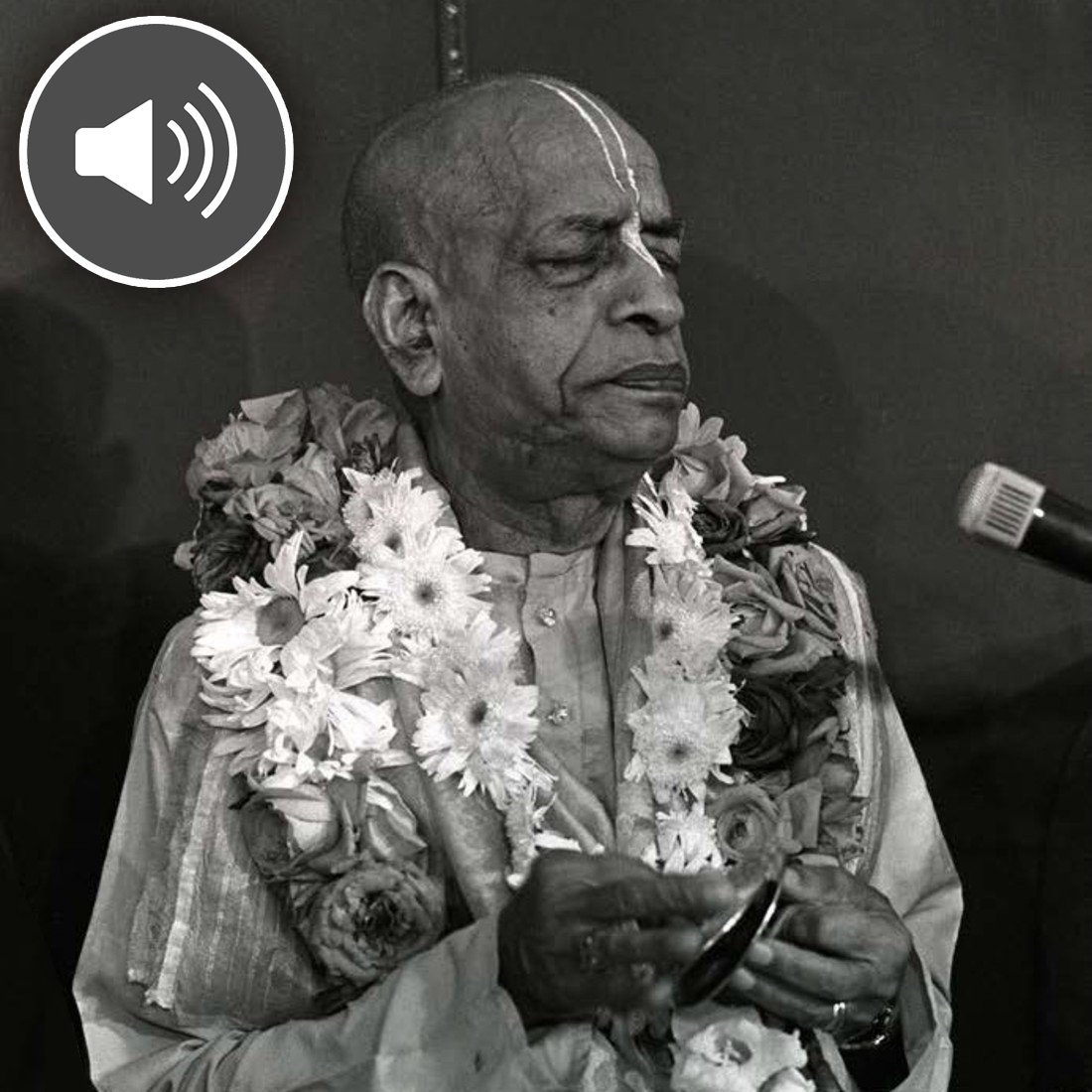
Srila Prabhupada
Śrīla Prabhupāda Audio
Hear the original words of Śrīla Prabhupāda.
So especially in India, the atmosphere is very good. It is especially meant, within this universe, this plot of land known as Bhārata-varṣa, India, is the most sacred place within this universe. And of the whole land Bhārata-varṣa, in Bengal, it is very sacred. And the whole of Bengal, this Nadia district is very sacred. And in the whole Nadia district, this spot is very sacred, Māyāpur-candrodaya Temple. So by Kṛṣṇa’s grace, you have got this opportunity to live here. Take advantage, full advantage of this opportunity, spiritual opportunity. This is the statement of Bhaktivinoda Ṭhākura.
(750408 – Lecture CC Adi 01.15 – Mayapur)
Bhaktivinoda Ṭhākura's aspiration that the Europeans, Americans and Indians all together dance jubilantly and chanting "Gaura Hari."
So this temple, Māyāpur Chandrodaya temple, is meant for transcendental United Nation. What the United Nation has failed, that will be achieved here by the process recommended by Śrī Caitanya Mahāprabhu,
pṛthivīte āche yata nagarādi grāma
sarvatra pracāra haibe mora nāma
(CB Antya-khaṇḍa 4.126)
So you have come from all parts of the world and living together in this temple. So train these small boys. I am very glad, especially, to see that the small children from all other countries, and Indian, Bengalis, all together, forgetting their bodily consciousness. That is the greatest achievement in this movement, that everyone forgets the bodily conception of life. Nobody thinks here as "European," "American," "Indian," "Hindu," "Muslim," "Christian." They forget all these designation, and simply they are ecstatic in chanting Hare Kṛṣṇa mantra. So kindly what you have begun, do not break it. Continue it very jubilantly. And Caitanya Mahāprabhu, the master of Māyāpur, He will be very much pleased upon you, and ultimately you will go back to home, back to Godhead.
(760115 - Lecture Excerpt - Mayapur)
So we have established this temple, Māyāpur-candrodaya. So this is the idea, that Śrī Caitanya Mahāprabhu is just like moon. Śrī Caitanya Mahāprabhu, He appeared in this land of Māyāpur; therefore He is said here as "the moon." Therefore we say candra, Māyāpur-candra. Now, as Śrī Māyāpur-candra is rising . . . rising. Rising means He is to distribute the moonshine all over the world. This is the idea, moonshine. Śreyaḥ-kairava candrikā-vitaraṇam. Śreyaḥ-kairava. Caitanya Mahāprabhu personally said. Don't keep Śrī Caitanya Mahāprabhu compact in your room and take some monetary profit. This is not required. This is not required.
You must allow Śrī Caitanya Mahāprabhu to rise more and more so that this sun, moonshine, may be distributed all over the world. That is wanted. Therefore this temple is situated. Of course, we shall try to construct a very nice temple for Śrī Caitanya Mahāprabhu. This morning we were thinking of this. So from this place, this moon, Śrī Kṛṣṇa Caitanya Mahāprabhu, will distribute. Śreyaḥ-kairava-candrikā-vitaraṇaṁ vidyā-vadhū-jīvanam. The Śrī Caitanya Mahāprabhu's Hare Kṛṣṇa movement . . . paraṁ vijāyate śrī-kṛṣṇa-saṅkīrtanam. This is spoken by Śrī Caitanya Mahāprabhu Himself. Ceto-darpaṇa-mārjanam bhava-mahā-dāvāgni-nirvāpaṇaṁ śreyaḥ-kairava-candrikā-vitaraṇaṁ vidyā-vadhū-jīvanam (CC Antya 20.12). Vidyā-vadhū-jīvanam. This is real enlightenment. People all over the world, they are in darkness. The moonshine will enlighten them.
(750330 - Lecture CC Adi 01.06 - Mayapur)
So go on cooperating in this way, and I am sure this mission of Caitanya Mahāprabhu will be successful. It must be successful, because Śrī Caitanya Mahāprabhu wanted it to be done. Simply we, the workers, the servitors, must be very sincere. Then Caitanya Mahāprabhu will give us more and more facilities so that we can work very well. So keep this mission always in view and do your best. That is my only request. Thank you very much.
(740927 - Lecture Arrival - Mayapur)
Śrī Caitanya Mahāprabhu appeared here at Māyāpur, this very place where you are now sitting, with all these five features: Nityānanda Prabhu, Śrī Advaita Prabhu and Gadādhara Prabhu, Śrīnivāsa Prabhu. So He Himself, Kṛṣṇa, and Nityānanda Prabhu is immediate expansion of His personal self—Advaita Prabhu is incarnation of Kṛṣṇa, or Viṣṇu, Mahāviṣṇu, three; and Gadādhara Prabhu is the expansion of spiritual energy; and Śrīnivāsa Prabhu is the expansion of His marginal potency, marginal energy, jīva-tattva. Jīva-tattva, śakti-tattva, prakāśa-tattva, and avatāra-tattva, and He Himself. This pañca-tattva.
(740303 - Lecture CC Adi 07.03 - Mayapur)
Just like Lord Caitanya Mahāprabhu, His personal expansion is Nityānanda Prabhu and Advaita Prabhu. And Śrīvāsādi, they are separated expansion.
Although they are associates, but Śrīvāsa, jīva-tattva; and Nityānanda Prabhu and Advaita Prabhu, viṣṇu-tattva. And Gadādhara is śakti-tattva. So in this way, God is person, and His personal expansions are innumerable, unlimited. The viṣṇu-tattva, They are worshipable. And other tattva, śakti-tattva and jīva-tattva, they are meant for service. But all together taken, that is one. That is Absolute Truth.
(721002 - Lecture SB 01.03.27 - Los Angeles)
pañca-tattvātmakaṁ kṛṣṇaṁ
bhakta-rūpa-svarūpakam
bhaktāvatāraṁ bhaktākhyaṁ
namāmi bhakta-śaktikam
(CC Adi 1.14)
So Śrī Kṛṣṇa Caitanya Mahāprabhu has five features. Kṛṣṇa has five features. Kṛṣṇa means these five features. What are those? Kṛṣṇa, Kṛṣṇa’s manifestation, Kṛṣṇa’s incarnation, Kṛṣṇa’s different potencies, in this way. And Kṛṣṇa, the source of devotional service, He is Kṛṣṇa Caitanya, bhakta-śaktikam. To advance in devotional service requires spiritual strength. It is not so easy thing. That spiritual strength is also Kṛṣṇa, bhakta-śaktikam. There is nothing except Kṛṣṇa. Ekaṁ brahmā dvitīya-nāsti. So we have to understand Him especially in these five features for advancing in devotional service. Therefore His name is pañca-tattvātmakam, with five features, kṛṣṇam, bhakta-rūpa-svarūpakam. Kṛṣṇa is so kind upon us that He is coming as He is, Kṛṣṇa’s original, and trying to convince us about the necessity of our life, or the goal of our life. Prayojana. Prayojana: it is necessary. It is not optional—compulsory. If you don’t take to Kṛṣṇa consciousness, then you will continue to suffer; therefore it is necessity. It is not that if you like, you can take it; if you don’t like, you reject it. If you reject it, then you will suffer. And if you take it, then actually you will enjoy life.
(750407 – Lecture CC Adi 01.14 – Mayapur)
This philosophy, acintya-bhedābheda, simultaneously one and different, is our philosophy, inaugurated by Śrī Caitanya Mahāprabhu, although it is in the Vedānta-sūtras. So everything is simultaneously one and different from the Supreme Lord. But there are two classes of philosophers. One class says that God and the living entities are different, and there is another philosopher, monist philosopher; they say God and the living entities are one.
So this acintya-bhedābheda philosophy adjusts that, "God and the living creatures, they are simultaneously one and different." They are one in quality, just like the energy and the energetic, the sun globe and the sunshine. In quality, in sunshine there is heat, there is illumination, light. In the sun globe also, there is heat, there is illumination. But the degrees are quite different. You can bear the heat and illumination of the sunshine, but you cannot go to the sun globe, or you can bear the heat and temperature there. The scientist says that so many millions miles away, if somebody goes or some planet goes near the sun globe, it will immediately burn into ashes.
Similarly, God and ourself, Kṛṣṇa and living entities, they are qualitatively one, but quantitatively, we are very minute.
(690827 - Lecture Initiation - Hamburg)
Caitanya Mahāprabhu’s one disciple, Prabodhānanda Sarasvatī, he took up a nice principle: dante nidhāya tṛṇakaṁ padayor nipatya kāku-śataṁ kṛtvā cāhaṁ bravīmi (Caitanya-candrāmṛta 8.90). His principle was that he would go to a gentleman, taking a straw in the mouth. According to Indian system, if you take a straw in your mouth and if you go to see somebody, he’ll understand, “He is coming to me with most humble manner,” so he’ll receive you, “He’s surrendered soul.” So he will at least say: “Oh, what do you want to say?” So dante nidhāya. This is the sign. If you want to go to some big man, and if you take one straw in your mouth, he will accept. He will receive you. That is the system.
So dante nidhāya tṛṇakam. So Prabodhānanda Sarasvatī, he says that, “I have taken the straw in my mouth.” Dante nidhāya tṛṇakaṁ padayor nipatya. “And I am falling down at your feet.” Padayor nipatya kāku-śataṁ kṛtvā cāham. “And I am flattering you in hundreds and thousands ways.” Why? Why you are so humble? What is the intention? Kāku-śataṁ kṛtvā cāhaṁ bravīmi: “I want to say something. Please hear.” “All right. Say it. What is that?”
He sādhava: “Oh, you are very learned man and you are very honest man.” He sādhava sakalam eva vihāya dūrād: “For the time being, so long I shall speak, whatever you have learned, please set aside. Please set aside.” Sakalam eva vihāya dūrād caitanya-candra-caraṇe kurutānurāgam: “Kindly hear for some time about the topics which Caitanya Mahāprabhu has presented before you.”
We are servant of Lord Caitanya. So, in the disciplic succession we are trying to present. The Caitanya Mahāprabhu’s topic is yāre dekha tāre kaha kṛṣṇa-upadeśa (CC Madhya 7.128): “Whoever you meet, please try to convince him about Kṛṣṇa consciousness.” So in order to preach Kṛṣṇa consciousness, that Prabodhānanda Sarasvatī, he says that “I have taken straw in my mouth, and I am falling down to your feet and I am flattering you in so many ways. Kindly, for the time being, you forget whatever you have learned. Please try to hear about the Kṛṣṇa consciousness.”
This should be the preaching method. Because you cannot enforce. You cannot enforce. The atheistic party, the godless civilization is so strong. So you are not weak. You are protected by the Supreme. But our mission is not to fight, but our mission is to convince. So this is the method to be accepted by devotees, those who are in Kṛṣṇa consciousness, to preach the philosophy in the world. Thank you very much.
(670123 – Lecture CC Madhya 25.36-40 – San Francisco)
If one takes to this philosophy of Kṛṣṇa consciousness and develops love of Godhead, then he can see God at every moment, in every step, in every thing. He's not, for a single moment, is out of the sight of God. Just like in the Bhagavad-gītā it is said, teṣu te mayi (BG 9.29). The devotee who has loved, who has developed love for God, he's also seeing God at every moment.
Similarly, God is also seeing him at every moment. They are not separated. So simple process. This hari-kīrtana, this is the simple process recommended in this age, and if we sincerely do it without any offense and with faith, then seeing of God is not difficult for a devotee. So:
kona brahmāṇḍe kona līlāra haya avasthāna
tāte līlā 'nitya' kahe āgama-purāṇa
(CC Madhya 20.395)
So similarly, in some of the brahmāṇḍas, or universes, there is already present kṛṣṇa-līlā; Kṛṣṇa is there. There is another Bengali verse, very nicely:
adya 'pi akāri līlā gaura-rāya
kona kona bhagavane dekhibāre pāya
Lord Caitanya's pastime is going on, still going on, but some of the fortunate devotees, they can see. Anything, God's pastime, that is perceivable through devotional service. Bhaktyā mām abhijānāti (BG 18.55).
Only. This is the process. No other process
(670102 - Lecture CC Madhya 20.391-405 - New York)
Vṛndāvana means Rādhā-Kṛṣṇa's activities, pastimes. So that is the destiny of life. That is the real goal. As Śrī Caitanya . . . Narottama dāsa Ṭhākura says, that manuṣya janama pāiyā, rādhā-kṛṣṇa nā bhajiyā, jāniyā śuniyā viṣa khāinu. One who has got this human form of life, if he does not understand what is Rādhā-Kṛṣṇa, his life is spoiled. Jāniyā śuniyā viṣa khāinu: knowingly they're eating poison. Because by coming in contact with Rādhā and Kṛṣṇa they can go back to home, back to Godhead, and there will be no more janma-mṛtyu-jarā-vyādhi (BG 13.9). Such opportunity is human life, simply to understand Rādhā Kṛṣṇa. And therefore Śrī Caitanya Mahāprabhu is mahā-vadānyāvatāra, because He is teaching about the love of Rādhā-Kṛṣṇa and teaching everyone kṛṣṇa-prema-pradāya te, real destination of life, how to achieve kṛṣṇa-prema, and He's personally teaching. Namo mahā-vadānyāya. Rūpa Gosvāmī understood it: "Here is namo mahā-vadānyāya, most magnanimous incarnation." Similarly, Locana dāsa Ṭhākura has sung:
parama karuṇa, pahū dui-jana
nitāi-gauracandra
saba avatāra, sāra śiromaṇi
kevala ānanda-kanda
Kevala ānanda-kanda, parama-karuṇa: "There are many incarnation, but no better incarnation, no magnanimous incarnation, like Śrī Caitanya Mahāprabhu, Nityānanda Prabhu." Nityānanda Prabhu is always . . . vrajendra-nandana yei, śaci-suta haila sei, balarāma haila nitāi.
(740301 - Lecture CC Adi 07.01 - Mayapur)
So the vairāgya-vidyā-nija-bhakti-yoga (CC Madhya 6.254). To conquer God is bhakti. If you are advanced in devotional service, then you can conquer God. Just like the gopīs, as I was speaking: their parentage was not very high, not at all high. Village, agriculturist, farmers, no education, practical . . . no education at all. And they were not rich at all. Agriculturist, farmers, they are not very rich. So how they conquered Kṛṣṇa? Kṛṣṇa was just a play toy in their hands.
Gopī-bhāva-rasāmṛtābdhi-laharī. They conquered Kṛṣṇa simply by devotional service. That's all. They did not know anything except Kṛṣṇa. They did not, I mean to . . . (indistinct) . . . care anything. Simply they’re, always they're thinking of Kṛṣṇa.
(680202 - Lecture CC Madhya 06.254 - Los Angeles)
So desire tree also described in the Brahma-saṁhitā: cintāmaṇi-prakara-sadmasu kalpa-vṛkṣa (Bs. 5.29)—the same kalpa-vṛkṣa—lakṣāvṛteṣu surabhīr abhipālayantam, lakṣmī-sahasra-śata-sambhrama-sevyamānam. This lakṣmī-sahasra-śata-sevyamānam is described here as preṣṭhālībhiḥ sevyamānau. Preṣṭha-alībhiḥ. Preṣṭha means very dear, and alī means gopīs, associates of Rādhārāṇī, friends. So they are all Lakṣmīs, goddess of fortune. Lakṣmī . . . you have heard the name Lakṣmī, Lakṣmī-Nārāyaṇa, associates of Nārāyaṇa. Kṛṣṇa is Nārāyaṇa. So all these gopīs, they are expansion of Śrīmatī Rādhārāṇī, the original Lakṣmī. This is spiritual world. It is not impersonal, neither nirākāra, formless. Everything form, but that form is different from this form. That form is sat-cid-ānanda form—eternal, full of bliss, full of knowledge.
(750409 - Lecture CC Adi 01.16 - Mayapur)
So when we come to that stage, as Caitanya Mahāprabhu’s teaching, the gopī-bhartuḥ pada-kamalayoḥ. . . He’s also bringing the reference of the gopī because Kṛṣṇa is completely under gopīs. He’s so much indebted to the gopīs that He said that “I cannot repay your debts. It is not possible.” Kṛṣṇa, the all-powerful, all opulences, but He had no means to repay the debts of the gopīs. This is the position of the gopīs. Caitanya Mahāprabhu recommends, ramyā kācid upāsanā vraja-vadhū-vargeṇa yā kalpitā (Caitanya-manjusa). There is no other better shape of worshiping Kṛṣṇa than it was planned by the gopīs. Ramyā kācid upāsanā vraja-vadhū-vargeṇa yā kalpitā. This is the highest. In the same way, He says, gopī-bhartuḥ pada-kamalayor dāsa, Gopī-jana-vallabha. Gopī-jana-vallabha is Kṛṣṇa; pada-kamalayoḥ, one who has taken shelter. Don’t try to become gopīs. No. Rather, try to become the dust of the lotus feet of the gopīs. Gopī-bhartuḥ pada-kamalayor dāsa-dāsānudāsaḥ (CC Madhya 13.80). Just like Uddhava. Uddhava wanted to become one grass in Vṛndāvana because the gopīs will trample over it. This is the highest perfection. So, liberation. Liberation means gopī-bhartuḥ pada-kamalayor dāsa-dāsa-dāsānudāsaḥ. The more you become servant of the servant, servant of Vaiṣṇava, then your perfection is there (CC Madhya 13.80). That is qualification.
(761002 – Lecture SB 01.07.41-42 – Vrndavana)
Kṛṣṇa is one, but when Kṛṣṇa wants to enjoy, He must expand His pleasure potency. That is Rādhārāṇī. Rādhā kṛṣṇa-praṇaya-vikṛtir. Kṛṣṇa cannot enjoy anything material. The original spiritual potency, pleasure potency, is Rādhārāṇī. So first of all He expanded, then again He combined together. That is Śrī Kṛṣṇa Caitanya Mahāprabhu. This is the study of the Gosvāmī. Rādhā kṛṣṇa-praṇaya-vikṛtir hlādinī.
Therefore Caitanya Mahāprabhu is given seat along with Kṛṣṇa. He's combination of Rādhā and Kṛṣṇa. We may not misunderstand that Caitanya Mahāprabhu is . . . imitating Caitanya Mahāprabhu, there are so many so-called avatāras. But this is approved by the śāstra. Kṛṣṇa-varṇaṁ tviṣākṛṣṇam (SB 11.5.32). Caitanya Mahāprabhu is Kṛṣṇa, same category, kṛṣṇa-varṇaṁ. Just like we say varṇa: brāhmaṇa varṇa, kṣatriya varṇa, śūdra varṇa, vaiśya varṇa. Varṇa means the same category, varṇa. Or kṛṣṇa-varṇaṁ means who is always describing Kṛṣṇa. Just like Caitanya Mahāprabhu is passing on the road, He's chanting,
kṛṣṇa kṛṣṇa kṛṣṇa kṛṣṇa kṛṣṇa kṛṣṇa kṛṣṇa he
kṛṣṇa kṛṣṇa kṛṣṇa kṛṣṇa kṛṣṇa kṛṣṇa kṛṣṇa he
kṛṣṇa kṛṣṇa kṛṣṇa kṛṣṇa kṛṣṇa kṛṣṇa pāhi māṁ
(CC Madhya 7.96)
Therefore kṛṣṇa-varṇaṁ is He; iti kṛṣṇa. Kṛṣṇa is describing Himself: kṛṣṇa-varṇaṁ tviṣākṛṣṇam. But by His complexion, He is not black—very fair complexion.
(730306 - Lecture BG 10.01-3 - Calcutta)
Lord Caitanya Mahāprabhu and Lord Nityānanda is standing before you, and He delivered many, many sinful persons to the transcendental position of love of Kṛṣṇa. Śrīla Narottama dāsa Ṭhākura has sung, vrajendra-nandana yei, śacī-suta hoilo sei, balarāma hoilo nitāi. This Balarāma, He became Nitai, and Kṛṣṇa, He became Caitanya Mahāprabhu. These two brothers, the same two brothers, Rāma-Lakṣmaṇa, Kṛṣṇa-Balarāma, again as Caitanya Mahāprabhu and Nityānanda Prabhu. So what was Their business? The pāpī-tāpī jata chilo, hari-nāme uddhārilo. This is Their business. All the pāpīs and all the persons suffering from material anxieties, They delivered? "Yes." How? Tāra sākṣī jagāi mādhāi. There were two brothers, Jagāi and Mādhāi. They are very debauchees. That debauchees means what was their fault? The fault was that they took their birth in brāhmaṇa family, but they became woman-hunter and drunkards and cheaters, like that. So Nityānanda Prabhu delivered them to become first-class Vaiṣṇava. Pāpī-tāpī jata chilo, hari-nāme uddhārilo, tāra sākṣī jagāi and mādhāi.
(750420 - Lecture CC Madhya 19.53 - Vrndavana)
This song has been sung by Narottama dāsa Ṭhākura. Nitāi-pada-kamala, koṭi-candra-suśītala. If we take shelter of Nityānanda Prabhu, then we get peace. Koṭi-candra-suśītala. Just like in daytime, especially in the summer season, we become very much exasperated. But at night, in the evening, as soon as there is moonshine, we become very much satisfied. All day's labor and fatigue is immediately moved. So nitāi-pada-kamala, the shade of Nityānanda Prabhu's lotus feet, is koṭi-candra-suśītala: as pleasing as one crore of moonshine. One moonshine gives us so much pleasure. So if we want actually peace of mind, if we actually want to be free from this material fatiguement, then we must take the shelter of Nityānanda Prabhu. Nityānanda Prabhu is the strength, spiritual strength. And without spiritual strength you cannot approach Kṛṣṇa.
(770202 - Lecture Festival Appearance Day - Lord Nityānanda Prabhu's Avirbhava - Bhuvanesvara)
Now please cooperate with this attempt as far as possible with your prāṇair arthair dhiyā vācā, four things: by your life, by your words, by your money . . . prāṇair arthair dhiyā vācā śreya-ācaraṇaṁ sadā (SB 10.22.35). This is the mission of human life. Whatever you have got . . . it is not that “Because I am poor man, I cannot help this movement.” No. If you have got . . . you have got your life. So if you dedicate your life, that is all-perfect. If you cannot dedicate your life, give some money. But if you can . . . poor man, you cannot give money, then you give some intelligence. And if you are fool, then give your words. So any way, you can help this movement and do the welfare activities for India and outside India. So that is my request. I welcome you.
(750123 – Lecture Festival Cornerstone Laying – Bombay)
Śrīla Prabhupāda Audio
Hear the original words of Śrīla Prabhupāda.
So under the direction of Jagannātha dāsa Bābājī Mahārāja, this present Yogapīṭha was ascertained to be the birth site of Śrī Caitanya Mahāprabhu. So Bhaktivinoda Ṭhākura in the beginning wanted to develop this place very gloriously, befitting the holy name of Śrī Caitanya Mahāprabhu. So he started this movement of developing Māyāpur. He could not finish it, so it was handed down to Bhaktisiddhānta Sarasvatī Ṭhākura. So under his effort, assisted by his disciples, this place has gradually developed, and our attempt is also to develop this place. Therefore we have named this temple Māyāpur Chandrodaya. We have got great ambition to develop this place nicely and gloriously, and fortunately we are now connected with foreign countries, especially with the Americans. Bhaktivinoda Ṭhākura's great desire was that the Americans would come here and develop this place, and they would chant and dance along with the Indians.
So his dream, as well as Caitanya Mahāprabhu's foretelling,
pṛthivīte āche yata nagarādi grāma
sarvatra pracāra haibe mora nāma
(CB Antya-khaṇḍa 4.126)
(760221 - Lecture Festival Appearance Day, Bhaktisiddhanta Sarasvati - Mayapur)
Caitanya Mahāprabhu's student life was known as Nimāi Paṇḍita. His mother gave a very beloved name, Nimāi, because He took His birth underneath a tree, nim tree. So His name was Nimāi Paṇḍita.
(740108 - Lecture SB 01.16.11 - Los Angeles)
If we take the path of Śrī Caitanya Mahāprabhu, then—we are embarrassed in so many ways—we can get the light. We can get the light. We can reform our life. Śrī Caitanya Mahāprabhu's teaching is so nice. Of course, the great author Kavirāja Gosvāmī has depicted the activities and teachings of Lord Caitanya Mahāprabhu, and this Māyāpur is the birth site of Śrī Caitanya Mahāprabhu. Five hundred years . . . 488 years ago, Śrī Caitanya Mahāprabhu traveled on this street. Now, still, that memory is going to be revived by this Kṛṣṇa consciousness movement all over the world because Caitanya Mahāprabhu wanted this.
pṛthivīte āche yata nagarādi grāma
sarvatra pracāra haibe mora nāma
(CB Antya-khaṇḍa 4.126)
So His prediction is coming to be true...Now you European and American, African and Australian, so many, all parts of the world, you have come. This is due to Śrī Caitanya Mahāprabhu's desire. He wanted it. Pṛthivīte āche yata nagarādi grāma (CB Antya-khaṇḍa 4.126). He wanted to be famous, to become famous, and people should thank Him. He wanted that. He told that that, "When they will know My philosophy"—that is the desire of Śrī Caitanya—"they'll thank Me."And actually you are already thanking Him by getting the sublime instruction of Śrī Caitanya Mahāprabhu.
(740301 - Lecture CC Adi 07.01 - Mayapur)
There is no difference between Kṛṣṇa and Caitanya Mahāprabhu. Caitanya Mahāprabhu is combination of Rādhā and Kṛṣṇa. That is the verdict of the Gosvāmīs.
rādhā-kṛṣṇa-praṇaya-vikṛtir hlādinī-śaktir asmād
ekātmānāv api (bhuvi purā) deha-bhedaṁ gatau tau
caitanyākhyaṁ prakaṭam adhunā tad-dvayaṁ caikyam āptaṁ
rādhā-bhāva-dyuti-suvalitaṁ naumi kṛṣṇa-svarūpam
(CC Adi 1.5)
So Caitanya Mahāprabhu is combination of Rādhā and Kṛṣṇa. That is the . . . this śloka is made by Svarūpa Dāmodara Gosvāmī, who was personal secretary of Lord Caitanya.
So Caitanya Mahāprabhu is giving us the easiest process to approach Kṛṣṇa.
(710216 - Lecture CC Madhya 06.154 - Gorakhpur)
Śrīla Prabhupāda Audio
Hear the original words of Śrīla Prabhupāda.
Bhaktivinoda Ṭhākura's aspiration that the Europeans, Americans and Indians all together dance jubilantly and chanting "Gaura Hari."
So this temple, Māyāpur Chandrodaya temple, is meant for transcendental United Nation. What the United Nation has failed, that will be achieved here by the process recommended by Śrī Caitanya Mahāprabhu,
pṛthivīte āche yata nagarādi grāma
sarvatra pracāra haibe mora nāma
(CB Antya-khaṇḍa 4.126)
So you have come from all parts of the world and living together in this temple. So train these small boys. I am very glad, especially, to see that the small children from all other countries, and Indian, Bengalis, all together, forgetting their bodily consciousness. That is the greatest achievement in this movement, that everyone forgets the bodily conception of life. Nobody thinks here as "European," "American," "Indian," "Hindu," "Muslim," "Christian." They forget all these designation, and simply they are ecstatic in chanting Hare Kṛṣṇa mantra. So kindly what you have begun, do not break it. Continue it very jubilantly. And Caitanya Mahāprabhu, the master of Māyāpur, He will be very much pleased upon you, and ultimately you will go back to home, back to Godhead.
(760115 - Lecture Excerpt - Mayapur).
Prabhupāda: Then Lord Caitanya's saṅkīrtana organization in the house of Śrīnivāsa. Śrīnivāsācārya. The saṅkīrtana movement was . . . they were all chanting together Hare Kṛṣṇa, and Caitanya Mahāprabhu asked the devotees that, "Hello, My dear friends. What do you want to eat?" So some of them said . . .
That was out of season, and still some of them asked that, "We shall be very glad if You give us some mangoes." (laughs) So Lord Caitanya said that "All right. You just bring one seed of mango."
So in Bengal there is . . . seed of mango is available always, because the people in the village, they eat mango and throw it in the ground, they say they come out as creep, creeper. So it is not very difficult. So he brought some creeper like that, and he sowed it, and at once it became a tree, and there was sufficient quantity of mango fruits. So all the devotees were distributed. And that mango tree remained there, and they were taking mango every day.
(670405-6 - Conversation on Lord Caitanya Play - San Francisco)
Śrīla Prabhupāda Audio
Hear the original words of Śrīla Prabhupāda.
I was taken to Bhaktisiddhānta Sarasvatī Ṭhākura by one of my friends. I did not want to go there, but he forcibly took me there. Yes. And he ordered me that “You preach the cult of Caitanya Mahāprabhu in English language. This is very much essential.” On the first meeting he told me like that. That was my first meeting with him. At that time I was in favor of Gandhi’s movement. So I said that “We are, I mean to say, not independent—subjugated. Who will hear about our message?” So Bhaktisiddhānta Sarasvatī Ṭhākura refuted my argument. I was very much pleased. I had so many talks. But I was very much pleased to be defeated, that “This so-called nationalism or any ‘ism,’ they are all temporary. Real need is the self-realization.”
(750302 – Lecture Festival Appearance Day, Bhaktisiddhanta Sarasvati – Atlanta)
I think by the beginning of December, 1936, I wrote one letter to Guru Mahārāja. I knew he was little kind upon me, so I wrote that "Guru Mahārāja, you have got many disciples. I am also one of them. But they are doing direct service to you. There some of them are brahmacārīs, some of them sannyāsīs, but I am a householder. I cannot . . ." Of course, I was giving sometimes some monetary help, but I could not give any direct service, so I asked him that, "If there is any particular service I can do for you?"
So that letter was replied in 13th December, dated 13th December, from Purī. And he passed away on the 31st December. Just a fortnight before. So the reply was the same as he wanted me to do this preaching work in 1922, when I first met him that, "You try to preach whatever you have learned from me, the English-knowing people in English. That will do good to you and to the people to whom you shall preach. That is my instruction." So I took up that . . . and then he passed away in 1936, 31st December.
(690207 - Lecture Festival Appearance Day, Bhaktisiddhanta Sarasvati - Los Angeles)
So Śrī Caitanya Mahāprabhu was a great scholar. There is no doubt of it. But in spite of His becoming a great scholar, He is presenting Himself as a great fool. He says: “My Guru Mahārāja saw Me a great . . .” Even one is very great scholar, he has to abide by the decision of his spiritual master. Even one is very great scholar, and if his spiritual master says that “You are a great fool,” he should accept it. This is called full surrender. For example, I’ll give you a practical . . . my Guru Mahārāja was very great scholar, and his Guru Mahārāja, from literary point of view, he could not even sign his name, Gaura-kiśora dāsa Bābājī Mahārāja. And Bhaktivinoda Ṭhākura asked Bhaktisiddhānta Sarasvatī Ṭhākura to accept Gaura-kiśora dāsa Bābājī Mahārāja as his . . . as his spiritual master, that “You go and take your initiation from Gaura-kiśora dāsa Bābājī Mahārāja.” So he thought that “I am a great scholar, and I am son of a magistrate, Bhaktivinoda Ṭhākura, and great Vaiṣṇava. He’ll be very much pleased to accept me.” Of course, he was very much pleased. But in the beginning he refused. He refused. Because . . . of course, that is only show—he was not proud—just to teach us. Bhaktisiddhānta Sarasvatī explained that, “I was little proud. So I was thrice refused by Guru Mahārāja,” although he was the only disciple.
So the scholarship is not a qualification of becoming devotee. That is Caitanya Mahāprabhu’s teaching. Scholarship may help, but it is not necessary. Real necessary is that one should be humble and meek and follow the instruction of the spiritual master. This is real qualification.
(740313 – Lecture CC Adi 07.91-2 – Vrndavana)
There are many devotees, they’re illiterate practically. They do not know what is Vedānta-sūtra. But still, by their sincere devotional service they’re very much elevated. What to speak of others, Gaura-kiśora dāsa Bābājī Mahārāja. Gaura-kiśora dāsa Bābājī Mahārāja, he was illiterate. He could not sign even his name. But he was so spiritually elevated that my spiritual master, who was the topmost scholar of his time, he accepted him as spiritual master.
What is the reason? The reason is that this transcendental science does not depend on academic qualification. It is . . . it is not that because one is very . . . academically very qualified, he’ll become a devotee. No. The secret is . . . that is given in the Vedic literature (SB 5.18.12) yasyāsti bhaktir bhagavaty akiñcanā. No.
yasya deve parā bhaktir
yathā deve tathā gurau
tasyaite kathitā hy arthāḥ
prakāśante mahātmanaḥ
(Svetasvatara Upanisad 6.23)
The transcendental knowledge becomes revealed. To whom it becomes revealed? It becomes revealed to such person who has got unflinching love for Kṛṣṇa and for the spiritual master. Caitanya-caritāmṛta also says, guru-kṛṣṇa-kṛpāya pāya bhakti-latā-bīja (CC Madhya 19.151). One can come to the spiritual perfectional stage, or come to the spiritual platform, by the mercy of Kṛṣṇa and the spiritual master.
(690610 – Lecture SB 01.05.11-12 – New Vrindaban, USA)
So one may question that, "Your Guru Mahārāja was sitting on the ground in a municipal lavatory . . ." Because he did not like that, "Anybody should disturb me," he was sitting by the side of municipal lavatory. Because so many people will come for darśana and āśīrvāda, he did not like it. He did not like to be disturbed by these āśīrvāda. You see? "They will not take any spiritual instruction. They are thinking that, 'Here is a saintly person, and he'll bless me. So I have got now one thousand; I'll tell ten thousand.' That's all. Therefore they come. They do not come to take any spiritual instruction. Therefore it is botheration. It is botheration." So Gaura-kiśora dāsa Bābājī Mahārāja did not like this botheration. He was sitting by the side of a municipal lavatory so that "These rascal will not come out of the bad smell and will not disturb me." You see?
So Mahārāja Maṇīndrānandī, he was one of the . . . he had organized one saṅkīrtana festival. So he came to Gaura-kiśora dāsa Bābājī Mahārāja and to invite him. So after many requests, Gaura-kiśora dāsa Bābājī Mahārāja said, "Mahārāja, you have got many tenants. You are Mahārāja. Why you are trying to make me your tenant? Because you are rich man, you also want . . . as your tenants carries your order, so you also want me. So why you are . . .?" "No, sir, no. You are my lord. Whatever you say, I shall carry out." "Will you carry out?" "Why not?" So he said that, "Don't go home. Sit down here. Chant Hare Kṛṣṇa." He fled away. (laughs) You see. So he was very humorous also, Gaura-kiśora dāsa Bābājī, that "If you are so obedient, then I ask you, 'Don't go home. Better give up your dress and chant Hare Kṛṣṇa here.' "
(741006 - Lecture SB 01.08.26 - Mayapur)
Because Kṛṣṇa, Caitanya Mahāprabhu, does not give anything else. Simply directly gives you Kṛṣṇa and His love. And to award this greatest benediction to the human society, He took sannyāsa at the age of twenty-four years only, in this land of Māyāpur, Navadvīpa. It is very glorified place. It is not ordinary place. Therefore Narottama dāsa Ṭhākura says, gauḍa maṇḍala bhūmi, yeba jane cintāmaṇi tara hoy vrajabhūme vāsa. Anyone who understands gauḍa maṇḍala bhūmi in Bengal—this Navadvīpa, Navadvīpa-candra, Śrī Caitanya Mahāprabhu—if anyone understands the spiritual value of this land, he lives in Vrajabhūmi, in Vṛndāvana. There is no difference between Vṛndāvana and this Gaura-maṇḍala-bhūmi. That is the verdict of the śāstra.
(740302 - Lecture CC Adi 07.02 - Mayapur)
And I was dreaming that, "Bhaktisiddhānta Sarasvatī Ṭhākura is calling me, 'Please come out with me!' " (break) So I was sometimes horrified, "Oh, what is this? I have give up my family life? Bhaktisiddhānta Sarasvatī Ṭhākura is calling me? I have to take sannyāsa?" Oh, I was horrified. But I saw several times, calling me. So anyway, it is by his grace I was forced to give up my family life and so-called business life. And he brought me some way or other in preaching his gospel.
So this is a memorable day. What he desired, I am trying little bit, and you are all helping me. So I have to thank you more. You are actually representative of my Guru Mahārāja (starts to cry) . . . because you are helping me in executing the order of my Guru Mahārāja. Thank you very much.
(731213 - Lecture Festival Disappearance Day, Bhaktisiddhanta Sarasvati - Los Angeles)
The sādhu, a saintly person, does not like that anyone should be killed, even an ant.” That is sādhu. A sādhu does not want to kill even an ant. But in the case of vṛścika-sarpa-hatyā, they are happy. They are happy. Vṛścika, scorpion, and sarpa.
So long, long ago, sometimes in the year 1933 in this Caitanya Maṭha, there was a big snake came out in my front. I was taking bath. So everyone was looking what to do. So Guru Mahārāja was on the upstair. He immediately ordered, “Kill him.” So it was killed. So at that time, 1933, I was newcomer. So I thought, “How that Guru Mahārāja ordered this snake to be killed?” I was little surprised. But later on, when I saw this verse, I was very glad. Modeta sādhur api vṛścika-sarpa-hatyā (SB 7.9.14). It remained a doubt, “How Guru Mahārāja ordered a snake to be killed?” But when I read this verse I was very much pleased, that these creatures, or creatures like the snake, they should not be shown any mercy. No. And Cāṇakya Paṇḍita said there are two kinds of cruel creatures. One kind is a sarpaḥ krūraḥ. The snake is very cruel. Sarpaḥ krūraḥ, khalaḥ krūraḥ. And khala, a person who has awakened the quality like snake . . . then there is no fault. Why a snake is called so cruel? Because unnecessarily they bite. If somebody commits some offense unto you, if you bite me, that is reasonable. But I have no fault, but you are biting me. The vṛścika, scorpion, and snake, they do that, without any offense. A man is passing, an animal is passing—unnecessarily it bites, without offense. A man is sleeping—it bites. Therefore they are very dangerous. Similarly, there are men also like the snake—without any fault they bite. Without any fault. If I do something faulty, you can punish me, bite. But without any fault, if you bite me . . . so therefore Cāṇakya Paṇḍita says, sarpaḥ krūraḥ-khalaḥ krūraḥ sarpāt krūrataraḥ khalaḥ. Such person is called khala, envious, jealous.
(760221 – Lecture SB 07.09.14 – Mayapur)
There are four Vaiṣṇava sampradāya originally: from Lord Brahmā, Brahmā-sampradāya; and from Lord Śiva, Rudra-sampradāya; and from goddess of fortune, Lakṣmī, Śrī-sampradāya; and from the catuḥ-sana, four kinds of sanas, Sanat Kumāra, Sananda, like that. So the four sampradāya is coming from time immemorial. We belong to the Brahmā sampradāya, the Gauḍīya-sampradāya.
(750304 - Lecture CC Adi 01.15 - Dallas)
Śrīla Prabhupāda Audio
Hear the original words of Śrīla Prabhupāda.
So Advaita, Advaita Ācārya, did it. He inaugurated this Kṛṣṇa consciousness movement. When He saw that the people are so much misled that simply they are busy for the bodily necessities of life and completely have forgotten Kṛṣṇa, He became sympathetic. That is Vaiṣṇava behavior. Vaiṣṇavas, they are the best friend of the society, best friend, Vaiṣṇava. Patitānāṁ pāvanebhyo vaiṣṇavebhyo namo namaḥ. The Vaiṣṇava is always thinking how to deliver these fallen souls who are so much captivated with this false philosophy of hedonism—"Eat, drink, be merry and enjoy." This is called hedonism. So they are always thinking how to deliver them. Advaita Prabhu did it; therefore He is īśvara. Prahlāda Mahārāja did it. Any Vaiṣṇava who is actually feeling for the poor conditioned souls, he must make arrangement for delivering these rascals from the death knell of ignorance.
(750405 - Lecture CC Adi 01.12 - Mayapur)
Śrīla Prabhupāda Audio
Hear the original words of Śrīla Prabhupāda.
So sāṅgopāṅgāstra-pārṣadam. This is the description of the God, Kṛṣṇa, in this age. That is Caitanya Mahāprabhu. Kṛṣṇa-varṇaṁ tviṣākṛṣṇaṁ sāṅgopāṅgāstra-pārṣadam (SB 11.5.32). And how to worship Him? What is the process? Yajñaiḥ saṅkīrtanaiḥ. That's all. You keep Caitanya Mahāprabhu's Deity and chant and dance—your life is successful. So easy. We are worshiping Rādhā-Kṛṣṇa. That is very difficult. But if we keep Caitanya Mahāprabhu with His associates, this Pañca-tattva, Gaura-Nitāi, Gaura-Gadādhara, or Pañca-tattva, and worship Him according to the śāstra description . . . the śāstra description is yajñaiḥ saṅkīrtanaiḥ. This is yajña. Life is meant for performing yajña. In the Bhagavad-gītā it is said, yajñārthe karma. You are very busy. Yes, you should be busy always, twenty-four hours. For what purpose? Yajñārthe, not for your sense gratification. That is devotional life.
(750310 - Lecture BG 07.02 - London)
Śrīla Prabhupāda Audio
Hear the original words of Śrīla Prabhupāda.
We are discussing that in the Fourth Canto, the life of Mahārāja Pṛthu, how good government can be maintained. Pṛthu Mahārāja is the ideal king. He produced . . . he made arrangement. The earth was not producing sufficient food grains, so he attacked the earth that, "Why you are not producing?" The mother earth said that, "Because the people have become demon and they are simply eating, but they are not doing their duty; therefore I have minimized producing grain."
This is to be very important, that the earth can produce any amount of food grains. There is no question of overpopulation. There is no question of overpopulation, because everyone is being fed by the mercy of God. Eko bahūnāṁ yo vidadhāti kāmān (Kaṭha Upaniṣad 2.2.13). God is giving everyone the foodstuff.
(720919 - Lecture SB 01.03.14 - Los Angeles)
Śrīla Prabhupāda Audio
Hear the original words of Śrīla Prabhupāda.
Just like Caitanya Mahāprabhu. There was a devotee of Caitanya Mahāprabhu. His name was Murāri Gupta. He was physician to the then Nawab, Muslim Nawab. Now, they were sitting. The Nawab was going some hunting excursion or something like that, but he was Nawab's physician. He was to accompany him. So they were sitting on the back of the elephant. In the meantime, that Murāri Gupta saw one peacock, and as soon as he saw the peacock, the feather, he at once remembered Kṛṣṇa and at once fainted and fall down. This is called ālambana. This is called ālambana. Ālambana means anything to the context, immediately he remembers his Lord and becomes ecstatic. This is the first-class stage of Kṛṣṇa consciousness. So there are many instances. Caitanya Mahāprabhu showed this manifestation in His life.
(670317 - Lecture SB 07.07.32-35 - San Francisco)
Although there is no difference between Rāma and Kṛṣṇa, some devotees are attracted with rāma-mūrti and some devotees are attracted with kṛṣṇa-mūrti. But factually there is no difference.
But in the śāstras it is said that if you chant the name of Viṣṇu, viṣṇu-sahasra-nāma, by chanting one thousand times Lord Viṣṇu's name is equal to one name of Rāma. And by chanting three times the name of Lord Rāma it is equal to one name of Kṛṣṇa. This is the verdict of the śāstra. So when we chant Hare Kṛṣṇa, Rāma is there already, three times. It is not that because we are chanting Hare Kṛṣṇa we are neglecting Rāma. No. With each Kṛṣṇa name there are three times Rāma name. That is the verdict of the śāstra.
Besides that, we are chanting also Hare Rāma. Hare Rāma and Sītā-Rāma the same thing. Hare Kṛṣṇa, Hare Kṛṣṇa or Hare Rāma, Hare Rāma, there is no difference. This is also rāma-dhun, Hare Rāma, Hare Rāma, Rāma Rāma, Hare Hare. In the śāstras it is recommended, Agni Purāṇa, Brahmāṇḍa Purāṇa, Kali-santaraṇa Upaniṣad the:
Hare Kṛṣṇa Hare Kṛṣṇa Kṛṣṇa Kṛṣṇa Hare Hare
Hare Rāma Hare Rāma Rāma Rāma Hare Hare
Besides that, when we chant Kṛṣṇa's name, we chant also Lord Rāma's name. Just like in the prayer offered by Śrī Caitanya Mahāprabhu:
kṛṣṇa kṛṣṇa kṛṣṇa kṛṣṇa
kṛṣṇa kṛṣṇa kṛṣṇa he
kṛṣṇa kṛṣṇa kṛṣṇa kṛṣṇa
kṛṣṇa kṛṣṇa kṛṣṇa he
kṛṣṇa kṛṣṇa kṛṣṇa kṛṣṇa
kṛṣṇa kṛṣṇa rakṣa mām
kṛṣṇa kṛṣṇa kṛṣṇa kṛṣṇa
kṛṣṇa kṛṣṇa pāhi mām
rāma rāghava rāma rāghava
rāma rāghava rakṣa mām
kṛṣṇa keśava kṛṣṇa keśava
kṛṣṇa keśava pāhi mām
So devotees, they always chant together Kṛṣṇa's name and Rāma's name.
(740401 - Lecture BG 04.12 Appearance Day, Lord Ramacandra - Bombay)
Rāmacandra, Lord Rāmacandra appeared on this world to educate, or to place ideal example of a king, how the king should be. Therefore when there is good government . . . the example is given, Rāma-rājya. Rāma-rājya. It is the kingdom of Lord Rāma. Because everyone was happy. Everyone. There are so many instances in the life of Rāmacandra.
(690327 – Lecture Festival Appearance Day, Lord Ramacandra, Rama-Navami – Hawaii)
Caitanya means living. That personification of all living forces is Kṛṣṇa Caitanya, Śrī Caitanya Mahāprabhu. People mistake Kṛṣṇa Caitanya Mahāprabhu because by misfortune they understand Kṛṣṇa Caitanya as a devotee or just like so-called sādhu or yogī, like that. That is mistake. Kṛṣṇa Caitanya means the original living force, Kṛṣṇa. So Sārvabhauma Bhaṭṭācārya, he understood Him. Śrīla Rūpa Gosvāmī, he understood Him. Similarly, the followers of Rūpa Gosvāmī—Sārvabhauma Bhaṭṭācārya, and all the Gosvāmīs—they will understand Kṛṣṇa Caitanya Mahāprabhu. And one who understands or follows the path enunciated by Kṛṣṇa Caitanya Mahāprabhu, for them Kṛṣṇa is very easily obtained. This is called Caitanya-caritāmṛta.
(750325 – Lecture CC Adi 01.01 – Mayapur)
Śrīla Prabhupāda Audio
Hear the original words of Śrīla Prabhupāda.
Now these same two brothers have again descended, as Śrī Kṛṣṇa Caitanya-Nityānanda. Sahoditau: simultaneously They have appeared. Not that one is appeared, another is not there. No. Both of Them, sahoditau. And They are compared with the sun and moon. The business of sun and moon is to dissipate darkness. The sun rises during daytime, and the moon rises at night. But this sun and moon, wonderful sun and moon, citrau, They have appeared together. But the business is the same, tamo-nudau. Business is to dissipate darkness, because we are in darkness. We, anyone who is in this material world, he's in darkness. Darkness means ignorant, no knowledge. They are mostly animals. "Why they are animals, so civilized men, so well dressed and university education degrees? Why they are in darkness?" Yes, they are in darkness. "What is the proof?" The proof is that they are not Kṛṣṇa conscious. This is the proof.
(750326 - Lecture CC Adi 01.02 - Mayapur)
Śrīla Prabhupāda Audio
Hear the original words of Śrīla Prabhupāda.
Just like Jayadeva kavi, the Vaisnava poet, Jayadeva. He is worshiping Lord Kṛṣṇa, thanking Him for His accepting the incarnation of Lord Buddha: keśava dhṛta-buddha-śarīra jaya jagadīśa hare (Gītā Govinda, Daśāvatāra-stotra 9). A devotee, in whatever form the Lord is there, because he is devotee he gives glorify, all glories to the Lord, keśava dhṛta-mīna-śarīra (Gītā Govinda, Daśāvatāra-stotra 1). When Kṛṣṇa appeared as a big fish, so the devotee is glorifying, keśava dhṛta-mīna-śarīra jaya jagadīśa hare (Gītā Govinda, Daśāvatāra-stotra 1). When Kṛṣṇa appeared as the boar, this Vaiṣṇava is also glorifying: keśava dhṛta-śūkara-rūpa jaya jagadīśa hare (Gītā Govinda, Daśāvatāra-stotra 3). So similarly, there are so many glorification of daśāvatāra by Jayadeva.
(760517 - Lecture about Mayavada Philosophy - Honolulu)
Śrīla Prabhupāda Audio
Hear the original words of Śrīla Prabhupāda.
So Śrī Caitanya Mahāprabhu appeared on this part 488 years ago to, I mean to say, hand the same two principles, paritrāṇāya sādhūnāṁ vināśāya ca duṣkṛtām. He . . . vināśāya duṣkṛtām. He killed Jagāi-Mādhāi not by the body, but by their atrocious activities, stopped that. So Śrī Caitanya Mahāprabhu's mission is to kill the demon—not by life but by their heinous activities. Anyone who comes to be killed by Śrī Caitanya Mahāprabhu, his heinous, nefarious activities becomes killed and he becomes a Vaiṣṇava, just like Jagāi-Mādhāi. So at the present moment, the whole world is full of Jagāi-Mādhāi, their four principles. Jagāi-Mādhāi means illicit sex, meat-eating, intoxication and gambling. This is Jagāi-Mādhāi. So this movement, Kṛṣṇa consciousness movement, is killing these Jagāi-Mādhāi principles: no illicit sex, no intoxication, no gambling and no meat-eating. So one side, killing the Jagāi-Mādhāi principle, and other side protection, chanting Hare Kṛṣṇa mahā-mantra.
(740303 - Lecture CC Adi 07.03 - Mayapur)
Śrīla Prabhupāda Audio
Hear the original words of Śrīla Prabhupāda.
So the scholars there first of all decided that, "Let this Keśava Kāśmīrī talk with Nimāi Paṇḍita. So if Nimāi Paṇḍita fails to conquer over him, then we should challenge that 'He is a boy. Now let us come. You come to us.' " But even the boy, Nimāi Paṇḍita, He defeated that Keśava Kāśmīrī. That is mentioned in the Caitanya-caritāmṛta, how He was digvijaya, Śrī Caitanya Mahāprabhu. This Keśava Kāśmīrī was a very learned scholar, and he was requested by Śrī Caitanya Mahāprabhu that "You are sitting on the bank of the Ganges. You can compose some prayers for the Mother Ganges." So he was very learned scholar, immediately he composed one hundred ślokas. So out of that one hundred ślokas, He found some fault in the sixty-fourth verse. So Caitanya Mahāprabhu said that you was such a learned scholar but, "We are simply student, grammarian. We cannot understand your poetic and literary magnitude of knowledge. So will you kindly explain the sixty-fourth verse, which We cannot understand very nicely." So immediately he was astonished. He thought that, "I have composed these hundred ślokas like wind, immediately. And He catch up . . . He catches up, with sixty-four, one particular śloka. What kind of boy this is?" Then in that śloka, there were so many literary fault. Literary fault. Formerly, amongst the learned scholar, any nonsense you write will not be accepted as poetry. It must be according to the rules and regulation of literary perfection. So there were some literary imperfection, and Śrī Caitanya Mahāprabhu pointed out, and He was also learned scholar. He admitted that, "He is a wonderful boy." So therefore it is said that, "You make your enemy a learned man, but don't make your friend a fool and rascal." Because an enemy, even though he is enemy, if he is learned, he will not make injustice. That he cannot. Any learned scholar cannot make any injustice. So he admitted his defeat, because he is learned scholar. That is scholarship.