
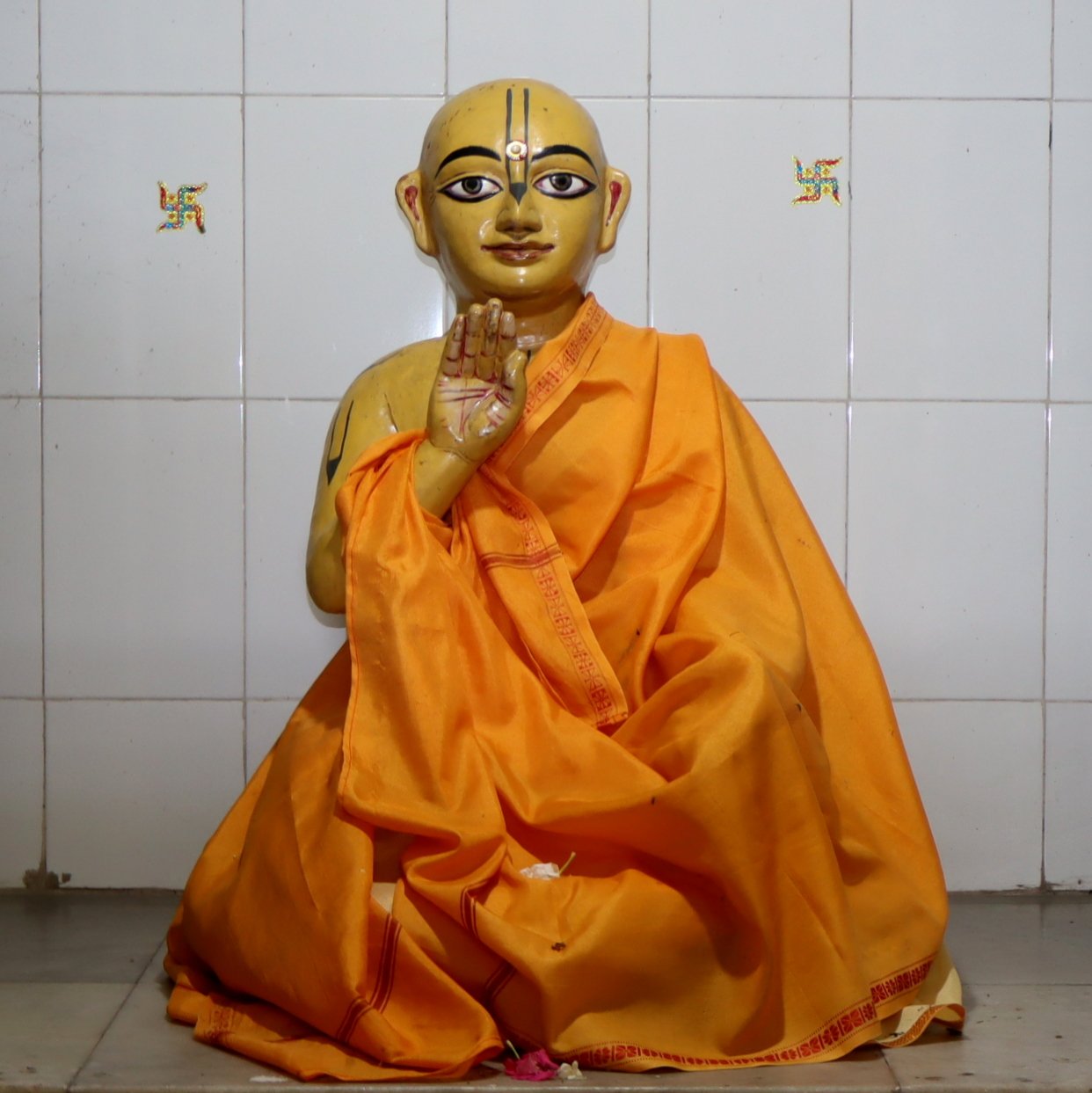
Birthplace of Īśvara Purī (Hālisahara)
The seed of devotional service next fructified in the form of Śrī Īśvara Purī, and then the gardener Himself, Caitanya Mahāprabhu, became the main trunk of the tree of devotional service.
PURPORT
Śrīla Bhaktisiddhānta Sarasvatī Ṭhākura writes in his Anubhāṣya, “Śrī Īśvara Purī was a resident of Kumāra-haṭṭa, where there is now a railroad station known as Kāmarhaṭṭa. Nearby there is another station, named Hālisahara, which belongs to the Eastern Railway. This railway runs from the eastern section of Calcutta.” Īśvara Purī appeared in a brāhmaṇa family and was the most beloved disciple of Śrīla Mādhavendra Purī. In the last portion of Śrī Caitanya-caritāmṛta (Antya 8.28-31), it is stated:
īśvara-purī gosāñi kare śrī-pada sevana
sva-haste karena mala-mūtrādi mārjana
nirantara kṛṣṇa-nāma karāya smaraṇa
kṛṣṇa-nāma kṛṣṇa-līlā śunāya anukṣaṇa
tuṣṭa hañā purī tāṅre kaila āliṅgana
vara dilā kṛṣṇe tomāra ha-uka prema-dhana
sei haite īśvara-purī premera sāgara
(rāmacandra-purī haila sarva-nindākara)
“At the last stage of his life Śrī Mādhavendra Purī became an invalid and was completely unable to move, and Īśvara Purī so completely engaged himself in his service that he personally cleaned up his stool and urine. Always chanting the Hare Kṛṣṇa mahā-mantra and reminding Śrī Mādhavendra Purī about the pastimes of Lord Kṛṣṇa in the last stage of his life, Īśvara Purī gave the best service among his disciples. Thus Mādhavendra Purī, being very pleased with him, blessed him, saying, ‘My dear boy, I can only pray to Kṛṣṇa that He will be pleased with you.’ Thus Īśvara Purī, by the grace of his spiritual master, Śrī Mādhavendra Purī, became a great devotee in the ocean of love of Godhead.” Śrīla Viśvanātha Cakravartī states in his Gurv-aṣṭaka prayer, yasya prasādād bhagavat-prasādo yasyāprasādān na gatiḥ kuto ’pi: “By the mercy of the spiritual master one is blessed by the mercy of Kṛṣṇa. Without the grace of the spiritual master one cannot make any advancement.” It is by the mercy of the spiritual master that one becomes perfect, as vividly exemplified here. A Vaiṣṇava is always protected by the Supreme Personality of Godhead, but if he appears to be an invalid, this gives a chance to his disciples to serve him. Īśvara Purī pleased his spiritual master by service, and by the blessings of his spiritual master he became such a great personality that Lord Caitanya Mahāprabhu accepted him as His spiritual master.
Śrīla Īśvara Purī was the spiritual master of Śrī Caitanya Mahāprabhu, but before initiating Lord Caitanya he went to Navadvīpa and lived for a few months in the house of Gopīnātha Ācārya. At that time Lord Caitanya became acquainted with him, and it is understood that he served Śrī Caitanya Mahāprabhu by reciting his book, Kṛṣṇa-līlāmṛta. This is explained in Śrī Caitanya-bhāgavata, Adi-khaṇḍa, Chapter Eleven.
To teach others by example how to be a faithful disciple of one’s spiritual master, Śrī Caitanya Mahāprabhu, the Supreme Personality of Godhead, visited the birthplace of Īśvara Purī at Kumāra-haṭṭa and collected some earth from his birth site. This He kept very carefully, and He used to eat a small portion of it daily. This is stated in the Caitanya-bhāgavata, Adi-khaṇḍa, Chapter Seventeen. It has now become customary for devotees, following the example of Śrī Caitanya Mahāprabhu, to go there and collect some earth from that place.
(CC Adi 9.11)
“I instructed this imperishable science of yoga to the sun-god, Vivasvān, and Vivasvān instructed it to Manu, the father of mankind, and Manu in turn instructed it to Ikṣvāku.” (BG 4.1)
This is the method of paramparā, or disciplic succession. Similarly, Śrīmad-Bhāgavatam explains that Kṛṣṇa imparted knowledge into the heart of Brahmā, the first created creature within the universe. Brahmā imparted those lessons to his disciple Nārada, and Nārada imparted that knowledge to his disciple Vyāsadeva. Vyāsadeva imparted it to Madhvācārya, and from Madhvācārya the knowledge has come down to Mādhavendra Purī, to Īśvara Purī, and from him to Caitanya Mahāprabhu.
One may ask that if Caitanya Mahāprabhu is Kṛṣṇa Himself, then why did He need a spiritual master? Of course He did not need a spiritual master, but because He was playing the role of an ācārya (one who teaches by example), He accepted a spiritual master. Even Kṛṣṇa Himself accepted a spiritual master, for that is the system. In this way the Lord sets the example for men. We should not think, however, that the Lord takes a spiritual master because He is in want of knowledge. He is simply stressing the importance of accepting the disciplic succession. The knowledge of that disciplic succession actually comes from the Lord Himself, and if the knowledge descends unbroken, it is perfect.
(CC Introduction)