
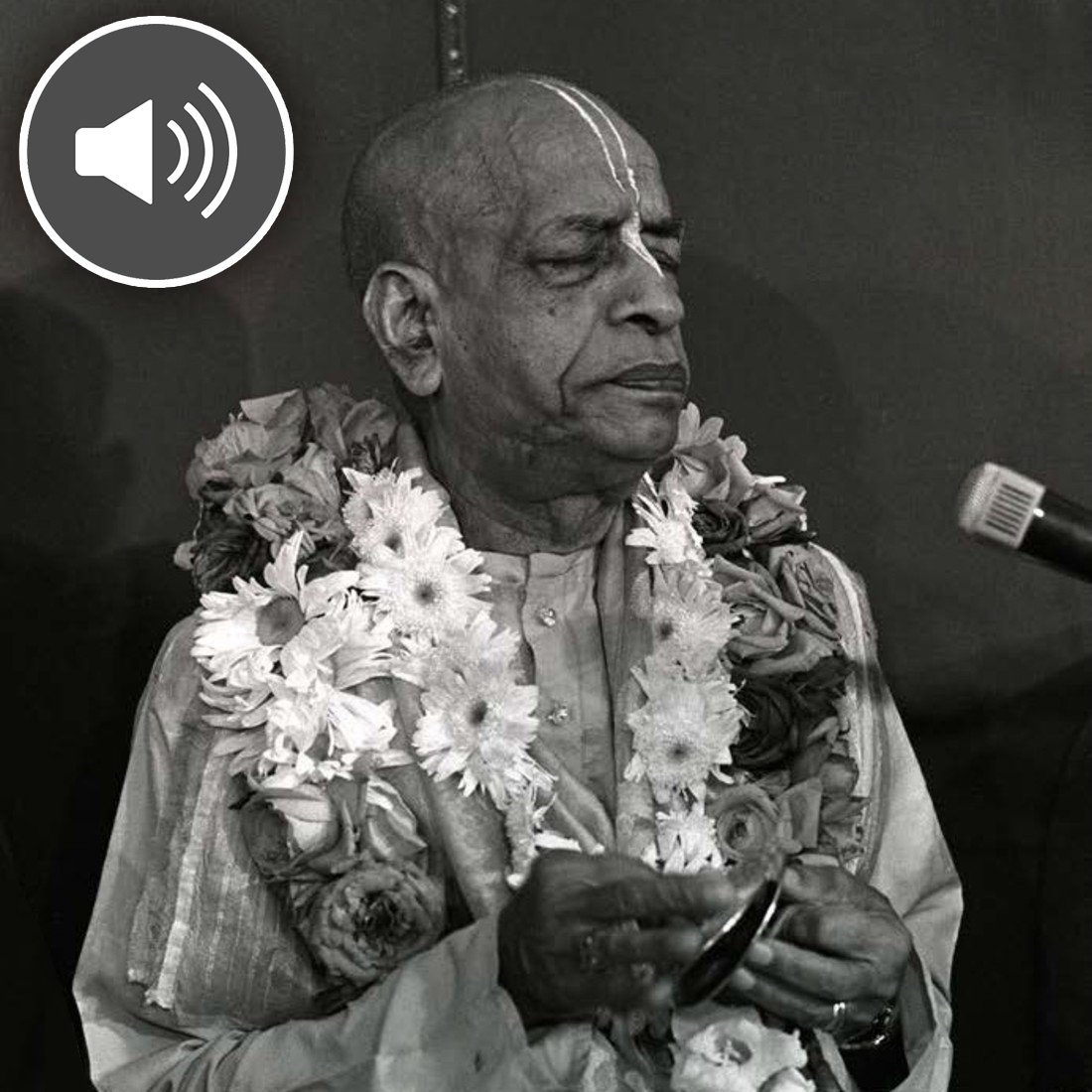
Srila Prabhupada
Śrīla Prabhupāda Audio
Hear the original words of Śrīla Prabhupāda.
So Kṛṣṇa has got two businesses. One, to give protection to the devotee, and the other is to kill the demon. Just like Kṛṣṇa appeared as keśava dhṛta narahari-rūpa (Śrī Daśāvatāra Stotra 4), Nṛsiṁha-deva, and Narahari, Nṛsiṁha-deva, one side He was blessing Prahlāda Mahārāja, the devotee, and the other side He was killing his atheist father, Hiraṇyakaśipu. You have seen the picture. So Kṛṣṇa, when He has got the fighting spirit . . .
Because Kṛṣṇa is the source of everything, janmādy asya yataḥ (SB 1.1.1). Here in this world also, you find two things: friendship and hostility. Just like modern political atmosphere, sometimes there is conference of friendship, and sometimes there is fight with lethal weapons. So this duality is visible in this material world, but in the spiritual world there is no duality. There is absolute peace. . . (break).
So when He wants to fight, He comes here, because here there are many demons, so His fighting spirit is satisfied. Otherwise, for killing the demons, Kṛṣṇa does not require to descend. There are many agents of Kṛṣṇa. For example, this city, Visakhapatnam, on the seashore, if Kṛṣṇa desires, this whole city can be killed in a second, simply by overflooding the sea, or by storm. He has got many agents, parasya śaktir vividhaiva śruyate (Śvetāśvatara Upaniṣad’ 6.8, CC Madhya 13.65, purport). Or the material agent, Durgā devī, she can all . . . do all these things.
So Kṛṣṇa does not require to descend for killing the demons, but when He feels . . . just like a rich man sometimes feels to contest with some wrestler, that does not mean he requires it. That is the Kṛṣṇa spirit. He is all-blissful. So when Kṛṣṇa comes, descends, there are many demons. He especially comes for the devotee. But when He fights with the demon, that is also His favor, because anyone killed by Kṛṣṇa, he immediately attains liberation. Therefore Kṛṣṇa is absolute. Either He fights or blesses, the result is the same.
(720220 – Lecture SB 01.02.05 – Visakhapatnam)
So Prahlāda Mahārāja, he was such a nice devotee. And to protect him when he was just going to be killed by his father . . . and his father was very polit . . . good politician. He took benediction from Brahmā that he will not be killed by anyone. By policy he took benediction from Brahmā that, "I shall not be killed by man." "Oh, yes." "I shall not be killed by demigods." "That's all right." "I shall not be killed by any animal." "That's all right." "I shall not be killed in day." "That's all right." "You shall . . . I shall not be killed at night." "That's all right." "I shall not be killed by any weapon." "That's all right."
And he said: "Now it is finished. Everything is now secure. I cannot be killed in day. I cannot be killed at night. No man can kill him (me). No demigod can kill me. No animal can kill me. Then where is the killing? Everything finished." But God is so, cunning that He assumed neither man nor animal, and no weapons. He killed him with the nails. He never expected that "I will be killed by the nails." This is the definition by negation, defective definition. There the . . . in argument, if you define negatively, "This is not this. This is not this. This is not this," then something will come that will, I mean to say, nullify all your arguments. You see? So he protected himself in all negative ways, "This will not. This will not. This will not. This will not." Something came which was not in his power. So this Nṛsiṁhāvatāra.
(661220 - Lecture CC Madhya 20.294-298 - New York)